Project Parameters
| Parameter | Value |
|---|---|
| Process route | MVR plate falling-film + tubular forced-circulation evaporation; alternative ten-body seven-effect plate falling-film arrangement |
| Industry | Pulp & paper — integrated semi-chemical and APMP (chemi-mechanical) pulping base |
| Feed type & key components | Stream 1: semi-chemical pulp black liquor (300 t/h). Stream 2: APMP chemi-mechanical pulping wastewater (400 t/h) — organic load, wood extractives, fines |
| Evaporation capacity | 700 t/h total across two streams |
| Construction materials | SS316L wetted parts (indicative for this service) |
Representative process configuration compiled from published industry project data. Indicative values, not a process guarantee.
Project Description
One of China’s largest packaging-paper bases, in South China, runs two pulping chemistries side by side — semi-chemical pulping and APMP chemi-mechanical pulping — and both generate liquor streams that cannot leave the site untreated. The published evaporation scope for this base totals 700 t/h: 300 t/h of semi-chemical black liquor on the recovery side and 400 t/h of APMP pulping wastewater on the water-management side, each with its own evaporation train engineered around its own liquor chemistry.
The two streams could not be more different as evaporation duties. Semi-chemical black liquor is hot, alkali, viscous and fouling, and its concentrate has fuel value in the recovery loop. APMP wastewater is cooler, carries dissolved wood organics, peroxide residues and fiber fines rather than alkali lignin, and its target is clean water return plus a manageable concentrate — zero liquid discharge in the modern reading. The published configuration answers each separately: MVR plate falling-film plus tubular forced-circulation service across the streams, with a ten-body seven-effect plate falling-film arrangement cited for the black liquor side as the alternative build.
Process Technology
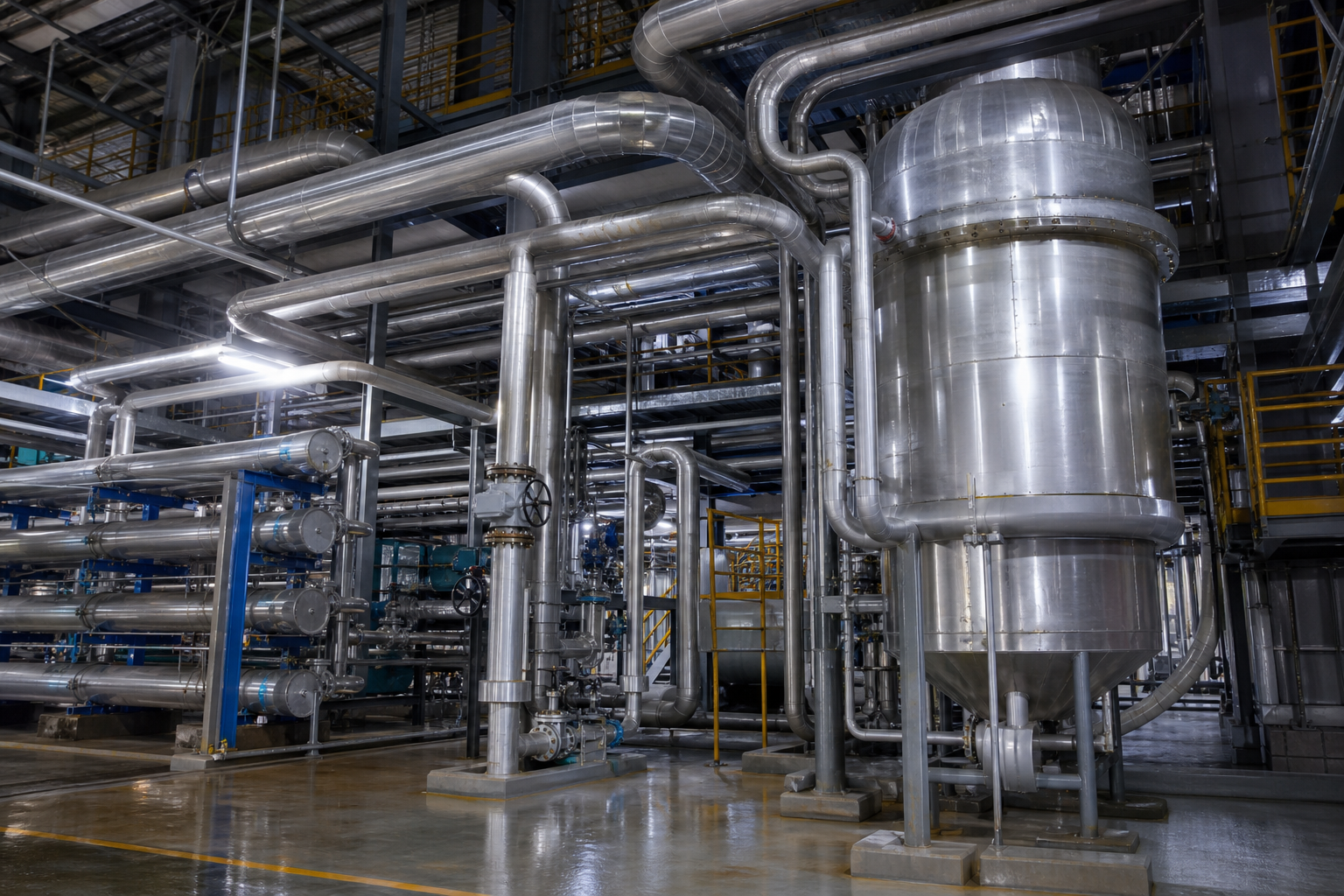
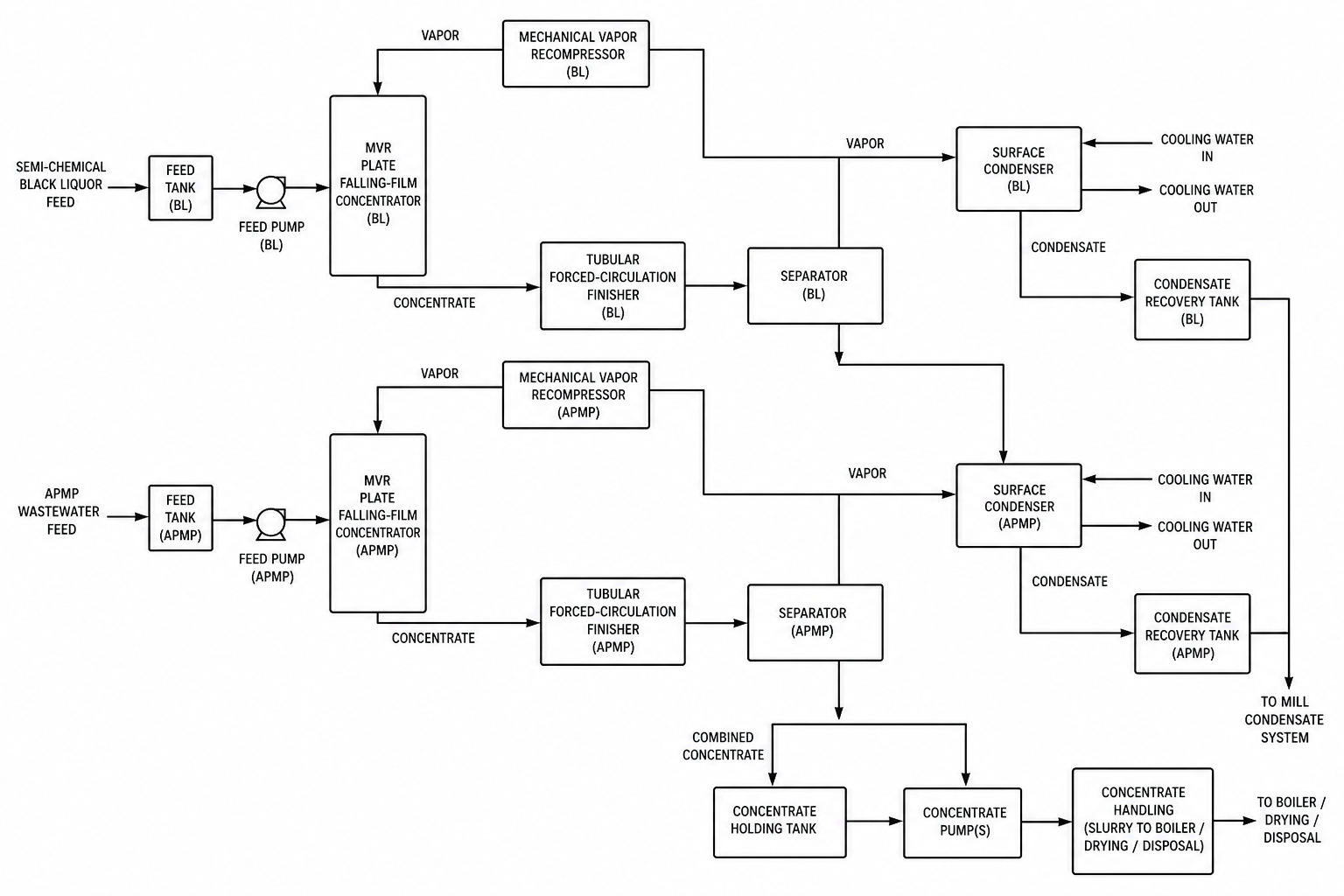
On the black liquor stream, plate falling-film bodies in MVR service concentrate the weak liquor: the mechanical vapor recompressor lifts secondary vapor from the separator back to condensing condition and returns it to the plate pack as heating steam, so the train runs on electricity rather than recovery-boiler steam — the choice that frees steam for the paper machine. Forced-circulation tubular service carries the finishing duty as solids climb and viscosity rises, where pumped wall velocity keeps the fouling liquor moving and stretches run length between cleans.
On the APMP stream, the wastewater is screened for fines and equalized before evaporation. MVR concentration lifts it from dilute organic wastewater to a concentrate volume the downstream stage can digest, while the evaporated water leaves as clean condensate — hot, low-COD water returned to pulping and washing. The same falling-film-plus-forced-circulation split applies: gentle high-coefficient film evaporation on the dilute front, pumped velocity on the concentrating tail where extractives and dissolved organics would otherwise plate onto surfaces.
Because both trains are MVR-driven, the site’s water balance closes with electricity as the marginal energy input. The configuration published for this base also documents the seven-effect steam-driven alternative for the black liquor side — the selection between MVR and multi-effect is made per site on steam price, power price and existing boiler capacity, and this base’s data set covers both branches.
CIP regimes run on rotation across both trains: alkaline washes for the black liquor bodies, and detergent or hot-water cycles for the APMP side where wood extractives deposit. Condensate segregation keeps the clean fraction out of the foul stream on both sides of the plant.
Equipment Configuration
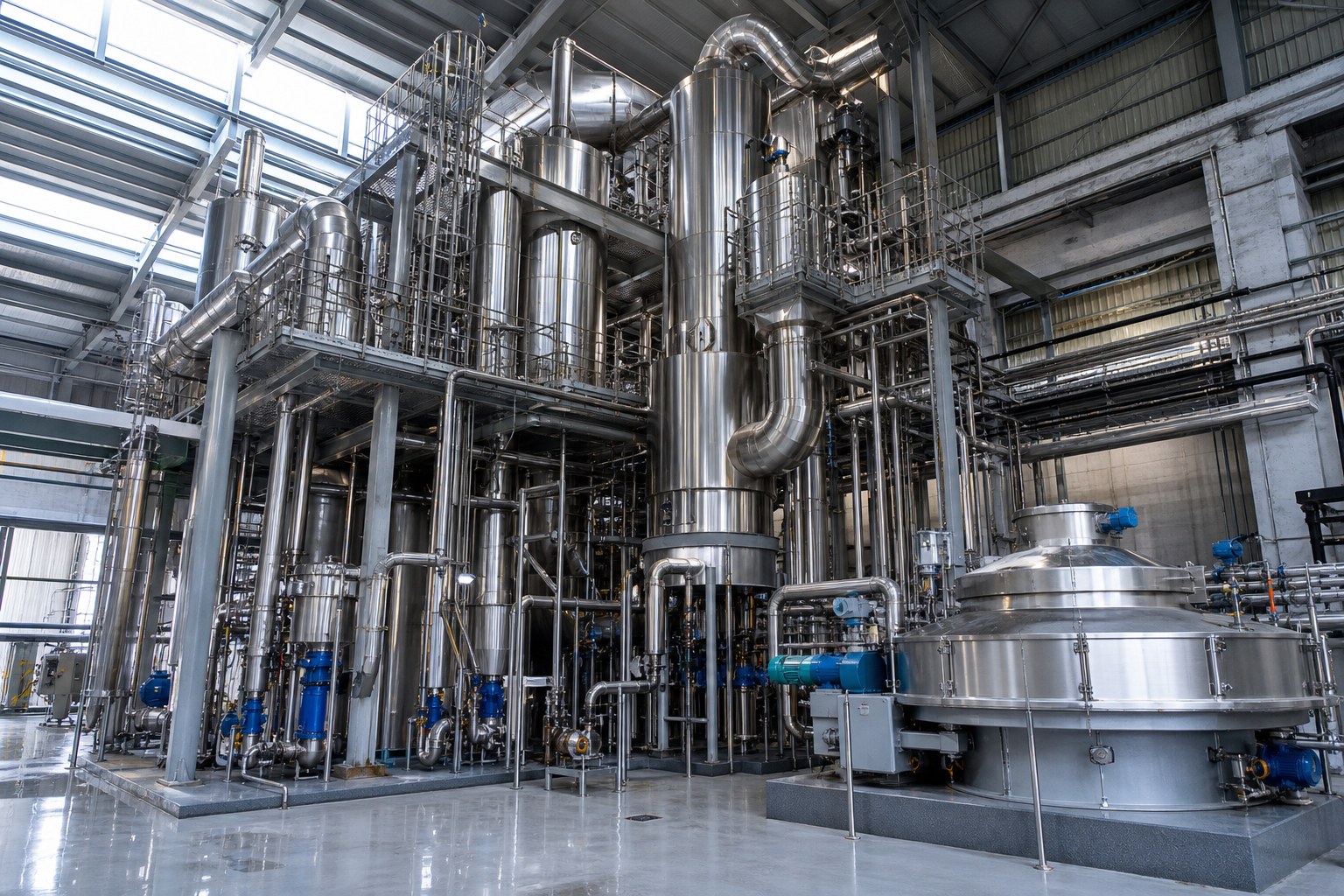
One set of the following equipment is typical for this duty:
- Two-stream feed screening, equalization and preheating (black liquor + APMP wastewater)
- MVR plate falling-film evaporator bodies with mechanical vapor recompressors
- Tubular forced-circulation finishers on the high-solids tails
- Surface condensers, vacuum systems and segregated condensate recovery
- Concentrate handling: recovery-loop liquor storage + APMP concentrate disposal
- Rotating CIP systems; SS316L wetted parts; DCS control across both trains
Performance & Outcome
Compiled from published industry project data, indicative: two-stream plants of this class evaporate 700 t/h across black liquor and APMP wastewater on MVR plate falling-film and forced-circulation duty, returning clean condensate to the mill and concentrate to recovery or disposal. Steam-equivalent savings and condensate quality are quoted per project stream.