Kraft mill alkali recovery is a five-stage cycle – evaporation, combustion, causticizing, lime reburning and energy recovery – in which multi-effect evaporation is the stage that sets every downstream number. The public reference case: a southwest-China kraft hardwood mill producing 500,000 t/y of bleached pulp from masson pine and eucalyptus, generating about 2,500 t/d of black liquor solids, whose recovery cycle concentrates 15-20% solids weak liquor through a 6-7 effect evaporation station (with the last 2-3 effects as high-solids effects) to 65-70% firing liquor at 0.25-0.35 kg steam per kg water evaporated, burns it at 800-1,050°C, recovers roughly 800 t/d of alkali as NaOH at above 95% recovery rate, and cogenerates 100 MW – a system the operator credits with over 300 million RMB net annual benefit (published Chinese environmental engineering case material – an external industry reference, not an EvapCryst delivery). The design premise: in kraft economics, the evaporator station is not wastewater equipment – it is the front end of a chemical plant that happens to clean water.
The Recovery Cycle, Stage by Stage
Weak black liquor leaves the brown stock washers at 15-20% solids in the reference case, carrying the dissolved lignin, hemicellulose degradation products, organic acids and residual alkali that make it the highest-pollution-load stream in the industry – the case cites COD at 100,000-150,000 mg/L and pH 12-14. Direct discharge would be catastrophic; simple incineration would waste the chemistry. The recovery cycle instead closes two loops simultaneously.
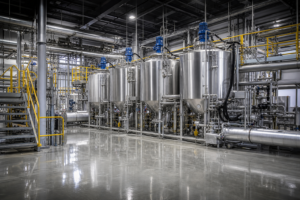
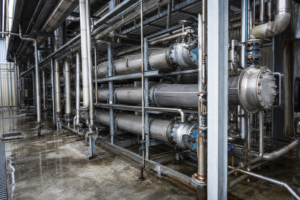
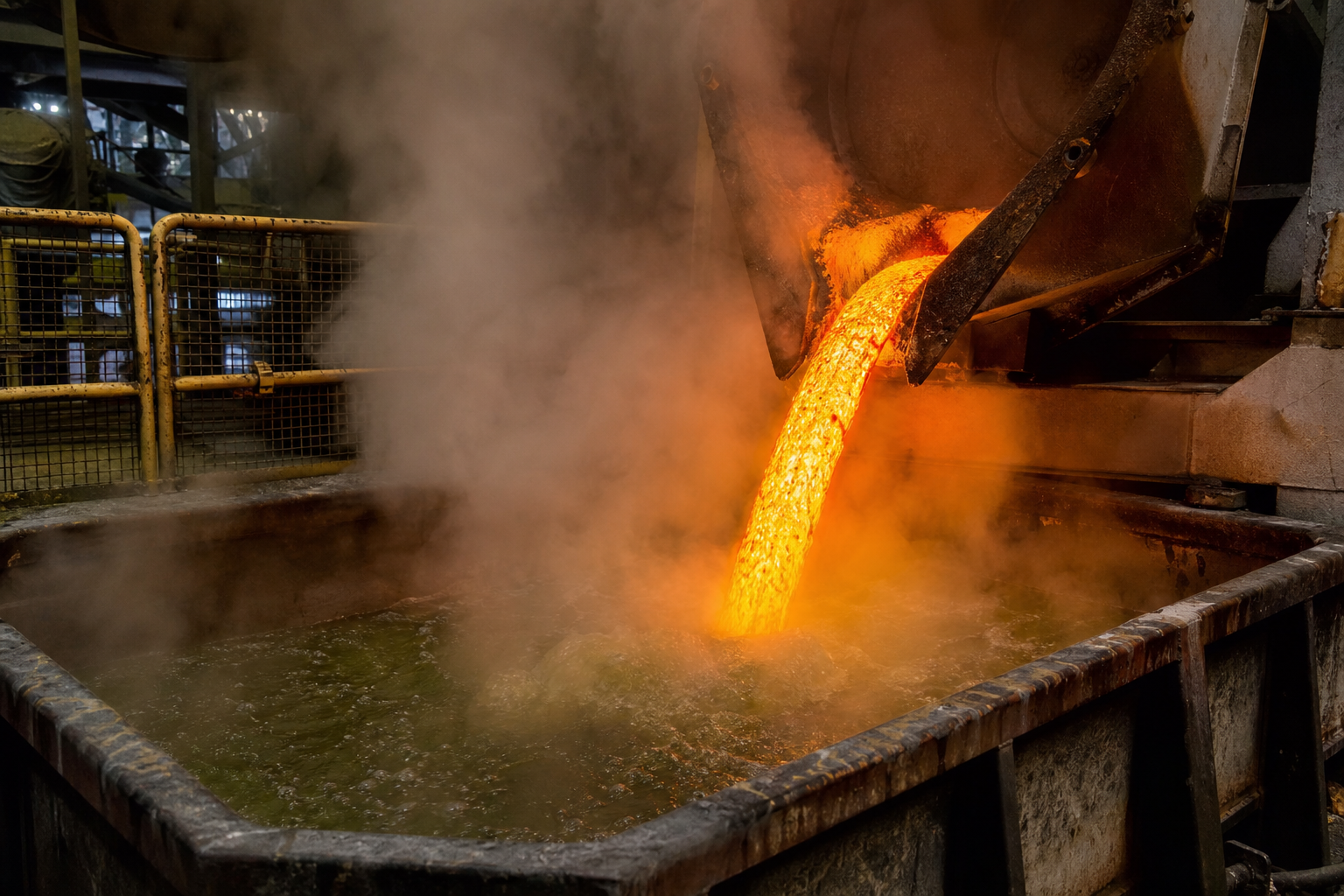
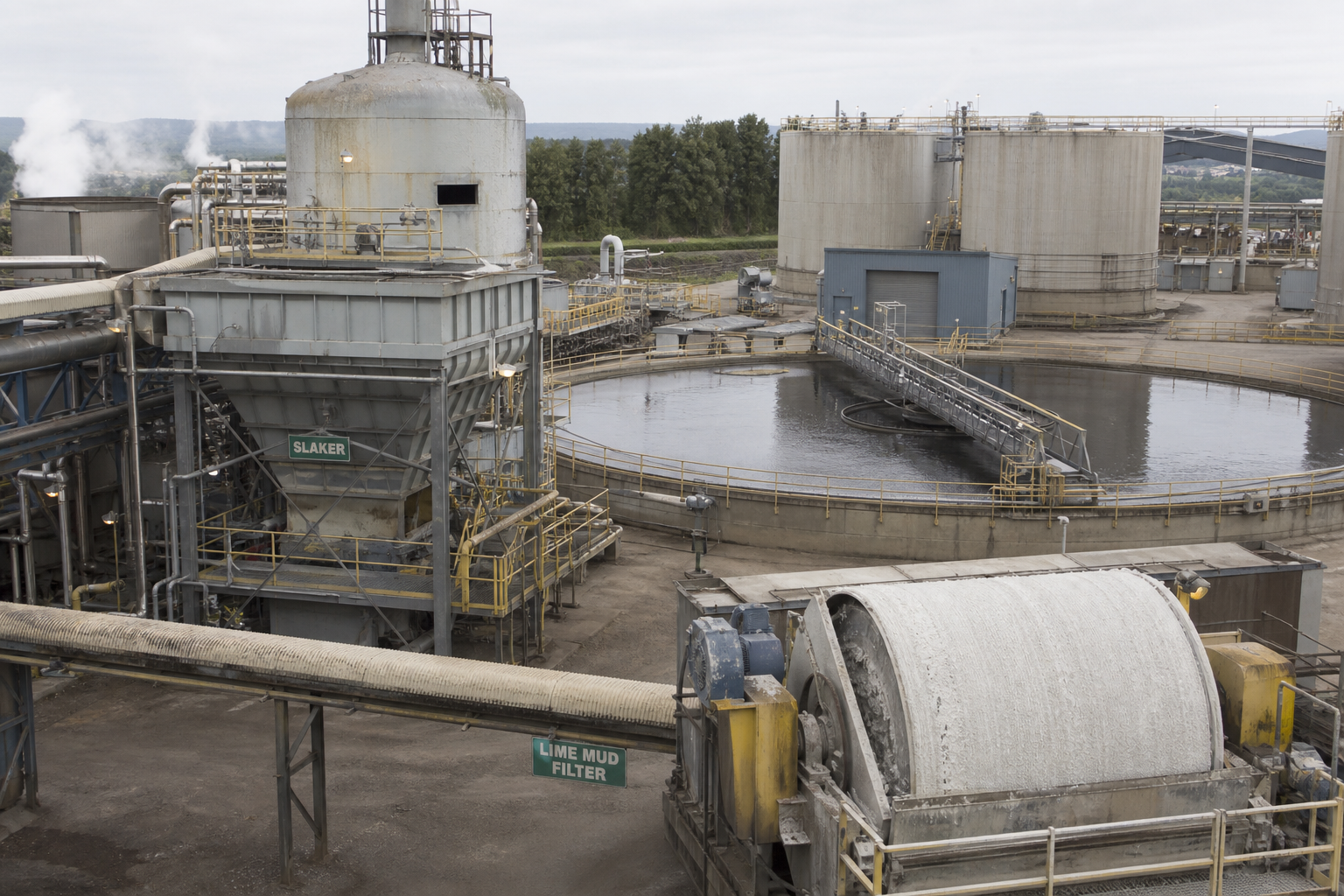
Stage one, evaporation: the 6-7 effect station lifts 15-20% liquor to 65-70% solids, with secondary steam from each effect heating the next – the published steam consumption of 0.25-0.35 kg per kg water is the signature efficiency of the multi-effect architecture. The case notes crystallization evaporation technology pushing exit concentration above 70% (the chemistry-assisted route covered separately). Stage two, combustion: strong liquor mixed with salt cake (Na2SO4 make-up) fires in the recovery boiler at 800-1,050°C; organics become heat, inorganics smelt to Na2CO3 and Na2S, and the flue gas raises high-pressure steam (6-9 MPa, 450-500°C class; the reference system runs 9.8 MPa / 510°C) for power generation. Stage three, causticizing: the smelt dissolves as green liquor, reacts with lime (Na2CO3 + CaO + H2O → 2NaOH + CaCO3), and clarifies into white liquor (NaOH + Na2S) returning to cooking. Stage four, lime reburning: the calcium carbonate mud filters, washes and calcines at 1,100-1,250°C back to CaO for the causticizing loop – the reference achieves residual alkali in the mud below 0.5% on pre-coat vacuum filters. Stage five, energy recovery: the steam raised in stage two drives turbine generation and supplies process heat – closing the energy loop on liquor organics.
Illustrative Duty Envelope for Screening
The envelope below consolidates the published reference case with standard kraft recovery practice. It is an illustrative envelope built from published industry material – not a customer dataset, and not a performance guarantee.
| Parameter | Illustrative range | Basis / note |
|---|---|---|
| Mill scale | 500,000 t/y bleached kraft pulp | Published reference case |
| Black liquor solids load | ~2,500 t/d DS | Weak liquor at 15-20% solids |
| Raw liquor COD / pH | 100,000-150,000 mg/L / 12-14 | Highest-load stream in the industry |
| Evaporation station | 6-7 effects, last 2-3 high-solids | 15-20% → 65-70% DS |
| Steam consumption | 0.25-0.35 kg steam / kg water | Multi-effect economy, published case figure |
| Boiler conditions | 800-1,050°C firing; 6-9.8 MPa steam class | Reference: 9.8 MPa / 510°C |
| Alkali recovery | ~800 t/d as NaOH, >95% recovery | ~500 t/d lime recycled at 85%+ self-sufficiency |
| Energy | 100 MW generation; ~80% of mill steam, all power | Reference case claims |
Where Evaporation Earns Its Place in the Cycle
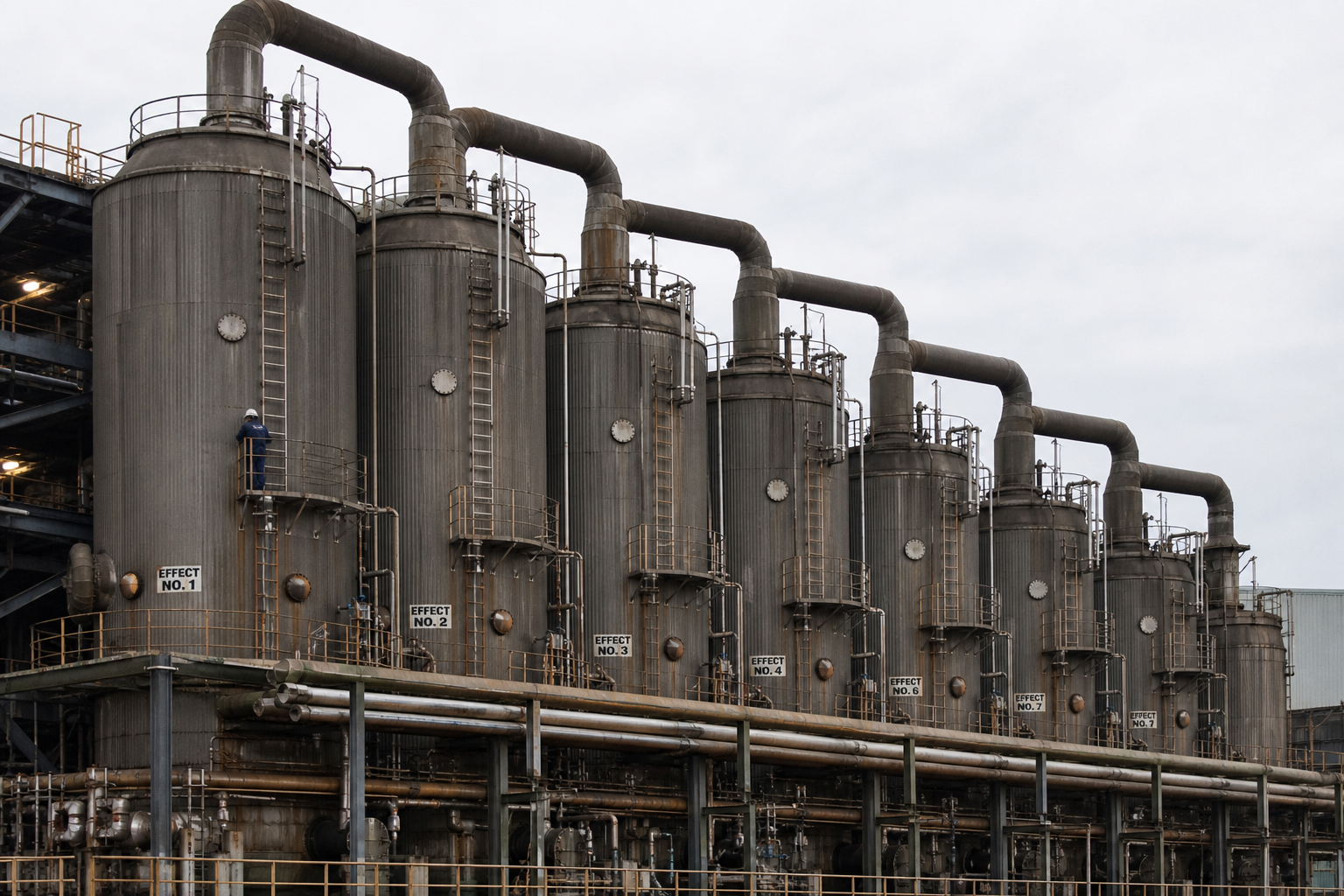
Three numbers position the evaporator station’s leverage. First, water removal: lifting 2,500 t/d of solids from ~17% to ~68% concentration means evaporating on the order of 9,000-10,000 t/d of water – the station is the mill’s largest single unit operation by water duty, and its steam economy (0.25-0.35 kg/kg published) translates directly into the recovery boiler’s net steam export. Second, boiler capacity: every point of firing solids is furnace capacity and steam, not water to be evaporated in the flame – which is why the industry keeps pushing the high-solids boundary (the crystallization route to 73-80%). Third, condensate value: the evaporation station’s condensates, segregated and stripped, are a primary clean-water source for washing and causticizing – the reference architecture treats them as product.
The combustion side closes the argument. The recovery boiler is simultaneously a chemical reactor (smelt production) and a power boiler (high-pressure steam from liquor organics). Its stability depends on liquor solids and viscosity; its output is the mill’s energy backbone. At the reference scale – 800 t/d alkali recovered, 100 MW generated – the recovery island pays for the whole cycle: the operator’s published accounting puts recovered alkali value around 250 million RMB per year, steam and power around 300 million, and net annual benefit above 300 million RMB after operating costs.
Technical Features That Decide Whether the Cycle Closes Cleanly
Three features carry the engineering weight. The first is steam economy discipline across the effect train. The published 0.25-0.35 kg/kg is achieved by effect count, vapor routing (including flash steam recovery from the liquor) and condensate management; it degrades quietly with fouled effects and leaking non-condensables – which is why the scaling-control and availability articles in this cluster are recovery-cycle economics, not maintenance notes.
The second is the causticizing-lime loop’s material balance. White liquor quality (sulfidity, active alkali) feeds straight back into pulping; the lime loop’s losses (mud residue, residual alkali below the 0.5% the reference achieves) set the make-up lime demand. The cycles compound: small lime-loop inefficiencies become continuous purchases.
Third is non-process element management across the whole cycle. Chloride and potassium accumulate loop-wise, attacking the boiler; the reference system’s emissions-control stack (low-NOx burners, ESP, flue-gas treatment) addresses the air side, while the ash-side purge (CRP-class crystallization, covered in the six-effect article) addresses the loop chemistry. Modern large systems, the case notes, push toward 5,000 t/d solids capacity, above 98% alkali recovery and full energy self-sufficiency – all of which presume NPE control that does not strangle the loops.
Process Modules
| Process module | Candidate equipment types | Selection rationale | Module duty |
|---|---|---|---|
| Weak liquor handling | Weak liquor storage, soap skimming | Buffer washing variability; tall oil value | Stable evaporator feed |
| Multi-effect evaporation | 6-7 effect train, last 2-3 high-solids effects | 0.25-0.35 kg/kg steam economy class | 15-20% → 65-70% DS |
| High-solids push (optional) | Crystallization/concentrator stage | Chemistry-assisted route above 70% | Boiler capacity and steam uplift |
| Combustion | Recovery boiler, 800-1,050°C, HP steam | Organics to energy; inorganics to smelt | Steam + green liquor source |
| Causticizing | Slakers, clarifiers, white liquor plant | Convert Na2CO3 to NaOH | White liquor to cooking |
| Lime reburning | Pre-coat filters, lime kiln 1,100-1,250°C | Close the calcium loop | CaO recovery, mud discharge |
| Energy recovery | Turbine generation, steam distribution | Liquefy the organics’ fuel value | Mill power and process steam |
Configuration, materials and operating envelopes above are potential considerations only; actual selections depend on liquor chemistry, boiler integration, energy balance and project capacity.
Expected Performance and Limits
The published reference performance: 2,500 t/d black liquor solids processed; ~800 t/d alkali recovered at >95%; ~1,200 t/h steam and 100 MW generation meeting ~80% of mill steam and all power demand; ~500 t/d lime recycled at 85%+ self-sufficiency; pollution load reduction above 99%; net annual benefit above 300 million RMB (published Chinese environmental engineering case material on a 500 kt/y southwest-China kraft mill – an external industry reference; indicative, not a project guarantee, and not an EvapCryst delivery). The modern large-system direction cited in the same material: 5,000+ t/d solids, 98%+ alkali recovery, 100%+ energy self-sufficiency. The practical limits: every number above scales with liquor yield and solids consistency from the washers – evaporator feed variability propagates through the whole cycle; boiler chemistry (chloride, potassium, sulfate balance) bounds availability; and the economic outputs are price-dependent – alkali value and power value move the benefit line materially between markets.
Industry References and Validation
One public anchor with full-cycle quantification: the 500 kt/y southwest-China kraft reference – stage data (evaporation steam rate, boiler conditions, causticizing and kiln parameters), recovery figures (alkali, lime, energy) and economic output (net benefit) all on record (published case material, 2026; an external industry reference, not an EvapCryst delivery). The companion articles in this cluster supply the depth on each stage’s technology choices: the six-effect-plus-CRP architecture, the crystallization route to higher solids, the MVR energy overlay, and the fouling-control practices that protect availability. For your own project, validation effort should concentrate on: a full liquor and solids balance from the washers (the evaporator feed defines everything); steam and power balance integration between the recovery island and the mill; scaling-species and NPE profiling for the boiler loop; and causticizing/lime loop material balances against your make-up costs.
Frequently Asked Questions
Is alkali recovery wastewater treatment?
No – it is chemical and energy recovery that happens to eliminate the industry’s worst pollutant. The framing matters commercially: the reference case runs at over 300 million RMB net annual benefit while cutting pollution load above 99%. Treating it as environmental overhead undersells it; treating it as a chemical plant frames every design decision correctly.
Why 6-7 effects specifically?
The economics of steam. Each effect reuses the previous one’s vapor; the published 0.25-0.35 kg steam per kg water is what 6-7 effects deliver. Fewer effects burn more of the boiler’s steam on evaporation instead of power; more effects run out of useful temperature difference for liquor service.
What are the high-solids effects?
The last 2-3 effects and any concentrator stage, engineered for the viscosity and scaling regime above ~50% solids – forced circulation or specialized falling-film bodies. They are the bridge from 60% class liquor to the 65-70%+ firing target.
How does 800 t/d of recovered alkali compare to purchases?
It displaces essentially the full cooking chemical demand at that scale – the reference runs above 95% recovery, meaning make-up soda is a small residual line. At sodium hydroxide market prices that is the bulk of the ~250 million RMB annual value the case cites.
Can the recovery island power the whole mill?
The reference case claims exactly that: 100 MW covering all electricity and ~80% of steam. The enabling condition is firing solids – the higher the liquor solids, the less furnace heat wasted on water and the more exported as steam. That is the evaporation station’s leverage one more time.
When This Route May Not Fit
If the mill is non-integrated (purchased pulp, paper only), there is no black liquor and no recovery cycle – mill water management belongs to the effluent-ZLD route. If the pulping line is small (specialty, dissolving-grade pilot lines), recovery island economics collapse and liquor is sold or co-processed instead. And if the furnish is straw or bagasse-dominant at small scale, the silica and sodium-balance problems make full kraft-style recovery marginal without specific engineering – the agrifiber concentration article covers what the evaporation stage needs there.
What Must Be Verified Before Committing
Five items: a washer-discharge liquor balance (flow, solids, consistency variability); a scaling-species and NPE profile (Ca, Si, Cl, K) for both the effects and the boiler loop; a mill steam-power balance integrating the recovery island’s output; causticizing and lime-loop material balances against make-up costs; and an emissions-compliance review of the boiler stack for the governing standards. These map directly onto the modules above and are the standard screening package we would run before any quote.