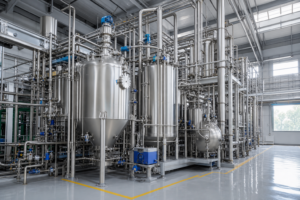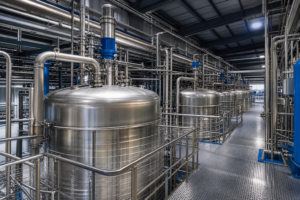
Zinc chloride (ZnCl2) is one of the most demanding inorganic salts to concentrate: it is highly hygroscopic, forms strongly acidic aqueous solutions, melts at approximately 290 °C before it decomposes, and attacks common metallurgies at almost every stage. The proven industrial answer is a three-stage route: vacuum multi-effect falling film evaporation for bulk water removal, an indirect high-temperature concentrator heated by thermal oil or molten salt that dehydrates the liquor to the molten state, and a cooled screw conveyor or flaker that solidifies the melt into high-purity solid zinc chloride. Compared with traditional batch graphite evaporators followed by sloping-plate dryers, this continuous configuration reuses secondary steam across effects, contains the HCl-bearing vapor, and cuts steam consumption dramatically.
Why Zinc Chloride Concentration Is Difficult
Zinc chloride serves the pharmaceutical, electronics, textile, battery, galvanizing and metallurgical industries, and demand increasingly comes from hydrometallurgical and battery-recycling streams that deliver dilute, acidic ZnCl2 solutions. Recovering a saleable solid from these liquors means removing far more water per tonne of product than almost any other commodity chloride, because ZnCl2 is exceptionally soluble — on the order of 400 g per 100 mL of water at ambient temperature. The salt simply does not crystallize from water the way sodium chloride does; it must be dehydrated.
Four material properties drive the process design:
- Extreme hygroscopicity and solubility. Solutions remain dense, low-vapor-pressure liquids up to very high dissolved-solids content, so ordinary crystallization routes are unavailable and evaporation must carry the load.
- Strong acidity from hydrolysis. Aqueous ZnCl2 hydrolyzes to release HCl, creating a corrosive chloride-acid medium that rules out carbon steel and many stainless grades.
- Molten-state finishing. With a melting point near 290 °C, fully dehydrated ZnCl2 must be handled as a hot melt, then flaked or granulated before packaging.
- Acid vapor in the exhaust. Vapor leaving a direct-fired or open batch evaporator carries HCl, which poses corrosion, emission and odor problems if it is simply vented.
Limitations of the Traditional Batch Route
Conventional plants evaporate zinc chloride solution in graphite batch evaporators and finish the paste in graphite sloping-plate dryers. The approach works chemically but performs poorly economically:
- Batch cycles introduce heating and cooling dead time, so effective capacity is a fraction of installed heat-transfer area.
- Vapor diffuses to atmosphere without steam reuse, so nearly every kilogram of evaporated water is paid for with fresh steam.
- Vapor containing HCl requires scrubbing and still shortens equipment life.
- Open handling of a hygroscopic, fuming material increases housekeeping and product-quality burdens.
The Recommended Process: Multi-Effect Falling Film Plus High-Temperature Finisher
The modern configuration separates the duty into stages, each operating where its technology is strongest.
Stage 1 — Preheating and Effect I Falling Film Evaporation
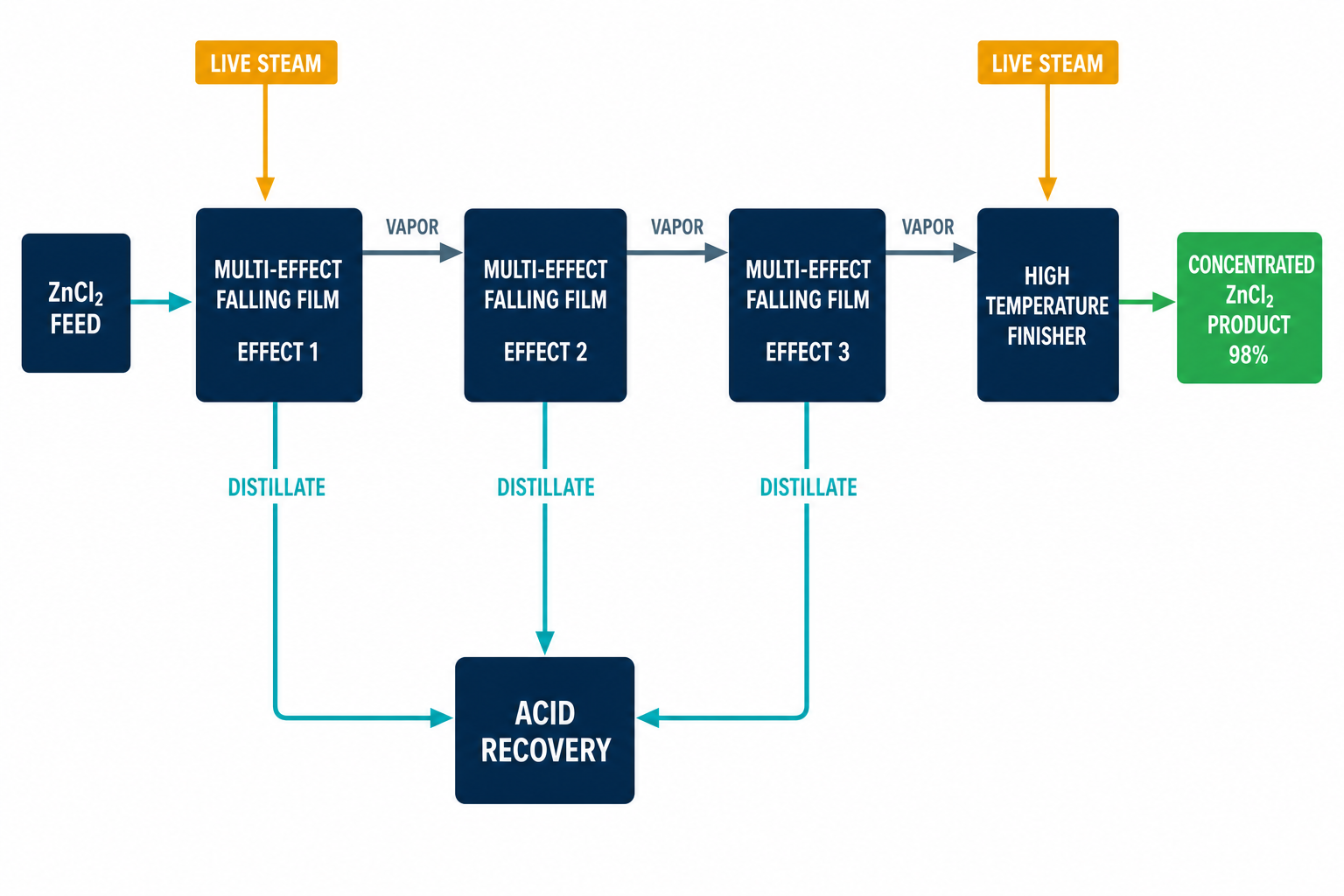
Dilute zinc chloride solution — for example a feed around 40% ZnCl2 from an upstream leaching or synthesis step — is preheated in plate heat exchangers by recovering heat from condensate and product, then distributed into the first-effect falling film evaporator. The liquor forms a thin film descending the interior of the heat exchange tubes while steam condenses on the outside. Because the film is thin and residence time is measured in seconds, heat transfer is high and local overheating — the main driver of hydrolysis and fouling in acidic chloride media — is minimized. Vapor and liquid are separated in a dedicated vessel, and the secondary vapor is routed forward as heating steam for the next effect.
Stage 2 — Effect II and Tandem Concentration
The partially concentrated liquor passes to the second effect, which operates at a lower temperature and pressure so that the first effect’s secondary vapor can drive it. Each effect therefore re-uses water vapor that a single-effect plant would have condensed and wasted. A dual-layer liquid distribution system keeps film coverage uniform across the tube sheet, which sustains heat-transfer coefficients and protects the tubes from dry patches. Operation under vacuum keeps boiling temperatures low even as concentration climbs, which limits corrosion rates and preserves product color and purity.
Stage 3 — High-Temperature Melt Concentrator
The interstage concentrate — now a dense, high-percentage ZnCl2 liquor — is transferred to a high-temperature concentrator heated indirectly by thermal oil or molten salt rather than by steam, because the temperatures required to reach the molten state exceed what a steam-heated surface can deliver economically. Inside this unit the last water is driven off and the salt becomes a molten zinc chloride stream. Indirect heating keeps the heat-transfer fluid separated from the process, so no combustion gases contact the product and the HCl-bearing off-gas remains a small, treatable stream suitable for absorption in a scrubbing circuit.
Stage 4 — Cooling, Flaking and Packing
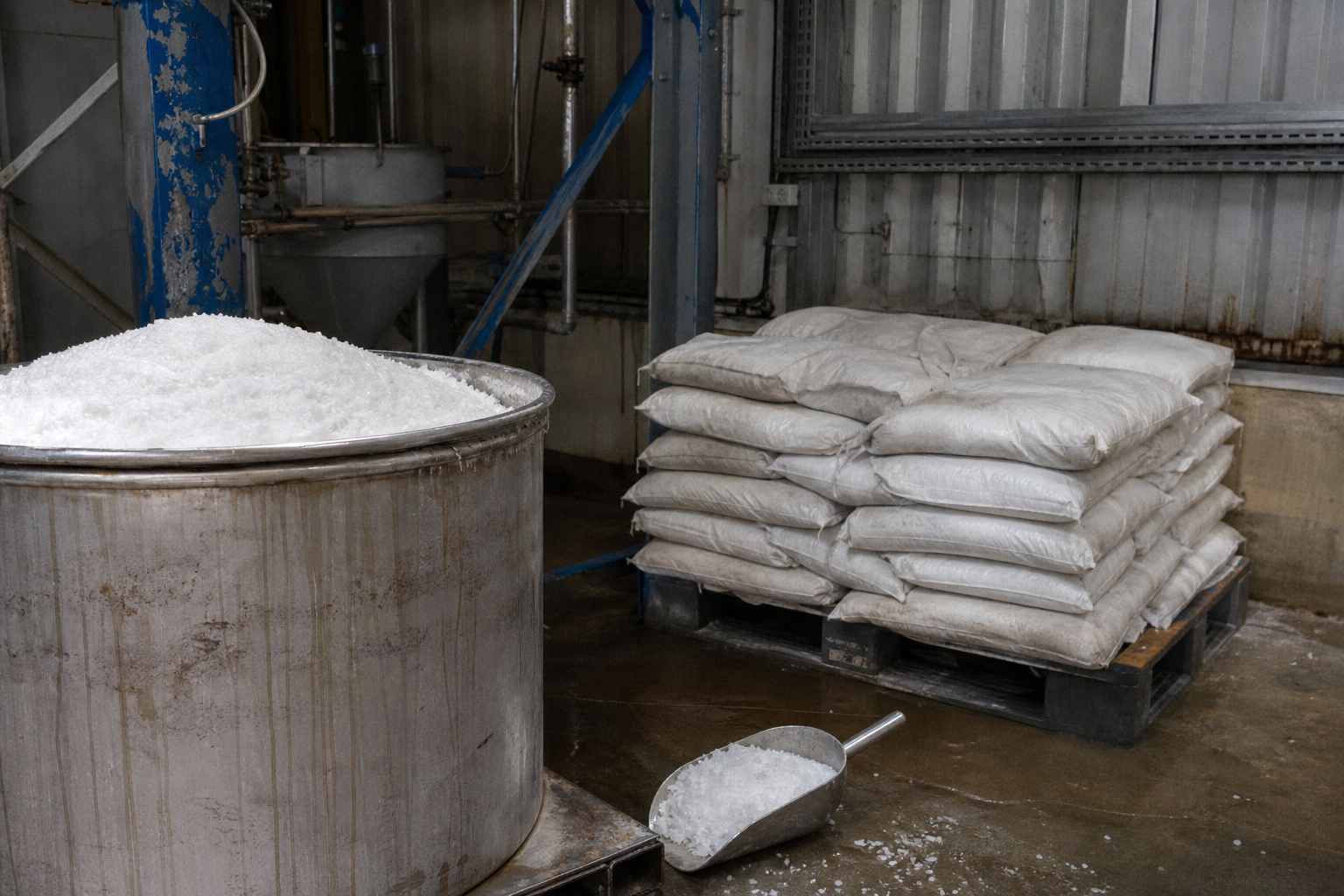
The molten zinc chloride is discharged through a heated line onto a cooled screw conveyor or rotating flaker, where it solidifies into flakes or briquettes. Because the material is hygroscopic, the solidification and packing section is kept dry and often blanketed, and packaging moves quickly to sealed containers. The result is a free-flowing, high-purity solid suitable for battery, fluxing, galvanizing and pharmaceutical customers.
In summary form, the train decomposes into standard process modules:
| Process module | Equipment candidates | Selection basis | Indicative envelope |
|---|---|---|---|
| Feed pretreatment | Filtration; oxidation and precipitation | Iron and heavy-metal removal per feed origin | Per feed analysis |
| Falling-film concentration | Plate preheaters; Effect I plus tandem effects under vacuum | Seconds-residence film; secondary-steam reuse | Per effects count |
| Melt finishing | Thermal-oil or molten-salt concentrator | Duty exceeds economical steam temperature | ~290°C melt class |
| Solidification & packing | Cooled screw or flaker; sealed packing | Hygroscopic product protection | Per product form |
| Acid-gas scrubbing | Interlocked scrubber circuit | HCl emission control | Per permit |
Configuration, materials, and operating ranges for each module depend on the actual feed, temperature, pressure, corrosion review, fouling behavior, utilities, and project capacity.
Energy and Configuration Comparison
The dominant operating cost in zinc chloride production is heat. The table below compares the traditional single-effect batch route with multi-effect evaporation on the parameters that decide plant economics.
| Parameter | Single-Effect Batch + Plate Dryer | Multi-Effect Falling Film + Melt Finisher |
|---|---|---|
| Specific steam consumption | Typically ~1 t steam per t water evaporated, plus dryer fuel | Multi-effect reuse typically cuts steam demand by half or more across the evaporation train (industry-reported; indicative, not a project guarantee) |
| Operation mode | Batch, with heat/cool dead time between charges | Continuous, steady-state film evaporation |
| Vapor handling | Vented with HCl content; scrubber load high | Closed system; secondary steam reused; off-gas limited to melt stage scrubbing |
| Product form | Paste or irregular solid from plate drying | Uniform flakes from molten-state solidification |
| Turn-down and control | Limited; operator-dependent | PLC-controlled with real-time visibility of temperatures and concentrations |
Materials of Construction
Acidic zinc chloride solution is aggressive toward stainless steels, and the attack intensifies with temperature. Practical plants therefore match metallurgy to stage duty: impervious graphite for heated surfaces in the acidic concentration range, PTFE-lined or glass-lined steel for vessels and piping where feasible, and high-alloy materials such as Hastelloy or tantalum-clad surfaces only where temperature and concentration make them necessary. At the melt stage, graphite and specialized alloys carry the duty, while the cooling conveyor uses corrosion-resistant surfaces with positive heat removal. A stage-wise materials plan — rather than a single exotic specification for the whole plant — is what keeps capital cost acceptable without sacrificing equipment life.
Process Controls That Protect Product Quality
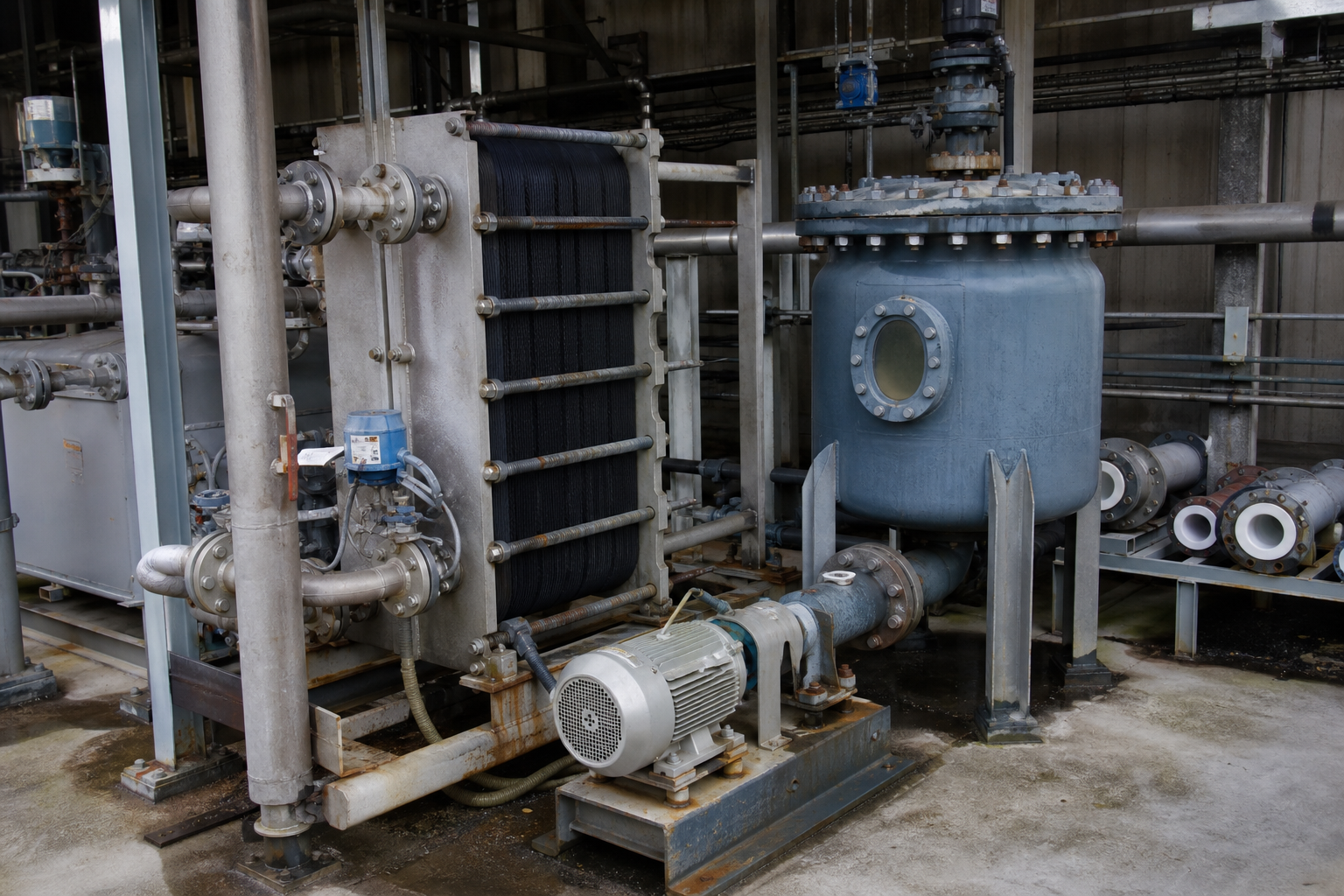
Zinc chloride quality problems usually trace back to temperature excursions. A well-instrumented train therefore controls feed temperature to each effect, maintains effect-to-effect temperature differences within design bands, and modulates the melt concentrator by product temperature rather than by heat input alone. Vacuum is held by liquid-ring systems compatible with acidic condensate, and the scrubber circuit is interlocked so that any loss of draft immediately alarms. With these controls in place the plant runs with minimal manual intervention, and consistent purity is maintained from shift to shift.
Where the Feed Comes From Matters
Design details shift with feed origin. Dry-cell and flux-grade synthesis liquors are relatively clean and allow a simple two-effect plus finisher arrangement. Zinc recovery and battery-recycling streams carry metals, chlorides of ammonium and alkalis, and organic tracers that may require pre-filtration, pH management, or an added effects count to reach the melt stage economically. On the waste-acid side, spent hydrochloric acid neutralized with zinc-bearing residues produces ZnCl2 liquor whose iron and heavy-metal content must be removed by oxidation and precipitation ahead of evaporation. Screening the full feed analysis — not only the ZnCl2 assay — is the first engineering task for a reliable design.
Related Zinc Salt Processing
Zinc sulfate crystallization, another major zinc-salt route, follows a different pattern: because zinc sulfate crystallizes readily from water, it is handled with evaporation plus forced-circulation or Oslo crystallization rather than melt dehydration. Understanding which zinc salt the project actually needs determines the entire flowsheet.
Validation Focus
Because this page cites no public third-party case data for zinc chloride duty, the route should be validated directly rather than by reference. Begin with the full feed analysis – ZnCl2 assay plus iron, heavy metals, ammonium, and organics – because feed origin, as described above, shifts the flowsheet materially. Then obtain corrosion data for the candidate materials at each temperature-and-concentration zone: graphite, linings, and high alloys have sharply different envelopes in acidic chloride media. Follow with vendor or pilot confirmation of film-evaporator behavior – fouling rate and hydrolysis tendency – on the actual liquor, and a melt-stage trial tying product temperature control to color and purity. Finally, verify the scrubber design against the HCl emission permit early, not at commissioning.
When This Route May Not Fit
Plants whose product is liquid zinc chloride solution do not need the melt train at all: concentration to the merchant solution grade is a simpler duty, and specifying a flaker adds capital for nothing. Small or intermittent productions are still served honestly by batch graphite equipment, whose poor energy economy matters less at low utilization. Feeds dominated by ammonium or alkali chlorides complicate melt finishing – volatile and corrosive species concentrate at the hottest stage – and may belong to a different recovery route. And where the product target is only a crude industrial grade, a simpler finishing tolerance may not justify the continuous train at all.
What Must Be Verified
Before this route is committed, verify the inputs that decide it. First, the feed analysis by origin – synthesis liquors, recycling streams, or neutralized waste acid – since iron and heavy metals set the pretreatment scope. Second, the target product grade: battery, fluxing, galvanizing, or pharmaceutical customers each fix purity and color specifications that propagate back through temperature control. Third, stage-wise materials data at the actual temperature bands, from coupon tests or supplier curves – the costliest assumption to leave unverified in this service. Fourth, the utility picture – thermal oil or molten salt capability, cooling water, and electricity – against the melt-stage duty. Fifth, the HCl emission permit and the disposal route for acidic condensate.
FAQ
Can zinc chloride be produced by crystallization instead of evaporation to a melt?
No practical route exists. Zinc chloride’s solubility exceeds 400 g per 100 mL of water at room temperature and the hydrates deliquesce, so it cannot be crystallized and dried the way NaCl or ZnSO4 can. Water must be removed by evaporation and final high-temperature dehydration to the molten state.
Why use thermal oil or molten salt instead of steam in the final concentrator?
Driving off the last water and reaching molten zinc chloride requires temperatures near the salt’s ~290 °C melting point. Steam at those temperatures demands very high pressure and expensive equipment; thermal oil or molten salt delivers the required temperature economically and indirectly, keeping the process stream clean.
What materials are suitable for zinc chloride evaporators?
Acidic chloride service typically calls for impervious graphite heat-transfer surfaces, glass- or PTFE-lined vessels and piping, and high alloys such as Hastelloy or tantalum only in the hottest, most concentrated zones. A stage-wise materials selection balances life and cost.
How much energy does multi-effect evaporation save versus the traditional batch route?
Savings depend on effects count, but reusing secondary steam across multiple effects typically cuts steam consumption by half or more compared with a single-effect batch evaporator, before counting the elimination of open-plate dryer fuel.
Is the process continuous or batch?
The recommended configuration runs continuously from feed preheating through melt flaking. Batch operation survives only in small, legacy plants; continuous falling film trains deliver better energy efficiency, more uniform product, and simpler automation.
For plants handling zinc-bearing chloride streams, EvapCryst engineers the complete train — multi-effect falling film evaporation, melt-stage dehydration, flaking and packing — together with acid-gas scrubbing and materials selection adapted to each concentration zone. Explore our multi-effect evaporation systems, energy retrofit and decarbonization options, and the sister article on zinc sulfate evaporation and crystallization to compare zinc-salt routes, or see how MVR evaporation fits low-concentration pre-concentration duties. To screen this route for a specific stream, share the feed analysis with ZnCl2 assay and impurities, the target product grade, and the site utility analysis – enough for an initial process-direction assessment.