What This Page Covers
Sodium acetate is crystallized by cooling, not evaporation, because its solubility rises steeply with temperature — a hot saturated liquor releases crystals on controlled cooling alone, at a fraction of the energy an evaporative route would spend boiling water off. Product quality in pharmaceutical, food, and buffer-grade service is decided by four controlled variables — crystallizer temperature, solution concentration, cooling rate, and agitation intensity — operated continuously inside the metastable zone. This page explains the supersaturation framework behind sodium acetate cooling crystallization, the equipment configurations available, the hydrate and drying considerations that shape final product form, and why continuous operation has displaced batch crystallization in quality-critical production.
Sodium Acetate and Its Applications
Sodium acetate is an important chemical raw material used across medicine, food, dyes, and buffer solutions. In medicine it treats severe acidosis and hyponatremia; in the food industry it functions as a buffer and preservative. In these applications, the purity and crystal quality of sodium acetate have a direct impact on product performance and effectiveness — an injectable-grade salt cannot carry the color bodies or trace chlorides that an industrial buffer grade tolerates. That purity gradient is what the crystallization circuit must deliver, and it is why efficient, precisely controlled crystallization processes matter commercially for this product.
Crystallization also carries most of the purification burden, so the feed preparation ahead of it is scoped deliberately. Liquor destined for pharmaceutical or food grades is decolorized and polished before it reaches the crystallizer — activated carbon treatment and fine filtration upstream are the standard tools — because impurities that enter the metastable zone either co-crystallize, occlude into the crystal, or accumulate in the mother liquor until they break through. Specifying the feed-quality boundary between pretreatment and crystallization is one of the early design decisions that separates a plant that holds grade from one that periodically re-processes off-spec batches.
Why Cooling, Not Evaporation
The choice of crystallization method follows the solubility curve. Sodium acetate dissolves progressively more as temperature rises, so a liquor prepared hot and saturated becomes supersaturated simply by losing heat. Cooling crystallization exploits this: the heat removed per kilogram of crystal yielded is small compared with the latent heat that would have to be supplied to evaporate the equivalent water, so the specific energy consumption of the separation is inherently low.
Low temperature also protects the molecule. Sodium acetate is an organic salt whose solution quality — especially color — degrades with prolonged thermal exposure. A cooling route keeps the entire process below the preparation temperature of the liquor, avoiding the discoloration and by-product formation that repeated boiling would introduce. Where the feed liquor arrives dilute rather than saturated, the practical flowsheet combines a modest evaporation or membrane concentration step to reach saturation, followed by cooling crystallization for the actual crystal production — evaporation to saturate, cooling to crystallize.
The Supersaturation Framework: Nucleation Versus Growth
Continuous crystallization of sodium acetate rests on the principle of solution supersaturation: when the solution is supersaturated, the solute precipitates as crystals. But how it precipitates is the whole engineering problem. If supersaturation is allowed to build high, the solution relieves itself by spontaneous nucleation — a cloud of tiny crystals with poor filtration, washing, and drying behavior. If supersaturation is held low and steady within the metastable zone, existing crystal surfaces consume the solute, and crystals grow large and uniform.
The operating strategy is therefore to seed deliberately and then feed supersaturation slowly enough that growth, not nucleation, absorbs it. In a continuous crystallizer, a crystal population is always present; the control system’s job is to keep generation of supersaturation (by cooling) matched to its consumption (by growth), so the crystal size distribution reaches a steady state rather than oscillating. Fines that do form are managed by dissolution loops or classified discharge, keeping the product population coarse.
The Four Control Variables
Four variables govern a sodium acetate cooling crystallizer, and each one maps to a specific failure mode when mismanaged:
- Temperature control. By regulating cooling water flow and steam pressure (for trim heating), the temperature inside the crystallizer is precisely adjusted to ensure uniform crystal growth. Temperature is the master variable because it sets the supersaturation directly along the solubility curve.
- Solution concentration. Precisely adjusting the sodium acetate feed concentration maintains the appropriate degree of supersaturation during continuous flow, promoting steady precipitation. Concentration that drifts high moves the operating point toward the nucleation boundary; drift low starves growth and shrinks yield per pass.
- Cooling rate. The cooling rate is the key factor affecting crystal size and shape. Adjusting it controls the growth rate and crystal morphology — fast cooling produces fine, intergrown crystals; controlled slow cooling produces the coarse, well-formed crystals that downstream handling requires.
- Agitation intensity. Proper agitation promotes uniform solute distribution, prevents premature precipitation caused by excessive local concentration, and improves crystal purity and uniformity. Too little stirring creates stagnant supersaturated zones on the walls; too much breaks crystals and re-generates fines.
These four variables interact, which is why modern plants close all four loops in the control system rather than leaving any to operator judgment. Seed addition is the fifth, semi-continuous input — dosed to anchor the crystal population at start-up and after upsets.
Equipment Configurations for Cooling Crystallization
Sodium acetate duties are served by three main configurations, differing in how they remove heat and manage wall supersaturation:
| Configuration | Heat Removal | Characteristics | Best Fit |
|---|---|---|---|
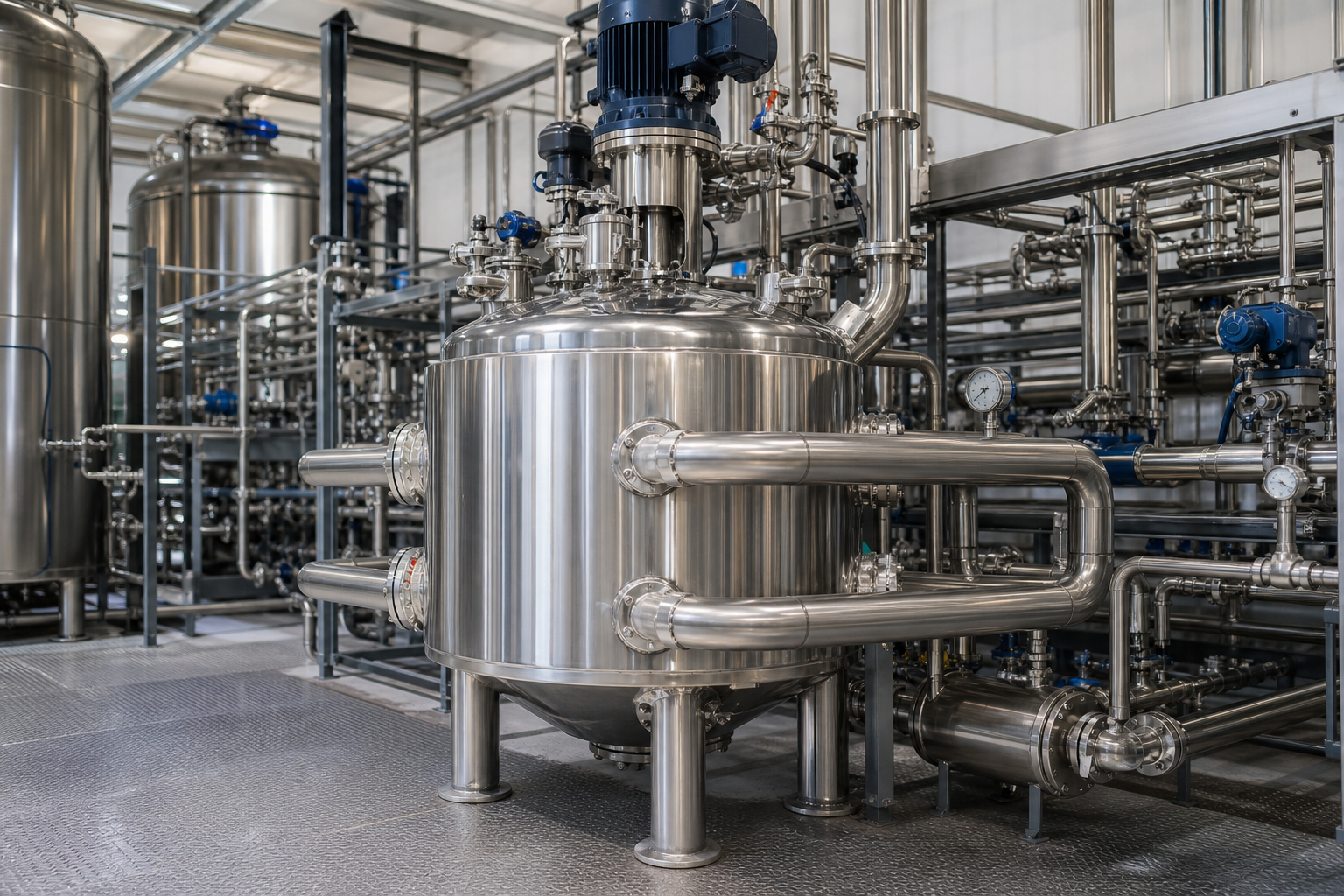
| Agitated cooling tank (batch or continuous) | Jacket or internal coils | Simple, flexible; wall-adjacent supersaturation risks scale build-up on cooled surfaces | Smaller campaigns; frequent product changes |
| Multi-stage (cascade) continuous cooling | Series of crystallizers at successively lower temperatures | Follows the solubility curve in steps; each stage operates at mild supersaturation, limiting encrustation and shaping crystal size | Large continuous production of uniform product |
| Vacuum (adiabatic) cooling crystallizer | Flash evaporation under vacuum — the liquor cools itself | No cooled heat transfer surface in the crystallizer body; simultaneous slight concentration; requires vacuum system | Scaling-prone liquors; duties where slight concentration is welcome |
Our technology pages detail the underlying equipment families: cooling crystallization and vacuum cooling crystallization, with growth-type geometries such as the DTB crystallizer applied when crystal size uniformity is at a premium.
| Module | Candidate Equipment Types | Selection Rationale | Indicative Operating Envelope |
|---|---|---|---|
| Liquor preparation and polishing | Decolorization carbon, fine filtration | Feed-quality boundary protects the metastable zone | Pharmaceutical and food grades |
| Pre-concentration (dilute feeds) | Membrane or modest evaporation step | Reaches saturation before cooling starts | Only where feed arrives dilute |
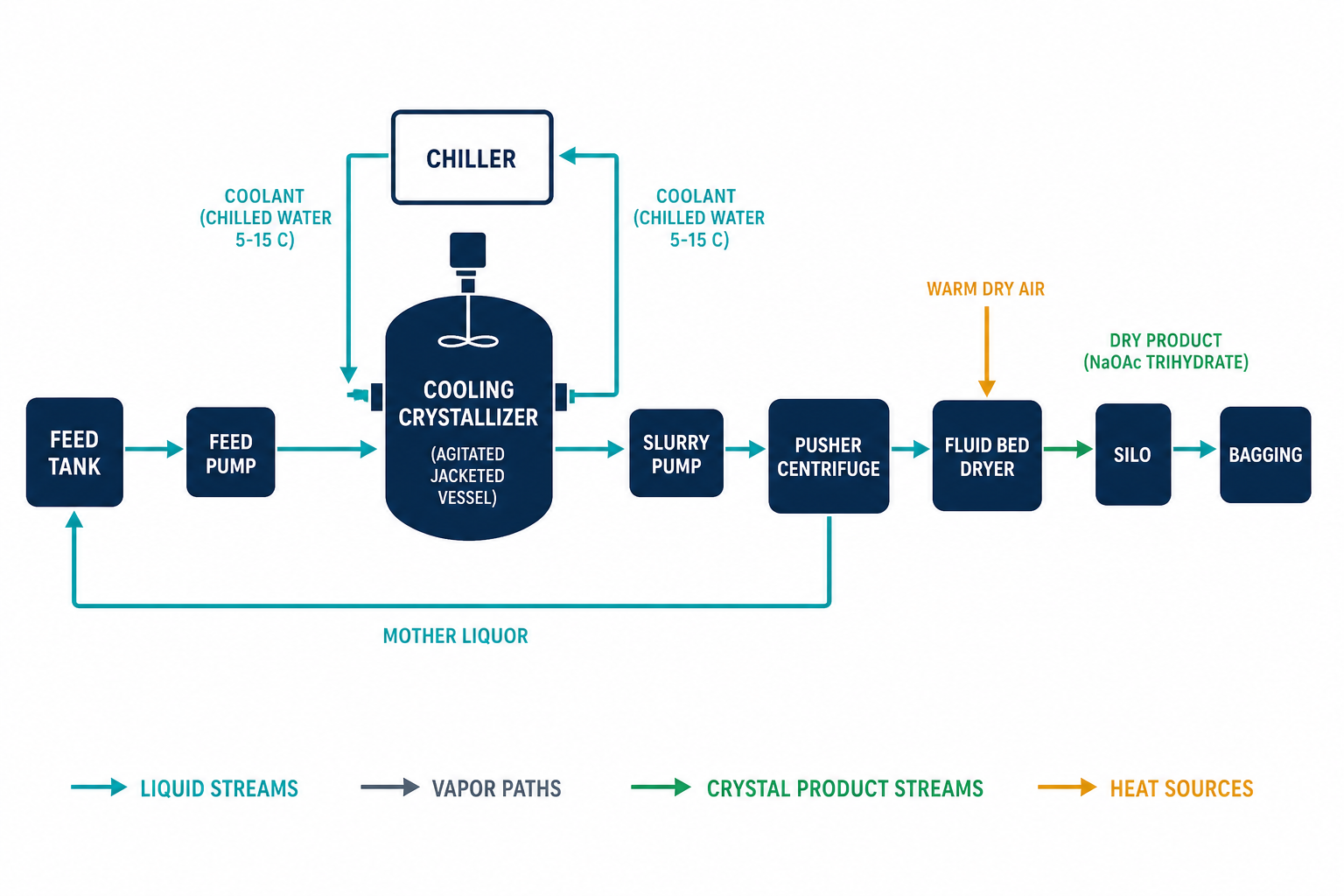
| Cooling crystallization | Agitated tank, cascade, vacuum flash | Metastable-zone control sets size distribution | Continuous at mild supersaturation |
| Solid-liquid separation | Thickener, centrifuge or filter | Mother-liquor recycle under controlled purge | Coarse product, fines dissolved |
| Drying and packing | Fluid-bed or gentle convection dryer | Fixes moisture and hydrate state | Trihydrate gentle; anhydrous barrier-packed |
Configuration, materials, and operating ranges depend on the actual feed, grade target, fouling behavior, site utilities, and project capacity.
Hydrate Form, Drying, and Product Handling
Sodium acetate crystallizes commercially as the trihydrate and as anhydrous salt, and the target form dictates the finishing line. The trihydrate is produced directly from aqueous crystallization and must be dried gently — and stored under conditions that do not drive hydration-state changes — because its water of crystallization is part of the assay. Anhydrous product requires drying that completes dehydration without caking or discoloring, and it is the more demanding form to keep free-flowing.
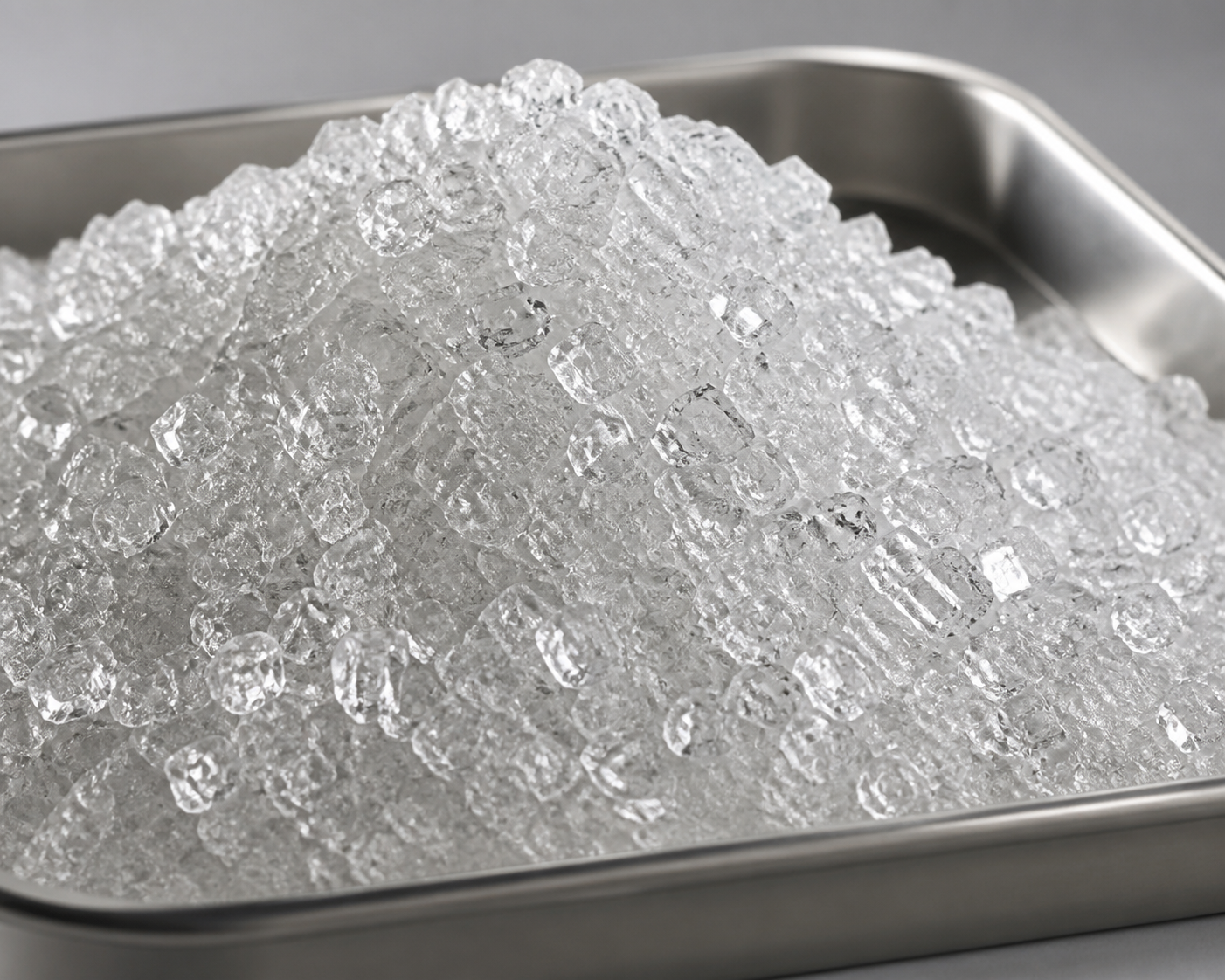
Downstream of the crystallizer, the slurry is thickened and centrifuged or filtered, with mother liquor recycled under a controlled purge, exactly as in other soluble-salt circuits. The drying step (fluid-bed or similar gentle convection drying) then fixes the final moisture. Product-handling decisions — bagging temperature, moisture barrier, storage climate — are genuinely part of quality specification for hydrated salts, and they belong in the crystallization supplier’s scope rather than being discovered at commissioning.
Continuous Versus Batch Operation
Continuous crystallization has become the preferred process route for sodium acetate production on three industry-documented grounds. Production efficiency: continuous operation under constant conditions, with higher equipment utilization and reduced idle time between batches. Product quality: precise control of the crystallization process yields minimal batch-to-batch differences, ensuring the quality stability and consistency that pharmaceutical and food customers contractually expect. Production cost: reduced solvent and energy consumption, less downtime for crystallizer maintenance and cleaning, and lower manual operation complexity and labor intensity.
The batch route retains a role for small-volume, multi-product fine-chemical plants where campaign flexibility outweighs uniformity. But wherever a plant makes one grade of sodium acetate continuously — which is the common commercial case for buffer, food, and pharmaceutical feedstock — the continuous circuit’s steady-state supersaturation control produces both better crystals and lower unit cost.
Related Resources
- Cooling Crystallization Technology — supersaturation by heat removal across soluble salts.
- Vacuum Cooling Crystallization — self-refrigerating adiabatic operation for scaling-prone liquors.
- DTB Crystallizer Design — classified-growth internals for uniform crystal size.
- Concentration & Crystallization Solutions — the integrated line architecture from liquor preparation to dry product.
- Sodium Sulfate Evaporation & Crystallization Solutions — the companion inorganic-salt route where evaporation leads instead of cooling.
Validation Focus
No project dataset is cited on this page; statements are engineering guidance drawn from published crystallization practice. Before a sodium acetate line is committed, validate on the actual liquor: metastable-zone width, seeding protocol, cooling-curve trials for target crystal size, and hydrate-state stability through drying and storage.
When This Route May Not Fit
Cooling crystallization earns its energy advantage only on salts with steep solubility curves, and sodium acetate qualifies; but the economics still depend on site conditions. Where the feed arrives already dilute and pre-concentration dominates the flowsheet, the saving shrinks and the route decision deserves a fresh comparison. Very high purity injectable grades may push beyond single crystallization into recrystallization stages, with cost consequences that cooling control alone cannot fix. Sites without chilled-water capacity, or in hot climates where cooling approach temperatures collapse, struggle to hold the cooling curve the crystal specification needs. Batch, multi-product plants should not force continuous cascade hardware onto campaign chemistry that changes weekly, and the anhydrous product route adds drying complexity that many buyers underestimate.
What Must Be Verified
Before a sodium acetate line is specified, verify the product brief and the liquor together. Required checks: target grade and its impurity ceilings (pharmacopeial, food, or industrial), which fix pretreatment depth; actual feed concentration and impurity profile after any decolorization; metastable-zone width and seeding response measured on the real liquor; the cooling-curve trial that demonstrates achievable crystal size and filtration rate; and hydrate-state stability through the drying, bagging, and storage climate the product will actually see. Chilled-water availability and summer design temperature decide whether the cooling envelope closes at the required final temperature. Continuous-operation claims should be proven against the plant’s own turndown and cleaning schedule, not generic literature. Each verification check protects a contractual quality clause.
Frequently Asked Questions
Why is sodium acetate crystallized by cooling rather than evaporation?
Sodium acetate solubility increases steeply with temperature, so a hot saturated liquor releases crystals upon cooling alone — far less energy than evaporating water to the same yield. Low-temperature operation also protects product color and avoids thermal degradation, which matters for pharmaceutical and food grades.
What are the key control variables in sodium acetate crystallization?
Four: crystallizer temperature (set via cooling water flow and steam trim), solution concentration (holding supersaturation in the metastable zone), cooling rate (the key factor determining crystal size and morphology), and agitation intensity (uniform solute distribution without crystal breakage). Seed dosing anchors the crystal population at start-up and after upsets.
What are the advantages of continuous crystallization over batch?
Continuous operation at constant conditions raises equipment utilization and production efficiency, minimizes batch-to-batch quality differences for the consistency that pharmaceutical and food customers require, and cuts cost through lower solvent and energy consumption, reduced cleaning and maintenance downtime, and less manual operation.
Which industries use crystalline sodium acetate, and to what purity?
Medicine uses it to treat severe acidosis and hyponatremia (the most demanding purity grade); the food industry uses it as a buffer and preservative; dye manufacturing and general buffer-solution production are further outlets. Each grade imposes its own impurity limits, which the crystallization and purge design must be scoped against.
How are the trihydrate and anhydrous forms handled after crystallization?
Centrifuged trihydrate is dried gently with its water of crystallization as part of the assay, and is stored under conditions that preserve the hydrated state. Anhydrous product requires drying that completes dehydration without caking or discoloration, plus moisture-barrier packaging to stay free-flowing. Both finishing routes belong in the crystallization supplier’s scope.
For a first-pass screening of a sodium acetate crystallization duty, send the feed liquor composition, target grade, and capacity; in return you receive an indicative route decision (cooling, vacuum, or hybrid), hydrate strategy, and control basis, before any detailed engineering.