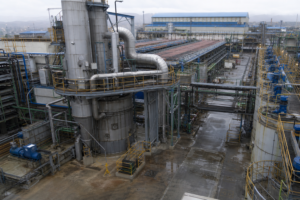
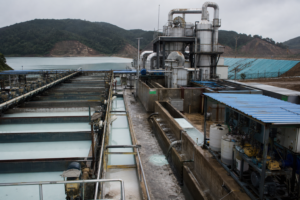
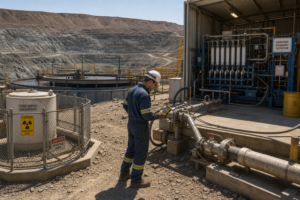
In rare earth and precious metals recovery, evaporation and crystallization are not wastewater equipment — they are unit operations of the metallurgy itself. They sit at four points in a hydrometallurgical flowsheet: concentrating dilute leach liquors up to the crystallization window, closing the water loop on wash and mother liquors, recovering ammonium salts as byproducts from separation-stage effluents, and distilling acids for reuse. Their common purpose is mass conservation: every liter of water and kilogram of salt that leaves the circuit as product instead of effluent is revenue instead of disposal cost. As battery-material recycling scales toward 100,000-ton-per-year projects, this evaporation backbone is what makes the flowsheet economics close.
Where Evaporation Sits in a Hydrometallurgical Flowsheet
Hydrometallurgy dissolves metal values into water and wins them back selectively — precipitation, solvent extraction, ion exchange, electrowinning. Dissolution is easy; the water balance is what gets away from operators. Leaching adds acid to ore or scrap, washing dilutes the pregnant liquor, extraction generates spent electrolyte and raffinate, and each step both consumes and produces water of varying quality. Without thermal concentration the plant accumulates low-grade solutions too valuable to discharge and too dilute to process.
Evaporation solves this by removing water selectively — metals, salts and acidity stay behind. A well-placed evaporator takes a leach liquor carrying a few grams per liter of metal (representative of low-grade feeds and wash waters) and lifts it to the tens of grams per liter where crystallizers, extractants and electrowinning cells operate; the condensate is demineralized water returned to washing or leaching. The evaporator is the pump that recirculates the plant’s water inventory while ratcheting metal inventory upward, and MVR makes that pumping affordable on continuous duty.
Concentrating Leach Liquors to the Crystallization Window
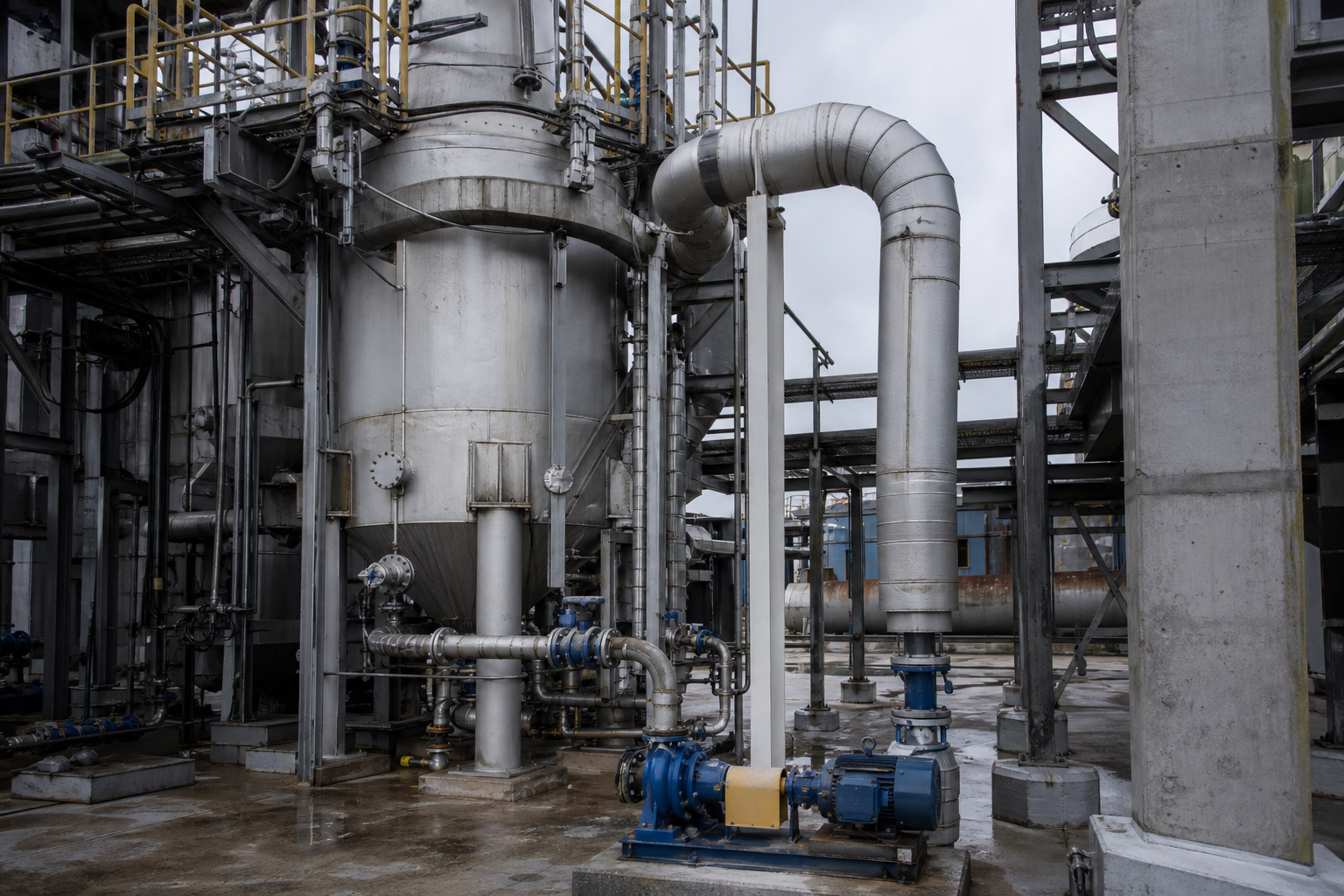
Metal salt crystallization is a concentration game. Nickel, cobalt, copper, and manganese are marketed to the battery and catalyst industries as sulfates — NiSO4·6H2O, CoSO4·7H2O, CuSO4·5H2O, MnSO4·H2O — and each has a solubility curve that defines the operating window. The flowsheet: evaporate the purified liquor under vacuum or MVR duty to near-saturation at the crystallizer feed temperature, crystallize by cooling or further evaporation, centrifuge, and recycle the mother liquor. Crystal quality — size distribution, hydration state, impurity content — is the product specification, controlled by evaporator endpoint stability, supersaturation management and the feed’s impurity profile.
| Metal salt product | Representative feed liquor | Crystallization route | Commercial driver |
|---|---|---|---|
| Nickel sulfate hexahydrate | Purified Ni liquor, sulfate circuit | Evaporation + cooling crystallization | Battery precursor (ternary cathode) feedstock |
| Cobalt sulfate heptahydrate | Co purification circuit | Evaporative crystallization | Cathode and catalyst demand |
| Copper sulfate pentahydrate | Cu leach / electrowinning bleed | Cooling crystallization | Electroplating, agriculture |
| Manganese sulfate monohydrate | Mn liquor (ore or battery recycle) | Evaporation to saturation | Battery and fertilizer markets |
| Ammonium chloride / sulfate | Rare earth separation effluent | Evaporation + crystallization | Fertilizer-grade byproduct sale |
The Ammonium Salt Problem in Rare Earth Separation
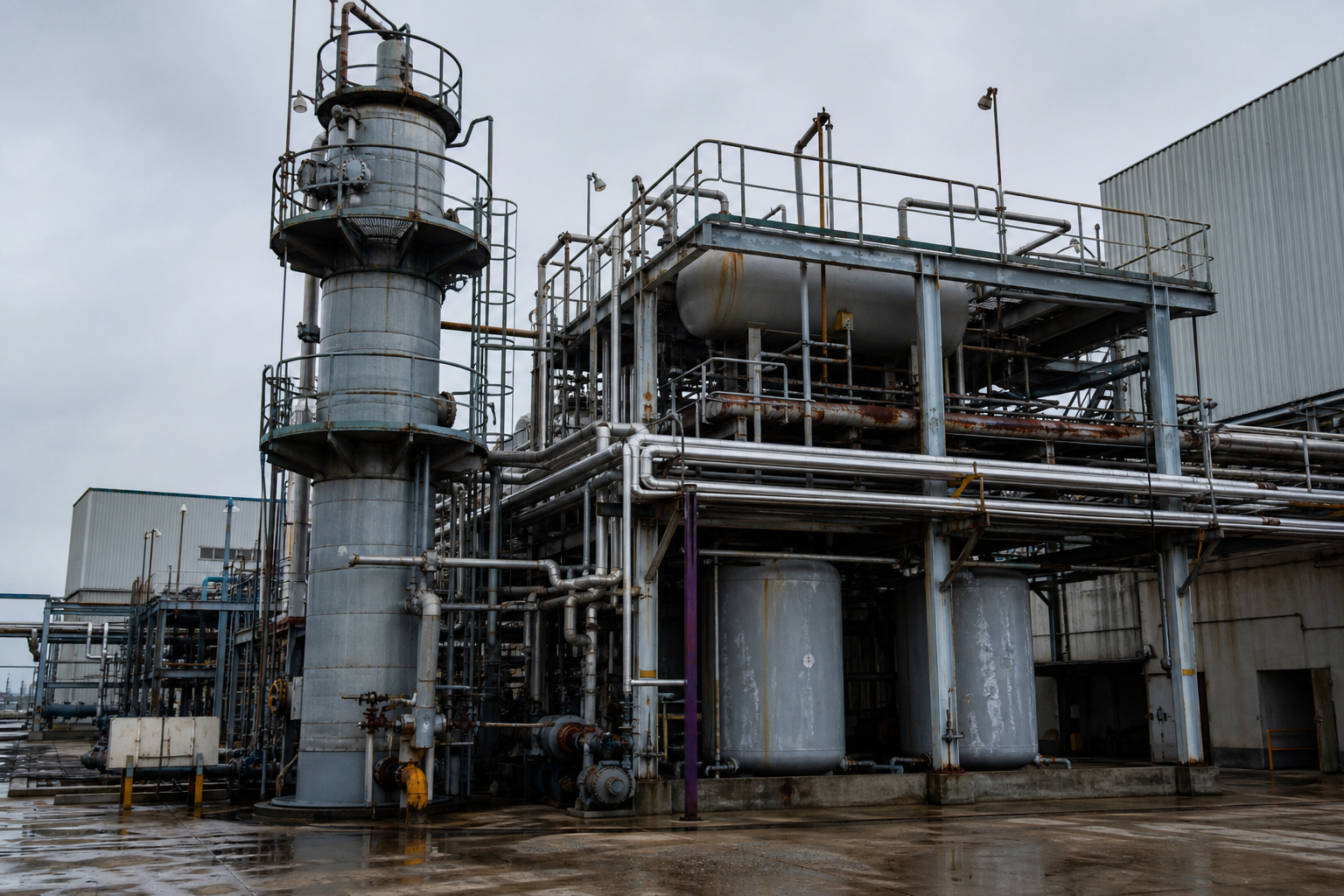
Rare earth refining is chemically distinctive: the separation of individual lanthanides runs on solvent extraction circuits that use acid and ammonium or sodium carbonate systems, generating wastewater loaded with ammonium chloride or ammonium sulfate rather than heavy metals. This ammonium load is the industry’s defining environmental liability — high salinity with nutrient pollution potential, unsuitable for discharge and expensive to treat biologically at high concentration. The mature answer is evaporation and crystallization: ammonium chloride (solubility roughly 372 g/L at 20 °C) and ammonium sulfate (about 754 g/L) both crystallize cleanly from concentrated liquor into a fertilizer-grade byproduct with an established market, with clean condensate returning to the separation circuit.
Executing this well requires two disciplines that separate experienced suppliers from the rest. First, corrosion engineering: hot ammonium chloride solutions are aggressively corrosive to standard stainless steels, and chloride stress corrosion cracking dictates duplex, higher alloys, or titanium on wetted paths — the same material logic as any hot chloride service. Second, ammonia management: ammonium salts dissociate as pH and temperature shift, and free ammonia escapes with the vapor unless the evaporator’s pH control and condensate handling are designed for it. An ammonia odor problem in the condensate tank is a design omission, not an operating nuisance.
Acid Recovery by Distillation
Precious metals refining — gold, silver, platinum group metals — dissolves metal in aqua regia, nitric or hydrochloric acid systems, and spent liquors carry substantial free acid. Distilling and returning it does two things: cuts fresh acid purchases, a major operating cost, and shrinks the wastewater neutralization load, since every kilogram of acid not distilled is a kilogram of carbonate or caustic later needed. Acid-water separation is constrained by azeotropes — nitric acid forms one — so recoverable concentration is bounded: recovered acid returns to less demanding duties (digestion makeup, washing) while primary dissolution uses fresh reagent, and the mildly acidic condensate recycles to rinse stages.
Mother Liquor Management: The Unseen Limit on Recovery
Every crystallizer returns mother liquor, and every recycle loop accumulates whatever the crystals reject: impurities more soluble than the product salt — sodium, calcium, organics, in battery recycling the leached aluminum and fluoride — build up cycle after cycle until they poison crystal growth, trap in the lattice or foul the evaporator. A recovery plant therefore needs a defined purge: a small continuous bleed of mother liquor through a secondary evaporator-crystallizer yielding a mixed-salt solid and recovering the water. Operators who skip the purge discover it anyway as slow purity decline no crystallizer tuning fixes. The correct sizing question is not only “can you crystallize my product salt” but “how does your design purge impurities, and where do they exit.”
Corrosion and Materials: Sulfate versus Chloride Service
Material selection in recovery plants follows the anion. Sulfate circuits are comparatively forgiving — stainless steels serve across most of the temperature range, with higher alloys reserved for acidic hot spots. Chloride circuits (ammonium chloride, sodium chloride, brine-derived feeds) are the hostile case: chloride pitting and stress corrosion cracking at temperature push selection to duplex stainless, higher nickel alloys, or titanium, with attention to gasketed joints and under-insulation chloride concentration. Mixed nitrate-chloride liquors from precious metals refining are evaluated case by case, because oxidizing chlorides (the conditions that dissolve gold) are among the most corrosive aqueous environments in industry. The practical procurement rule: demand the material matrix in the bid, by stream and temperature, not a single “stainless steel construction” line item.
Battery Recycling Is Scaling This Chemistry
The growth engine behind metal-salt evaporation and crystallization is lithium-ion battery recycling: black mass is leached in sulfuric acid, nickel, cobalt, manganese and lithium are separated and crystallized as battery-grade salts, and the circuit generates a large sodium sulfate stream recovered by evaporation and crystallization for the detergent and glass industries. The industry has moved from pilot to industrial scale — recycling projects at the 100,000-ton-per-year class were being launched by 2025 — and turnkey hydrometallurgical plants are now offered as integrated packages. The water-balance work is done by the same evaporator-crystallizer backbone described here, which is why evaporation capability has become a selecting criterion for recycling plant builders. For the sodium sulfate crystallization detail and its markets, see salt separation methods.
Putting the Train Together
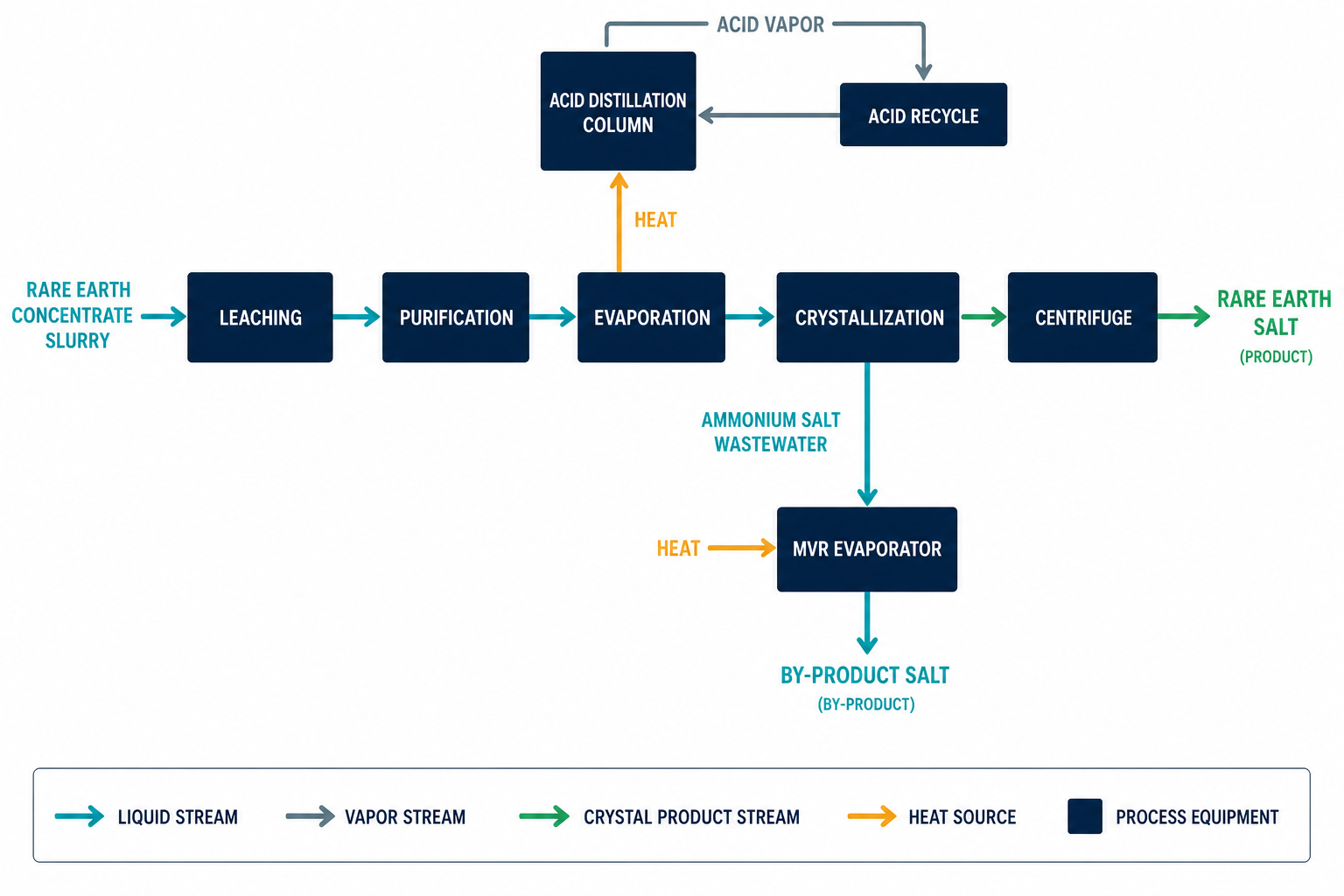
A recovery flowsheet that closes its loops typically runs: leaching and washing, solution purification (precipitation or solvent extraction), MVR evaporation of the purified liquor to the crystallizer feed window, product-salt crystallization and centrifuging, mother liquor purge through a mixed-salt crystallizer, acid distillation where the chemistry supports it, and condensate returned to washing. Delivery format follows scale and site maturity: skid-mounted evaporator and crystallizer packages suit pilot and mid-scale plants and capacity upgrades, while greenfield refineries integrate the train into the process design from the start. The governing economics are simple to state and worth restating to any project team: metal products pay for the plant, water reuse pays for the operation, and byproduct salts determine whether the residue line is a cost or a credit.
| Process module | Equipment candidates | Selection basis | Indicative envelope |
|---|---|---|---|
| Leach liquor concentration | MVR / vacuum evaporator | Lift into crystallization window | Few to tens of g/L metal |
| Product-salt crystallization | Cooling / evaporative crystallizer, centrifuge | Crystal quality specification | Battery-grade hydrated sulfates |
| Mother-liquor purge | Secondary mixed-salt crystallizer | Impurity ceiling, water recovery | Mixed-salt solid plus distillate |
| Ammonium salt recovery | Evaporation + crystallizer | Fertilizer-grade byproduct | NH4Cl / (NH4)2SO4 sale |
| Acid distillation | Distillation column | Acid reuse, neutralization load | Azeotrope-bounded recovery |
Configuration, materials and envelopes depend on the actual liquor analyses, salt systems, corrosion review and capacity.
Related technologies in detail: MVR evaporation for continuous concentration duty, salt separation methods for mixed-salt streams, solvent recovery and distillation for acid and reagent loops, and zero liquid discharge system design for the water-balance framework. Adjacent case chemistry is covered in polysilicon wastewater ZLD and RO reject evaporation and crystallization.
When This Route May Not Fit
This route fits hydrometallurgical plants whose liquors hold recoverable metal or salt value. It may not fit a pyrometallurgy-led recycler whose hydromet step is minor — the evaporation backbone earns nothing on a small side stream. It may not fit extremely dilute, very large volumes (sub-gram-per-liter wash water beyond what the circuit needs), where the energy per kilogram of recovered metal never closes. It may not fit where no outlet exists for byproduct salts: if ammonium sulfate or sodium sulfate cannot be sold or accepted locally, the crystallizer converts a liquid liability into a solid one. And oxidizing nitrate-chloride precious-metal liquors may not fit at all when the materials budget cannot carry titanium or high-nickel alloys — that chemistry forgives no cheaper metallurgy.
What Must Be Verified
Before the route is fixed, the validation focus is: complete liquor analyses — metal tenor, anion system, and the impurity profile that decides mother-liquor behavior, with aluminum and fluoride flagged for battery feeds. Then the crystallization window: solubility curves of the target salt against the real impurity mix, confirmed by bench crystallization rather than pure-solution data. Then the purge: at what recycle concentration impurities threaten product grade, and what the mixed-salt residue’s waste classification will be. Then the corrosion review, by anion and temperature, producing a stream-by-stream material matrix rather than a single line item. Then the byproduct salt outlets and the azeotrope bound on any acid recovery. Verified liquor data and bench crystallization are the evidence base.
Required inputs: liquor analyses (metal, anion, impurities), daily volumes and product targets — in exchange, an initial direction on concentration duty, crystallizer selection and materials strategy.
FAQ
Why does a metals recovery plant need evaporation if it already has crystallizers?
Crystallizers only work near saturation, while leach liquors and wash waters typically carry a few grams per liter of metal. Evaporation lifts those dilute streams into the crystallization window, and its condensate returns as clean wash water — the evaporator is what closes the plant’s water and metal balances simultaneously.
Can rare earth wastewater really produce a saleable byproduct?
Yes. The ammonium chloride or ammonium sulfate that dominates rare earth separation effluent crystallizes cleanly from concentrated liquor into fertilizer-grade products — ammonium chloride dissolves at roughly 372 g/L and ammonium sulfate at about 754 g/L at 20 °C — turning the industry’s main wastewater liability into a byproduct revenue line.
What metals are recovered as crystalline salts?
Nickel, cobalt, copper, and manganese are marketed as hydrated sulfate crystals (battery-grade NiSO4·6H2O and CoSO4·7H2O among them), while lithium is usually recovered as carbonate or hydroxide via concentration upstream of precipitation.
Why does crystal purity drift over months of operation?
Impurities more soluble than the product salt accumulate in the recycled mother liquor until they contaminate or inhibit crystal growth. A continuous purge through a secondary mixed-salt crystallizer is the standard fix; without it, purity decline is gradual but unremitting.
What materials are required for these liquors?
By anion: sulfate circuits run on stainless steels, chloride circuits (including hot ammonium chloride) require duplex, high-nickel alloys, or titanium to resist pitting and chloride stress corrosion cracking, and oxidizing nitrate-chloride refining liquors are evaluated case by case.