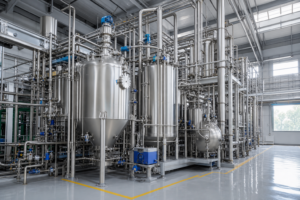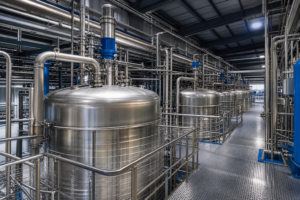
Adipic acid plants face two emissions problems that sit at opposite ends of the flowsheet: nitrous oxide (N₂O) in the off-gas from nitric acid oxidation, and acidic organic wastewater from crystallization and purification. The N₂O is treated by catalytic decomposition — the off-gas is heated and passed over a catalyst bed where N₂O breaks down to nitrogen and oxygen — bringing emissions to standard and cutting the greenhouse effect; the wastewater is handled by evaporation-crystallization and recovery technology that removes water, recovers dicarboxylic acid value, and closes the liquid loop. This article covers both sides of the adipic acid environmental problem: why N₂O from this process matters, how decomposition systems are configured, and how crystallization and wastewater units are engineered for a product whose crystal quality is notoriously sensitive to temperature and rate.
Adipic Acid Production and Its Two Emission Streams
Adipic acid is the key raw material for nylon 6,6 and is widely used across the plastics, coatings, pharmaceutical, and chemical industries. The dominant route runs cyclohexane through oxidation to cyclohexanol/cyclohexanone (KA oil), then nitric acid oxidation to adipic acid. Both emissions of consequence originate in that second step:
- Off-gas N₂O — nitrous oxide forms as a by-product wherever nitric acid oxidizes organic substrate; adipic acid plants have historically been among the largest single industrial N₂O sources.
- Acidic wastewater — mother liquors from crystallization carry nitric acid residues, unreacted intermediates, and the homologous dicarboxylic acids (glutaric and succinic acids) that co-form during oxidation.
Neither stream can be ignored: one is regulated as a potent greenhouse gas, the other as a high-load organic wastewater. Plants that solve only one of the two still fail their environmental permit.
Why N₂O From Adipic Acid Plants Matters
Nitrous oxide is a long-lived atmospheric gas with a global warming potential roughly 270 times that of carbon dioxide on a century timescale, and it also contributes to stratospheric ozone depletion. Because a single world-scale adipic acid plant can emit N₂O in quantities whose CO₂-equivalent exceeds the fossil emissions of a mid-sized city, abatement at these plants has been among the most cost-effective greenhouse-gas projects anywhere in industry — the tonnage is concentrated, the gas stream is well-defined, and one decomposition unit serves the whole plant. That combination of high potency and high concentration is also why adipic-acid N₂O abatement projects were early participants in carbon credit programs, and why buyers of adipic acid increasingly audit abatement performance as part of supplier sustainability scoring.
N₂O Treatment Routes
| Route | Principle | Where it fits |
|---|---|---|
| Catalytic decomposition | Off-gas is preheated and passed through a catalyst bed; N₂O decomposes to N₂ and O₂ over the catalyst at moderate temperature | The standard choice for adipic acid off-gas — the documented approach for meeting emission standards while reducing the greenhouse effect |
| Thermal decomposition | N₂O is destroyed by sustained high temperature without catalyst | Simpler in chemistry but more energy-intensive; higher operating cost where recoverable heat is limited |
| Recovery / utilization | N₂O is captured and used, e.g. as an oxidant in selective oxidation chemistry or routed to adjacent nitric acid facilities | Site-specific; requires a consumer for the captured gas nearby |
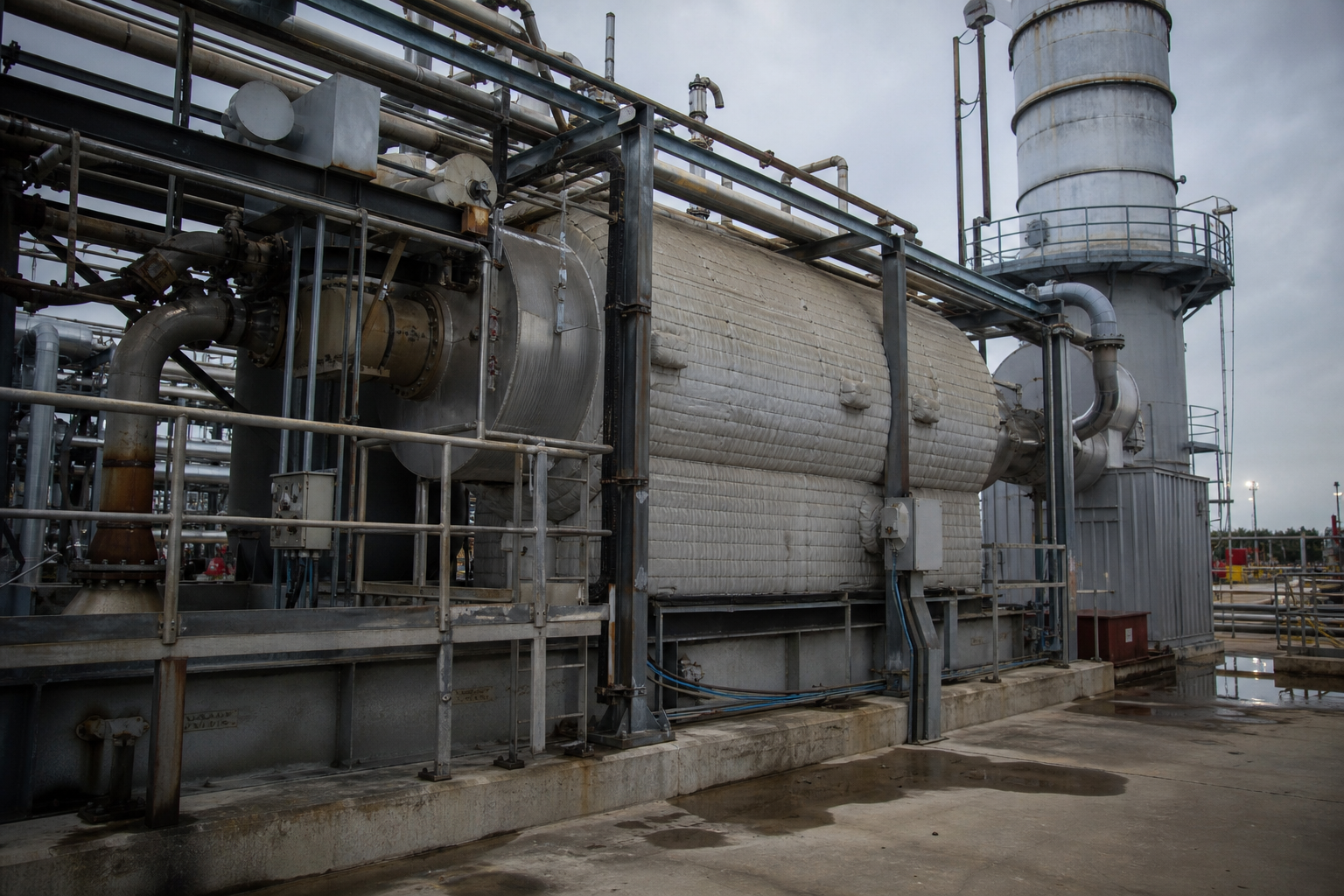
Catalytic decomposition is the route the industry settled on for adipic acid service, and for the practical reasons that usually decide such choices: high destruction efficiency in a compact reactor, lower temperature operation than plain thermal destruction (hence cheaper metallurgy and preheat duty), and a catalyst bed that tolerates the residual NOx and oxygen in the stream. The engineering essentials of the system are preheat (getting the off-gas to catalyst light-off temperature, ideally with internal heat recovery against the treated gas), a reactor sized for space velocity and catalyst aging, heat recovery on the outlet, and a monitoring layer that proves destruction efficiency to the regulator continuously rather than intermittently.
Adipic Acid Crystallization: The Product Side of the Same Plant
The same plant’s product section has its own engineering problems, and they are crystallization problems. Adipic acid is an organic dibasic acid — odorless or slightly sour, soluble in hot water, with good thermal and chemical stability — that crystallizes from solution as a white crystalline powder in the orthorhombic system, typically as small particles. The recognized difficulties are three:
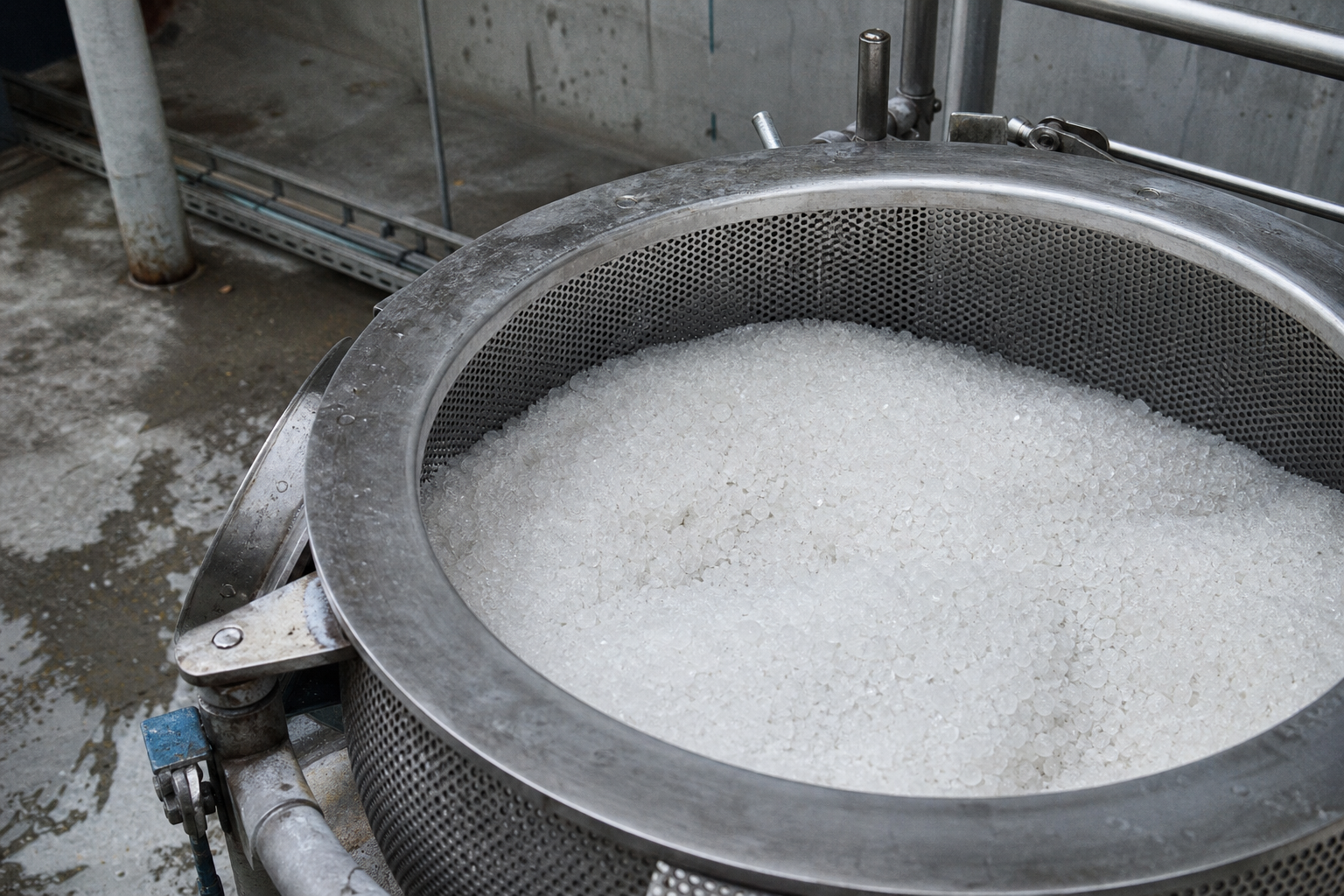
- Purity control — impurities in the mother liquor (including the co-formed glutaric and succinic acids) affect both crystal purity and morphology.
- Crystallization rate and crystal size — excessive crystallization speed creates internal crystal defects that degrade product quality, while uneven size complicates downstream processing.
- Temperature control — temperature fluctuations translate directly into uneven size distributions and crystal defects.
The corresponding keys, in the order practitioners rank them: precise temperature control (too high or too low both give poor morphology), correct mixing intensity (promoting uniform crystallization, preventing agglomeration, and shaping size and form), and design experience — the continuous crystallization of organic acids is an experience-driven discipline in which suppliers’ installed bases, not simulation alone, de-risk a project. Published references for this equipment class cite cumulative annual designed capacity above 2 million tons across organic acids – an external industry figure, indicative rather than a record of any single supplier’s deliveries.
Continuous Crystallizers for Adipic Acid
Continuous crystallization has displaced batch tanks for adipic acid at scale, and the advantage list is consistent across suppliers: lower labor cost through high automation, compact footprint saving plant space, lower energy consumption through staged heat management, comprehensive safety protection, improved crystal quality through precise control, and continuous production matched to large-scale throughput. Crystal size above 1 mm is demonstrably achievable in this duty — large-particle adipic acid production is a published reference application for multi-stage continuous cooling crystallizers.
For the plant integrator, the crystallizer’s position between oxidation and drying means its stability defines the plant’s stability: a crystallizer that drifts off-specification pushes defects downstream into centrifuging, drying, and product certification. The same crystal-size-vs-fines logic covered in our drying and packing technology overview applies — coarser, uniform crystals dry more uniformly and bag without caking.
Mother Liquor Management Inside the Crystallization Loop
Adipic acid crystallization generates its own internal wastewater question: the mother liquor that remains after each crystallization pass carries the impurities the product must not — co-formed dicarboxylic acids, nitrate residues, and trace organics — and it has only two exits. Recycle it fully and impurities climb until crystal morphology and purity degrade (the first documented difficulty above); purge it entirely and the plant pays to evaporate and dispose of acid value it should have recovered. Operating practice therefore runs a controlled purge: a defined fraction of mother liquor leaves the loop for evaporation-recovery while the balance recycles, with the purge rate set by measured impurity concentration rather than by schedule. The evaporated concentrate is where the economic question lands — glutaric and succinic acids have their own markets when separated cleanly, which is a fractional-crystallization problem, not a drying problem. Plants that, in published practice, treat mother liquor as an internal design variable rather than a disposal afterthought report both higher adipic acid yield per ton of nitric acid and a smaller wastewater plant at the battery limit.
Wastewater: What to Do With the Acidic Mother Liquor
The liquid effluent from adipic acid production combines acidity, organic load, and dissolved salts — a profile that conventional biological treatment alone cannot bring to discharge standard. The evaporative recovery approach attacks all three at once: the wastewater is concentrated — typically in an MVR evaporator where the vapor recompression cycle supplies the heat, as covered in the MVR technology overview — water leaves as clean condensate for reuse, and the organics and salts concentrate toward a stream from which value (dicarboxylic acids) can potentially be recovered by crystallization, or which is reduced to a solid residue for disposal at a fraction of the liquid volume.
Two design cautions from analogous duties. First, nitric-acid-bearing condensate and sulfate/chloride traces make materials selection a wetted-surface decision — the same corrosivity-first logic that governs ammonium salt plants. Second, mixed-salt mother liquors may separate into individual products rather than a mixed waste if the concentration-temperature path is chosen deliberately; the sequencing rules live on our salt separation technology page. Where the plant objective is full compliance plus water reuse, the crystallization island is the closing step of a zero-liquid-discharge train.
Integration: One Plant, Two Abatement Objectives
The practical lesson reported from operating adipic acid complexes is that the gas and water problems should be engineered together, not sequenced. The N₂O decomposition unit has a heat signature that can preheat wastewater or boiler feed; the crystallization section defines the wastewater composition the recovery unit must handle; and the product dryer’s exhaust and the off-gas treatment can share monitoring and stack infrastructure. Plants that treat these as separate vendor packages pay for the interfaces twice. A single solution provider carrying catalytic decomposition, crystallization, evaporation, and drying under one process guarantee keeps the mass balance closed at the battery limit — which is ultimately what the operating permit, and the sustainability report, measure.
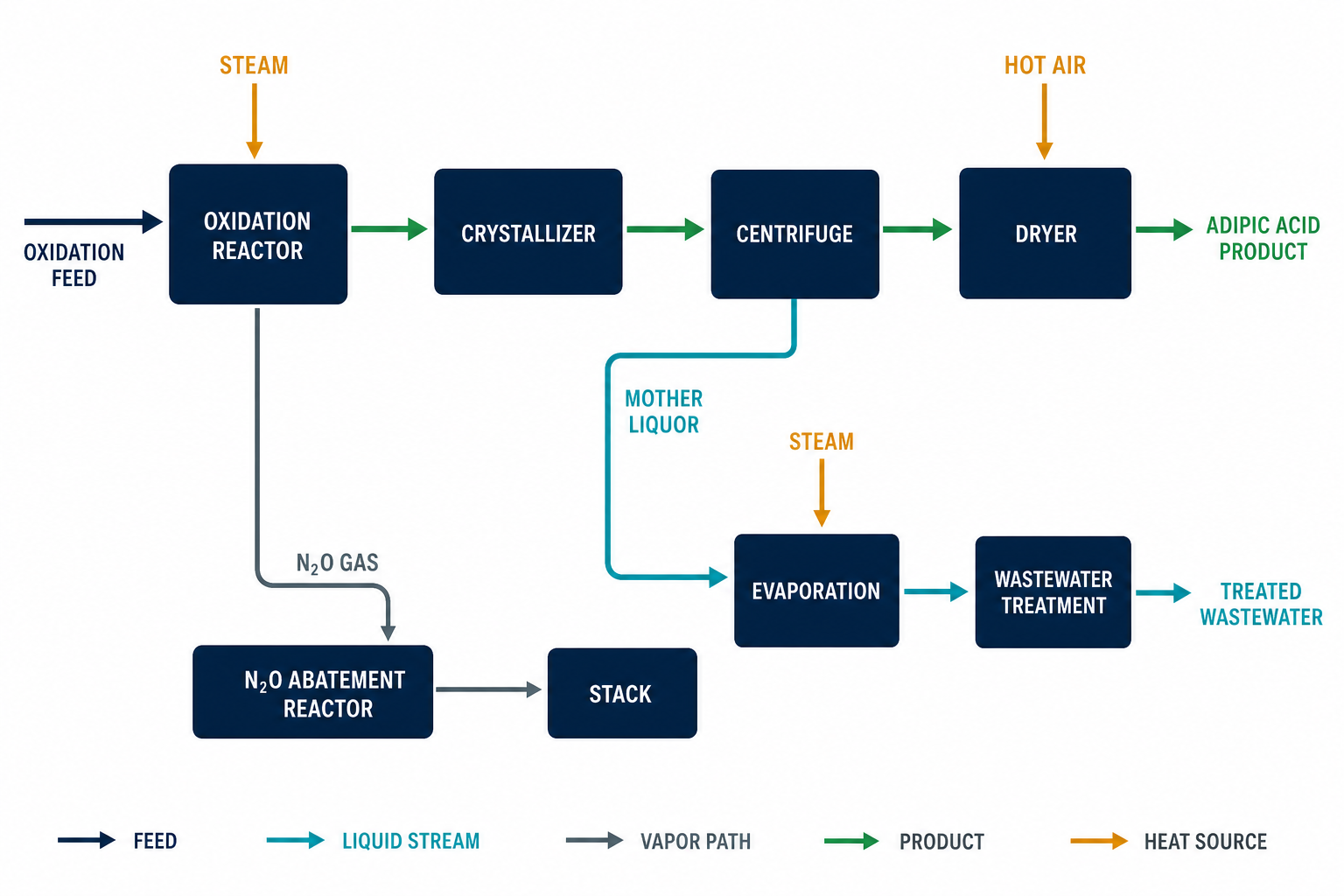
Validation focus. Two assumptions carry this architecture and both need verification on the actual plant: the off-gas composition and N₂O concentration profile across turndown (they size the catalytic reactor, its preheat duty, and the monitoring layer the permit will demand), and the mother-liquor chemistry – impurity levels, nitrate residues, and the dicarboxylic acid split – which decides the purge rate and whether fractional recovery of glutaric and succinic acids is worth its separation cost. Verification runs on measured off-gas data, mother-liquor analysis across campaigns, and bench crystallization tests for purity and morphology on the real liquor.
Read as process modules, the two-sided abatement plant looks like this – candidate equipment types, the selection rationale, and the indicative operating envelope each module must cover (envelopes derived from published industry data, not project specifications):
| Process Module | Candidate Equipment Types | Selection Rationale | Indicative Operating Envelope |
|---|---|---|---|
| Off-gas preheating | Feed-effluent exchanger with trim heater | Reaches catalyst light-off with internal heat recovery | Duty set by catalyst light-off temperature |
| N₂O decomposition | Fixed-bed catalytic reactor | High destruction efficiency at moderate temperature | Sized for space velocity and catalyst aging |
| Treated-gas handling | Outlet heat recovery, stack, monitoring layer | Cuts net energy; proves efficiency continuously | Continuous CEMS-style verification |
| Product crystallization | Multi-stage continuous cooling crystallizer | Size and morphology control for organic acids | Crystal size above 1 mm in published references |
| Mother-liquor handling | Controlled purge with recycle | Impurity ceiling balanced against acid recovery | Purge rate set by measured impurity level |
| Wastewater concentration | MVR evaporator with crystallization finish | Returns condensate; recovers dicarboxylic acid value | Corrosive nitrate service drives materials |
Configuration, materials, and operating ranges depend on the actual feed, temperatures, pressures, corrosion review, fouling behavior, utilities, and project capacity.
Related Solution Lines
Adjacent chemistries handled on the same platform include ammonium sulfate evaporation crystallization (the same multi-stage continuous cooling crystallizer family also serves succinic acid at large particle size) and aluminum hydroxide production and crystallization on the inorganic side.
When This Route May Not Fit
Catalytic decomposition plus evaporative recovery assumes a world-scale plant whose N₂O tonnage justifies dedicated abatement hardware and whose mother-liquor volume justifies an MVR train. Small adipic acid or specialty dicarboxylic acid producers may face simpler permit paths and find thermal destruction or off-site disposal honest. If the recovered acid mixture has no market – no buyer for separated glutaric and succinic acids – the recovery loop degenerates into an expensive way to make corrosive concentrate. And plants whose wastewater permits still allow conventional treatment should check whether the ZLD-closing crystallization island is actually required before buying it.
What Must Be Verified
The off-gas analysis – N₂O and NOx concentrations, oxygen, and dust or mist carryover – sizes the catalyst bed and fixes preheat and monitoring scope; destruction efficiency must be proven continuously to the regulator’s method, not assumed from vendor curves. On the water side, the mother-liquor composition across campaigns sets the purge policy and the corrosion review for nitrate-bearing wetted surfaces. Bench crystallization tests on the actual liquor should confirm crystal size, purity, and morphology targets. And the buyer’s sustainability audit requirements – increasingly part of adipic acid supply contracts – define the monitoring and reporting layer before equipment scope is fixed.
FAQ
Why does adipic acid production generate nitrous oxide?
N₂O forms as a by-product of the nitric acid oxidation step that converts cyclohexanol/cyclohexanone (KA oil) to adipic acid. The off-gas carries it at concentrations that make adipic acid plants major point sources of this greenhouse gas.
How is N₂O from adipic acid plants treated?
The documented approach is catalytic decomposition: off-gas is preheated and passed over a catalyst bed where N₂O decomposes to nitrogen and oxygen, bringing emission to standards and reducing the greenhouse effect. Thermal decomposition and recovery/utilization are alternatives with higher energy cost or site-specific requirements.
Why is N₂O abatement at adipic acid plants considered high-value?
N₂O has a global warming potential roughly 270 times CO₂ over a century, and a single adipic acid plant concentrates large N₂O tonnage in one well-defined gas stream — so one decomposition unit delivers very large CO₂-equivalent reductions at low unit cost.
What makes adipic acid crystallization difficult?
Three documented difficulties: impurity control (co-formed acids affect purity and morphology), the rate-size trade-off (excessive speed causes internal crystal defects), and temperature sensitivity (fluctuations produce uneven size distributions and defects). Precise temperature control and correct mixing are the primary levers.
How is adipic acid wastewater treated?
By concentration in an evaporation-crystallization train — typically MVR-driven — that returns clean condensate for reuse, recovers dicarboxylic acid value where feasible, and reduces the residual to a small solid or concentrated stream, closing the plant toward zero liquid discharge.
To start a first-pass screening, send the off-gas analysis (N₂O and NOx concentrations) and the wastewater profile (acidity, organic load, dicarboxylic acid content) with the compliance targets for both streams.