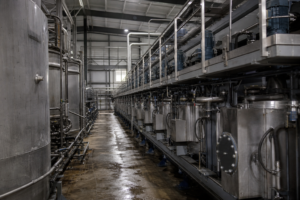
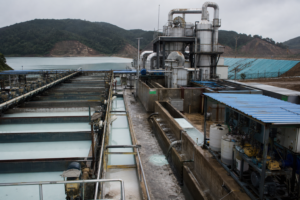
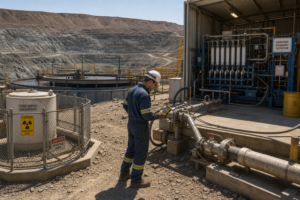
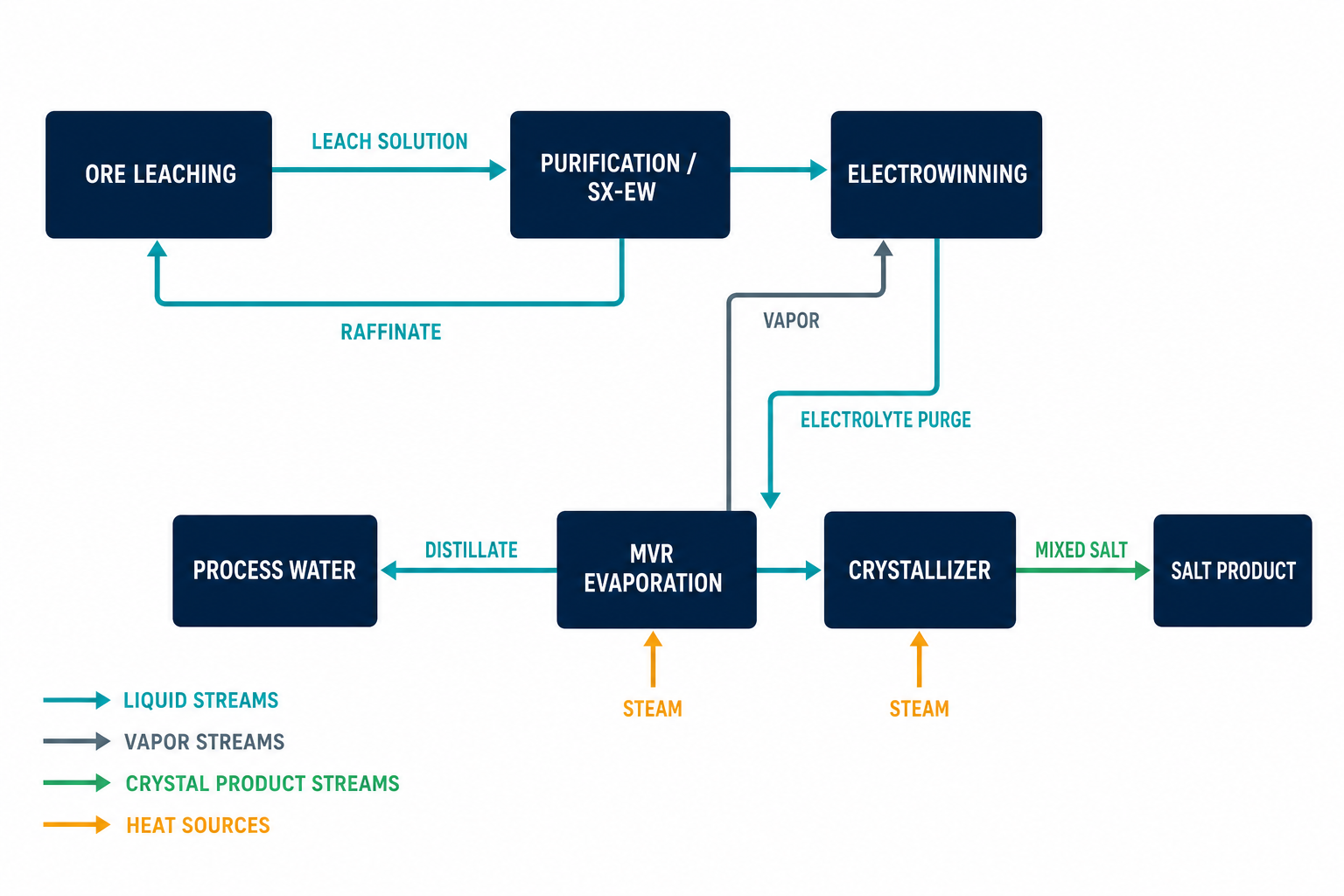
Hydrometallurgy — the extraction and refining of metals through leaching, purification, and electrowinning or precipitation — runs on water, acid, and salt. Every tonne of nickel, cobalt, copper, or lithium produced hydrometallurgically moves through aqueous liquors that must be concentrated, separated, and ultimately cleaned, and evaporation–crystallization is the unit operation that does all three. In the value direction, evaporators concentrate leach solutions and mother liquors to enrich metals before recovery; in the environmental direction, evaporator-crystallizers close the water loop on high-salinity wastewaters that membranes and biology cannot finish. With discharge permits tightening around non-ferrous plants worldwide, the two directions are converging into one engineering discipline: thermally driven concentration and salt recovery for hydrometallurgical circuits. This article maps where evaporation and crystallization sit in a hydrometallurgical flowsheet, what makes these liquors difficult, and how modern MVR-based systems are configured.
The Hydrometallurgical Water Map
A typical hydrometallurgical plant — whether processing nickel-cobalt laterites, copper concentrates, black mass from spent lithium-ion batteries, or rare-earth ores — generates a family of aqueous streams with sharply different characters:
| Stream | Origin | Illustrative Character | Thermal Processing Role |
|---|---|---|---|
| Pregnant leach solution (PLS) | Acid or ammonia leaching of ore, concentrate, or black mass | Metals in strong acid; often dilute in target metal | Concentration to enrich metal ahead of purification |
| Raffinate / stripped liquor | Solvent-extraction circuits | Acidic, metal-depleted but salt-rich | Acid recovery; water recycle |
| Mother liquors | Crystallization or precipitation steps (e.g., nickel sulfate, cobalt sulfate) | Near-saturated salts with residual metal value | Evaporative concentration to raise yield |
| Electrolyte purge / electrowinning bleed | Copper, zinc electrowinning tanks | Accumulating impurities in strong acid | Concentration and copper sulfate recovery |
| Wastewater (mixed) | Washing, scrubbing, neutralization, membrane rejects | TDS from tens to hundreds of thousands mg/L; heavy metals; COD | ZLD evaporation-crystallization; salt recovery |
Illustrative stream character, compiled from published hydrometallurgical practice and stated design assumptions — not customer or project data; plant-specific water chemistry governs every actual design.
The common thread is salt. Sulfate systems dominate nickel, cobalt, and zinc hydrometallurgy; chloride systems appear in copper and in some lithium and rare-earth routes; sodium accompanies every neutralization step as Na₂SO₄ or NaCl. Evaporation and crystallization are the only unit operations that separate these salts from water at industrial scale with complete reliability — which is why a hydrometallurgical plant without a thermal section is increasingly an incomplete plant.
Application One: Concentrating Leach Solutions and Mother Liquors
In the flowsheet’s value direction, evaporators do straightforward but lucrative work: removing water so that downstream recovery sees richer feed. Concentrating a dilute nickel sulfate liquor before crystallization increases crystallizer yield and cuts the energy that the crystallizer itself must supply. Concentrating a lithium-bearing mother liquor before carbonate precipitation raises lithium recovery per pass — the same logic applied in the battery-materials industry, where battery materials solutions depend on evaporation at multiple points between leaching and cathode-salt production.
For these duties, falling-film evaporation suits the dilute, clean end of the concentration range — high heat-transfer coefficients, short residence time, gentle thermal treatment of liquors that may carry heat-sensitive organics from processing aids. As liquor approaches saturation, forced-circulation evaporators or directly coupled forced-circulation crystallizers take over, because boiling near the saturation point of a sulfate system is exactly the condition where tube-wall scaling begins and high circulation velocity is the proven defense.
Application Two: Electrolyte Purge and Copper Electrolyte Concentration
Copper electrowinning and electrorefining circuits continuously accumulate impurities that must be bled off, and the bleed is a copper sulfate solution too valuable to discard. The traditional processing route — single-effect vacuum evaporation with live steam — works, but at an energy cost that has made it a prime target for mechanical vapor recompression.
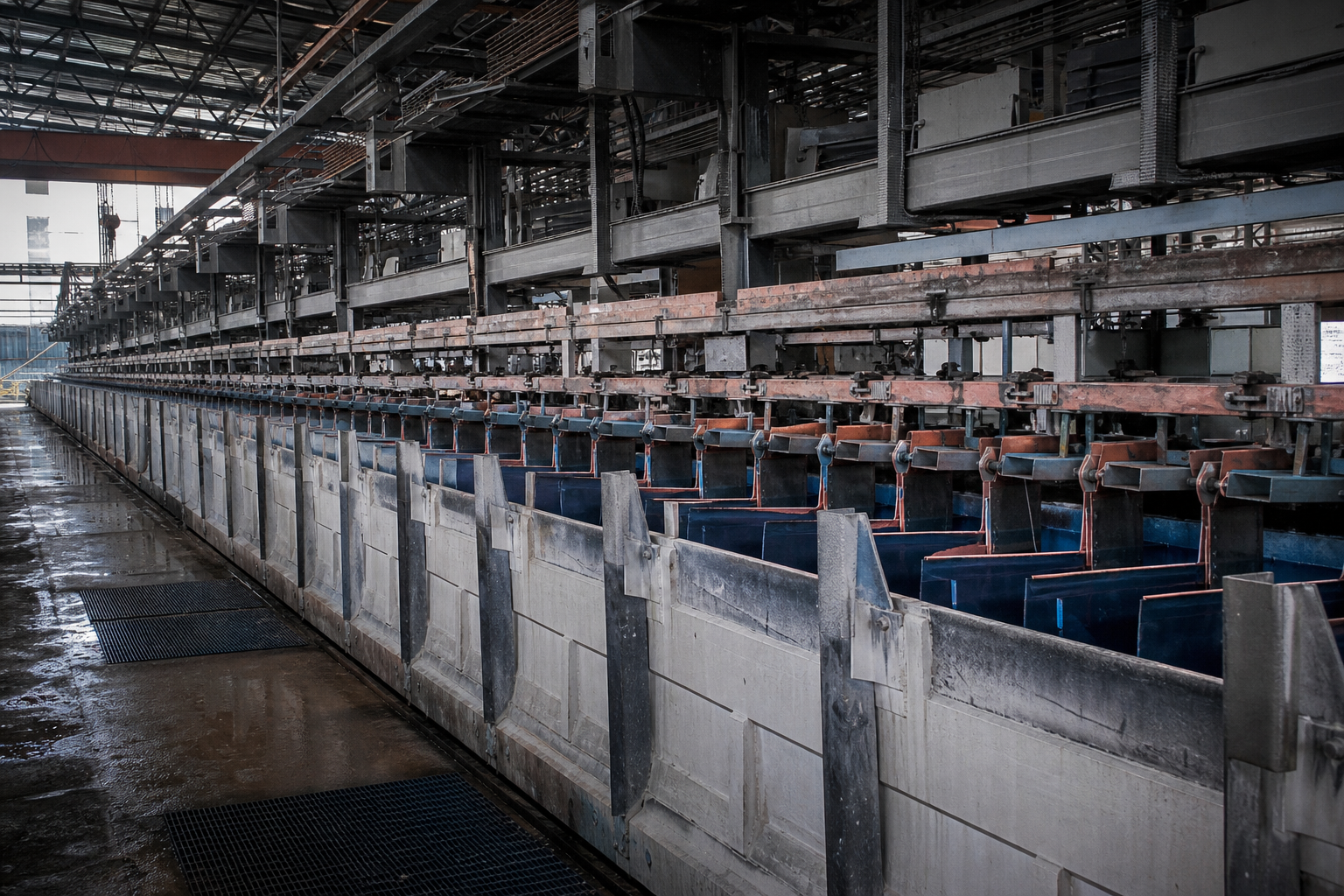
The engineering contrast is documented in vendor-published Chinese copper-plant practice — an external industry reference, not an EvapCryst delivery. A conventional single-effect evaporator for copper electrolyte requires continuous live steam, produces large volumes of steam condensate and hot process water that then burden the plant’s cooling-water system, and leaves the site with a water balance that cannot close. An MVR rebuild of the same duty replaces the steam with a roots-type or centrifugal vapor compressor: vapor boiled from the electrolyte is recompressed to higher pressure and temperature and returned to the heat exchanger as the heating medium. The system runs with multi-stage feed preheating (raising electrolyte to roughly 90°C entering the evaporator body), forced circulation through the heat exchanger, and PLC-based control of compressor frequency, valve positions, and flows — with condensate recovered as clean warm water for reuse in the plant. The reported outcomes are lower energy consumption, simplified water balance, and better stability for zero-discharge operation of the copper circuit.
The same logic extends to zinc electrolyte, nickel electrolyte purification, and the etching liquors of the printed-circuit industry — anywhere a hot acid salt liquor must be concentrated without spending live steam.
Application Three: Hydrometallurgical Wastewater and Zero Liquid Discharge
The environmental direction is where hydrometallurgy places its hardest demands. Mixed plant wastewater — washing water, scrubber blowdown, neutralization overflows, and membrane-concentration rejects — combines four punishing characteristics in one liquor:
- Extreme salinity. TDS reaching tens of thousands to hundreds of thousands of mg/L, as sodium chloride, sodium sulfate, calcium salts, and the process’s own metal salts.
- Heavy metals. Copper, zinc, lead, nickel, chromium — toxic, regulated, and corrosive to equipment at process temperatures.
- Organic load. Extraction-entrained organics, flocculants, and cleaning chemicals that show up as COD and tend to foul membranes.
- pH swings. Streams that alternate between strongly acidic and alkaline as process cycles change, forcing material selection and buffering design to handle both.
No single unit operation treats this water to zero discharge. The industry-standard architecture is a cascade: equalization and chemical pretreatment (hydroxide or sulfide precipitation of heavy metals, dissolved air flotation or sedimentation for suspended solids, activated carbon for residual organics) reduces the contaminant load; reverse osmosis or nanofiltration concentrates the salt into a smaller, cleaner brine while returning permeate as process water; and finally a thermal evaporation-crystallization system receives that brine and takes it to dry salts. Membranes alone cannot finish the job — high salinity defeats them — and thermal evaporation alone is uneconomical on the full flow; the combination lets each technology operate in its efficient zone.
A Representative Configuration
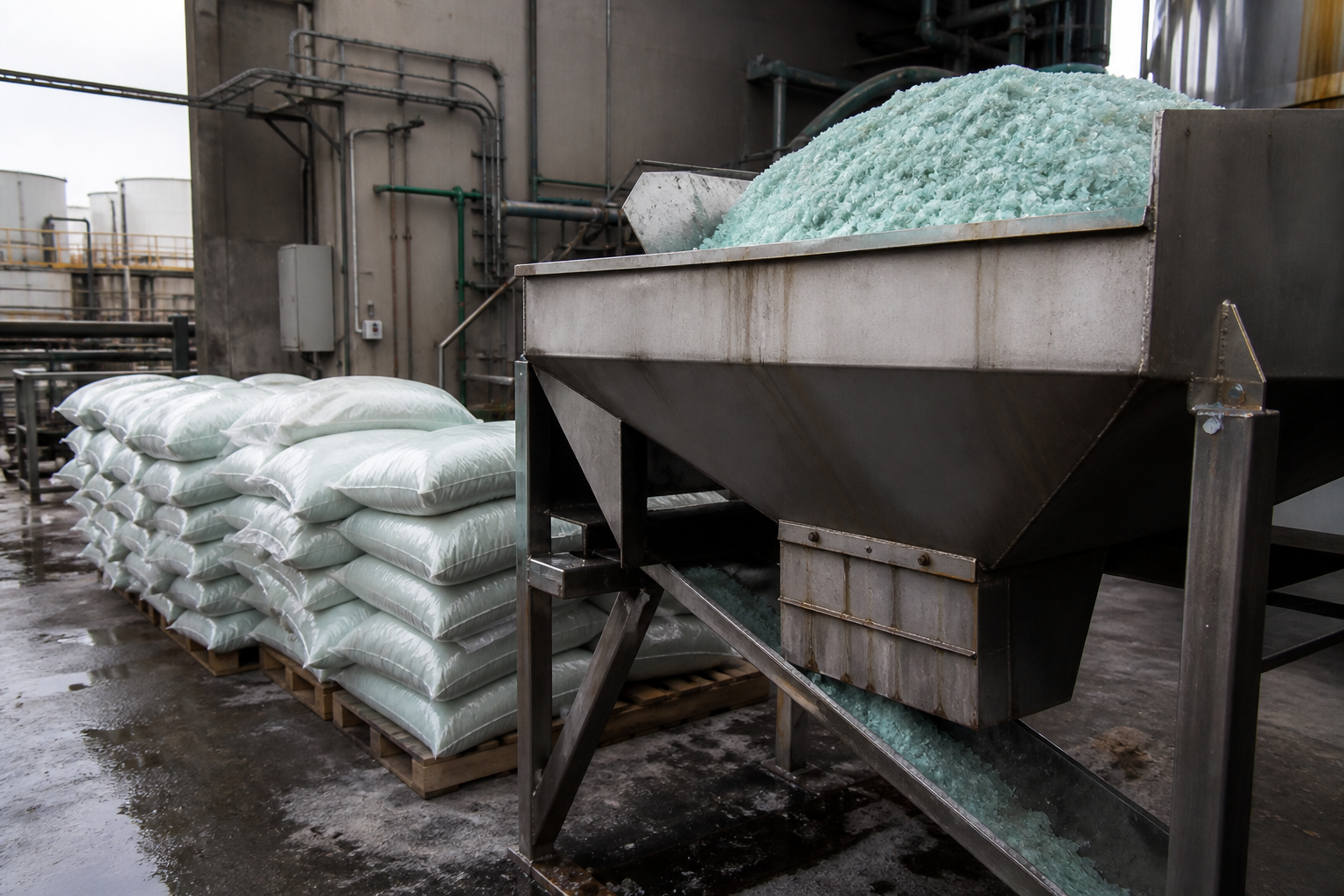
One supplier-published Chinese metal-refinery project — an external industry reference, not an EvapCryst delivery, indicative rather than a project guarantee — illustrates the pattern at industrial scale: a 26 t/h MVR forced-circulation evaporation-crystallization system processing a mixed feed of magnesium-removal wastewater and membrane-concentrated high-salinity wastewater, designed to national (GB) standards, producing sodium chloride crystals separated by centrifugation with a portion dried for sale. The design point worth noting is the mixing of two wastewater types into one crystallizer — a common economy in hydrometallurgy, since the sodium chloride stream and the magnesium-circuit brine share a salt system, and a single thermal unit closes both water loops at once.
For plants whose salt system is more complex — sulfate and chloride together, for example — the flowsheet adds salt-splitting strategy: selective crystallization in sequence, or upstream separation chemistry, so that the discharged salts arrive as single salts with commercial value rather than a mixed hazardous residue. Our salt separation and crystallization systems page covers these configurations in detail.
Why MVR Dominates New Hydrometallurgical Thermal Capacity
Energy is the operating cost of thermal separation, and metallurgical sites feel this acutely because their wastewater volumes are large and continuous. MVR evaporation addresses it directly: electrically driven vapor recompression consumes on the order of 20–40 kWh per tonne of evaporated water, replacing roughly a tonne of live steam per tonne of water in single-effect service and a substantial fraction of it even against well-configured multi-effect plants.
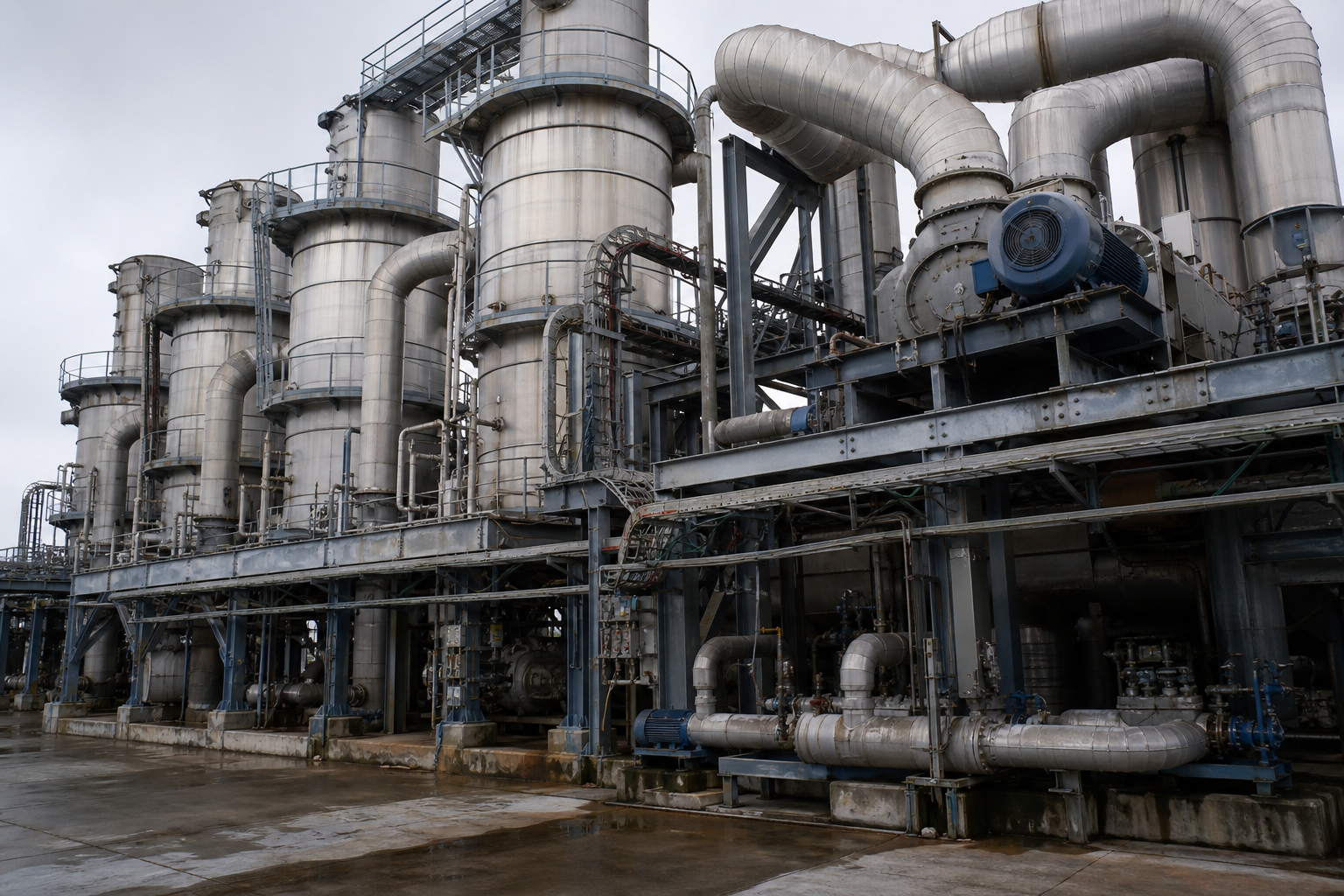
Three site-specific factors favor MVR in hydrometallurgy specifically. First, the temperature lifts are modest — most hydrometallurgical liquors are evaporated under vacuum at temperatures well below atmospheric boiling, so the compressor does not need an aggressive pressure ratio, and roots-type machines suffice at small scale with centrifugal machines at larger duties. Second, many metallurgical plants have limited spare steam but reliable electric supply, and electricity from on-site waste-heat recovery or renewable contracts continues to get cheaper relative to fuel steam. Third, MVR systems package well into skid-mounted modular plants, which suits the brownfield retrofits that make up most hydrometallurgical ZLD projects.
Where waste steam or low-pressure process heat is genuinely abundant — some smelter complexes have more waste heat than they can use — a multi-effect evaporator remains a legitimate choice, and the multiple-effect evaporation route can be the cheaper operating option. The selection is an energy-arithmetic exercise on site data, not a doctrine.
| Process Module | Candidate Equipment Types | Selection Rationale | Indicative Operating Envelope |
|---|---|---|---|
| Leach-liquor / mother-liquor concentration | Falling-film evaporator (dilute end); forced-circulation evaporator near saturation | Enriches metal ahead of recovery while avoiding tube-wall scaling | Set by liquor saturation chemistry |
| Electrolyte purge concentration | Single-effect vacuum evaporator or MVR rebuild with roots/centrifugal compressor | Recovers copper sulfate value without live steam | Electrolyte preheated to roughly 90°C entering the body (published reference) |
| MVR forced-circulation evaporation-crystallization | FC crystallizer with centrifugal compressor, multi-stage feed preheating | Closes water loops on mixed high-salinity brines | Industry-reported ~20–40 kWh per tonne of evaporated water |
| Salt separation | Sequenced / selective crystallizers; centrifuge; dryer | Delivers single salts with commercial value | Per salt system (e.g., 26 t/h reference fed by two brines) |
| Pretreatment guard | Hydroxide/sulfide precipitation, DAF or sedimentation, activated carbon | Protects salt product purity from heavy metals and organics | Sized to feed contaminant load |
Configuration, materials, and operating ranges depend on actual feed, temperature, pressure, corrosion review, fouling behavior, utilities, and project capacity.
Materials, Scaling, and Other Engineering Realities
Corrosion Management
Acidic chloride and sulfate liquors at elevated temperature demand material discipline: 316L as the baseline for sulfate systems, higher alloys (904L, duplex, or in severe chloride service, titanium or specialty alloys) for chloride-bearing liquors, and non-metallic linings where pH swings are extreme. The vapor path deserves the same attention as the wetted liquid path, because acidic condensate in vapor spaces is the classic hidden corrosion location.
Scaling and Fouling
Calcium sulfate, magnesium salts, and silica are the scale formers of hydrometallurgy. Forced circulation with high tube velocity, controlled supersaturation in the crystallizer body, and — where the chemistry allows — softening or seed-slurry tactics keep them in the liquor instead of on the tubes. Water chemistry surveillance (Ca, Mg, SO₄, Si) on the evaporator feed is cheap insurance.
Heavy Metals in the Salt Product
Salt recovered from hydrometallurgical wastewater is only a product if it meets purity specifications for its intended market. Heavy metals that escape pretreatment will co-crystallize or adsorb onto the salt, turning a saleable byproduct back into a hazardous waste. The pretreatment chain is therefore not an accessory to the crystallizer — it is the guardian of the crystallizer’s economics.
Waste Acid Recovery
A parallel duty deserves mention: hydrometallurgical and metal-processing plants generate waste acids (pickling acids, leach overflows) whose acid value can be recovered by diffusion dialysis followed by evaporation, separating recovered acid from the metal-salt residue. Published supplier experience — an external industry reference, indicative and not a project guarantee — reports acid recovery above 90% with closed-loop acid recycle, cutting both fresh-acid purchase and neutralization cost.
Related Pages
- Rare earth solutions — the industry hub for rare-earth and critical-minerals separation projects.
- Zero liquid discharge solutions — the plant-wide water-closure architecture that hydrometallurgical evaporation serves.
- MVR evaporation systems — the energy-recovery technology behind most new hydrometallurgical thermal capacity.
- Acid mine drainage evaporation and crystallization — the mining-side counterpart that treats acidic sulfate water at the source.
Conclusion
Evaporation and crystallization occupy two seats in the hydrometallurgical flowsheet that no other technology can take: concentrating metal-bearing liquors to raise recovery, and closing the plant water balance by crystallizing salt from wastewater no membrane can finish. The engineering challenges — corrosion, scaling, mixed salts, heavy metals, and energy cost — are all tractable with known configurations: pretreatment cascades protecting a membrane-concentration stage, MVR forced-circulation crystallizers doing the thermal work, and salt-splitting strategy turning residue into product. Plants that get this section right convert an environmental obligation into recovered water, recovered metal, and saleable salt, with an energy bill they can defend.
When This Route May Not Fit
Thermal closure is not the default for every plant. Small wastewater volumes carrying little metal value are often cheaper to precondition and haul as concentrate than to crystallize on site. Where the salt system is complex — sulfate and chloride together — and no salt-splitting budget exists, forcing everything through one crystallizer yields mixed hazardous salt instead of products. Sites with genuinely abundant waste heat may find multi-effect evaporation the cheaper operating choice, and liquors whose acid strength and chloride levels push metallurgy into exotic alloys can erase MVR’s energy savings in capital. Unstable heavy-metal pretreatment disqualifies the route: salt that fails purity limits is a liability, not a product.
What Must Be Verified
Validation focus: a plant-wide water and salt balance, with full analysis of each contributing stream — heavy metals, chloride, sulfate, silica, COD, and pH swing — across operating campaigns, not a single sample. The salt-system phase behavior and crystallization sequence must be confirmed for the actual brine blend, and endpoint boiling point elevation measured rather than assumed. A corrosion review across the acid-chloride-temperature envelope fixes materials before budgets are set. Scaling tendency (Ca, Mg, Si) needs surveillance data or pilot indication. Confirm the salt outlet — market grade and heavy-metal limits — and run the energy arithmetic on the site’s real electricity and waste-heat steam prices.
Frequently Asked Questions
Where is evaporation used in hydrometallurgy?
In two directions: value-side concentration of leach solutions, solvent-extraction raffinates, and mother liquors to enrich metals before recovery; and environmental-side evaporation-crystallization of high-salinity wastewater for zero liquid discharge and salt recovery.
Why can’t reverse osmosis alone achieve zero liquid discharge for hydrometallurgical wastewater?
Because the brine exceeds what membranes can concentrate economically — TDS in these wastewaters reaches tens to hundreds of thousands of mg/L, causing osmotic-pressure and fouling limits. RO recovers permeate and shrinks the volume; a thermal evaporation-crystallizer finishes the job on the brine.
What salt is recovered from hydrometallurgical wastewater?
Most commonly sodium chloride (as in a 26 t/h MVR forced-circulation project fed by magnesium-removal and membrane-concentrated brines) or sodium sulfate, depending on the process chemistry. Whether the salt is a saleable product or a hazardous residue depends on separation purity and heavy-metal control in pretreatment.
Is MVR better than multi-effect evaporation for metallurgical plants?
MVR usually wins where steam is scarce or expensive and electricity is available, consuming roughly 20–40 kWh per tonne of evaporated water. Multi-effect remains attractive where waste steam or low-pressure process heat is abundant. The choice follows site energy prices, not a universal rule.
What are the main scaling risks in hydrometallurgical evaporators?
Calcium sulfate, magnesium salts, and silica are the principal scale formers, plus general crystallization fouling near saturation. High-velocity forced circulation, controlled supersaturation, feed softening or seeding, and routine water-chemistry monitoring are the standard defenses.
Mapping thermal capacity onto a hydrometallurgical flowsheet? Send the stream inventory with analyses, the water-balance targets, and site energy prices — in exchange you will receive a first-pass screening of where evaporation and crystallization belong, and which salt products your chemistry supports.