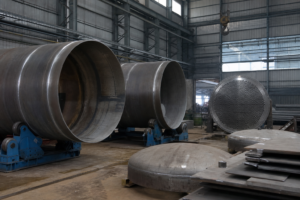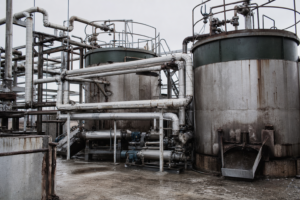
Choosing an MVR evaporator comes down to seven checks in order: characterize the feed (solids, viscosity, heat sensitivity, corrosivity), confirm the compressor temperature lift covers the boiling point rise, pick the evaporator body configuration, choose between MEE/TVR/MVR on site energy economics, specify materials for the chloride and abrasion load, verify scale economics, and pilot the process if it is new to you. Skip the front checks and the back of the project pays for it — industry-reported experience indicates that a majority of large-scale evaporation systems commissioned without process validation end up requiring post-commissioning modification. This page walks through each decision with the numbers that matter.
Step 1: Characterize the Feed — Four Factors
Everything downstream follows from four feed properties:
- Total solids: above roughly 30% suspended solids, fouling accelerates and heat-transfer coefficients decay; the design must compensate with circulation velocity or periodic solids withdrawal.
- Viscosity: above roughly 1000 mPa·s, evaporation slows and film-type heaters lose their advantage; forced circulation becomes the safer configuration.
- Heat sensitivity: proteins, extracts, enzymes, and many organics demand low temperature and short residence — pointing to negative-pressure falling-film MVR.
- Corrosivity: pH, chloride concentration, and temperature together set the materials envelope (Step 5).
Suspension duties with up to about 15% solids are routinely handled by adding a forced-circulation module and maintaining 2–3 m/s tube velocity for stable heat transfer. Above that band, expect crystallizer-plus-thickener arrangements rather than plain evaporation.
Step 2: Match the Compressor Lift to the Boiling Point Rise
This is the most common technical failure point in MVR projects. Dissolved salts and organic acids raise the boiling point of the liquor above that of pure water — the boiling point rise (BPR). High-salt wastewater and concentrated organic acids can show BPR of 15–20 K (typical published values). The compressor must deliver a temperature lift that covers the BPR plus the design temperature difference across the heater; if it cannot, heat transfer stalls regardless of how much area is installed.
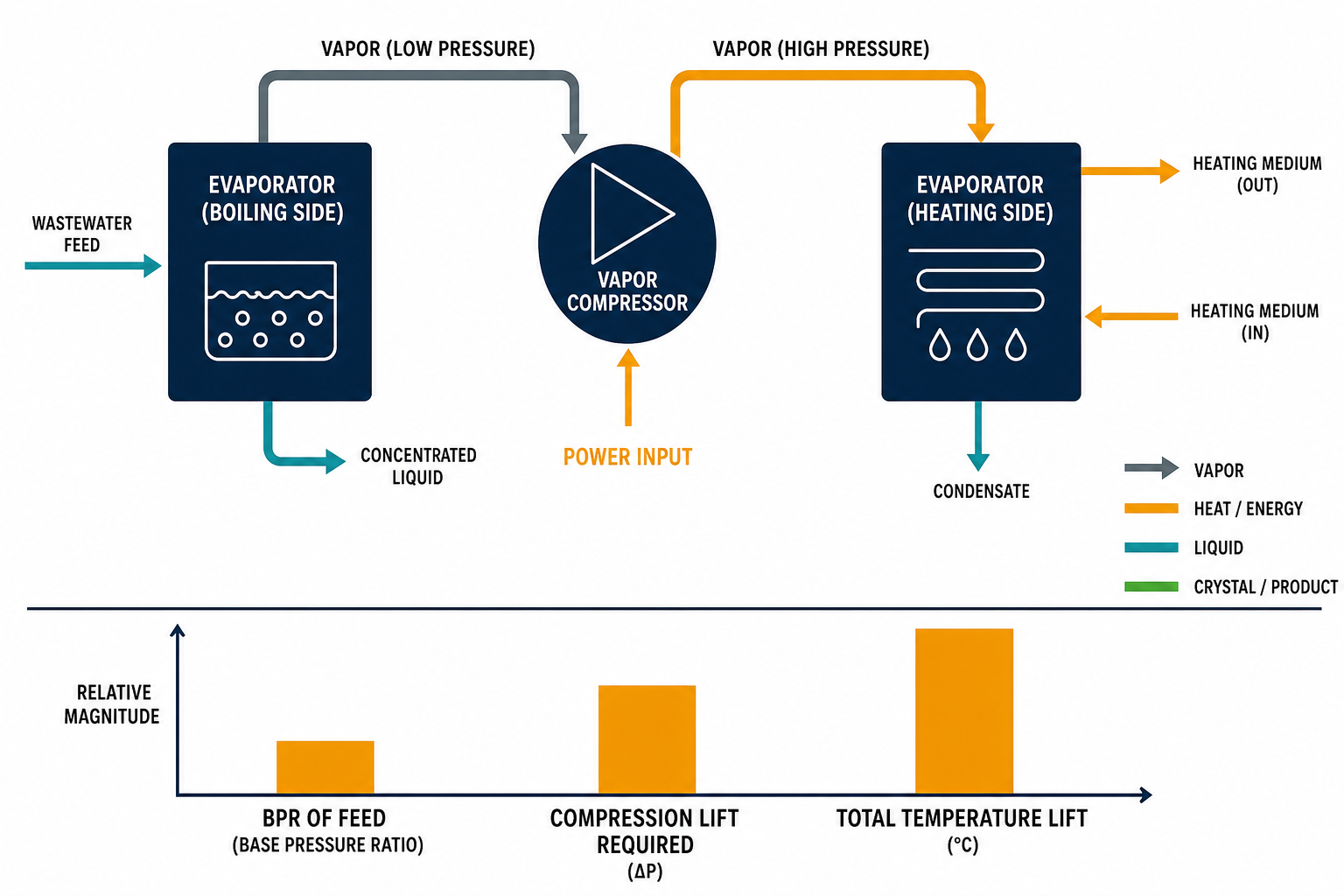
Practical rules: high-speed centrifugal or roots compressors must be verified against the actual BPR of your liquor at the target concentration, not a pure-water approximation; and because BPR grows with concentration, the check must be repeated at end-of-concentration conditions, not just the feed.
Step 3: Select the Evaporator Configuration
| If your liquor is… | Choose… | Because… |
|---|---|---|
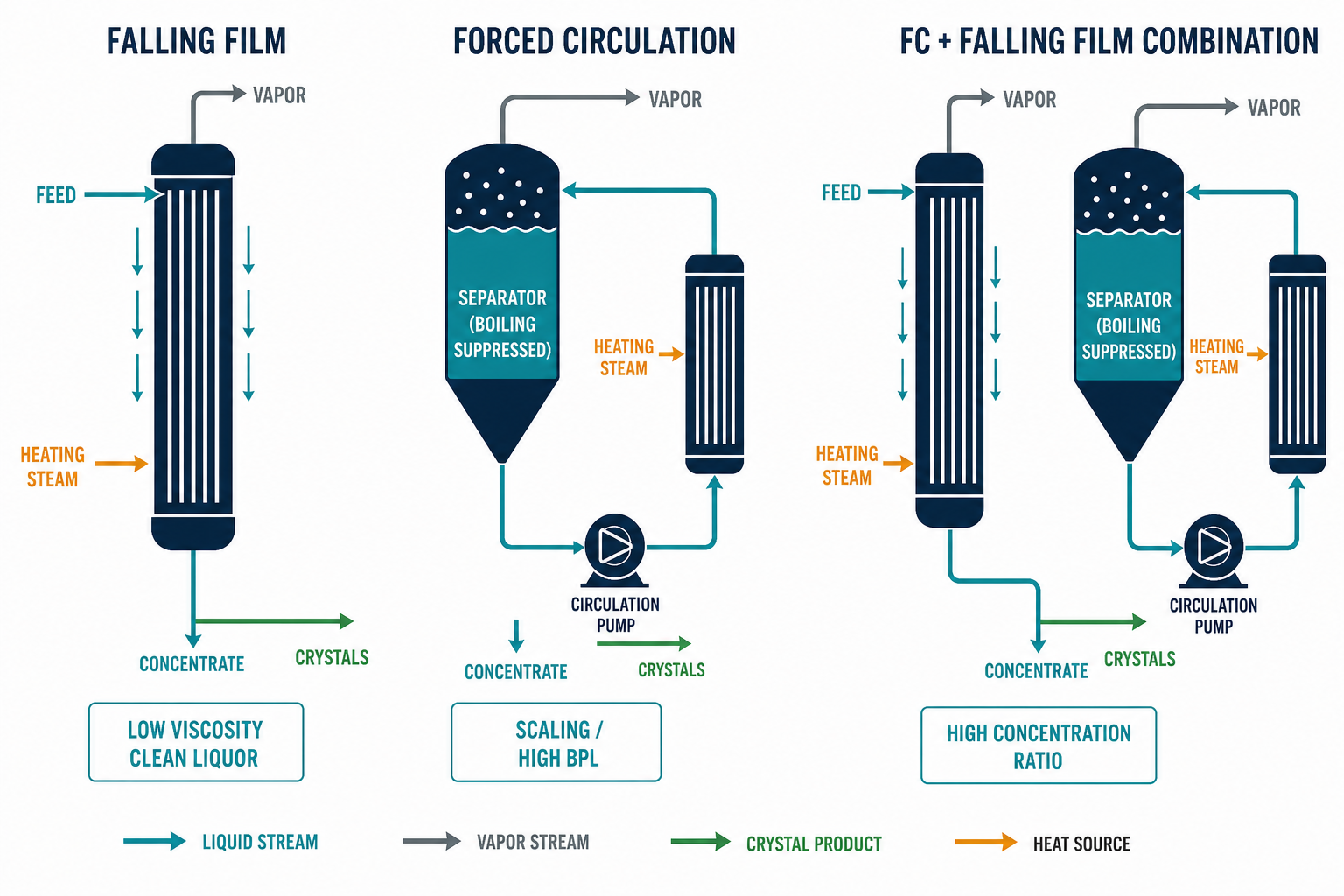
| Clean and low-viscosity (clear solutions, RO permeate-class feeds) | Falling film | Highest heat-transfer coefficient, short residence; but tube bottoms are fouling-sensitive |
| High-salinity, high-viscosity, scaling-prone | Forced circulation | Circulation pump scouring velocities (up to ~3.5 m/s) prevent wall deposits and plugging |
| Zero liquid discharge target with solids output | MVR + forced circulation crystallizer | Combines MVR energy efficiency with tolerance of high solids; residual brine goes to drying with only a small solid fraction |
The falling-film-versus-forced-circulation trade-off is covered in depth on our falling film and forced circulation technology pages. A working example of the configuration logic in a corrosive, high-BPR duty (illustrative application) is on the by-product HCl and CaCl2 solutions page.
Step 4: MEE vs TVR vs MVR — the Energy Framework
Three technologies compete for the evaporation duty, and the choice is driven by site energy reality more than by vendor preference:
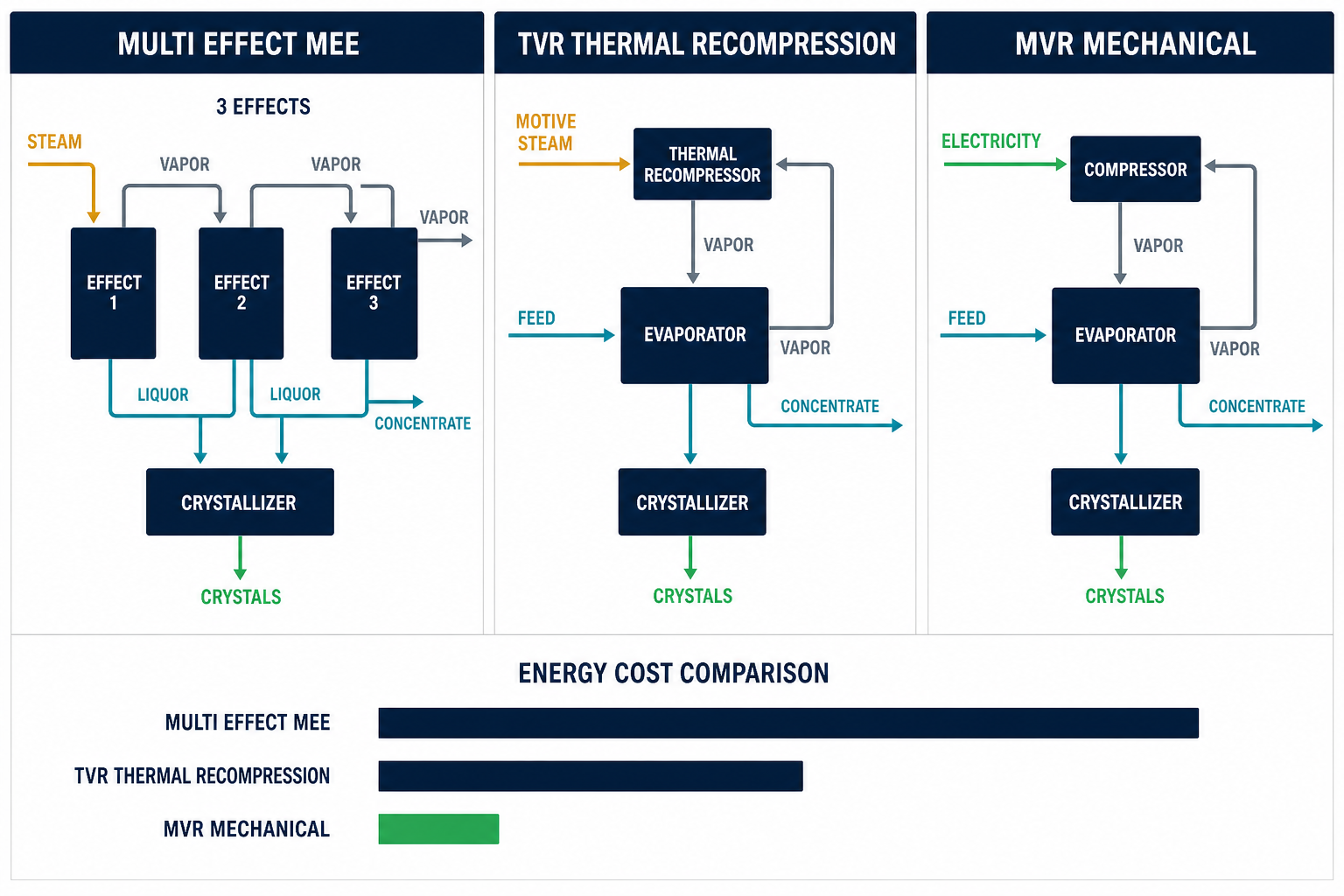
- Multi-effect evaporation (MEE) uses each effect’s secondary vapor to heat the next, stepping down temperature effect by effect. Simple, steam-driven, and often the most economical choice at very small scale or short project horizons.
- Thermal vapor recompression (TVR) uses a steam ejector — no moving parts, low investment, high reliability — to boost part of the secondary vapor with motive steam.
- MVR mechanically recompresses all the secondary vapor, achieving the lowest specific energy consumption of the three and running on electricity alone after start-up.
MVR is the right framework when one or more of these apply: the site has no steam source; boiler capacity expansion is too costly; the location is remote and fuel supply unreliable. In pure-electricity operation, MVR typically consumes 20–50 kWh per tonne of evaporated water (rising with boiling-point elevation and compressor temperature lift), cuts steam consumption by up to 95%, and reduces cooling water demand by more than 90% because the heating side doubles as the condenser. Its thermal performance is equivalent to a 20–30 effect evaporator in a smaller footprint. The physics behind these numbers is explained in our MVR working principle and system design article.
Step 5: Materials of Construction — Three Factors
Material selection is evaluated on corrosion (pH, chloride level, temperature), abrasion (suspended solids and crystal hardness), and fouling tendency (calcium, magnesium, silica). The escalation ladder in practice:
- Standard: SUS316L for neutral, low-chloride duties.
- Chloride service: above roughly 5,000 ppm chlorides, upgrade from 316L to 2205 duplex stainless; above roughly 10,000 ppm, or in hot acidic chloride service, Grade 2 titanium is the safer specification. One reported case at a Southeast Asian chemical plant (external industry reference) saw unplanned downtime fall 85% after switching the heat exchanger to titanium.
- Specific salt systems: ammonium sulfate systems (illustrative application) are commonly quoted with all-titanium configurations to defeat corrosion-plus-crystal abrasion — a supplier practice, with final selection set by the project corrosion review; the largest custom systems (>30 t/h) are offered in titanium or Hastelloy.
Although duplex and titanium raise the capital quote, life-cycle cost on hot chloride service almost always favors them over repeated 316L replacement.
Step 6: Heat-Sensitive Products — the 40–60 °C Window
Conventional evaporators run at 70–100 °C, temperatures that cause irreversible damage to heat-sensitive products (illustrative applications: traditional Chinese medicine extracts, enzyme preparations, functional food ingredients, and antibiotic intermediates). Negative-pressure MVR holds evaporation in a gentle 40–60 °C band with small, uniform temperature differences and no local overheating. Pilot data in food duty (whey protein, external industry reference) reported amino-acid activity retention 22% higher than conventional thermal concentration. If your product has an active ingredient specification, specify low-temperature MVR up front rather than paying for it in product downgrades later.
Step 7: Scale Economics and Payback
MVR’s higher initial investment is recovered through operating savings, with payback typically quoted at 2–4 years depending on energy prices. Two boundary conditions:
- Small scale or short project life: multi-effect evaporation can be the better economic answer; supplier-published guidance itself notes that MVR does not replace every evaporator.
- Large continuous duty with costly steam: MVR’s economics strengthen with operating hours; 8,000-hour annual operation against expensive steam is the sweet spot.
For orientation, external reference points at 1,000 kg/h evaporation: single-effect steam consumption 1.1–1.2 t/h; three-effect TVR 0.35–0.4 t/h steam plus 5 kWh/m³ electricity; mobile MVR zero steam (start-up only) at 15–25 kWh/m³ electricity with heat recovery above 90%.
The Pilot Question: Why Unvalidated Systems Get Modified
Industry-reported experience (no audited statistic is public, so read this as a qualitative pattern rather than a measured rate) is that systems commissioned without process validation frequently require modification — re-piping, area additions, material changes, or control rework. A mobile MVR pilot campaign de-risks the project by collecting the three datasets that cannot be predicted from lab beakers:
- Fouling rate curve — how fast the U-value actually decays on your liquor, which sets the CIP interval and confirms the 1.1–1.3 area safety factor.
- Non-condensable gas venting ratio — under-vented NCGs blanket heat-transfer surfaces and quietly cut capacity.
- Compressor frequency versus evaporation rate mapping — confirms turndown behavior and the frequency at which the train stays stable.
Piloting is also where BPR at end concentration and crystal nucleation behavior are measured, closing the loop on Steps 2 and 3.
Delivery Times by Size Class
| System class | Capacity | Typical materials | Lead time |
|---|---|---|---|
| Small skid-mounted | 1–10 t/h | Stainless steel | 12–16 weeks |
| Medium | 10–30 t/h | Duplex / titanium | 16–24 weeks |
| Large custom | >30 t/h | Titanium / Hastelloy | 24–32 weeks |
These bands are indicative supplier-published planning ranges, not quotations; they assume fabrication to recognized codes; exotic alloys, testing requirements, and export logistics extend the upper classes. Project schedules should also reserve time for factory acceptance testing before shipment.
Automation and Monitoring Configuration
Specify the control system as part of the selection, not as an afterthought. The baseline is PLC control with HMI touch screens and remote login; the differentiator is what the system does with the data. Real-time monitoring of the dynamic overall heat-transfer coefficient lets the PLC forecast CIP timing; feed-forward control on concentration sensors keeps the train stable through feed composition swings; and compressor protection logic (surge avoidance, vibration, seal condition) protects the single most expensive rotating asset on the skid.
Supplier Evaluation Checklist
- Turnkey capability: process design, mechanical fabrication, electrical, commissioning, and performance guarantee from one accountable party.
- Material recommendation report: a written metallurgy recommendation against your chloride/abrasion/fouling data — not a default “stainless is fine.”
- Pre-installation and FAT: factory assembly and witnessed acceptance testing before shipment.
- Pilot availability: access to mobile MVR equipment for liquor validation (see the pilot-question section above).
- Remote operations support: remote diagnostics and process tuning after start-up.
- Reference duties: plants in your chemistry family — sulfate crystallization, chloride brines, food concentration, or ZLD wastewater — with verifiable performance.
For the underlying technology background before engaging vendors, start with the MVR evaporation systems overview; for energy economics specific to your tariff structure, run the ROI calculator with your own steam and electricity prices.
Frequently Asked Questions
What is the first thing to check when selecting an MVR evaporator?
Feed characterization: solids content (fouling accelerates above roughly 30%), viscosity (above roughly 1000 mPa·s pushes you toward forced circulation), heat sensitivity, and corrosivity. Every later decision — configuration, materials, compressor — follows from these four.
Why does boiling point rise matter so much?
BPR raises the liquor’s boiling temperature above pure water, eating directly into the temperature lift the compressor can deliver. High-salt wastewater and concentrated organic acids can show 15–20 K of BPR; if the compressor lift does not cover it plus the design ΔT, heat transfer stalls. Always verify at end-of-concentration conditions.
When is multi-effect evaporation better than MVR?
At very small evaporation duties or short project horizons, the simpler steam-driven multi-effect plant can offer better economics, since MVR’s advantage builds through operating hours. MVR dominates when steam is expensive or unavailable and electricity is reliable.
What materials do I need for high-chloride wastewater?
Standard SUS316L suits neutral, low-chloride feeds. Above roughly 5,000 ppm chlorides, upgrade to 2205 duplex stainless; above roughly 10,000 ppm, or in hot acidic chloride service, specify Grade 2 titanium; reported switchovers to titanium heat exchangers have cut unplanned downtime by 85%.
Is a pilot run really necessary?
For any liquor new to the supplier, yes: industry experience is that systems commissioned without validation frequently require post-commissioning modification. A mobile MVR pilot delivers the fouling curve, non-condensable venting ratio, and compressor frequency mapping you need to fix the design safely.