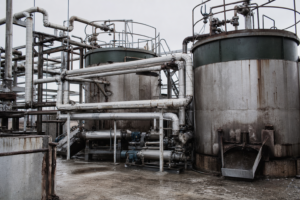
For salt and crystal production, the industrial dryer of choice is overwhelmingly the fluid bed dryer (FBD): hot air rising through a perforated distribution plate at a velocity above the minimum fluidization velocity suspends the crystals in a boiling, vigorously mixed state, so every crystal is heated uniformly and drying time is roughly halved versus static-bed methods (supplier-published comparison) — while downstream polishing duties (pharma APIs, fine chemicals, toxic or solvent-wet products) are better served by the closed agitated nutsche filter dryer (ANFD), which filters, washes and dries in one sealed vessel. Between those two anchors sit rotary, flash, spray and vacuum dryers, each with a defensible niche. This guide explains where drying sits in the crystallization train, how the main dryer families actually work, the control variables that decide final moisture, and how to match a machine to your material.
Where Drying Sits in the Process Train
Drying is the third solids step in a crystallization plant. The crystallizer discharges a slurry; a centrifuge dewaters it to a wet cake — typically still carrying 3–8% residual moisture for well-formed salt crystals (handbook-typical centrifuge-cake values), and filter cakes from closed filtration can hold 5–20% solvent depending on the solid’s characteristics (handbook-typical filter-cake range); the dryer then brings that down to the product specification; and screening and packaging follow. Two consequences flow from this position:
- Every point of moisture left by the centrifuge is thermal load on the dryer. Dewatering and drying should be engineered as a pair, not purchased separately — see centrifuge selection for crystal dewatering.
- Feed consistency is a dryer’s precondition. Uniform feed moisture and particle size are the prerequisite for stable fluid bed operation; a drifting particle size distribution upstream (often caused by the crystallizer’s crystal size distribution) shows up first as instability in the dryer.
What Makes Salt and Crystal Drying Demanding
Four requirements distinguish this duty from ordinary bulk drying:
- Free moisture removal to spec — surface moisture drives caking, not trapped moisture.
- Anti-caking — hygroscopic salts cake in storage if packaged warm or wet, which is why a cooling section after drying is standard.
- Crystal integrity — fluidization imposes mild attrition; products sold on crystal appearance need gentle handling.
- Corrosion — a salt-laden, humid atmosphere is aggressively corrosive; the dryer’s stainless grade must be matched to the chloride service, exactly as on the evaporator side of the plant.
Fluid Bed Drying: The Salt-Plant Workhorse
Working Principle
Hot air from the air handling unit passes through a perforated distribution plate into the fluidization chamber. Once the air velocity exceeds the minimum fluidization velocity, the crystal bed expands and behaves like a boiling liquid: particles suspend, mix intensely, and each crystal presents its full surface to the hot gas stream. Heat and mass transfer area is maximized, every crystal receives uniform treatment, and drying completes in roughly half the time of static-bed methods (supplier-published comparison).
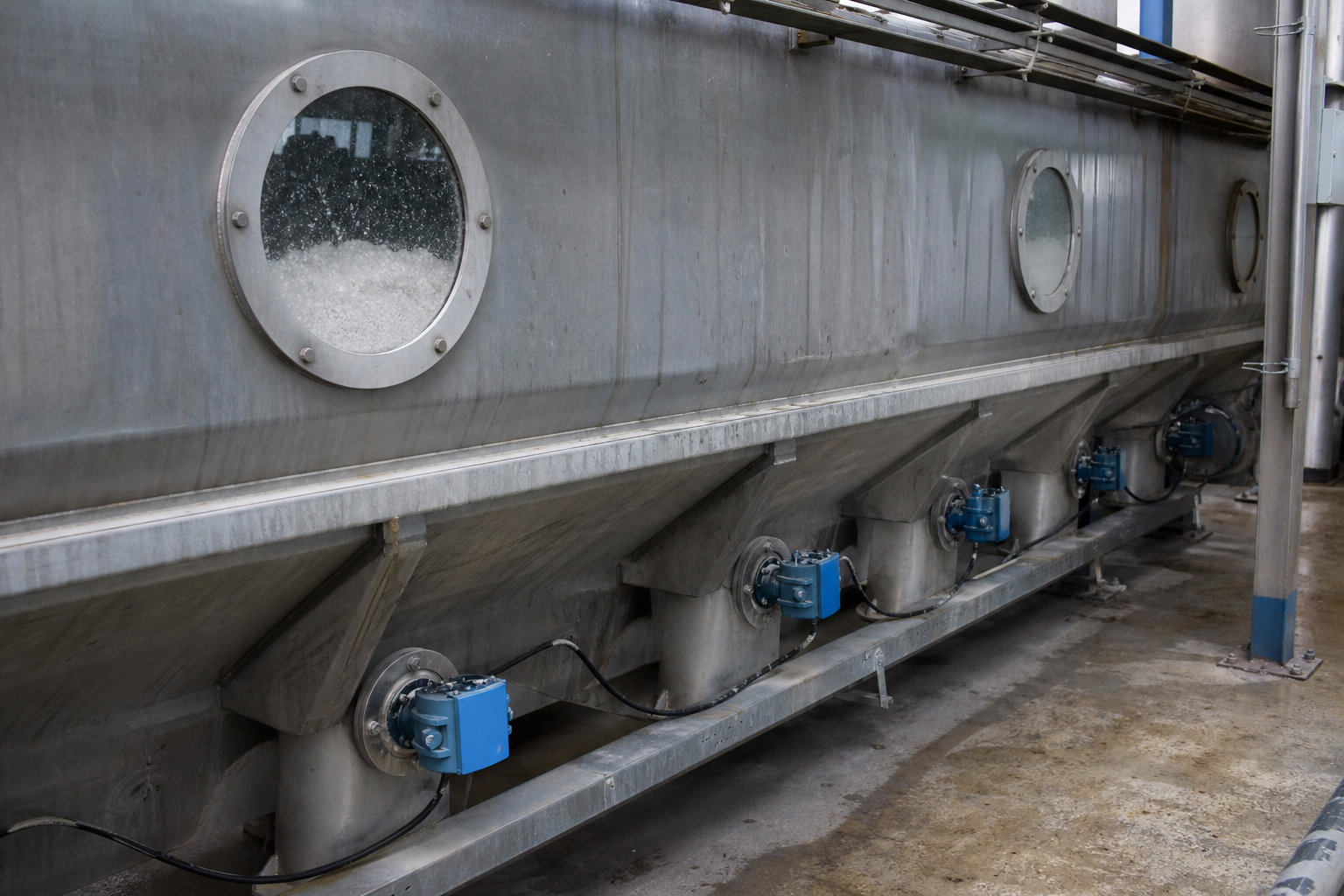
Seven System Components
| Component | Role | Selection Notes |
|---|---|---|
| Air handling unit | Blower plus steam coils or gas burner; filters and heats the drying air | Heater fan power is the dominant energy consumer — specify heat recovery where the duty justifies it |
| Air distribution plate | Distributes flow evenly; prevents product falling through | Uniform air distribution is the foundation of uniform drying |
| Fluidization chamber | Stationary or vibrating type | Vibrating beds handle sticky or heterogeneous feeds better |
| Feed system | Screw conveyor or rotary valve meters wet cake (usually straight from the centrifuge) | Controls bed loading and residence time |
| Discharge with overflow weir | Sets bed depth — therefore residence time — therefore final moisture | The single most direct moisture control lever |
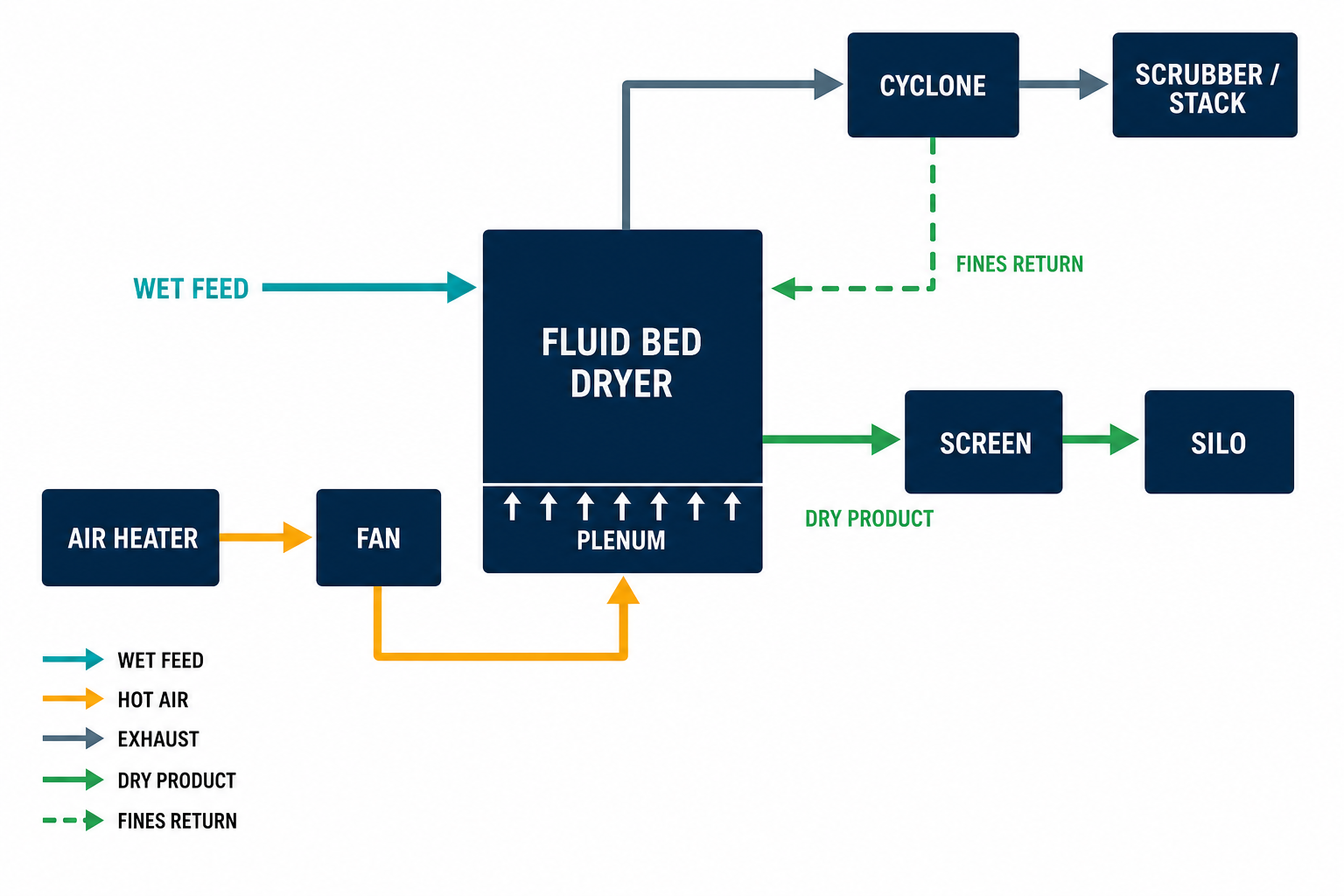
| Exhaust system | Cyclone plus bag filter recovers fines and salt dust | Recovered fine salt returns to process; wide or fine particle size distributions require heavier dust separation |
| PLC control | Real-time temperature, pressure and airflow monitoring | Feeds the online moisture interlock that prevents overdrying |
The Seven-Step Drying Flow
- Wet feed enters (typically from the centrifuge) at a metered rate.
- Air is filtered and heated to the drying temperature the crystal can tolerate.
- Fluidization suspends the bed in boiling motion.
- Drying proceeds by convective heat and mass transfer.
- Discharge moves product out over the weir, with online moisture instrumentation guarding against overdrying.
- Exhaust dedusting recovers fine salt from the off-gas for reuse.
- Cooling section fluidizes the product with ambient or chilled air down to a safe packaging temperature — the step that prevents caking in storage and is too often value-engineered away.
The Control Variables That Decide Final Moisture
Air velocity and air temperature set the drying rate and product quality; residence time — fixed by bed depth and the overflow weir — sets the final moisture content. Around these two axes, the practical rules are:
- Uniform feed moisture and particle size are prerequisites for stable operation; batch-to-batch drift shows up as moisture swing.
- Overly wide particle size distributions or fine-rich feeds demand reinforced dust collection.
- Where crystal integrity is paramount, remember fluidization involves mild attrition — verify against the product’s breakage tolerance.
- Match the stainless grade to the salt environment, and evaluate heat recovery against the heater’s electrical load.
The Agitated Nutsche Filter Dryer (ANFD): Closed Three-in-One
Concept
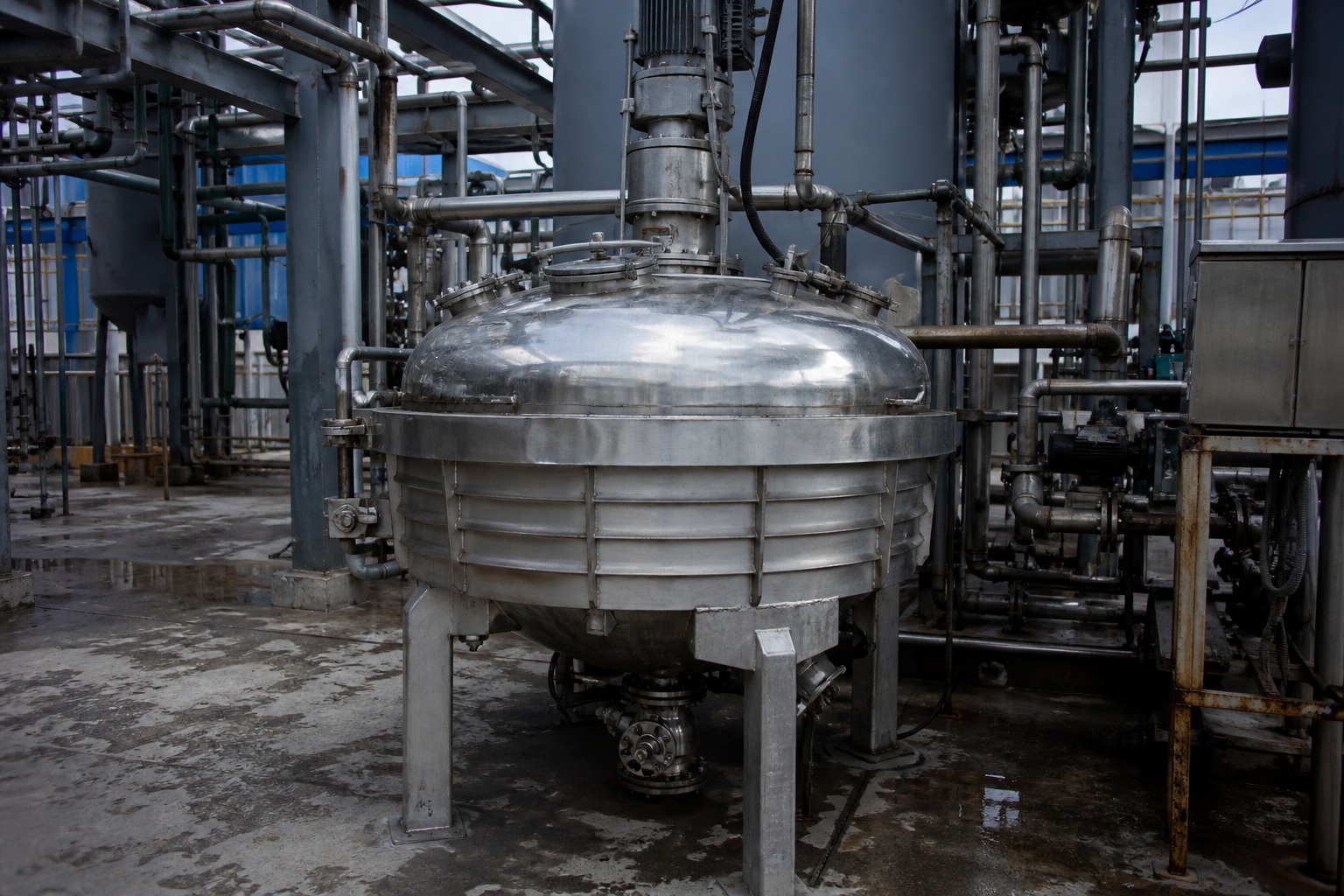
The ANFD integrates filtration, washing and drying in a single sealed, pressure- and vacuum-rated vessel — the equipment class known in China as the “three-in-one.” Its reason for existing is containment: high-value, toxic, oxygen-sensitive or high-purity materials never leave a closed environment between reaction and dry powder, which is what GMP- and FDA-regulated production requires.
Core Components
A pressure vessel rated for both vacuum and positive pressure (stainless or Hastelloy); a raised, variable-speed agitator that both rotates and moves vertically; a filter plate supporting cloth or mesh; jacket or coil heating/cooling; a vacuum system that both dries and recovers solvent by condensation; dust containment to stop fine escape during pressure equalization; and PLC automation of the whole cycle.
The Eight-Step Operating Cycle
- Pressure feed: slurry enters under compressed air or nitrogen; wash liquid can be preloaded.
- Filtration: the agitator parks at its highest position so cake forms undisturbed.
- Washing: the agitator lowers and rotates to homogenize cake and wash liquor; high-purity products repeat this as a reslurry cycle, iteratively raising purity.
- Smoothing: the blade reverses to compact the cake surface and eliminate cracks.
- Drying: hot medium through the jacket plus a heated agitator; the descending blade peels the cake layer by layer, continuously exposing fresh evaporation surfaces — the core mechanism that shortens the drying cycle.
- Sampling: pressure is balanced with gas before the sample is taken; out-of-spec moisture sends the batch back to drying.
- Discharge: the agitator rotates forward, its angled blade sweeping dry product toward the side discharge valve.
- CIP: clean-in-place between batches minimizes turnaround.
Two details separate expert practice from average practice. First, the smoothing step — eliminating cake cracks so drying gas cannot short-circuit — is routinely under-appreciated and directly lengthens or ruins cycles when skipped. Second, the heated agitator combined with vacuum eliminates cold spots; it is the dominant lever on cycle time.
Four Dryer Families Compared
| Machine | Feed / Mode | Strengths | Best Fit |
|---|---|---|---|
| ANFD (agitated nutsche) | Batch, closed, cake from slurry | Filtration + washing + drying in one sealed body; solvent recovery; GMP/FDA compliance | Toxic, high-value, oxygen- or moisture-sensitive products: APIs, fine intermediates, specialty chemicals |
| Rotary vacuum drum | Paste-like, viscous, batch/continuous | Low-temperature drying of heat-sensitive pastes | Thermally delicate, sticky materials |
| Centrifugal drying | Mechanical dewatering of robust granules | Lowest energy per unit water removed | Sturdy crystals where mechanical dewatering suffices |
| Spray drying | Liquid/slurry feed, continuous | Fastest transformation of liquid to powder; particle engineering | Continuous powder production from solution or slurry — highest energy intensity |
Vacuum Drying: Honest Boundaries
Vacuum drying excels at heat-sensitive products and solvent recovery — evaporation happens at low temperature, and the vacuum system condenses and captures the solvent. Its limits are equally physical: vacuum does not itself supply heat, so drying rate is bounded by how fast heat conducts into the material, and dense, deep or batch-heavy wet loads dry slowly. Vacuum vessel dimensions are constrained by fabrication economics, which caps single-line scale below what open-air convective systems reach, and the vacuum pump group’s continuous power and maintenance means lifetime cost can exceed expectations on long campaigns. Treat vendor claims either way with skepticism and size from your material’s measured conductivity.
Nitrogen Closed-Loop Fluid Beds
When the material carries organic solvent, or dust explosion and oxidation risks matter, the fluid bed operates on a closed nitrogen loop: nitrogen displaces oxygen inside the bed, eliminating deflagration and oxidative degradation; the gas circulates through the loop — heater, bed, dust separation, condensation of solvent — and is reused rather than vented, avoiding continuous purge-gas purchase. This is the mainstream configuration in pharmaceutical fluid bed drying and for any solvent-wet crystal. Its discipline is maintenance: small leaks admit oxygen and lose pressure, so seals, piping and valves need scheduled inspection; filters must be cleaned or replaced before dust loading chokes airflow; and sensors require recalibration on a fixed calendar.
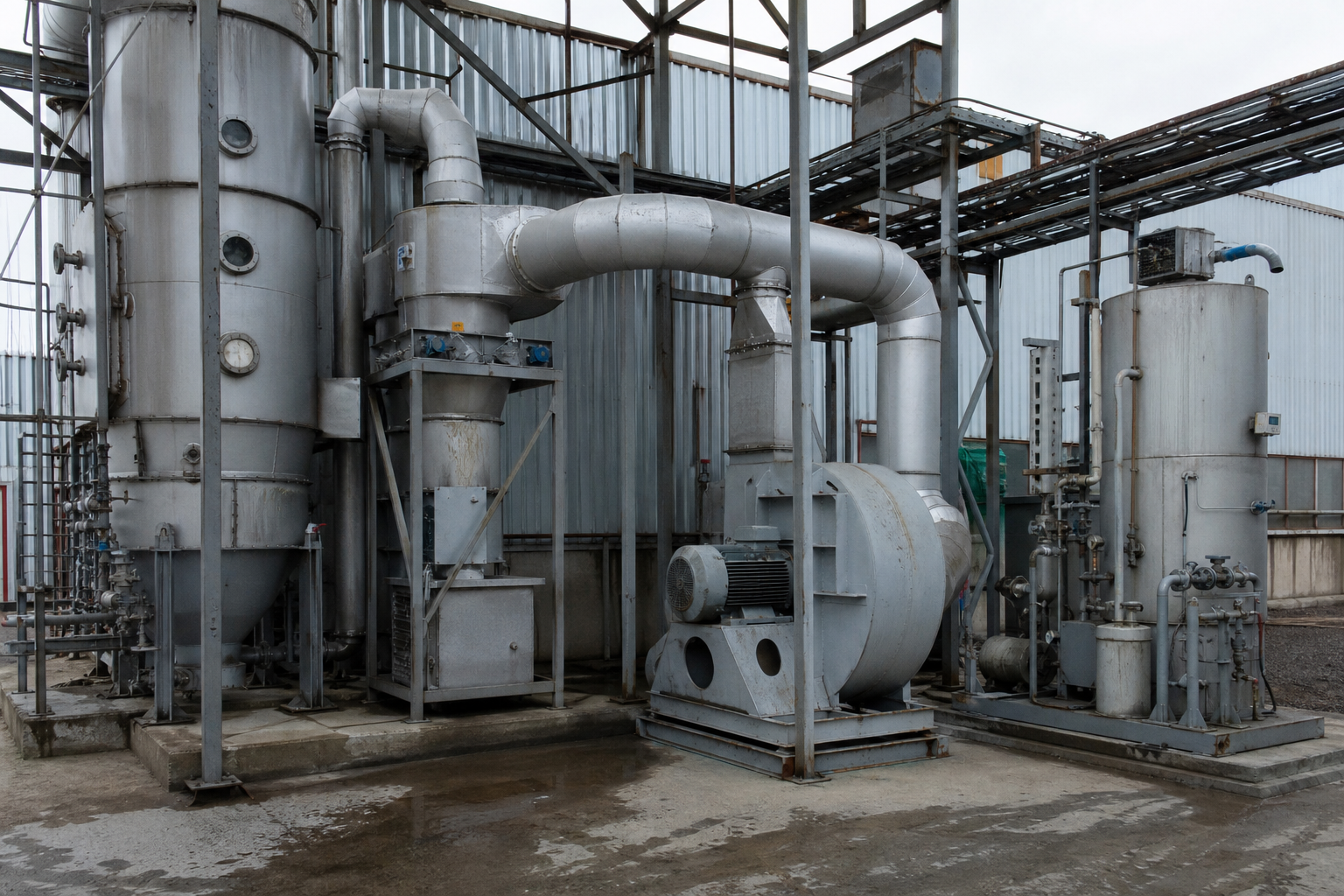
Drying Train Process Modules
| Module | Function | Typical Hardware | Selection Driver |
|---|---|---|---|
| Wet-cake feed and metering | Deliver centrifuge or filter cake at a stable rate | Screw conveyor, rotary valve, charge vessel | Cake consistency, throughput |
| Drying body | Remove surface and bound moisture to spec | Fluid bed, ANFD, rotary, flash, spray, vacuum tray | Thermal sensitivity, solvent, scale |
| Heating medium | Supply drying energy | Steam coils, gas burner, hot oil, electric, jacket+vacuum | Site utilities, temperature ceiling |
| Gas loop and dedusting | Carry off vapor, recover fines | Cyclone, bag filter, scrubber; closed nitrogen loop if solvent | Solvent presence, ATEX, emission limits |
| Solvent recovery | Condense and capture solvent for reuse | Condenser + receiver on vacuum/closed-loop systems | Solvent value, VOC regulation |
| Product cooling | Bring crystal to packaging-safe temperature | Fluid-bed cooling section, indirect cooler | Caking tendency, hygroscopicity |
| Screening and packaging | Grade and seal the final product | Vibrating screen, bagging with moisture barrier | Product spec, storage life |
A Selection Framework
Work through four questions in order:
- Material character: thermally sensitive? toxic or potent? sticky or viscous? high unit value?
- Feed state and moisture: centrifuge cake (3–8% moisture), filter cake (5–20% solvent), paste, or liquid?
- Scale and duty: continuous multi-ton-per-hour salt duty points to fluid bed; kg-scale high-value batches point to ANFD.
- Regulatory and safety envelope: GMP containment, solvent atmosphere and ATEX zoning push the choice toward closed, nitrogen-inerted equipment regardless of other preferences.
Then customize within the chosen family — vessel size, metallurgy, automation level, seal and explosion-proof rating — rather than switching families late in the project. Plant-level context for the drying-packing end of a crystallization train is covered on the drying and packing systems page, and the upstream solids route is described under salt separation.
When This Route May Not Fit
Drying investment is not automatic at the end of a crystallization train. Products sold and shipped as wet filter cake — the route some fine-chemical and pigment trades use deliberately — need no dryer at all, only consistent cake moisture and compatible packaging. Heat-sensitive materials on a site with no vacuum or inert-gas infrastructure face a facilities decision before an equipment one: without low-temperature capability, an open hot-air dryer will damage the product, and the honest answer may be external drying or a different flowsheet. Very small campaigns — laboratory supply, kg-scale specialty batches — are better served by a batch vacuum oven or tray room than by any continuous machine whose controls cost more than the product. And robust, non-hygroscopic crystals whose centrifuge discharge already meets the moisture specification need only a cooling and packaging step; a dryer purchased for them earns nothing.
What Must Be Verified
Four material facts anchor the drying specification. The measured cake moisture and particle-size distribution actually leaving the centrifuge or filter, because both set the dryer’s stability margin. The product’s thermal tolerance — decomposition, discoloration, or caking onset temperature — which caps the drying air or jacket temperature. The final moisture specification together with the product’s hygroscopicity and packaging temperature, which decide whether a cooling section is optional or mandatory. And the presence of solvent in the cake, which flips the entire gas loop from open air to closed nitrogen and adds solvent recovery to the scope.
FAQ
Which dryer is best for salt production?
A fluid bed dryer is the standard choice. Wet salt from the centrifuge fluidizes uniformly, dries in roughly half the time of static-bed methods, and the downstream cooling section returns it to a packaging-safe temperature that prevents caking in storage.
How is final moisture controlled in a fluid bed dryer?
Primarily by residence time, which is set physically by bed depth and the overflow weir, and by air velocity and temperature, which set the drying rate. Online moisture measurement at discharge guards against overdrying, which wastes energy and increases dusting.
What is an ANFD and when do I need one?
An agitated nutsche filter dryer combines filtration, washing and drying in one sealed vessel. You need one when the product is toxic, high-value, oxygen- or moisture-sensitive, or when GMP/FDA containment requires that material never be exposed between reaction and dry powder.
Why does the agitator in an ANFD improve drying?
The heated agitator descends through the cake, peeling it layer by layer and continuously exposing fresh evaporation surfaces to vacuum — this is the main mechanism that shortens the drying cycle. The pre-drying smoothing step that eliminates cake cracks is equally important, preventing drying gas from short-circuiting.
When should a fluid bed dryer use nitrogen instead of air?
When the feed carries organic solvent, or when dust explosion or oxidation risk is present. A closed nitrogen loop removes oxygen from the bed, recycles the gas instead of venting it, and is the standard pharmaceutical configuration — at the cost of a disciplined seal, filter and calibration maintenance regime.