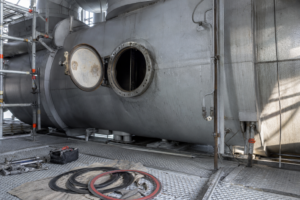
Evaporation is a thermal separation process in which heat drives the solvent—water in most industrial duties—out of a solution as vapor, leaving the solute behind at higher concentration or recovering the solvent as clean condensate. In an industrial evaporator the vapor is condensed and collected rather than discarded, so the same unit both concentrates the process liquid and produces recyclable distilled water. Every evaporator system, from a simple single-effect batch pot to a multi-train MVR plant, follows this same principle; what changes is how efficiently the latent heat is used.
What Evaporation Is—and What It Is Not
Evaporation is often confused with two neighboring unit operations, and the distinction matters when specifying equipment:
- Evaporation vs. drying: evaporation removes part of the solvent from a liquid solution, stopping while the material is still pumpable. Drying removes essentially all moisture to yield a free-flowing solid. Many plants chain the two—evaporators concentrate to the saturation point, dryers finish the job.
- Evaporation vs. distillation: distillation aims to collect a specific volatile component as a purified fraction, exploiting volatility differences between liquids. Evaporation deliberately vaporizes the solvent while non-volatile solutes (salts, organics, metals) stay in the liquor. The condensate quality target is “clean water,” not a separated product.
When the concentrate reaches saturation and dissolved salts crystallize out as a solid product, evaporation hands over to crystallization—the two steps together form evapo-crystallization, the backbone of zero liquid discharge plants.
Anatomy of an Industrial Evaporator
Despite the wide range of configurations, every evaporator is built from three functional sections:

- Heating section (calandria): a shell-and-tube or plate heat exchanger where energy enters the system—supplied by live steam, electric heaters, or a mechanical vapor recompressor in MVR duty.
- Vapor body (evaporation chamber): the vessel providing vapor-liquid disengagement space. A demister at the top intercepts entrained droplets so salt-laden liquor does not carry over into the condensate.
- Condensation system: surface condensers, condensate tanks, and vacuum equipment that recover the secondary vapor as distillate and set the operating pressure of the system.
The interplay of these three sections—heat in, vapor out, condensate collected—defines both capacity and energy performance.
Single-Effect Evaporation: The Baseline
In a single-effect evaporator, live steam heats the liquor in the calandria; the water vapor generated (secondary steam) is condensed and discarded. The latent heat contained in that secondary vapor is used exactly once, which caps the energy performance: specific steam consumption typically runs about 1.1–1.2 tons of steam per ton of evaporated water.
That simplicity has a place. Single-effect units suit small throughputs, batch campaigns, laboratory and pilot duty, and materials where investment must be minimal. They also serve as the conceptual baseline against which all multi-effect and MVR designs are judged.
Multiple-Effect Evaporation (MED): Reusing the Latent Heat
The secondary steam leaving one effect still carries valuable latent heat. A multiple-effect evaporator puts that heat back to work: the vapor from effect one becomes the heating medium for effect two, whose vapor heats effect three, and so on down the train. To make heat flow in the right direction, each successive effect operates at a lower pressure, so the liquor boils at progressively lower temperatures.
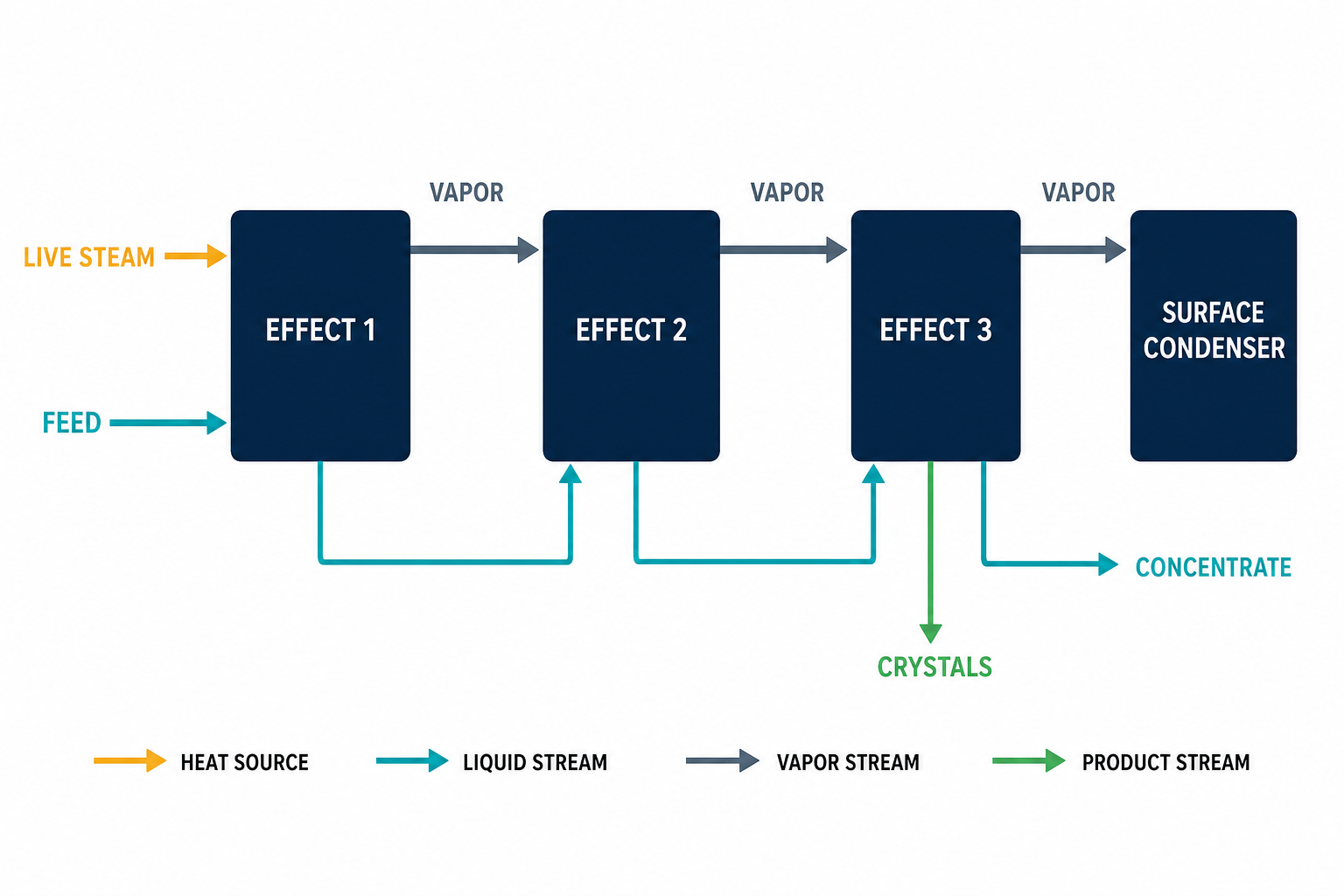
Because each pound of live steam evaporates water in several effects in series, steam economy rises with effect count—an N-effect system saves roughly (N−1)/N of the steam a single effect would need. In practice this means a double-effect plant cuts steam consumption by about 50%, and a triple-effect plant by about 67%. Detailed technology and configuration guidance is covered on the multiple-effect evaporation (MED) page.
MVR: Mechanical Vapor Recompression
A mechanical vapor recompression evaporator closes the loop differently. Instead of passing secondary steam to a next effect, a compressor raises the pressure and temperature of the vapor and returns it to the heating side of the same calandria. The vapor condenses on the tube wall, releasing its latent heat to the boiling liquor on the other side. Once started, the system needs only a small amount of live steam for startup and trim; electricity driving the compressor becomes the main energy input.

The result is the lowest specific energy consumption of the mainstream configurations—electricity-based consumption per ton of evaporated water can fall to roughly one third to one half of what an equivalent multi-effect system demands in steam terms. MVR is examined in depth on the MVR evaporation technology page, and interactive cost comparisons are available in the MVR vs multi-effect energy calculator.
Single-Effect vs. MED vs. MVR at a Glance
| Criterion | Single-Effect | Multiple-Effect (MED) | MVR |
|---|---|---|---|
| Heat source | Live steam | Live steam, reused across effects | Electricity (compressor) + small startup steam |
| Typical steam use | ~1.1–1.2 t steam per t water | Falls ~50% (2 effects) to ~67% (3 effects) | Minimal live steam; power-driven, typically 1/3–1/2 of MED energy cost |
| Best fit | Small or batch duty, low capex | Sites with cheap, reliable steam supply; high boiling point rise fluids | Steam-scarce or electricity-rich sites; low-BPE fluids |
| Complexity | Lowest | Medium (effects, interstage piping) | Medium (compressor and control) |
Vacuum Evaporation: Lowering the Boiling Point
Operating under vacuum reduces the boiling temperature of the liquor in direct proportion to the absolute pressure—at roughly −0.09 MPa gauge, water boils near 50 °C. This low-temperature capability delivers three compounding benefits:
- Product protection: heat-sensitive materials in food, pharmaceutical, and fine chemical duty avoid degradation that atmospheric boiling would cause.
- Reduced fouling and corrosion: lower wall temperatures and altered salt solubility behavior slow scale formation and corrosion rates.
- Low-grade heat utilization: the modest temperature lift allows hot water, waste heat, or heat pumps to drive evaporation instead of boiler steam.
The trade-off is real: vacuum systems (pumps, condensers) add capital and electrical load, so the vacuum level should be chosen to balance low-temperature benefits against vacuum cost—deeper vacuum is not automatically better.
Evaporator Types: Matching Configuration to Material
How liquor moves through the heating surface defines the evaporator family, and material behavior dictates the choice:
| Type | Liquor behavior | Typical duty |
|---|---|---|
| Natural circulation | Low to moderate viscosity, non-fouling | General chemical concentration |
| Forced circulation | Scaling, crystallizing, high viscosity | High-salinity brines and ZLD crystallizer feed (forced-circulation systems) |
| Falling film | Low viscosity, heat sensitive, large throughput | Dairy, juice, thin chemical liquors (falling film systems) |
| Rising/climbing film | Low viscosity, non-foaming | Pre-concentration duty |
| Scraped/thin film | Very high viscosity, fouling, heat sensitive | Concentrates, pastes, mother liquors to dryness |
Wastewater Volume Reduction Logic
In wastewater duty the goal inverts: the water is the product and the contaminants are the residue. Non-volatile pollutants—heavy metals, salts, COD—remain in the concentrate while the condensed vapor becomes high-quality distillate suitable for reuse or compliant discharge. Volume reduction of up to 99% is achievable in industry-reported brine duty before the residue is discharged as a small concentrated stream or a crystallized salt.
This is why evaporation anchors zero liquid discharge architectures. A common and economical arrangement puts reverse osmosis upstream: RO rejects concentrate the stream to roughly 5–8% TDS at low energy cost, and the evaporator handles the high-salinity tail where membranes stop being viable. Details of the full train are covered in the high-salinity ZLD solutions overview (illustrative application).
Key Operating Parameters and the Concentration Endpoint
Four variables dominate evaporator performance:
- Evaporation temperature—set by vacuum level and product constraints; lower is gentler but shrinks the driving temperature difference.
- Operating pressure—fixes the boiling point; also determines compressor suction conditions in MVR plants.
- Feed concentration and concentration factor—the ratio of feed to concentrate flow determines vapor load and how close the liquor runs to saturation.
- Effective temperature difference (ΔT)—the true driving force for heat transfer after subtracting boiling point elevation and losses.
As concentration proceeds, operators track density, refractive index, or boiling point rise to locate the endpoint. In evapo-crystallization duty the endpoint is deliberately overshot into the metastable zone so the concentrate feeds a crystallizer at controlled supersaturation rather than scaling the heat transfer surface.
Energy Structure and the Three Levers of Efficiency
Steam and electricity dominate operating cost in any evaporation plant. Three levers reduce that bill, usually in this order of implementation:
- Condensate heat recovery: hot distillate and condensate preheat incoming feed, scavenging sensible heat that would otherwise be lost to cooling water.
- Effect optimization: adding effects (or re-staging an existing train) improves steam economy at moderate capital cost—until available temperature difference is exhausted.
- MVR retrofit: recompressing vapor converts the latent heat loop from steam-driven to power-driven, typically the largest single energy reduction available to an existing plant.
Because boiling point rise consumes part of the available temperature difference, high-BPE liquors constrain both effect count and MVR compression ratio—a selection topic treated in the companion article on boiling point elevation in industrial evaporation.
Where Evaporation and Concentration Earn Their Keep
The application spectrum spans every industry that handles dilute solutions:
- Wastewater minimization and ZLD: brine concentration ahead of crystallizers in chemical, coal chemical, and FGD wastewater plants.
- Food and fermentation: juice, dairy, and extract concentration where vacuum falling-film systems preserve flavor and color.
- Pharmaceuticals: extraction liquor concentration under vacuum before crystallization of the API.
- Chemical processing: pre-concentration of process liquors ahead of reactors or dryers.
- Salt production: concentration to saturation followed by crystallization of NaCl, sodium sulfate, ammonium sulfate, and other products.
Frequently Asked Questions
What is the difference between evaporation and distillation?
Evaporation removes the solvent (usually water) from a solution containing non-volatile solutes; the goal is a concentrated liquor plus clean condensate. Distillation separates volatile components from each other based on relative volatility, and the goal is a purified distillate fraction. Evaporator condensate is water quality; distillate is a product stream.
How much steam does an evaporator consume?
A single-effect evaporator typically uses about 1.1–1.2 tons of steam per ton of evaporated water. A double-effect system cuts this by roughly 50% and a triple-effect system by roughly 67%. MVR systems replace most steam with compressor electricity, reducing energy cost to typically one third to one half of a multi-effect plant.
When should I choose MVR instead of multiple-effect evaporation?
Choose MVR when steam is scarce or expensive and electricity is reasonably priced, and when the liquor has a low boiling point rise so the compressor temperature lift stays modest. Prefer multi-effect when cheap boiler steam is already available on site or when the fluid has a high boiling point rise that would overload a compressor.
Why do many evaporators operate under vacuum?
Vacuum lowers the boiling point—water boils near 50 °C at about −0.09 MPa gauge—which protects heat-sensitive products, slows fouling and corrosion, and allows low-grade heat sources to drive the process. The cost is additional vacuum equipment and its electrical consumption, so the vacuum level is optimized rather than maximized.
How is evaporation combined with reverse osmosis?
RO performs the low-energy concentration step first, typically bringing total dissolved solids to about 5–8%, then the evaporator handles the concentrated reject to near saturation or dryness. This staged approach minimizes the thermal duty—the most expensive ton of water removal is left to the smallest possible stream.