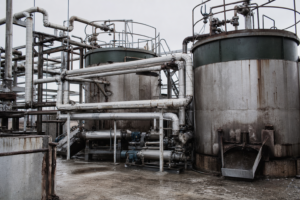
Boiling point elevation (BPE) is the increase in a solution’s boiling temperature above that of the pure solvent, caused by dissolved non-volatile solutes. In industrial evaporation it is not a textbook curiosity—it is a first-order design variable that sets the compressor temperature lift in MVR plants, erodes the driving temperature difference in every effect, and ultimately decides whether a target concentration is reachable at all. Engineers who treat BPE as an afterthought routinely end up with undersized heat exchangers, overloaded compressors, or plants that stall below the specified concentration.
What Boiling Point Elevation Is
When a non-volatile solute dissolves in a solvent, the vapor pressure of the liquid falls below that of the pure solvent at the same temperature. The solution must therefore be heated to a higher temperature before its vapor pressure reaches the surrounding pressure and boiling begins. That temperature difference is the boiling point elevation.
BPE is a colligative property: for dilute ideal solutions it depends only on the number of dissolved particles (ions or molecules), not on their chemical identity. A mole of sodium chloride, which dissociates into two ions, elevates the boiling point roughly twice as much as a mole of a non-dissociating sugar at the same molarity. In concentrated industrial brines the behavior departs from this ideal picture—ion interactions amplify or dampen the effect—which is why serious design work relies on measured data or activity-coefficient models rather than dilute-solution formulas.
Why BPE Matters More in Evaporators Than Anywhere Else
Many process units tolerate a modest boiling point rise without consequence. An evaporator cannot, because its entire function is built on temperature differences:
- Heat transfer driving force: the rate of evaporation is proportional to the effective temperature difference between the heating medium and the boiling liquor. BPE consumes part of that difference before a single watt of useful transfer occurs.
- Vapor chain integrity: in multiple-effect trains and MVR loops, the vapor leaving the liquor becomes the heating medium of the next stage. If the liquor boils hotter than the pure-solver boiling point, the vapor it generates carries less usable temperature advantage than a pure-water pressure balance predicts.
- Energy accounting: steam economy calculations and compressor power estimates are both functions of the true (elevated) boiling temperature, not the water-table value.
In short, BPE is the silent tax on every temperature difference the designer has to spend.
How BPE Attacks the Effective Temperature Difference
Consider a calandria heated by steam at a given saturation temperature. The available driving force is:
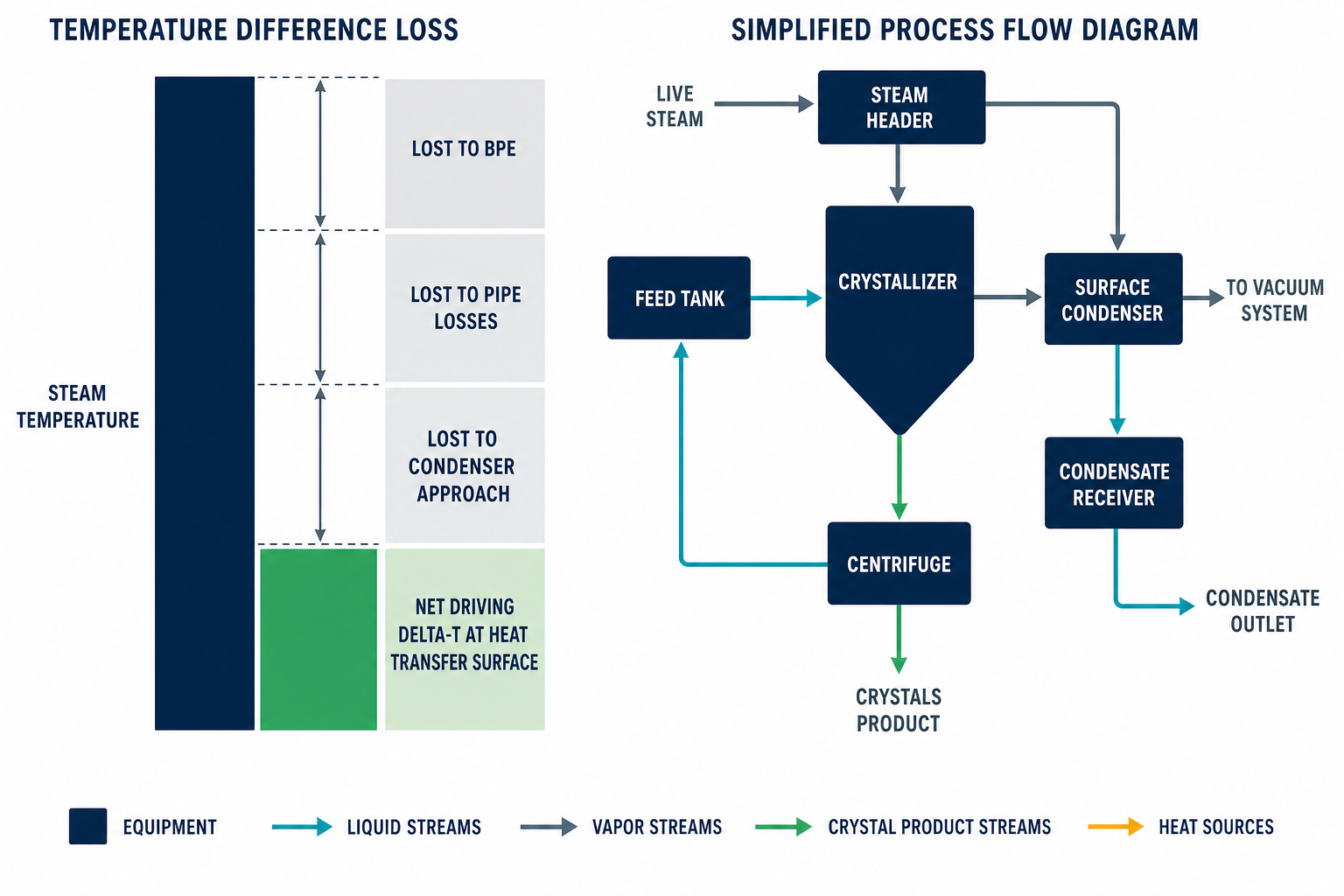
Effective ΔT = heating steam temperature − (pure-solvent boiling temperature at system pressure + BPE)
Every degree of BPE subtracts directly from the effective ΔT. Because heat flux is proportional to this difference (and to the overall heat transfer coefficient), an elevated BPE immediately throttles evaporative capacity. The designer has only three ways to recover it, and all of them cost money:
- Increase the heat transfer area to compensate for reduced flux—more tubes, a larger shell, higher capital cost.
- Raise the heating steam pressure (or compressor discharge temperature) to widen the gross temperature difference—higher energy cost and mechanical stress.
- Accept lower throughput—lost production.
At extreme BPE values the arithmetic collapses entirely: the required area or pressure becomes impractical, and the system cannot run efficiently no matter how it is operated.
The Transmission Chain from BPE to Capital Cost
| BPE effect | Mechanism | Engineering consequence |
|---|---|---|
| Shrinks effective ΔT | Elevated boiling temperature reduces the net driving force | Lower evaporation flux at fixed area |
| Demands more heat transfer area | Area must grow to restore duty at reduced ΔT | Larger calandria, higher vessel cost |
| Raises compressor lift (MVR) | Compressor must deliver BPE plus a working ΔT | More compression stages, higher power draw, more expensive machine |
| Accumulates across effects (MED) | Each effect’s BPE subtracts from the train’s total available ΔT | Fewer viable effects, worse steam economy |
| Limits final concentration | BPE climbs steeply as concentration rises | Target solids content may be unreachable economically |
BPE and MVR: The Critical Coupling
Of all evaporator configurations, mechanical vapor recompression is the most sensitive to boiling point elevation, because the compressor must physically lift the secondary vapor from the liquor’s boiling condition back to a condition useful for heating. The governing selection rule is:
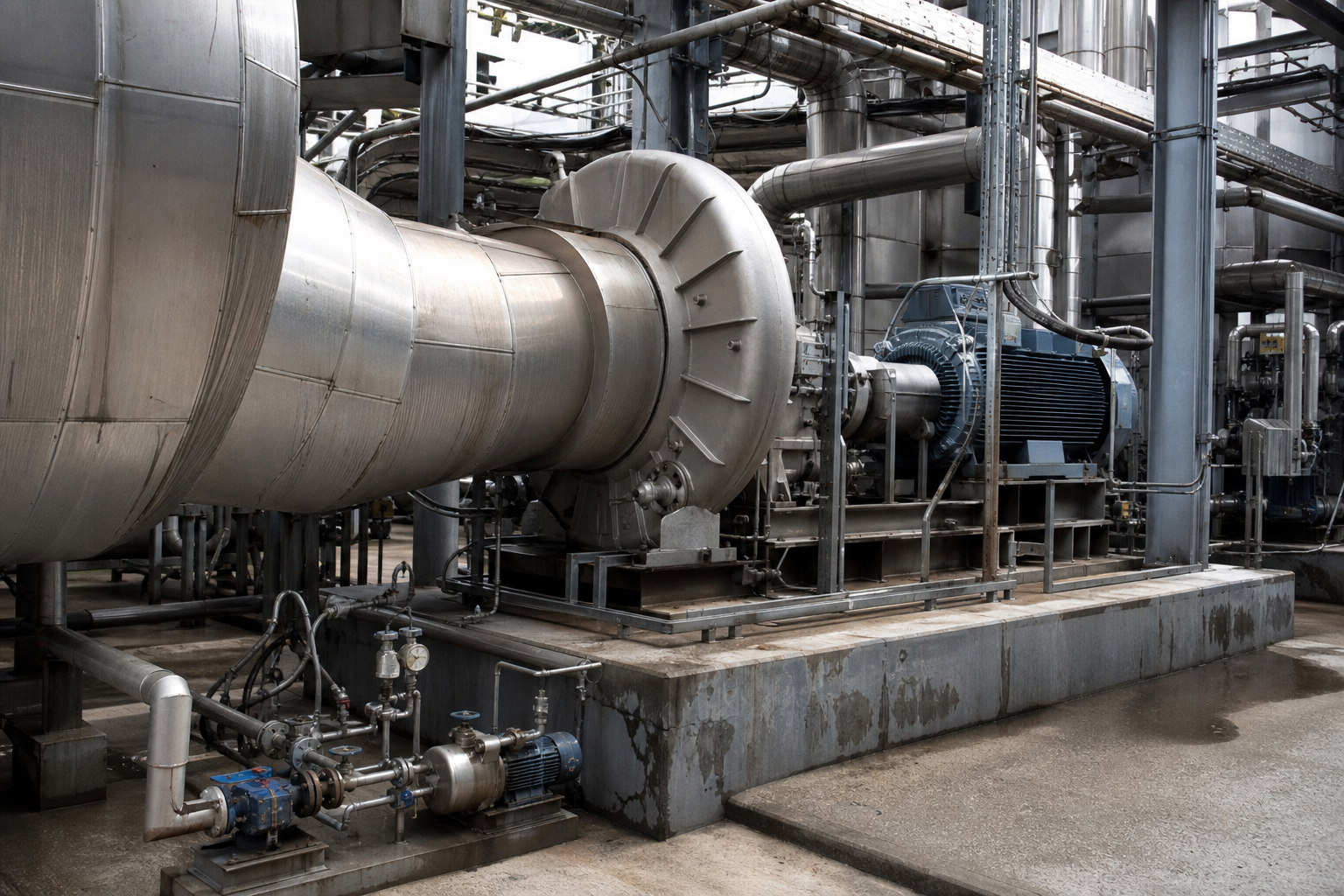
Required compressor temperature lift ≥ BPE + effective heat transfer ΔT (plus line and entrainment losses)
A liquor with a boiling point rise of a few degrees leaves ample room: the compressor provides a modest lift, power consumption stays low, and MVR delivers its signature energy performance. As BPE grows, the required lift grows with it, and compression power rises steeply—compressor power scales unfavorably with pressure ratio, so a few extra degrees of BPE can translate into a disproportionate increase in electricity demand. The compressor itself must also grow: higher lift means more stages, larger frames, and a more expensive machine.
This coupling is why BPE is the single most important screening variable when deciding between MVR and thermal alternatives, as discussed in the MVR evaporation overview.
Representative BPE Magnitudes
Exact values depend on concentration, temperature, and the full ion matrix, but the order of magnitude tells the selection story. The ranges below are indicative of values encountered in evaporation duty:
| Solution | Typical concentration in evaporation duty | Indicative BPE | Selection implication |
|---|---|---|---|
| Seawater / mild brine | 3.5–7% TDS | Under ~1 °C | Negligible; MVR and many-effect MED both easy |
| Sucrose syrup | 50–65 °Brix | Roughly 5–10 °C | Managed with adequate ΔT; sugar trains routinely 4–6 effects |
| NaCl brine near saturation | 20–26% NaCl | Roughly 5–10 °C | MVR salt plants operate here; compressor lift must be sized with margin |
| Concentrated calcium chloride | 30–40% CaCl2 | Roughly 20 °C and above | Severe; usually favors multi-effect with high-pressure steam or special design |
| Caustic soda (NaOH) | ~50% NaOH | 40 °C or more | Extreme; conventional single-stage MVR is effectively ruled out |
Two lessons stand out. First, the same salt can be harmless at feed concentration and punishing at discharge concentration—BPE grows as the liquor concentrates. Second, hydroxides and dense divalent brines sit in a different league from common salts, which is why caustic concentration plants look nothing like salt crystallization plants.
BPE in Multiple-Effect Evaporation: Accumulation Down the Train
A multiple-effect train lives on a fixed budget: the temperature difference between the first effect’s heating steam and the final effect’s condenser pressure. Every effect must carve out enough ΔT to drive heat transfer, and BPE subtracts from each effect’s share before any useful transfer happens.
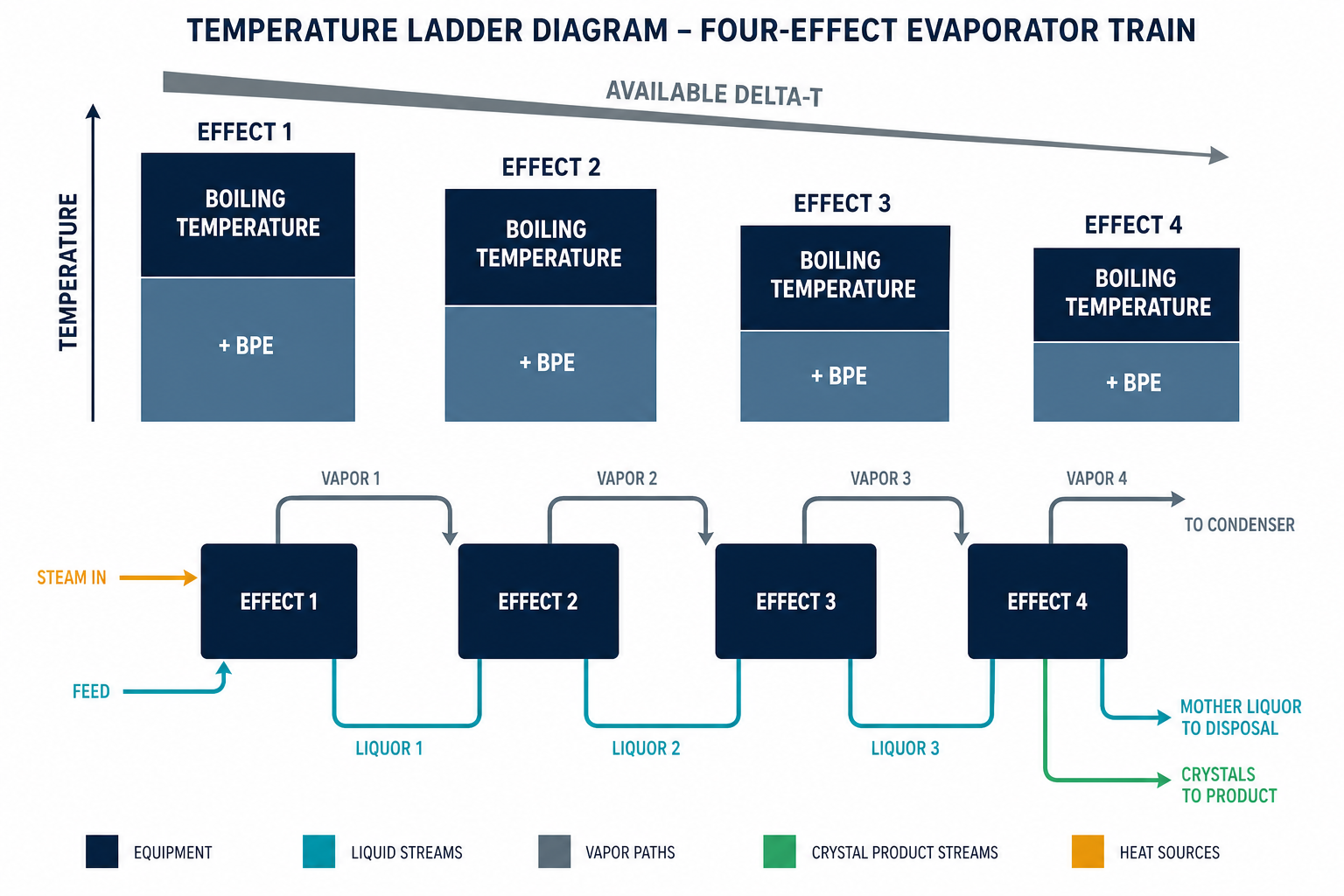
As liquor passes down the train and concentrates, its BPE typically rises effect by effect. The cumulative effect is that the train’s total usable ΔT shrinks faster than a pure-water balance suggests. Practical outcomes include:
- Fewer effects are economically justifiable—the designer cannot simply add a fifth or sixth effect because each additional effect demands its own ΔT slice that BPE has already eaten.
- Later effects run with small true driving forces, making them sensitive to fouling (any additional heat transfer resistance tips them into underperformance).
- Steam economy forecasts based on pure-water boiling temperatures overstate real performance.
Train-level design therefore requires a liquor-specific ΔT allocation, effect by effect, with BPE measured or modeled at each expected concentration. The multiple-effect evaporation page covers how effect count and ΔT distribution are optimized in practice.
Concentration Limits: When the Boiling Point Runs Away
BPE rarely rises linearly with concentration. In many systems it climbs steeply as saturation approaches, precisely where evaporation duty concentrates the liquor. The result is a practical concentration ceiling: each incremental increment of solute costs disproportionate ΔT, area, and energy.
Complex wastewater compounds the problem. High solute loads and mixed-salt matrices produce large and poorly predictable boiling point rises, and as evaporation proceeds the concentration effect slows markedly—the plant “runs out of temperature difference” before reaching the specified solids content. Where the target concentration is essential (crystallizer feed, dryness), designers respond with higher-grade heating media, additional area, or a switch of technology rather than brute-force operation.
Technology Selection: When High BPE Rules Out MVR
The selection boundary is qualitative but consistent across the industry:
- MVR is favored when BPE is low to moderate (roughly single-digit °C), electricity is available at reasonable cost, and steam is scarce or expensive. The compressor lift stays modest and the energy advantage is preserved.
- Thermal vapor recompression (TVR) uses a steam ejector instead of a mechanical compressor. It tolerates duty where a mechanical machine would be uneconomic, at the cost of steam consumption—viable when boiler capacity exists.
- Multiple-effect evaporation (MEE) handles high-BPE fluids by spreading the concentration across effects with generous heating steam on the first effect. It is structurally robust, mature, and a good fit where cheap steam exists or where the fluid’s boiling point rise would overburden a compressor.
Comparative guidance across these routes is available in the evaporator technology comparison, and the underlying thermodynamic background is covered in evaporation and concentration fundamentals.
How BPE Is Estimated and Measured in Practice
Engineering practice uses a ladder of methods, trading accuracy against effort:
- Raoult’s law and dilute colligative formulas—quick screening only; adequate below a few percent solute, misleading in concentrated brines.
- Activity-coefficient models (Pitzer for high-ionic-strength aqueous electrolytes, electrolyte NRTL for mixed-solvent and mixed-salt systems)—the standard modeling toolkit for concentrated solutions; accuracy depends on parameter availability for the specific ion matrix.
- Dühring diagrams—empirical plots of solution boiling temperature against pure-water boiling temperature at matching vapor pressures. For classic systems (caustic, brines, sugar) they remain one of the fastest reliable tools.
- Laboratory boiling measurement—for complex or novel liquors (wastewaters, mother liquors, reaction mixtures), a boiling curve measured across the concentration range is the only trustworthy basis for design. Reputable vendors require a feed sample for exactly this reason.
The measured curve has a second use: by revealing where BPE accelerates, it indicates the concentration at which heat transfer area and compressor duty should be budgeted more conservatively.
Design Practices That Absorb BPE Intelligently
- Size the compressor lift with margin: design lift = BPE at discharge concentration + effective ΔT + losses; procuring against the feed concentration instead of the discharge concentration is a classic and expensive error.
- Split the duty: concentrating in two stages (a low-BPE pre-concentration stage followed by a high-BPE finishing stage) lets each stage use the technology that suits its liquor—e.g., MVR pre-concentration feeding a forced-circulation crystallizer, as in mother liquor recovery duty (illustrative application).
- Protect the ΔT you have: since high-BPE liquors often concentrate toward saturation, fouling control matters doubly—scale layers consume the same ΔT that BPE spares. Prevention and cleaning strategies are detailed in fouling and scaling management.
- Test the real liquor: a full water analysis and boiling curve costs little relative to the compressor and area decisions it informs.
Frequently Asked Questions
What is boiling point elevation in simple terms?
It is the amount by which a solution boils hotter than the pure solvent, caused by dissolved non-volatile solutes lowering the liquid’s vapor pressure. It is a colligative property—in dilute solutions it scales with the number of dissolved particles, not their identity.
Why is BPE so important for MVR evaporator selection?
An MVR compressor must lift the secondary vapor’s temperature by at least the boiling point elevation plus the working heat transfer ΔT. High BPE therefore means higher compression ratio, disproportionately more electric power, and a larger, more expensive compressor—beyond a certain point MVR stops making economic sense.
How does BPE reduce evaporator capacity?
BPE subtracts from the effective temperature difference between heating steam and boiling liquor. Less driving force means lower heat flux; compensating requires more heat transfer area, higher steam pressure, or accepting lower throughput.
What BPE value is considered too high for MVR?
There is no universal cutoff, but as a practical guideline MVR is most attractive with single-digit °C boiling point rise. Once the required compressor lift reaches the high teens and beyond—typical of concentrated calcium chloride or 50% caustic solutions—thermal vapor recompression or multiple-effect evaporation usually becomes the better choice.
How is boiling point elevation calculated for industrial liquors?
Dilute solutions can be screened with Raoult-based colligative formulas; concentrated brines require activity-coefficient models such as Pitzer or electrolyte NRTL, Dühring diagrams for classic systems, or direct laboratory boiling measurement for complex wastewaters. For design of high-concentration duty, measured boiling curves are the reliable standard.
Does boiling point elevation accumulate across multiple effects?
Yes. Each effect’s BPE subtracts from that effect’s share of the train’s total available temperature difference, and BPE typically grows as liquor concentrates down the train. The cumulative effect limits how many effects are economically viable and drags real steam economy below pure-water estimates.