Evaporation removes COD very well or barely at all, and the difference is decided by one property: the boiling behavior of the organic molecules in your wastewater. High-boiling organics stay in the concentrate and leave the system with the brine, salt or mother liquor, so condensate COD drops significantly. Low-boiling organics evaporate together with the water vapor and re-condense in the distillate, so condensate COD barely improves. Because removal efficiency depends entirely on the specific composition, concentration and character of the organics present, the only reliable way to predict it is a laboratory evaporation test under simulated operating conditions. This article explains the mechanism, the five-point test protocol, why high-COD wastewater overwhelms conventional biological plants, and how evaporation is correctly positioned inside a combined treatment train.
What COD Actually Measures
Chemical oxygen demand (COD) is a water-quality index determined by the concentration and character of the organic matter in the water—not a single pollutant. It expresses, in milligrams of oxygen per liter, how much oxidant the organics would consume. When engineers say “removing COD,” they mean separating or destroying those organic molecules. Evaporation attacks this problem by physical separation: it never destroys organics, it only decides which phase they follow—concentrate or distillate. That single insight explains every result that follows.
How Organics Behave Inside an Evaporator
Organic molecules split into two broad behavioral classes during evaporation:
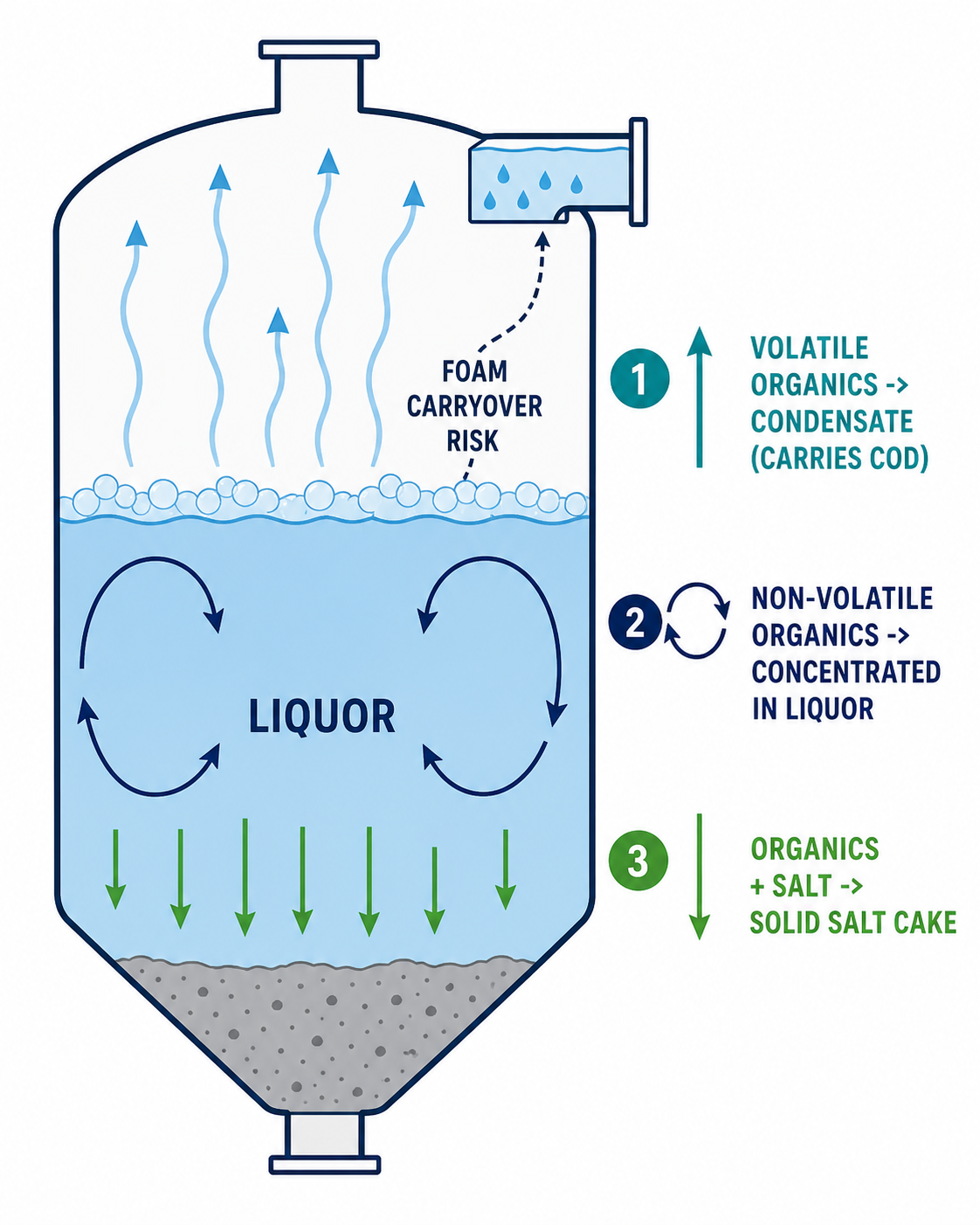
- High-boiling organics (heavy oils, resins, humics, most synthetic intermediates) have vapor pressures far below water at process temperature. They remain in the concentrate, accumulating as water boils off, and ultimately leave the system with the concentrated brine or crystal solids. Condensate COD falls substantially.
- Low-boiling organics (alcohols, light solvents, volatile acids, some amines) have vapor pressures comparable to or above water. They co-evaporate, travel with the vapor, and re-condense into the distillate. Condensate COD shows little improvement despite high water recovery.
Between these classes lie intermediate species whose split depends on operating pressure and temperature—vacuum operation at lower temperature can improve the relative volatility advantage of water for some compounds. The practical conclusion: COD removal efficiency in evaporation is highly case-specific. With detailed information on organic types and concentrations, engineers can make a preliminary assessment; for a bankable number, an evaporation test is mandatory.
What Sets the Split: Volatility, Pressure and Operating Temperature
The dividing line between the two organic classes is not a fixed boiling point but a relative-volatility comparison against water at the chosen operating temperature and pressure. A molecule that is semi-volatile at atmospheric boiling may be effectively non-volatile in a vacuum system evaporating at a much lower temperature, because its vapor pressure falls faster than that of water; conversely, pressure selection can shift water’s volatility advantage for some oxygenated solvents. Engineers therefore treat the organic split as a function of the design point rather than a constant: choosing the evaporator’s operating pressure is simultaneously choosing which fraction of the COD follows the vapor. Foaming adds a second practical signal. Surfactants and proteins that stabilize foam in the vapor-liquid separator often correlate with organics that partially entrain into the distillate as liquid droplets; antifoam dosing and demister upgrades reduce this mechanical carryover even where true volatility carryover remains, which is why condensate COD problems are always diagnosed as either a vaporization problem or an entrainment problem before equipment is blamed.
The Five-Point Evaporation Test

Before an evaporator is designed or purchased for a COD-laden stream, a laboratory qualification test on a representative sample should evaluate five items:
| # | Test item | What it decides |
|---|---|---|
| 1 | pH | Compatibility with construction materials and corrosion risk; neutralization recommended where necessary |
| 2 | Specific gravity | Pump selection and evaporator hydraulic design parameters |
| 3 | Boiling point at atmospheric and vacuum conditions | Correct evaporation operating parameters and pressure selection |
| 4 | Concentration behavior | Viscosity rise vs. concentration, crystallization onset, potential scaling risk |
| 5 | Condensate quality analysis | COD carryover measurement; material selection and design of the condensate recovery system |
Test results drive customized design: the goal is an evaporation system that is technically reliable, economically optimized and matched to the specific wastewater—rather than a generic unit hoped to fit. For streams rich in volatile organics, the test usually reveals that condensate polishing (biological treatment or oxidation) must be budgeted from day one.
Why High-COD Wastewater Breaks Conventional Biological Treatment
To understand where evaporation earns its place, it helps to see why the default route—biological treatment—fails on high-COD industrial wastewater. Three mechanisms do the damage:
- Rapid oxygen depletion. When COD is extreme, conventional aeration cannot supply oxygen fast enough; dissolved oxygen crashes toward zero, the activated sludge deteriorates, degradation efficiency collapses, odors develop and the process destabilizes.
- Osmotic shock. High salinity, strong acidity or alkalinity and toxic compounds abruptly shift the osmotic environment; microbial cells dehydrate and suffer structural damage—much like vegetables wilting in strong brine—and lose their ability to reproduce and metabolize pollutants.
- Refractory organics. Lignin, polycyclic aromatic hydrocarbons (PAHs), synthetic dyes and pharmaceutical residues exceed the enzymatic and metabolic capability of ordinary microorganisms; biology simply cannot mineralize them.
Four limitations of the traditional route then compound each other. First, organic shock loads—industrial COD can reach 50,000 mg/L or higher—overload the biomass, causing sludge bulking, excessive foaming, poor settling and unstable effluent; after a biological crash, restoring the bacterial community takes 15–30 days (industry-reported recovery range). Second, toxic inhibitors such as copper, mercury, cadmium, cyanide and toxic solvents, fed without protective pretreatment, destroy the microbial community outright. Third, the aeration energy required at such loads is economically unacceptable—and the energy embedded in the organics is wasted rather than recovered. Fourth, forced extended hydraulic retention times can exceed 10 days, inflating land area and capital investment.
The Three-Stage Combined Treatment Model
Modern high-COD wastewater strategy chains three stages, each doing what it is good at:
| Stage | Technologies | Function |
|---|---|---|
| 1. Physicochemical pretreatment | Fenton advanced oxidation; adsorption on carbon-based powders; incineration for extreme COD (chemical residues, pharma concentrates) | Hydroxyl radicals cleave complex molecules into biodegradable fragments; COD, toxicity drop and biodegradability rises; adsorption offers an economical activated-carbon alternative; incineration fully mineralizes the strongest streams to CO2 and water vapor |
| 2. Core degradation | High-rate anaerobic (IC, UASB) | High tolerance to organic concentration, no continuous aeration, low energy use, biogas recovery—roughly 0.35 m³ of methane per kg COD removed under suitable conditions, turning treatment from an energy cost into an energy harvest |
| 3. Polishing | Sequencing batch reactor (SBR) | Fill-react-aerate-settle-decay cycles with adjustable parameters; flexibly absorbs industrial load swings and delivers stable, compliant COD removal |
Where Evaporation Fits in the High-COD Train
Evaporation is a physical separation step, and its correct position depends on the boiling behavior described above:
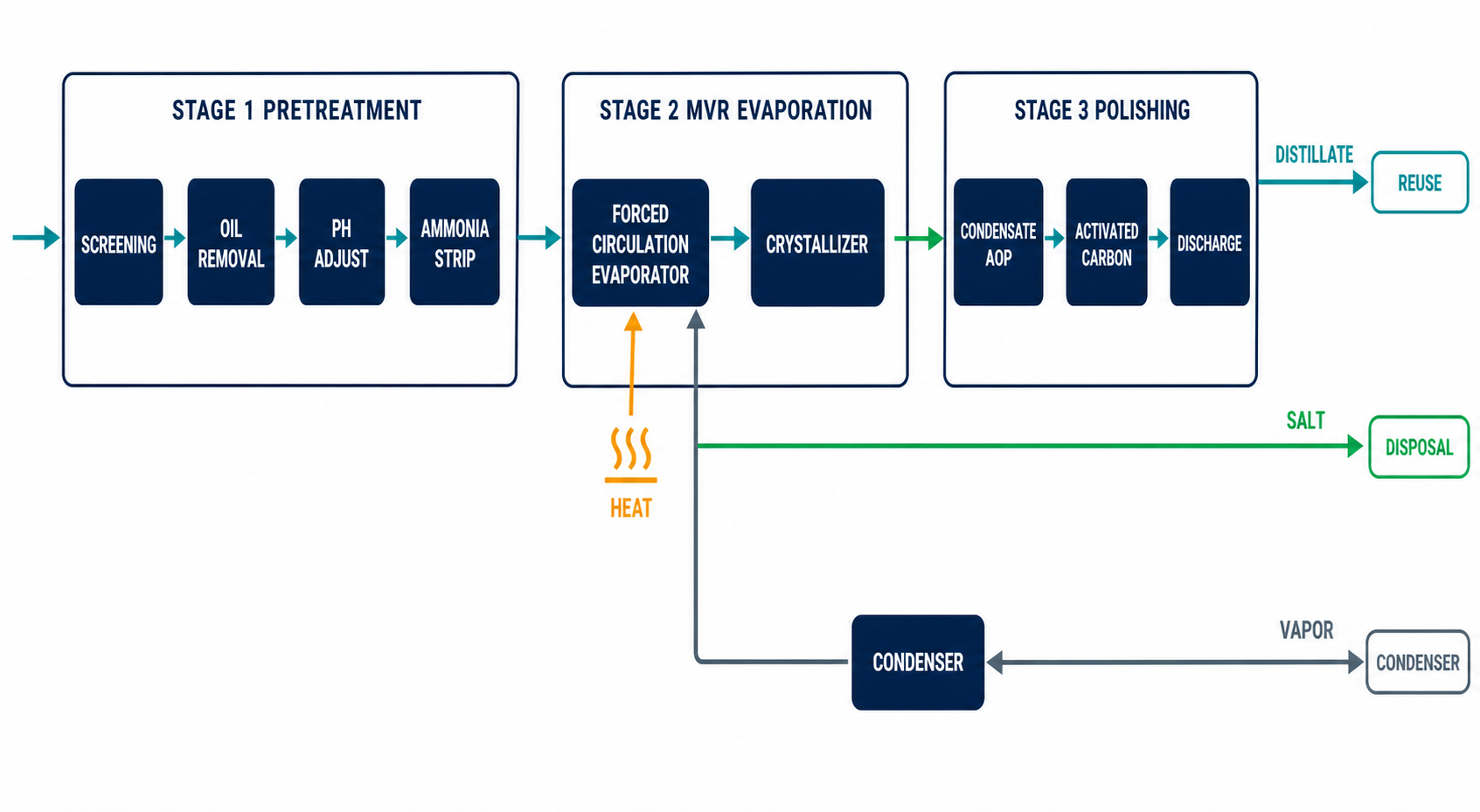
- High-boiling COD. Evaporation concentrates the organics into a small brine or mother-liquor volume, which is then incinerated or dried for disposal. The water leaves the system clean. This is the classic duty in high-complexity wastewater and ZLD projects.
- Low-boiling COD. Because those organics follow the vapor, evaporation alone cannot clean the condensate. The stream needs upstream stripping or chemical oxidation first—typically steam or air stripping for volatile acids and solvents, or advanced oxidation for reactive species—so that what remains in the water is predominantly the high-boiling fraction the evaporator can capture.
- Concentrate management. The organics-rich concentrate is a fuel in disguise: chemical and pharmaceutical residues at extreme COD are routinely incinerated, converting a disposal liability into heat value.
In membrane-plus-evaporation ZLD trains, this division of labor is standard: membranes and biology handle the bulk water, while the evaporator takes the salty, organic-laden reject and reduces it to a disposable solid. MVR evaporation is often chosen for this duty precisely because the electrically driven vapor recompressor keeps the steam demand—usually the dominant operating cost of high-COD concentration—far below direct-steam alternatives.
Sector practice follows the same logic; the following are illustrative applications. Pharmaceutical fermentation and synthesis wastewater concentrates well because most intermediates and extractants are high-boiling; landfill leachate and coal-chemical gasification liquor carry a measurable volatile-acid fraction that is usually stripped before or after evaporation; dyeing and pigment streams sit in between, with high-boiling colorants captured in the brine while textile auxiliaries partially distill over. In every case the five-point test replaces guesswork with a measured split.
Condensate Discharge Decisions
Once the evaporator is running, every condensate molecule faces one of three routes, and the choice should be engineered, not improvised:
- Compliant discharge—where condensate COD and other parameters already meet the discharge permit directly.
- On-site reuse—as cooling make-up, washing water or process water; reuse multiplies the value of every cubic meter recovered and is the default objective in ZLD design.
- Condensate polishing—where volatile carryover pushes COD above target, a compact biological polisher or oxidation unit on the condensate line closes the gap; sizing this unit is exactly what the five-point test’s condensate analysis is for.
Conclusion
Evaporation is neither a universal COD cure nor irrelevant to it. It is a sharp separator whose performance on COD is set by organic volatility: high-boiling species are captured in the concentrate and disposed of or incinerated, while low-boiling species ride the vapor into the condensate and demand stripping or oxidation upstream. Test before you design, place the evaporator where volatility works in your favor, and budget the condensate polisher the test predicts—then evaporation becomes one of the most reliable tools in the high-COD treatment arsenal.
Frequently Asked Questions
Does evaporation remove COD from wastewater?
It depends on the organics. High-boiling organics stay in the concentrate and condensate COD drops significantly; low-boiling organics co-evaporate with the water vapor and condensate COD barely improves. Removal efficiency is determined by the composition, concentration and character of the specific organics in your wastewater.
How can I predict the COD removal rate before buying an evaporator?
Run a laboratory evaporation test on a representative sample covering pH, specific gravity, boiling point at atmospheric and vacuum conditions, concentration behavior (viscosity, crystallization, scaling) and condensate quality. The condensate analysis directly measures simulated COD removal under your expected operating conditions.
Why does high COD crash a biological treatment plant?
Extreme COD depletes dissolved oxygen faster than aeration can supply it, while salinity and toxic compounds impose osmotic shock on the microbial cells. Refractory molecules such as lignin, PAHs, dyes and pharmaceutical residues exceed the metabolic capability of ordinary sludge. After a crash, rebuilding the bacterial community typically takes 15–30 days.
What should be done when evaporator condensate COD is too high?
High condensate COD signals low-boiling organic carryover. Options include upstream stripping or oxidation to remove volatiles before evaporation, adjusting operating pressure to improve relative volatility, and installing a compact biological or oxidation polisher on the condensate line.
Can high-COD concentrate be used rather than dumped?
Yes. Concentrates from chemical and pharmaceutical streams at extreme COD are routinely incinerated, recovering their heat value while mineralizing the organics to CO2 and water vapor. Where the concentrate also carries recoverable salt, crystallization can separate a saleable by-product from the organic residue.