When wastewater carries molecules that biology cannot touch—pharmaceutical residues, synthetic dyes, halogenated solvents, aromatic intermediates—advanced oxidation processes (AOP) are a recognized answer. AOPs generate hydroxyl radicals (•OH), among the strongest oxidants available in water treatment, which attack pollutant molecules almost without selectivity and break them down toward carbon dioxide, water and inorganic ions. External industry references report COD removal above 70% with marked color reduction on textile dyeing wastewater, and pharmaceutical residues cut to levels that allow production reuse. This article explains what makes an organic molecule refractory, the chemistry and numbers behind hydroxyl radicals, the four main AOP routes with their engineering trade-offs, documented performance, cost drivers, and—because this site lives and breathes evaporation—exactly where AOP fits in an evaporation-centered zero liquid discharge train.
What Makes an Organic Molecule “Refractory”
Refractory organic matter (ROM) is the fraction of wastewater organics that resists biological and many physicochemical treatments. Chemically, these molecules share structural features that make them stubborn: aromatic rings, halogenated frameworks, and synthetic chemical backbones absent from nature. Their chemical stability defeats the enzymatic and metabolic pathways that ordinary microorganisms use, so they pass through an activated-sludge plant essentially unchanged.
The sources are concentrated in a handful of sectors: pharmaceutical waste streams (fermentation residues, synthesis mother liquors, expired formulations), industrial chemicals and fine synthesis effluents, petrochemical processing water, and agricultural runoff carrying pesticides. In pharmaceutical plants and textile dyeing operations, refractory organics are not a marginal pollutant—they are the main reason conventional treatment trains underperform.
Why Conventional Methods Fall Short
Biological methods cannot mineralize ROM: the microbes simply lack the machinery. Conventional physicochemical methods—coagulation, sedimentation, plain chlorination, adsorption—do better but still show low removal rates against low-concentration, high-toxicity, persistent pollutants. Adsorption only transfers the pollutant to a solid phase that then needs disposal or regeneration; chlorination can leave halogenated by-products that are worse than the parent compound. What these recalcitrant molecules need is not capture but destruction—an oxidant strong enough and fast enough to break aromatic rings and carbon-halogen bonds outright.
The Hydroxyl Radical: The Numbers Behind the Chemistry
AOPs all converge on one species. Hydroxyl radicals are generated in situ—from ozone, from hydrogen peroxide, from ultraviolet radiation or from electric current—and then do the work: •OH attacks pollutant molecules essentially without selectivity, cleaving chemical bonds and driving the fragments toward full mineralization as CO2, water and inorganic ions such as nitrate or sulfate.
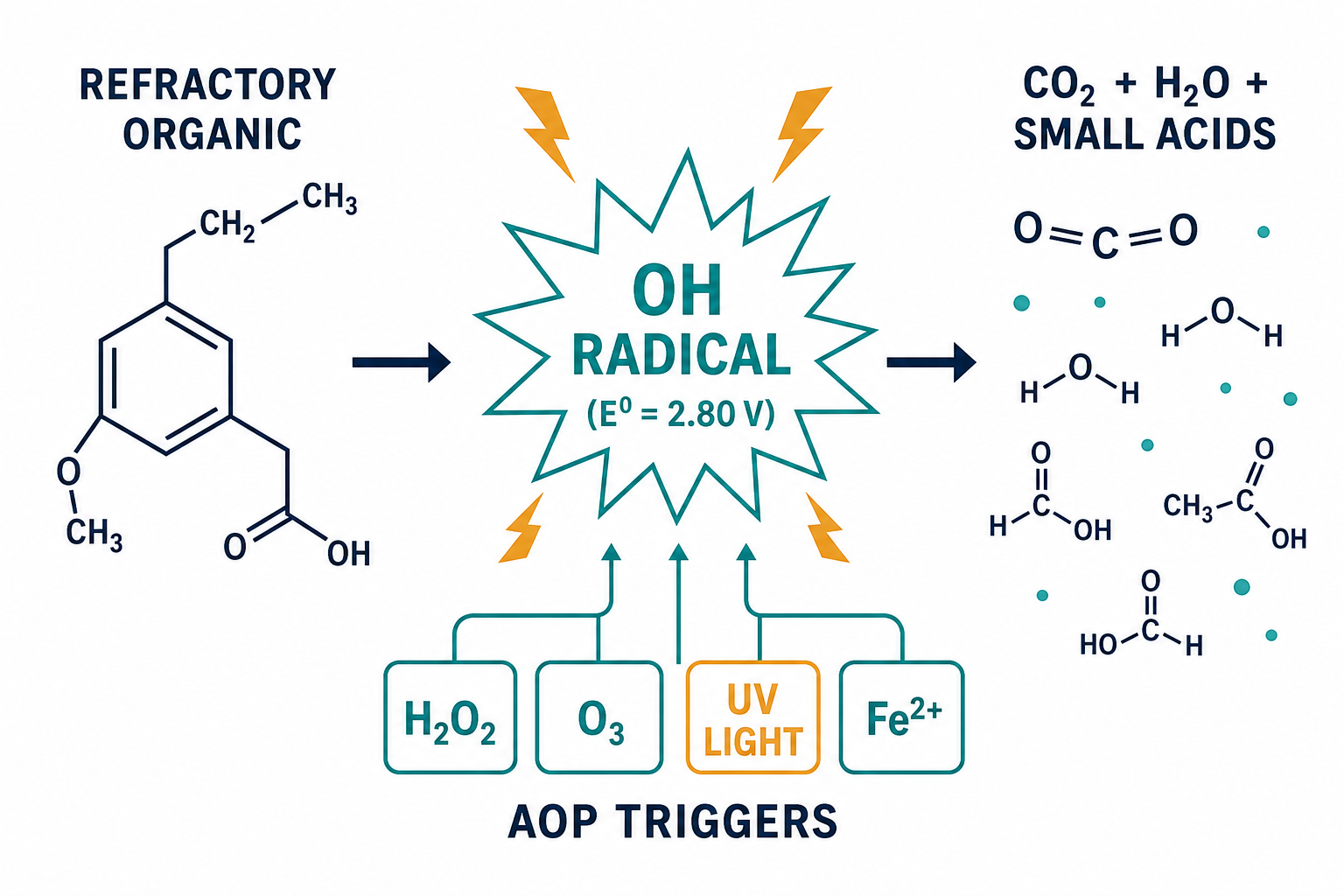
Two numbers explain why •OH is called the workhorse of advanced oxidation:
| Oxidant | Standard oxidation potential (V) | Comment |
|---|---|---|
| Hydroxyl radical •OH | ≈2.80 | Generated in situ; reacts near the diffusion limit |
| Ozone O3 | ≈2.07 | Strong but selective; slower against many ROMs |
| Chlorine Cl2 | ≈1.36 | Conventional disinfectant; forms halogenated by-products |
Oxidation potentials shown are standard electrode potentials—published reference values.
Second, the rate constants for •OH reactions with organic compounds typically fall in the range of 108–1010 M⁻¹s⁻¹—close to the diffusion limit. In practical terms, hydroxyl radicals react with almost every organic molecule they encounter, which is why AOP performance depends on generating enough radicals and contacting them with the water efficiently, rather than on matching a specific pollutant.
The Four Main AOP Routes
| Route | How •OH is generated | Strengths | Watch-outs |
|---|---|---|---|
| O3/H2O2 (peroxone) | Ozone reacts with hydrogen peroxide in water | Ozone also directly attacks pollutants and initiates radical chain reactions; no sludge | Ozone generation is energy-intensive; off-gas destruction needed |
| UV/H2O2 photolysis | UV light decomposes hydrogen peroxide | Highly effective against organic micropollutants; simple dosing | UV transmission reduced by turbidity and color; lamp replacement cycle |
| Fenton reagent | H2O2 + ferrous salt (typically ferrous sulfate) under acidic conditions | Low-cost reagents; robust against dyes and complex organics | Works best around pH 3; acidic dosing then neutralization required; iron sludge must be dewatered and disposed |
| Electrochemical oxidation | Current generates •OH at electrode surfaces | No stored chemical reagents; continuous or batch operation; compact | Electrode material and cost set performance—boron-doped diamond (BDD) anodes give strong oxidation but cost more than mixed-metal oxide (DSA) alternatives; energy per cubic meter must be managed |
Selection among the four is a water-chemistry question. Colored, turbid streams punish UV-based routes; high-chloride streams complicate electrochemistry through by-product formation; reagent logistics and local electricity pricing often decide between Fenton and peroxone. A treatability test on the actual wastewater remains the deciding step.
Photocatalysis and Hybrid Assemblies
A fifth family—photocatalytic oxidation—uses UV light to activate a photocatalyst, generating radicals at the catalyst surface and decomposing pollutants that resist both biochemical and conventional chemical treatment. In practice, photocatalysis is rarely deployed alone: modern skids combine UV photocatalysis, chemical oxidation and radical chain reactions into integrated AOP systems, because the combinations attack different bonds in parallel and raise overall removal beyond what any single mechanism achieves on refractory molecules.
What AOP Can—and Cannot—Do for Heavy Metals
Refractory wastewaters often carry heavy metals alongside organics: chromium, lead and mercury are the classic trio. Here the honest engineering position is that AOP is not a metals-detoxification step—and for chromium it points in exactly the wrong direction. Chromium(VI) is the toxic, mobile form, and oxidation can only push chromium toward Cr(VI), never away from it. The correct sequence is chemical reduction of Cr(VI) to Cr(III)—sodium bisulfite or iron at controlled pH—followed by hydroxide precipitation. Lead and mercury are taken out by pH-adjusted precipitation, co-precipitation with iron hydroxide, or chelation and adsorption. What AOP genuinely contributes on a metals-bearing stream sits upstream of these steps: hydroxyl radicals destroy the cyanide, EDTA-type chelants and humic ligands that keep metal ions complexed and dissolved, releasing free metal so the reduction–precipitation train downstream can actually reach its outlet spec.
Four Engineering Advantages
- Speed at high removal efficiency. Radical kinetics are fast; residence times are minutes, not the days biology needs.
- Minimal sludge. Compared with biological treatment, AOPs convert organics to CO2 and water rather than converting them into biomass—Fenton’s iron sludge being the known exception to manage.
- Flexible integration. AOPs run standalone or combined with biological filters, activated carbon and membrane filtration; they are equally effective before biology (detoxifying influent) or after it (polishing effluent).
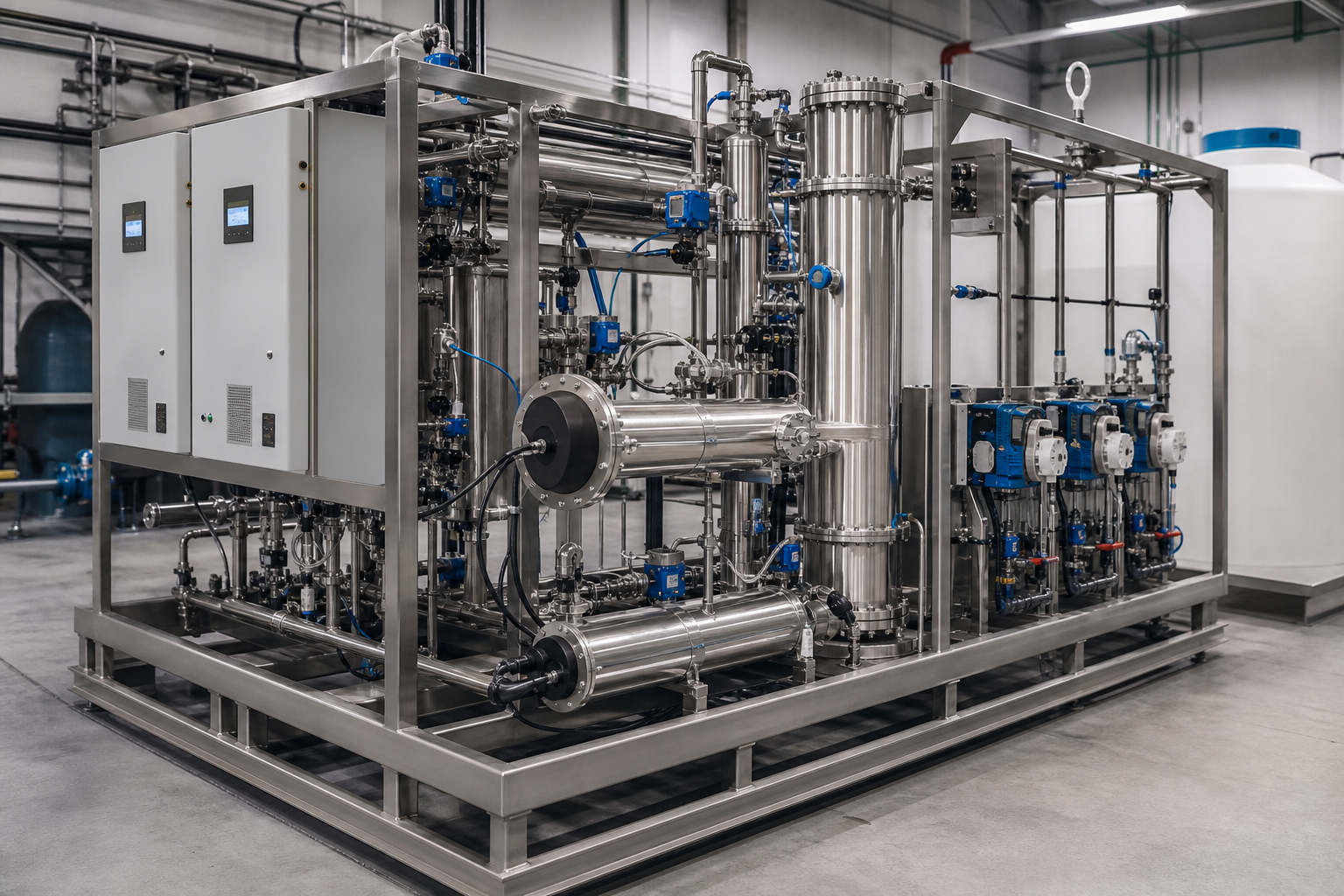
- Modular deployment. Skid-mounted, PLC-controlled designs support both fixed installations and mobile units—rapid installation and a compact footprint make AOPs a natural fit for emergency response and remote sites.
Documented Performance
Reported results in external industry references give a realistic picture of what to expect:
- Textile dyeing wastewater: COD removal above 70% with color markedly reduced—treated water meets reuse criteria for production.
- Pharmaceutical wastewater: drug residues significantly cut; treated water reaches reuse standards and returns to production duty.
- Municipal polishing: trace pharmaceuticals and micropollutants removed as an advanced purification step.
- Emergency and remote water supply: mobile AOP units deployed where permanent infrastructure does not exist.
Automated operation is part of the value: intelligent control systems monitor operating status and automatically adjust reaction parameters—flow, UV intensity, reagent dosing—reducing energy and operating cost and supporting unattended operation.
Process Modules of an AOP Package
| Module | Scope | Selection notes |
|---|---|---|
| Oxidation reactor unit | O3/H2O2 contactor, UV/H2O2 reactor, Fenton reaction tank, or electrochemical cell | Chosen by water chemistry (UVT, chloride, pollutant profile); sized by treatability-test kinetics |
| Reagent storage and dosing | H2O2 storage and dosing, ozone generation, ferrous-salt make-down, acid and alkali for pH control | Bulk-storage codes and dosing accuracy set both safety compliance and stoichiometric efficiency |
| Off-gas and residual handling | Ozone destruct unit on vent streams; residual-peroxide quench ahead of downstream biology or membranes | Mandatory on ozone routes to meet off-gas limits and protect biological or membrane stages |
| Coupling and polishing | Upstream coagulation and filtration; downstream biology, activated carbon, or the evaporation train itself | Position decided by the ZLD architecture—pre-evaporator for foaming control or post-condensate for polishing |
Whether these modules arrive on one skid or several depends on scale and on the route chosen—Fenton packages are dominated by tankage and dewatering, ozone packages by generation and destruct, electrochemical packages by the power supply and electrode stack.
Cost Drivers and How to Contain Them
AOP operating cost is dominated by four lines: electricity for ozone generation or electrochemistry, lamp replacement for UV routes, hydrogen peroxide consumption, and—specifically for Fenton—acid, alkali and iron-sludge dewatering and disposal. Two levers keep these costs rational. First, concentrate before you oxidize: AOP reagent demand scales with pollutant mass, not with percentage removal, so removing bulk water upstream (membranes, evaporation) shrinks the volume that needs radical treatment and can cut cost per ton of original wastewater markedly. Second, pair AOP with biology: use oxidation to break refractory molecules into biodegradable fragments, then let a cheap biological stage finish the job—radicals do the hard chemistry, microbes do the bulk volume.
Where AOP Sits in an Evaporation-Centered ZLD Train
For high-salinity, high-COD wastewater—the home turf of evaporation—AOP earns two distinct positions:

- Upstream of the evaporator: oxidizing organics before concentration reduces foaming in the evaporator and limits organic fouling of heat-transfer surfaces, protecting the steam economy of the MVR or multi-effect plant downstream.
- Downstream, on the condensate: volatile organics that co-distill into the evaporator condensate—exactly the fraction evaporation cannot capture, as explained in the COD removal in evaporation analysis—are polished by UV/H2O2 or ozone to reach reuse standards.
Placed this way, AOP and evaporation cover each other’s blind spots: evaporation concentrates and captures high-boiling organics into a small disposable residue, while oxidation destroys the volatile and refractory fraction that would otherwise slip through with the water. Together with salt separation on the brine side, they close the loop on complex wastewater.
When This Route May Not Fit
AOP is a tool for refractory organics, not a universal polishing step. On a low-concentration stream dominated by one or two identifiable pollutants, targeted adsorption or a single Fenton polishing dose is usually cheaper than a full radical train. High-turbidity, high-color water blinds UV-based routes—coagulation and filtration come first, or the lamps chase shadows. Where electricity is expensive and reagent logistics are easy, electrochemical oxidation loses its cost case and Fenton or peroxone wins it back. And when the wastewater is genuinely biodegradable, biology should simply be allowed to work: running AOP on a BOD-rich, easily metabolized stream spends money destroying what microbes would have eaten for free. The route earns its place on the hard middle ground—water biology cannot finish and adsorption cannot afford.
What Must Be Verified
Every AOP selection should close on four checks, all run on the actual water sample:
- Treatability testing. Jar-scale or pilot AOP runs on the real wastewater—not a synthetic surrogate—confirming COD and target-pollutant removal against the outlet spec.
- UV transmission. For UV/H2O2 and photocatalysis, the UVT of the pre-filtered water sets lamp power and reactor length; low UVT changes the route, not just the sizing.
- Chloride and by-products. On high-chloride water, electrochemical and ozone routes can form chlorate, perchlorate or halogenated by-products—the verification plan must analyze these, not only COD.
- Reagent and energy consumption. H2O2 dose per kg COD removed, ozone transfer efficiency or kWh per cubic meter, measured at pilot scale—unit-consumption numbers drive OPEX and are the main source of quote-stage surprises.
Where the Technology Is Heading
Four trends are visible in current deployments: IoT-based intelligent systems with predictive maintenance; hybrid AOP-biological-membrane processes engineered as a single train rather than bolted-together stages; solar-assisted UV systems and energy-recovery features that cut the electricity line item; and standardized modular skids—fixed or mobile—that can be redeployed as regulations tighten. Treated water reuse for industrial production, irrigation and cooling is the common objective, driven by discharge limits that keep getting stricter.
Conclusion
Refractory organics are a chemistry problem, and advanced oxidation is the chemistry answer: hydroxyl radicals at roughly 2.80 V of oxidizing power and near-diffusion-limit kinetics, delivered through four mature routes—O3/H2O2, UV/H2O2, Fenton and electrochemical oxidation. Choose the route by water chemistry and cost structure, contain cost by concentrating first and pairing with biology, and position the step where it multiplies the performance of the surrounding evaporation train. On the hardest wastewaters, that combination is what turns an impossible discharge permit into a routine operating line item.
Frequently Asked Questions
What are advanced oxidation processes (AOPs)?
AOPs are water treatment processes that generate hydroxyl radicals (•OH) in situ—via ozone, hydrogen peroxide, UV light, Fenton chemistry or electric current. The radicals attack organic pollutants almost non-selectively, breaking them down toward CO2, water and inorganic ions.
Why can’t biological treatment remove refractory organics?
Refractory molecules such as aromatic rings, halogenated compounds, synthetic dyes and pharmaceutical residues exceed the enzymatic and metabolic capability of ordinary microorganisms. They pass through biological systems largely unchanged, which is why a destructive step like AOP is required.
Which AOP route should I choose?
Match the route to the water: UV/H2O2 and photocatalysis struggle with turbid or colored water; Fenton is economical but works best near pH 3 and produces iron sludge; O3/H2O2 avoids sludge but consumes ozone-generation energy; electrochemical oxidation is reagent-free but sensitive to electrode cost and water chemistry. A treatability test on the actual wastewater decides.
Can AOP remove heavy metals?
Not directly, and for chromium not in the detoxification direction: oxidation can shift chromium toward the more toxic Cr(VI) form, so chromium is handled by chemical reduction of Cr(VI) to Cr(III)—sodium bisulfite or iron—followed by precipitation. Lead and mercury are removed by precipitation or chelation. AOP’s real role on a metals-bearing stream is breaking the organic complexes that keep metals dissolved, so the downstream precipitation train can work.
How does AOP fit with evaporation in a ZLD system?
Upstream, AOP reduces organics that would foam and foul the evaporator; downstream, it polishes condensate where volatile organics have co-distilled. Evaporation captures high-boiling organics in the brine; AOP destroys the volatile and refractory fraction—each covers the other’s blind spot.