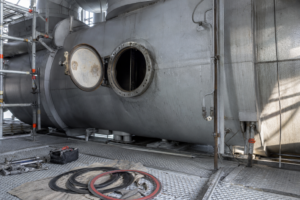
A plate evaporator (PHE-type) builds its evaporation duty on plate heat-exchange cassettes instead of tube bundles, and that single construction choice delivers the format’s signature benefits: high heat-transfer coefficients in a compact, low-holdup package, strong resistance to fouling when velocities are set correctly, and hygienic variants that satisfy food and pharmaceutical duty. Standardized integrated machines cover roughly 200 kg/h to 2 t/h of evaporation, arriving factory-assembled and ready to connect — no civil works. Selecting one correctly is a seven-parameter exercise: evaporation capacity, material-to-structure matching, corrosion grade-to-plate material, heat sensitivity-to-temperature window, heat-transfer area and plate velocity, compressor matching, and site utilities. This article works through all seven, then closes with the five-step selection framework and the three mistakes that produce most mis-specified purchases.
Where Plate Evaporators Win — and Where They Don’t
The plate format trades breadth for efficiency. The conservative selection rule from suppliers who build both formats: a tubular evaporator handles the widest range of fluids — anything a plate unit can process, a tubular unit can process too, while the reverse is not true. The plate format earns its place when the liquor is low-viscosity, flows freely, and carries moderate organic load: for those duties it delivers higher heat-transfer efficiency, a smaller footprint, and easier opening and cleaning than a tubular equivalent. Push a plate machine onto a high-viscosity, fouling, or crystallizing feed and the narrow channels that made it efficient become its liability. Plate evaporators therefore dominate food, pharmaceutical, and clean chemical concentration duties (an indicative pattern), while heavy wastewater and crystallization service stays tubular.
| Attribute | Plate evaporator | Tubular evaporator |
|---|---|---|
| Fluid compatibility envelope | Low-viscosity, free-flowing, moderate-organic liquors | Widest — including viscous, fouling, crystallizing feeds |
| Heat-transfer efficiency | Higher for suited liquors | Lower per m², compensated by larger area |
| Footprint and holdup | Compact, low liquid inventory | Larger vessel and structure |
| Cleaning and maintenance | Cassettes open for inspection and cleaning | Tube bundles harder to open; CIP-dependent |
| Hygienic fitness | Polished plate variants satisfy food/pharma duty readily | Achievable, at more effort |
Capacity First: Sizing Without Folklore
Evaporation capacity anchors every other parameter, and it is the one buyers most often get wrong in both directions — a unit sized on nameplate optimism drags the plant (“small drags the load”), while an oversized one strands capital (“big wastes the budget”). The honest method: compute required evaporation from a material balance on your actual feed (covered in evaporation capacity and heat transfer area calculation), then combine daily operating hours with realistic peak feed rates to set the design point. Plants with intermittent feeding or swinging concentration should add explicit margin: a machine held permanently at 100% load ages disproportionately, and the margin against fluctuation is cheaper bought at specification than at downtime.
Matching Plate Structure to Your Material
Material behavior, not vendor catalog order, chooses the plate-side configuration. Three material characteristics set the foundation — corrosivity (which drives plate metallurgy), viscosity (which drives channel geometry), and suspended solids or crystallization tendency (which drives the fouling strategy) — and two structural answers exist inside the plate format.
Falling-Film or Forced-Circulation Plates
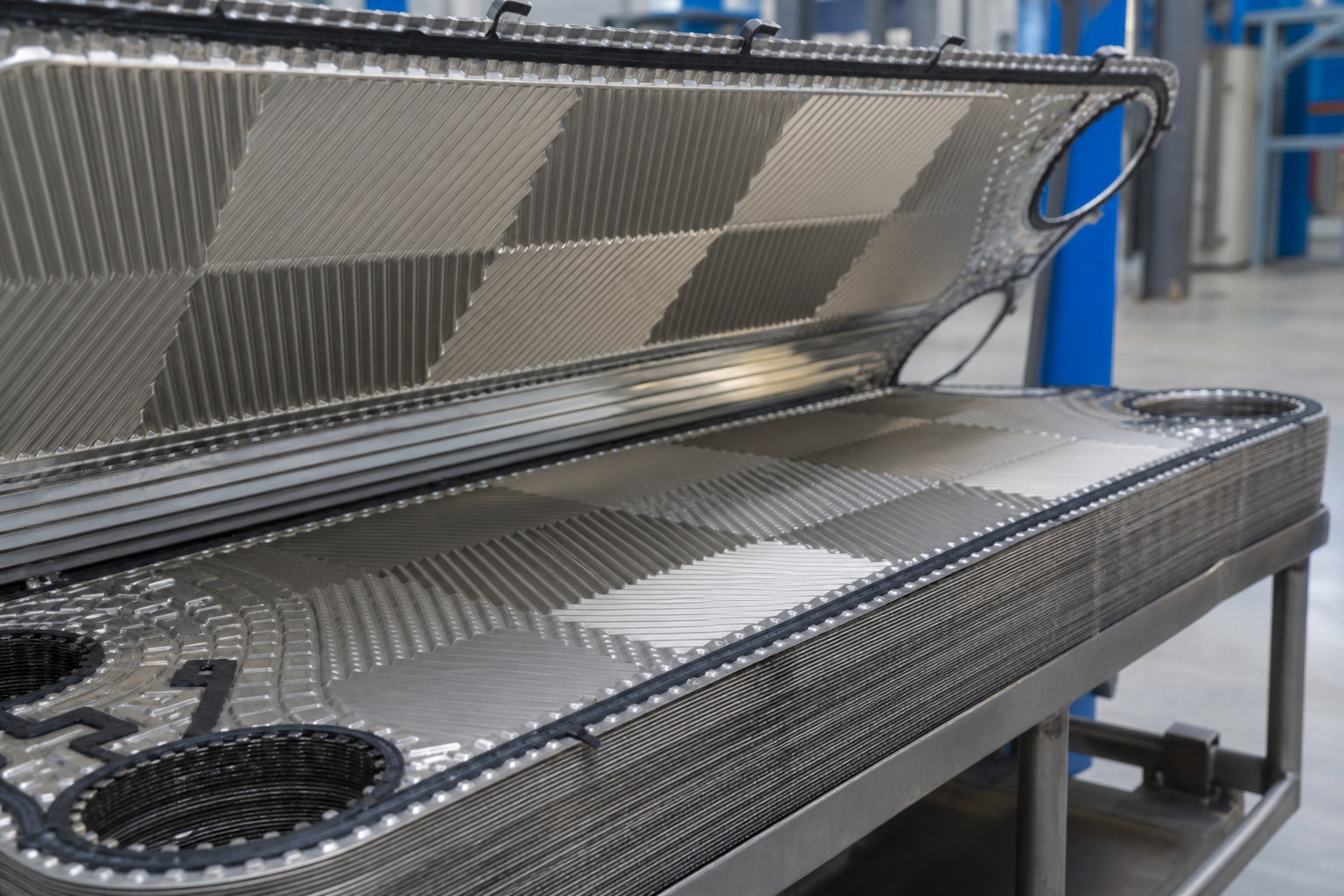
For low-viscosity liquors without crystallization risk, falling-film plate evaporators are the efficient default: liquor spreads as a thin film across the plate pack with short residence time and gentle heat exposure. When the liquor is viscous or tends to precipitate crystals, forced-circulation plate designs take over: a pump drives velocity between the plates, keeping solids suspended and suppressing deposition — accepting higher pump energy as the price of availability. A third material behavior sits outside the thermal circuit: protein-bearing and surfactant-bearing liquors foam, and the specification should then include vapor-liquid separation buffer volume in the separator design to keep entrainment out of the condensate.
Corrosion Grade and the Temperature Window
Plate metallurgy follows a three-grade ladder. Neutral aqueous solutions and food-grade original liquors: 316L, which also satisfies hygiene regulations for food contact. Chloride-bearing or mildly acidic/alkaline service: duplex stainless or titanium plates, buying the pitting resistance that 316L lacks in chloride environments. Strongly oxidizing media: specialty alloys, quoted per chemistry. The honest input is a full water or liquor analysis — chloride level, pH, and oxidizing character — mapped onto the vendor’s material charts before the order, not after the first leak.

The 30–65°C Window for Heat-Sensitive Products
For heat-sensitive products the temperature window is the product: plate evaporators in negative-pressure (vacuum) low-temperature service operate stably across roughly 30–65°C, preserving active components, aromatics, and proteins that atmospheric boiling would degrade. The window is chosen by the product’s sensitivity curve and held by the control system — the broader evaporation-side temperature logic is detailed on the falling-film evaporation page, where thin-film thermal behavior is developed.
Area, Plate Velocity, and Compressor Matching
Two hydraulic parameters discipline the thermal design. Heat-transfer area margin should stay within about 30%: enough reserve to absorb fouling-driven coefficient decay between cleanings, but not so much that capital and footprint inflate for margin that never pays. Plate-channel velocity should sit in the 1.8–2.5 m/s band (typical published design values): fast enough for turbulent flow, whose wall shear keeps calcium and magnesium salts and colloids from adhering — velocity is the plate format’s built-in antifoulant, and the specification should hold it even at turndown.

Compressor matching is where MVR-driven plate evaporators succeed or disappoint. The compressor’s temperature rise must cover the liquor’s boiling point elevation — and high-salt mother liquors carry BPE of 8–12°C (typical published range), which a compressor sized for clean-water duty will not span. Compressor character divides cleanly: centrifugal machines offer wide adjustment range and suit fluctuating production lines; Roots (lobe) machines suit small flows at high BPE. And the operating point should be set at about 85% of rated capacity, leaving regulation headroom for the concentration swings that real feeds deliver — a machine specified to live at 100% has no vocabulary for disturbance.
| Selection parameter | Working rule |
|---|---|
| Evaporation capacity | Material balance + peak feed + margin for fluctuation; avoid permanent 100% load |
| Plate configuration | Falling-film for clean low-viscosity; forced-circulation for viscous/crystallizing; separator buffer for foaming |
| Plate material | 316L (neutral/food) → duplex or titanium (chloride/mild acid-alkali) → specialty alloys (strong oxidizers) |
| Temperature window | 30–65°C under vacuum for heat-sensitive actives |
| Area margin / channel velocity | ≤ ~30% area reserve; 1.8–2.5 m/s turbulent plate velocity |
| Compressor | Temperature rise ≥ liquor BPE (8–12°C for high-salt); centrifugal for range, Roots for small-flow/high-BPE; operate at ~85% rated |
| Site and utilities | Water-power-pipe connections only; CIP module for food/pharma; verify plant electrical capacity for all-electric MVR |
Site, Utilities, and Hygiene Modules
The integrated format compresses site engineering to connections: feed, discharge, power, and cooling water. Control follows duty — a basic PLC handles temperature and discharge control for industrial service, while food and pharmaceutical lines add automated clean-in-place (CIP) modules designed around the hygienic plate pack. One specification item is routinely missed: all-electric MVR plate evaporators carry their full energy demand as electrical load, and sites without steam must verify that the plant’s electrical distribution can carry the installed power before the order — the retrofit of a substation after delivery is the most expensive way to discover a mismatch. Delivery logistics and factory testing for these integrated units follow the modular pattern described in skid-mounted and modular evaporation systems, and the vapor-compression core common to all MVR variants on the MVR evaporation page.
The Five-Step Framework and the Three Classic Mistakes
The disciplined selection path runs five steps in fixed order: material characteristics (corrosivity, viscosity, solids) → process requirements (capacity, temperature, pressure) → the energy account (steam versus waste-heat recovery, plus secondary consumers) → maintenance practicality (openable cleaning, spare-part availability) → the weighted decision. Running the steps in order prevents a seductive single number from doing the whole job, because three mistakes account for most regretted purchases. First, judging by evaporation capacity alone — the machine with the right number and the wrong materials is a scheduled failure. Second, skipping the material heat balance: without it, neither area nor compressor can be honestly sized. Third, unbalanced area reserve: too small an area forces the machine to widen temperature difference to hold capacity, driving electricity (or steam) up; too large an area inflates cost and footprint forever. All three are avoided by the same act: running the balance before choosing the box.
Maintenance Planning That Holds the Selection’s Value
Two maintenance realities deserve line items in the purchase decision. The openable plate pack is the format’s serviceability asset — inspection and mechanical cleaning happen with hand tools, not bundle extraction — and the specification should confirm access clearances around the machine for opening. Gaskets are the wear part: confirm the gasket material against your liquor chemistry, the replacement procedure, and — most decisive for imported or integrated machines — the supplier’s spares lead time. A plate evaporator whose gaskets wait eight weeks for shipment is a plant stoppage with a purchase order attached.
FAQ
What capacity range do standard plate evaporators cover?
Standardized integrated machines run roughly 200 kg/h to 2 t/h of evaporation, delivered factory-assembled and needing only water, power, and pipe connections. Larger duties are typically served by tubular designs or multiple plate units, following the capacity-versus-format logic in modular system delivery.
How do I choose between falling-film and forced-circulation plate designs?
Follow the liquor. Falling-film plates suit low-viscosity feeds without crystallization risk — thin film, short residence time, high efficiency. Forced-circulation plates add a pump that holds velocity between plates for viscous liquors or ones that precipitate crystals, trading pump energy for fouling resistance. Foaming protein liquors additionally need separator buffer volume.
Which plate material do I need?
316L for neutral solutions and food-contact duty; duplex stainless or titanium where chlorides or mild acid/alkali are present; specialty alloys for strongly oxidizing media. Decide from a full liquor analysis mapped to vendor material charts before ordering — material retrofits after delivery are the most expensive correction in the format.
What compressor should a plate MVR evaporator use?
Size the temperature rise to cover your liquor’s boiling point elevation — 8–12°C for high-salt mother liquors. Choose centrifugal compression for wide adjustment range on fluctuating lines, Roots (lobe) for small flows with high BPE. Set the operating point around 85% of rated capacity so the machine has regulation headroom for feed swings.
Why does plate velocity matter so much?
Turbulent velocity between plates — the working band is 1.8–2.5 m/s — creates wall shear that keeps scale-forming salts and colloids from adhering. Velocity is the plate format’s built-in antifoulant; specifying area without holding velocity buys a machine that fouls efficiently.