Project Parameters
| Parameter | Value |
|---|---|
| Process route | MVR + five-effect falling-film evaporation |
| Industry | Food & fermentation — corn deep processing / starch sweeteners |
| Feed type & key components | Glucose solution from enzymatic starch conversion; heat-sensitive sugars |
| Evaporation capacity | 42.24 t/h (comparable deployments at 70 t/h in the same segment) |
| Construction materials | SS304/SS316L food-grade wetted parts |
Representative process configuration compiled from published industry project data. Indicative values, not a process guarantee.
Project Description
Shandong province hosts China’s densest cluster of corn deep-processing plants, and glucose is the cluster’s central molecule: enzymatic conversion turns starch into glucose liquor, which is either crystallized, fermented, or isomerized toward fructose — and every route passes through evaporation to lift solids from conversion strength to product strength. The reference configuration concentrates glucose solution at 42.24 t/h at a Shandong corn processor, on a hybrid MVR multi-effect train that has become the segment’s standard modern build; comparable published configurations in the same province run the duty at 70 t/h in MVR four-effect service.
The product defines the constraints. Glucose is heat-sensitive: extended time at temperature drives color-body formation and sugar degradation, so the evaporation must be short-contact and low-temperature-difference. The liquor is also clean and low-fouling relative to industrial brines — which allows the efficient falling-film geometry — but viscous at high solids, which sets the distribution and circulation engineering in the final effect.
Process Technology

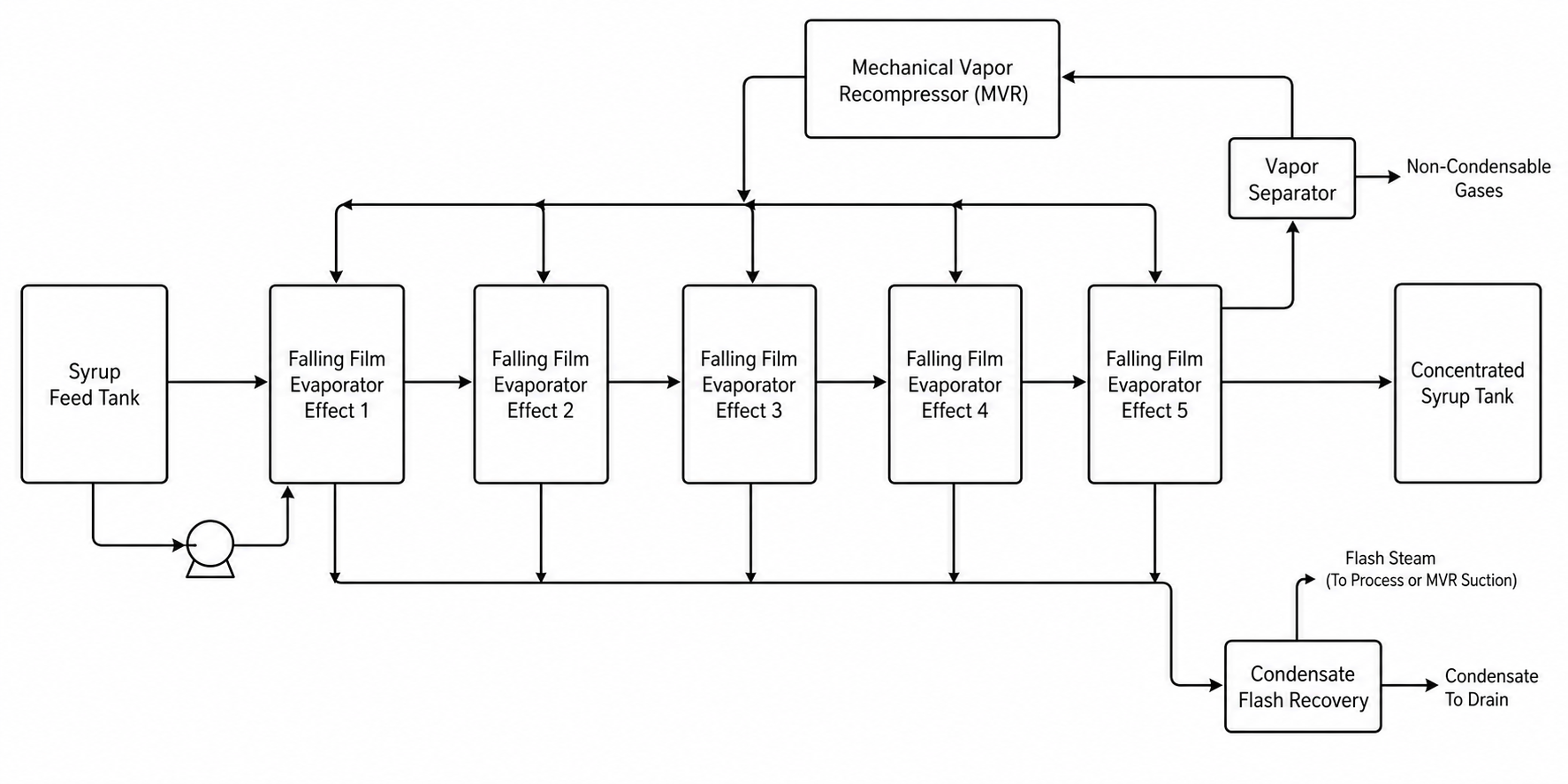
Glucose liquor from conversion is screened and preheated in condensate and vapor recompression heat exchangers — energy integration first, as in every modern sweetener plant. The train combines five effects with MVR drive in a hybrid arrangement: the MVR recompressor motivates the early effects where vapor volumes are highest, while the multi-effect chain reuses vapor from each effect to heat the next, multiplying every unit of energy put into the train.
Falling-film evaporation is the geometry of choice for glucose across the industry: the liquor descends the heating surfaces as a thin film under gravity, evaporating in seconds of wall contact at low temperature difference. That short contact is what protects color and sugar integrity — the difference between a syrup that ships and a syrup that reprocesses. In the later effects, as solids climb and viscosity rises with it, liquor distribution systems and circulation rates are engineered up to keep films intact and prevent dry-out patches that would foul and darken.
The train condenses against a surface condenser at the final effect, with the vapor pulled by vacuum system to hold boiling temperatures down through the chain. Condensate segregation recovers clean hot water from the later effects — a valuable stream in a corn plant, reused for starch washing and conversion dilution — while first-effect condensate with traces of volatile organics is collected separately.
Product syrup leaves the final body at target solids into finished-syrup tankage, headed for crystallization, isomerization or storage. Between campaigns, clean-in-place circuits restore the film surfaces — sugar fouling is manageable but never absent, and the wash sequences are part of the plant’s operating rhythm.
Equipment Configuration
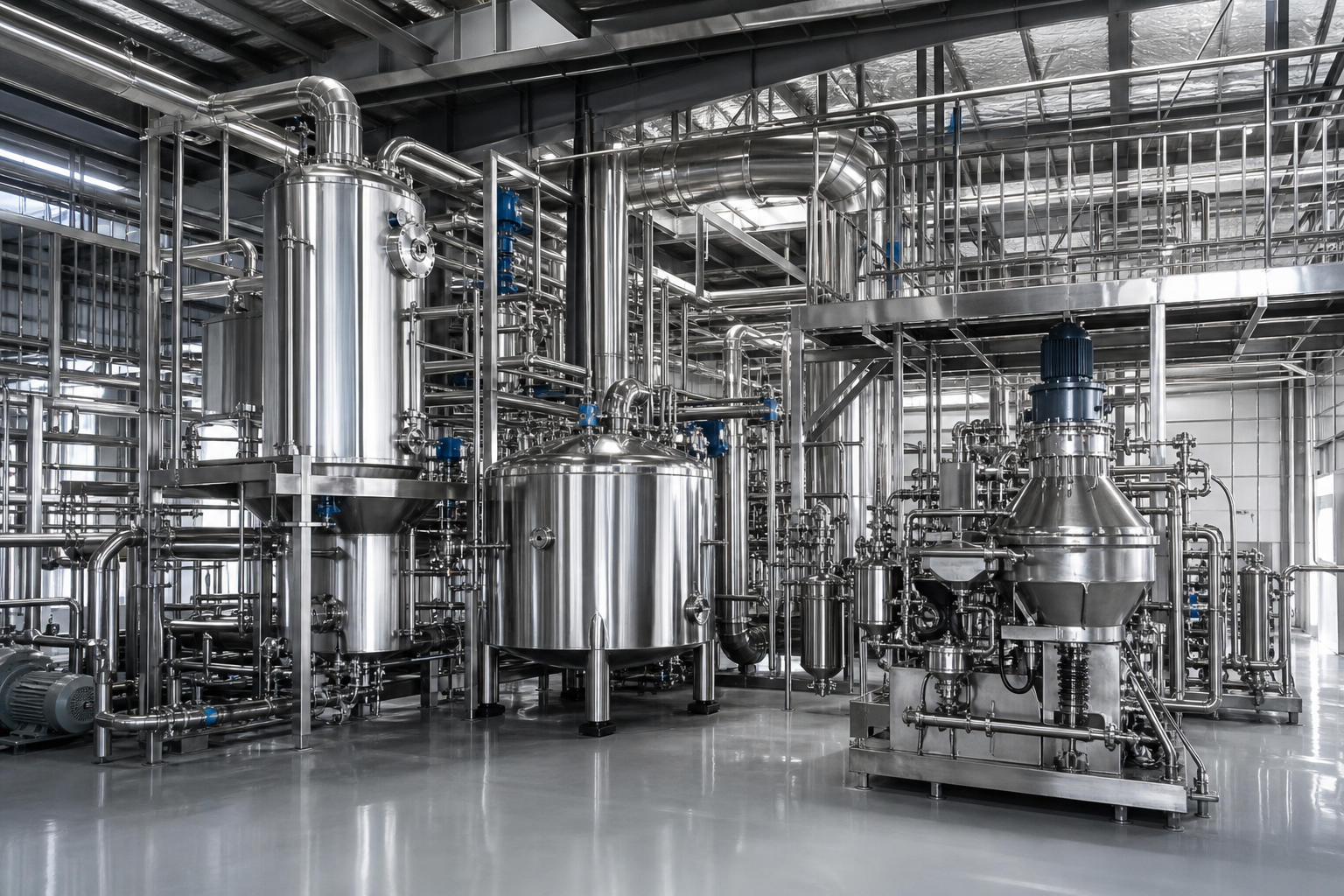
One set of the following equipment is typical for this duty:
- Feed screening and condensate/vapor-based preheating
- Five-effect falling-film evaporator train with MVR recompressor on the head effects
- Vacuum system and surface condenser on the final effect
- High-viscosity distribution and circulation engineering in the finishing effect
- Segregated condensate systems for starch-washing reuse
- Food-grade SS304/316L construction; PLC control of solids profile with CIP between campaigns
Performance & Outcome
Compiled from published industry project data, indicative: trains of this class concentrate glucose to product solids on hybrid MVR multi-effect energy with color protection from short-contact falling-film geometry, at duties from 42 to 70 t/h. Steam-equivalent savings and final color are quoted per project.
For context on where this equipment class fits, see Starch Syrup & Sweetener Evaporation Solutions.