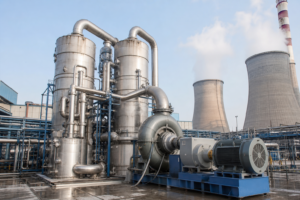
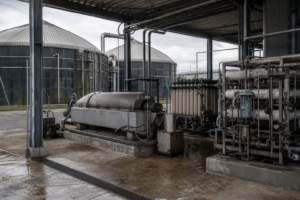
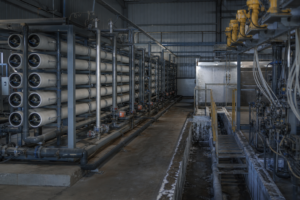
For coal-to-liquid (CTL) plants running in water-stressed regions, the workable zero liquid discharge (ZLD) configuration is a full-recovery train: conventional UF/RO pretreatment, a high-recovery reverse osmosis stage that tolerates the silica and hardness profile of synthesis-loop water, then a falling-film brine concentrator followed by a forced-circulation crystallizer, with ion exchange polishing the recovered water back to boiler-feed quality. The design premise is simple and unforgiving: a CTL facility can consume on the order of ten tons of fresh water per ton of coal-derived fuel, so the ZLD island is not an environmental accessory – it is the plant’s second water supply.
Why Coal-to-Liquid Plants Cannot Discharge – and Why Conventional Reuse Falls Short
Direct coal liquefaction and indirect Fischer-Tropsch routes both generate a consistent family of wastewater: high-salinity process condensates and sour water strippers, gasification quench blowdown, and circulating-cooling sidestreams. After phenol recovery, ammonia stripping and biological treatment, the plant is left with a brine stream whose dissolved salt keeps accumulating in any open reuse loop. Discharge permits in the dry coal-chemical basins of northwest China are effectively unobtainable for these streams, and freshwater allocation is the binding constraint on capacity expansion.
Conventional treatment gets a CTL plant partway. Ultrafiltration and reverse osmosis recover 65-75% of the water as reuse-grade permeate, but the remaining 25-35% leaves a concentrated brine that still carries every gram of salt the plant generated. Standard RO also struggles with the silica and scaling tendencies of synthesis-loop water at high recovery. Closing the last fraction of the water balance is precisely where the thermal ZLD island – concentrator plus crystallizer – earns its capital cost, and where most of the engineering risk concentrates.
The scale reference that defines this application is external and public: the ZLD facility supplied for Shenhua Ningxia Coal Industry’s 4 million ton per year coal-to-liquid project recycles over 55,000 m³/d (2,300 m³/h) of wastewater and eliminates all liquid discharge, using UF/RO, high-efficiency reverse osmosis (HERO), unseeded falling-film evaporators as brine concentrators, and back-end crystallizers, with ion exchange post-treatment returning high-purity water to the process (Aquatech press reference – an external industry reference, not an EvapCryst delivery).
Illustrative Feed Envelope for Screening
The envelope below consolidates publicly reported values from the Ningxia CTL reference with ranges commonly used for early-stage screening of coal-liquefaction brines after biological treatment. It is an illustrative envelope built from published industry material and stated assumptions – not a customer dataset, and not a performance guarantee.
| Parameter | Illustrative range | Basis / note |
|---|---|---|
| Feed to ZLD island (post-UF/RO concentrate) | RO reject from a 65-75% recovery front end | Salt mass fixed by coal and catalyst chemistry |
| Dissolved silica | 50-300 mg/L in HERO feed after pH adjustment | Drives high-pH RO chemistry selection |
| Hardness (Ca/Mg) | Softened to low levels ahead of concentration | Carbonate/sulfate scaling control |
| Principal ions | NaCl dominant; Na2SO4, CaCl2 fractions vary by gasifier | Coal-chemical mixed-salt family |
| Reference scale | 2,300 m³/h recycled water for a 4 Mt/y CTL base | Published Shenhua Ningxia reference |
| Treatment objective | No liquid discharge; distillate to ion exchange and full reuse; salt solids out | Regulatory and water-balance driven |
Process Solution: Membrane Front End, Thermal Back End, Polish in Between
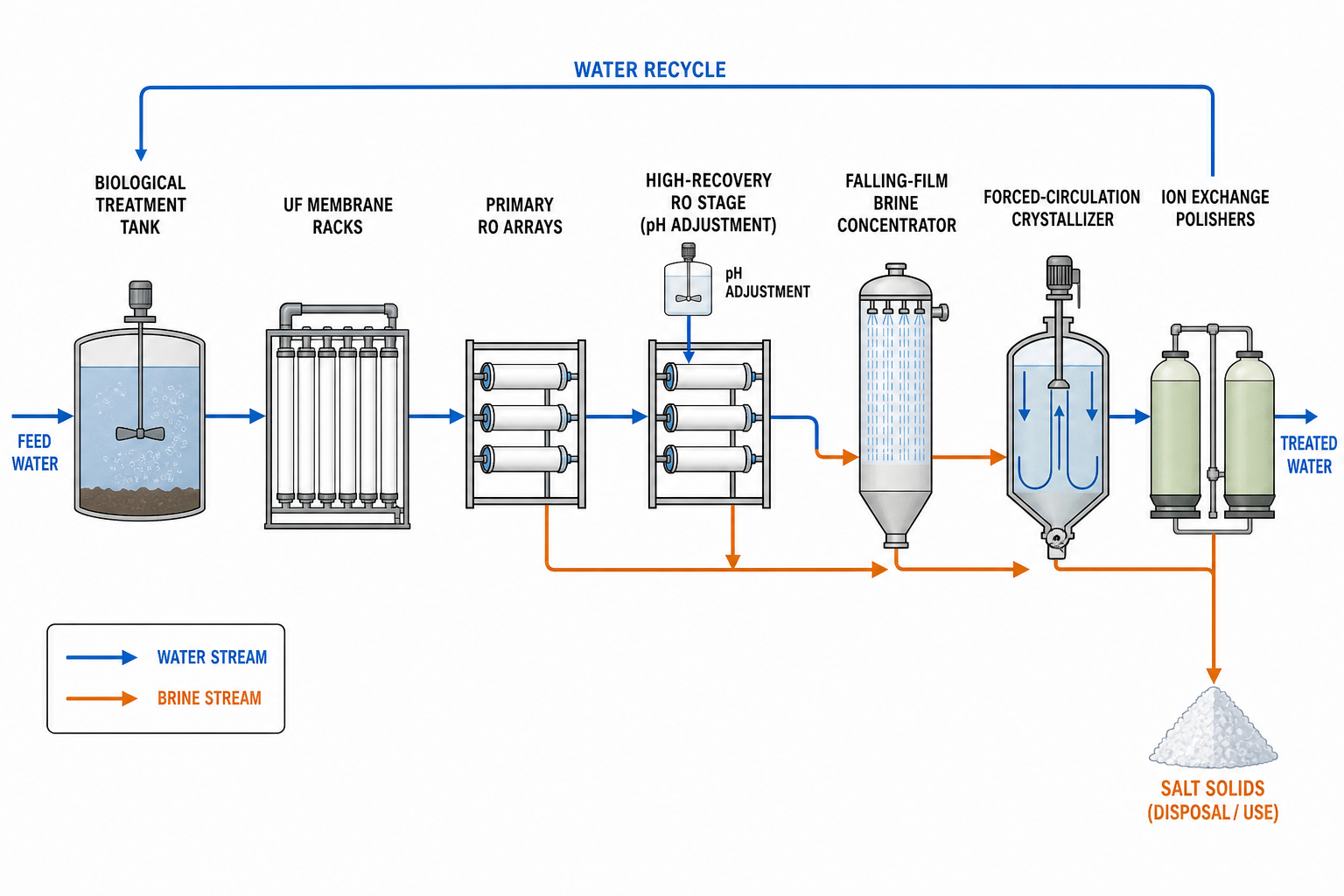
The train runs in four blocks. First, UF/RO does the bulk water lifting: ultrafiltration removes suspended and colloidal matter from the biologically treated water, and primary RO recovers two-thirds or more of the flow as direct reuse permeate. Second, the RO reject passes to a high-recovery RO stage operated under high-pH conditioning – the configuration that makes silica manageable by keeping it ionized and soluble while hardness is softened ahead of the membranes. This is the block that decides how much brine the thermal island must evaporate; every percentage point of membrane recovery here removes a percentage point of evaporator duty, which is the dominant OPEX and CAPEX lever in the whole flowsheet.
Third, the concentrated brine enters the thermal ZLD island: a falling-film brine concentrator that takes the feed from RO-reject concentration to near-saturation, followed by a forced-circulation crystallizer that drives the liquor through saturation to a dischargeable salt slurry. The falling-film concentrator is deliberately run unseeded in the published reference configuration – a design choice that relies on wetted-tube chemistry and controlled supersaturation rather than crystal seeding to manage sulfate and carbonate scale. Fourth, distillate from both thermal blocks condenses clean and reports to ion exchange polishing, producing the high-purity water the synthesis and steam systems demand. Salt solids from the crystallizer are dewatered and leave the water balance entirely.
Technical Features That Decide Whether ZLD Holds at This Scale
Three features carry the engineering weight at CTL scale. The first is the high-recovery RO chemistry. Standard RO at neutral pH will silica-scale or hardness-scale before reaching the recoveries that make the thermal island affordable. Operating the high-recovery stage at elevated pH after softening changes the silica speciation and lets the membrane front end do more work – this single choice can move tens of percent of the water recovery from the evaporator (the expensive side) to the membranes (the cheap side). Published MLD/ZLD analyses put the cost gap between membrane recovery and thermal recovery at a factor of several (DuPont MLD economics reference – external industry reference), which is why the boundary between the two blocks is the most consequential line on the flowsheet.
The second is the unseeded falling-film concentrator. Seeded slurry evaporators suppress scaling by growing crystals in suspension; the unseeded design instead keeps the tube wall wetted and the film-side supersaturation controlled so that scale never forms at the rate that matters. For CTL brines with moderate calcium and sulfate, this reduces solids inventory and simplifies operation, but it demands disciplined feed chemistry control – the protection is chemical, not mechanical.
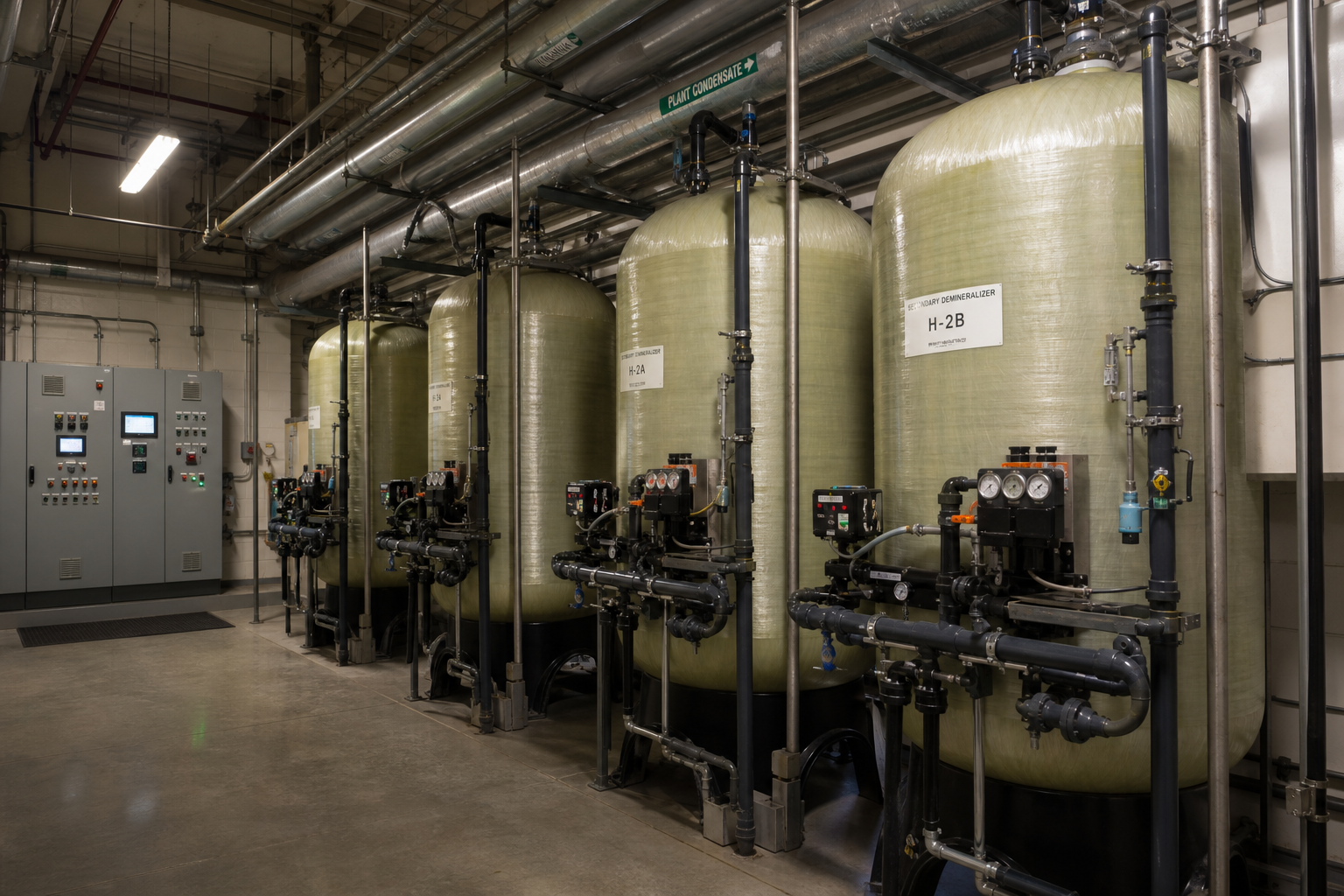
The third is water-quality closure through ion exchange. The value of the recycled water in a CTL plant is set by whether it can replace demineralized makeup. Distillate from the evaporator is clean but not boiler-grade; the polishing exchange train is what converts the ZLD island from a compliance asset into a production asset.
Process Modules
| Process module | Candidate equipment types | Selection rationale | Module duty |
|---|---|---|---|
| Solids and colloids removal | Ultrafiltration modules | Stable RO feed quality from biologically treated water | Protect downstream membranes |
| Primary water recovery | Brackish/high-recovery RO arrays | Lowest-cost water recovery increment | Recover 65-75% as reuse permeate |
| Brine concentration (membrane) | High-pH high-recovery RO after softening | Silica management under alkaline conditioning | Minimize thermal duty; fix evaporator feed TDS |
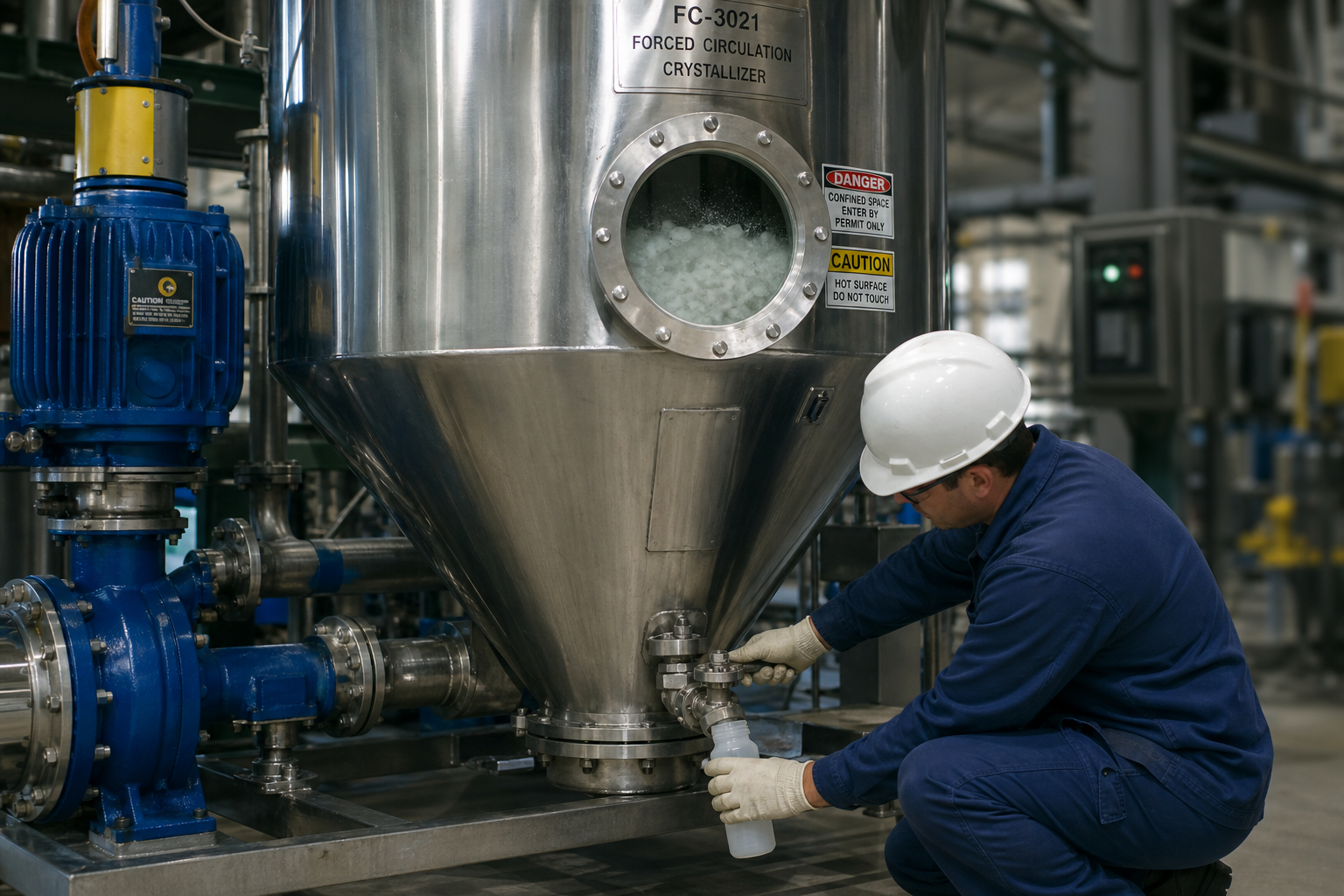
| Thermal concentration | Falling-film brine concentrator (MVR or live-steam) | High coefficient at moderate TDS; near-saturation delivery | Bulk evaporation of RO reject |
| Crystallization | Forced-circulation crystallizer | Handles supersaturated slurry without tube plugging | Convert brine to dewaterable salt solids |
| Distillate polishing | Ion exchange trains | Boiler/synthesis-grade water from condensate | Close the purity loop for reuse |
| Solids handling | Thickener, centrifuge, dryer | Handleable salt cake for disposal or valorization | Remove salt mass from site |
Configuration, materials and operating envelopes above are potential considerations only; actual selections depend on feed composition, temperature, corrosion review, fouling behavior, utilities and project capacity.
Expected Performance and Limits
The published reference performance for this application class: over 55,000 m³/d recycled with complete elimination of wastewater discharge at the Shenhua Ningxia CTL base, with recycled water treated to high purity and returned to process use (external industry reference; indicative, not a project guarantee). For a generic CTL train of this architecture, overall water recovery to the ZLD boundary is effectively total – what the membranes do not recover, the evaporator does – and the practical limits sit elsewhere: specific energy of the thermal island (typically the largest single OPEX line, scaling with the RO-reject flow the membrane front end fails to recover), and the disposal or valorization route for the mixed salt cake.
Engineering estimates for trains of this shape put membrane-stage recovery at 65-75% for the primary stage and substantially higher for the conditioned high-recovery stage, leaving a thermal duty sized on the balance. Limits worth respecting: the unseeded concentrator depends on disciplined softening and pH control upstream; silica excursions or hardness breakthrough will find the evaporator within days. Mixed CTL salts (NaCl with Na2SO4 and calcium fractions) rarely meet product salt standards without separation steps, so the default planning assumption is disposal or co-processing, not sale.
Industry References and Validation
Two public references anchor this route. The ZLD system supplied for the Shenhua Ningxia Coal Industry 4 Mt/y coal-to-liquid project – UF/RO, HERO high-recovery RO, unseeded falling-film evaporators, crystallizers, and ion exchange – recycling over 55,000 m³/d in northwest China (Aquatech published material; an external industry reference, not an EvapCryst delivery). And the membrane-concentration economics that justify pushing recovery before the thermal island: MLD configurations recovering up to 95% by membrane means before thermal processing, reducing overall ZLD cost by up to 60% (DuPont Water Solutions published MLD analysis; external industry reference). For your own project, validation effort should concentrate on four items: a site-wide water and salt balance to fix the ZLD feed; softening and silica speciation testing to set the high-recovery RO boundary; boiling-point-rise and scaling-assessment of the concentrated brine for the concentrator; and a confirmed outlet for the salt solids.
Frequently Asked Questions
Why not just run the evaporator on the full wastewater flow?
Cost. Every cubic meter the membranes recover first is a cubic meter the thermal island does not have to evaporate, and membrane recovery is several times cheaper per cubic meter than thermal recovery. The evaporator should only ever see the brine the membranes cannot economically touch.
What does “unseeded” falling-film operation actually mean?
It means scale is managed by keeping the tube fully wetted and the film-side supersaturation controlled, rather than by adding seed crystals that absorb precipitating salts in suspension. It simplifies the plant but shifts the protection burden onto upstream softening and pH discipline.
Can the recovered water replace demineralized makeup?
Yes, after ion exchange polishing. Evaporator distillate is low-TDS condensate; the polishing train raises it to the purity the steam and synthesis systems require, which is what turns the ZLD island into a water supply rather than a treatment cost.
Is MVR or live steam better for the concentrator?
It depends on the site’s energy picture. MVR converts the duty to electricity and suits sites with costly steam; live-steam or multi-effect suits sites with cheap coal-fired steam. CTL bases usually have cogeneration, so the comparison must be made on actual marginal steam and power prices.
Can the crystallizer salt be sold?
Not usually without separation. CTL brines carry mixed NaCl/Na2SO4 with calcium and trace organics; saleable product salt requires a salt-splitting or fractional crystallization step. The prudent baseline is disposal with valorization as upside.
When This Route May Not Fit
If the plant’s brine is very small – a pilot or single-train facility generating a few cubic meters per day of concentrate – trucking to a regional evaporation or treatment facility will remain rational long after the ZLD business case is forced. If feed silica runs far above the envelope and softening cannot economically reduce it, the high-recovery RO boundary retreats and the thermal island grows until the economics invert. And if local regulation still permits controlled discharge of treated brine, the entire ZLD question changes shape – it becomes a water-supply decision rather than a compliance one.
What Must Be Verified Before Committing
Five items: a 24-hour profiled water and salt balance across the plant (TDS trend by stream); softening and silica-speciation jar work on real RO reject to fix the high-recovery RO limit; a boiling-point-rise and scaling-tendency assessment of the concentrated brine for the falling-film and forced-circulation blocks; a distillate-quality target agreed with the boiler and synthesis teams so the ion exchange train is sized correctly; and a legally confirmed disposal or valorization route for the salt cake. These map directly onto the modules above and are the standard screening package we would run before any quote.