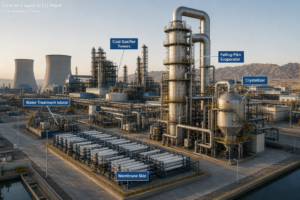
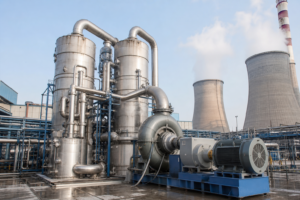
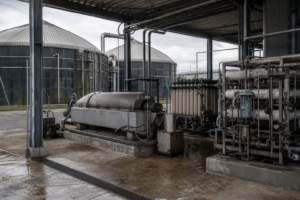
Black liquor evaporation to high firing solids runs on multi-effect trains – six or seven effects for the mainstream concentration duty – with forced-circulation or enhanced high-solids concentrator stages pushing the product to 74-80% total solids, and with chloride removal crystallization protecting the recovery boiler from non-process element buildup. The defining public reference is the evaporator island built for a US containerboard mill in Virginia: a single six-effect falling-film train rated 897,000 lb/hr (407 t/h) of evaporation producing 74% product solids, integrated with a salt cake crystallizer for precipitator ash treatment and an Enhanced High Solids Concentration (EHSC) forced-circulation stage for the final lift (a supplier-published forced-circulation case study – an external industry reference, not an EvapCryst delivery). The design premise: every point of solids to the recovery boiler is boiler capacity, and the evaporator train is where that number is set.
Why the Evaporator Island Is the Mill’s Throughput Governor
Kraft black liquor leaves the washers at 13-17% dry solids. The recovery boiler needs it fired as strong as viscosity allows – typically above 68% for stable operation and up to 80% in high-solids firing practice, because each increment of solids is increment of fuel and decrement of furnace heat lost to water evaporation. The evaporator train that closes that gap is therefore not auxiliary equipment: it sizes the chemical and energy recovery the whole mill runs on. The technology family has a deep installation base – the HPD black liquor systems alone count more than 450 installations worldwide across Brazil, Indonesia, China, Japan, Australia, South Africa and Europe, supplying evaporators and concentrators up to 80% TS, black liquor heaters, condensate segregation, foul condensate stripping and methanol rectification, NCG collection, soap skimming and tall-oil acidulation, and turpentine recovery (supplier-published material – an external industry reference).
The reference project illustrates the full integration scope. The mill replaced three aging evaporator trains with one design-build island: the six-effect falling-film train at 407 t/h evaporation and 74% product solids; processing of precipitator slurry, tall-oil brine and recovered boilout liquors alongside the black liquor; a salt cake crystallizer (the Chloride Removal Process, CRP, unit); soap skimming tank, cooling towers, foul condensate tank, new MCC and control system; and an indirect black liquor heater system outside the island. MACT I compliance was achieved through condensate segregation producing high-quality water for mill reuse – the regulatory driver and the water-recovery benefit arriving together.
Illustrative Duty Envelope for Screening
The envelope below consolidates the published reference case with standard kraft evaporation practice. It is an illustrative envelope built from published industry material – not a customer dataset, and not a performance guarantee.
| Parameter | Illustrative range | Basis / note |
|---|---|---|
| Weak liquor feed solids | 13-17% TS from brown stock washers | Standard kraft practice |
| Firing solids target | 68-80% TS depending on firing practice | Reference case: 74% product |
| Evaporation duty (reference) | 407 t/h (897,000 lb/hr) in six effects | Published reference rating |
| Steam economy class | Six to seven effects on low-pressure steam | Published configuration family |
| Chloride/potassium control | CRP crystallizer on dissolved precipitator ash | Reference case: high-Cl ash confirmed |
| Condensate strategy | Segregated clean/foul streams; foul stripped | MACT I compliance + reuse water |
Process Solution: Falling-Film Body, High-Solids Tail, Chloride Purge
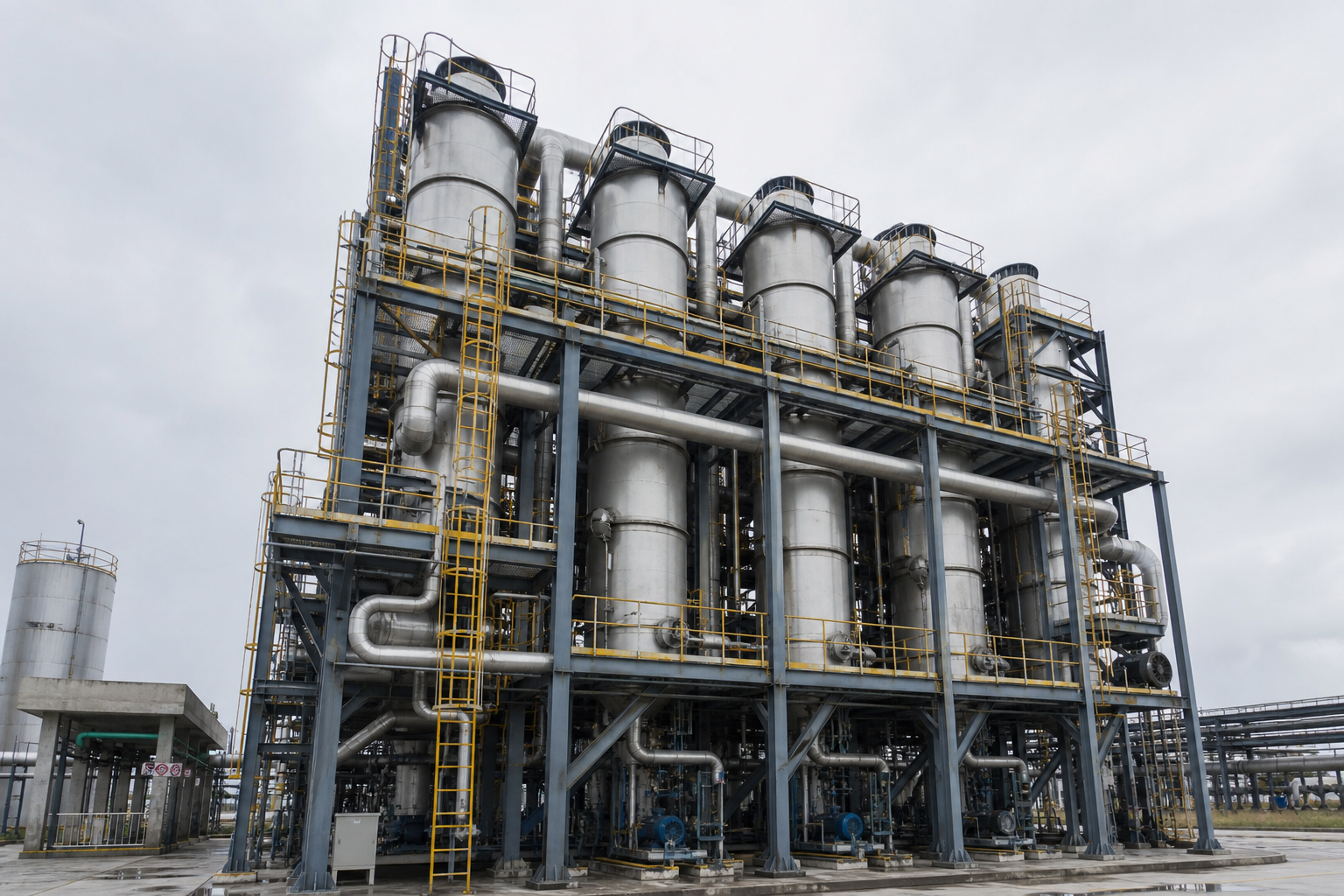
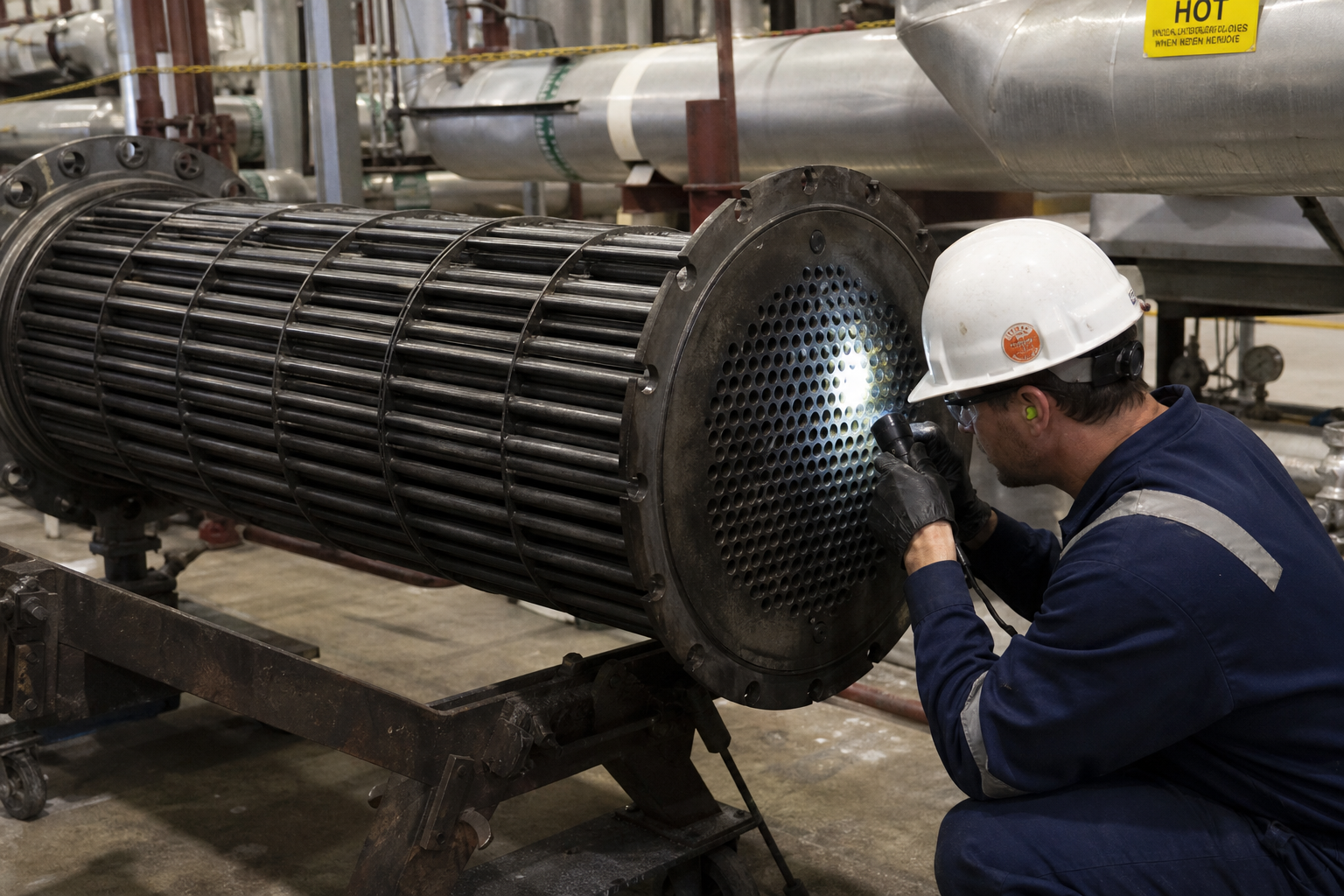
The train runs in three functional blocks. The first is bulk concentration: weak liquor rises through the falling-film effects in sequence (five to six effects in the reference class), each effect evaporating water at progressively lower temperature and pressure with the vapor serving the next effect’s heating duty. Falling-film heat transfer coefficients are high at moderate solids, which is where the bulk of the water leaves; the published family runs these trains on low-pressure steam at the first effect. Condensate is segregated effect by effect – clean condensate back to the boiler cycle, foul condensate to stripping and methanol recovery – which is simultaneously the MACT I compliance mechanism and the mill’s high-quality water source.
The second block is the high-solids tail. Above roughly 60-65% TS, black liquor viscosity climbs steeply and calcium carbonate and burkeite scale risk concentrates; plain falling film gives way to forced circulation. The reference solution is the EHSC arrangement: forced-circulation evaporation with spiral rib inserts in the heater tubes creating turbulence at high viscosity with lower recirculation rates than conventional forced circulation – the published description credits the inserts with mixing the boundary layer and minimizing the laminar sublayer on the tube wall, reducing fouling while spending less horsepower.
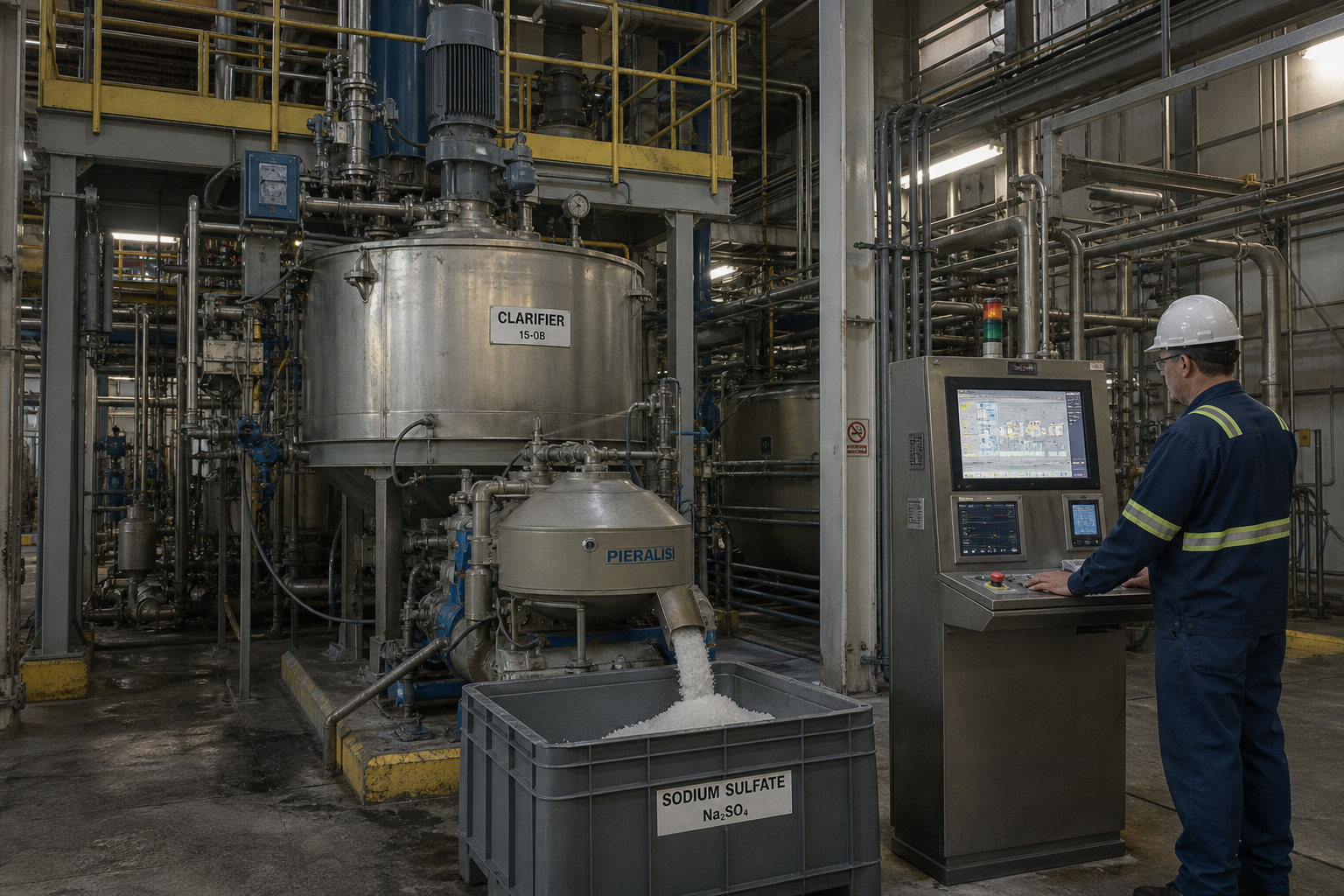
The third block is non-process element control. Chloride and potassium entering with wood and chemical makeup accumulate in the recovery cycle; the consequences are superheater plugging, boiler corrosion and rising steam demand. The CRP answer: dissolve precipitator ash in condensate, feed it to an evaporative crystallizer where sodium sulfate (and depending on ash composition, sodium carbonate) crystals precipitate, centrifuge the slurry, wash the crystals, and return the sodium to the black liquor for chemical recovery. The purge removes chloride and potassium with it while recovering soda – less purge for the same chloride removal than raw ash dumping, cutting soda makeup expense.
Technical Features That Decide Whether the Train Holds Its Rating
Three features carry the engineering weight. The first is the viscosity-solids boundary management. The economics of 74-80% firing solids collapse if scale closes the heat transfer surface – the train’s availability is set by how long the high-solids sections run between washes. The reference class attacks this with the insert-turbulence EHSC design and with liquor chemistry management (firing-side salt cake balance feeding back through the ash cycle); the companion crystallization-route article covers the sulfate-seeding approach to the same problem.
The second is condensate segregation discipline. The value of the evaporator island’s water output depends on keeping clean and foul condensates apart – effect by effect, with the foul fraction stripped for methanol and reduced sulfur compounds. Mills that blend the streams surrender both the reuse water value and the MACT compliance margin; the segregation system is as much a product of the island as the strong liquor itself.
Third is ash-loop chemistry. The CRP stage only pays if the precipitator ash actually carries the chloride – the reference case reports analysis confirming high chloride levels before the CRP was justified. Mills whose chloride load runs low (hardwood-rich furnish, low-Cl makeup) may find the purge economics thin; mills firing significant straw, bamboo or recycled furnish generally find it decisive.
Process Modules
| Process module | Candidate equipment types | Selection rationale | Module duty |
|---|---|---|---|
| Bulk water removal | Six/seven-effect falling-film train | High coefficient at moderate TS on low-pressure steam | 13-17% to ~60-65% TS |
| High-solids concentration | EHSC forced circulation with tube inserts | Turbulence at high viscosity, lower recirculation power | Final lift to 74-80% TS |
| Liquor heating | Indirect black liquor heaters | Viscosity control for firing | Deliver firing-temperature liquor |
| Condensate management | Segregation system, foul stripper, methanol rectification | Compliance + reuse water value | Clean condensate to mill; foul treated |
| NPE control | CRP evaporative crystallizer + centrifuge on dissolved ash | Cl/K removal with sodium recovery | Protect boiler; cut soda makeup |
| By-product recovery | Soap skimming, tall-oil acidulation, turpentine recovery | Value streams riding the liquor | Revenue credits on the island |
Configuration, materials and operating envelopes above are potential considerations only; actual selections depend on liquor chemistry, scaling behavior, steam balance and project capacity.
Expected Performance and Limits
The published reference performance: design production rates and operational targets reached in the reference case – 407 t/h evaporation, 74% product solids, MACT I compliance via condensate segregation with high-quality reuse water, salt cake crystallization integrated – delivered on a single-point design-build basis; the broader family claims more than 450 black liquor installations and concentrator capability to 80% TS (a supplier-published case study and capability material – an external industry reference; indicative, not a project guarantee, and not an EvapCryst delivery). For the configuration class generally, steam economies scale with effect count and vapor reuse (the companion MVR-retrofit article documents the marginal-COP behavior of such trains). The practical limits: high-solids availability is bounded by scaling in the concentration stages – the reference designs buy run-length with insert turbulence and salt chemistry, not immunity; CRP economics depend on the ash chloride assay; and firing-solids targets above 80% move into high-solids firing territory where liquor chemistry (soap, calcium, silica) decides feasibility mill by mill.
Industry References and Validation
Two public anchors. The reference case: six-effect falling-film train at 897,000 lb/hr evaporation and 74% solids, EHSC forced-circulation high-solids stage, CRP chloride removal, integrated ash/brine/boilout processing, MACT I compliance through condensate segregation (a supplier-published case study; an external industry reference, not an EvapCryst delivery). And the capability base: 450+ installations, evaporators and concentrators to 80% TS, and the integration scope from condensate stripping to tall oil (supplier-published material; an external industry reference). For your own project, validation effort should concentrate on: a full liquor balance (flows, solids, scaling species – calcium, silica, oxalate); a viscosity-temperature profile at target firing solids; scaling-assessment testing for the high-solids stages; an ash chloride and potassium assay to price the CRP stage; and a condensate segregation and reuse plan agreed with the boiler and mill water systems.
Frequently Asked Questions
Why falling film for the bulk duty and forced circulation only at the tail?
Heat transfer physics. Falling film earns its high coefficients on thin-film flow at moderate viscosity – which describes the 15-60% range. Above that, viscosity defeats the film and wall wetting; forced circulation takes over, deliberately trading energy for scale tolerance exactly where scaling concentrates.
What do the spiral rib inserts actually do?
They disrupt the laminar sublayer on the tube wall. In high-viscosity liquor the resistance to heat transfer concentrates at that layer; the inserts mix bulk liquor into it, raising the effective coefficient at lower recirculation rates than smooth-tube forced circulation – less pumping power for the same scale protection, per the published EHSC description.
Why crystallize precipitator ash instead of just purging it?
Sodium. Raw ash purge throws away soda with the chloride, forcing makeup purchase. The CRP dissolves the ash, crystallizes the sodium salts out, washes and returns them to the liquor, and lets the chloride and potassium exit in the mother liquor – the same chloride removal with much less soda loss.
Is 74% solids or 80% the right target?
It is a liquor-chemistry and boiler question. The reference case landed at 74%; the family extends to 80% TS. Each increment buys boiler capacity and steam, and costs evaporation energy and scale risk. The viscosity profile and scaling assessment at your liquor’s chemistry set the defensible ceiling.
What is MACT I and why did it drive the design?
A US EPA maximum achievable control technology standard governing hazardous air pollutant emissions – in this context, the foul condensate and NCG handling of the evaporator island. Aging trains that could not meet it economically were replaced; the replacement’s condensate segregation simultaneously produced the compliance margin and the mill’s reuse water.
When This Route May Not Fit
If the mill is small – a specialty or non-integrated operation whose liquor flow supports only three or four effects – the six-effect-plus-concentrator class is over-built, and simpler train architectures or purchased-steam arrangements serve better. If the liquor carries extreme scaling chemistry (high silica from straw or bagasse furnish, for instance), the standard falling-film body needs heavy adaptation and the high-solids target retreats. And if the mill has no chloride problem in its ash assay, the CRP block is idle capital – verify before including it.
What Must Be Verified Before Committing
Five items: a full liquor balance with scaling-species profiling (Ca, Si, oxalate, burkeite tendency); viscosity-temperature curves at candidate firing solids for the mill’s liquor; scaling-assessment and wash-cycle testing for the high-solids stages; a precipitator ash chloride/potassium assay to price the CRP; and a condensate segregation plan with the boiler team confirming reuse quality targets. These map directly onto the modules above and are the standard screening package we would run before any quote.