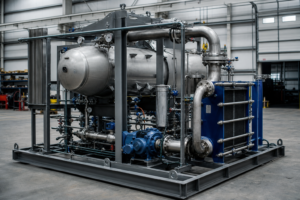
Before an evaporator is a machine, it is a heat-transfer surface—and everything in the feed water conspires to coat, corrode or choke that surface. Three mechanisms decide the fate of nearly every installation: scaling (hardness and silica depositing on heat-transfer area), corrosion (pH and chloride attacking the metallurgy) and foaming (surfactants destabilizing vapor release). For MVR evaporators the inlet red lines are concrete: combined Ca2+/Mg2+ below 100 mg/L, silica below 30 mg/L, pH between 5 and 8, fluoride below 20 ppm, no cyanide, and a boiling point elevation preferably under 15 °C. Feed that misses those lines is not a reason to abandon evaporation—it is a reason to pretreat. This article maps the softening and pH-adjustment options, the special cases of silica and fluoride, and the laboratory workflow that turns guesswork into a material and process specification.
Why Feed Quality Decides the Evaporator’s Fate
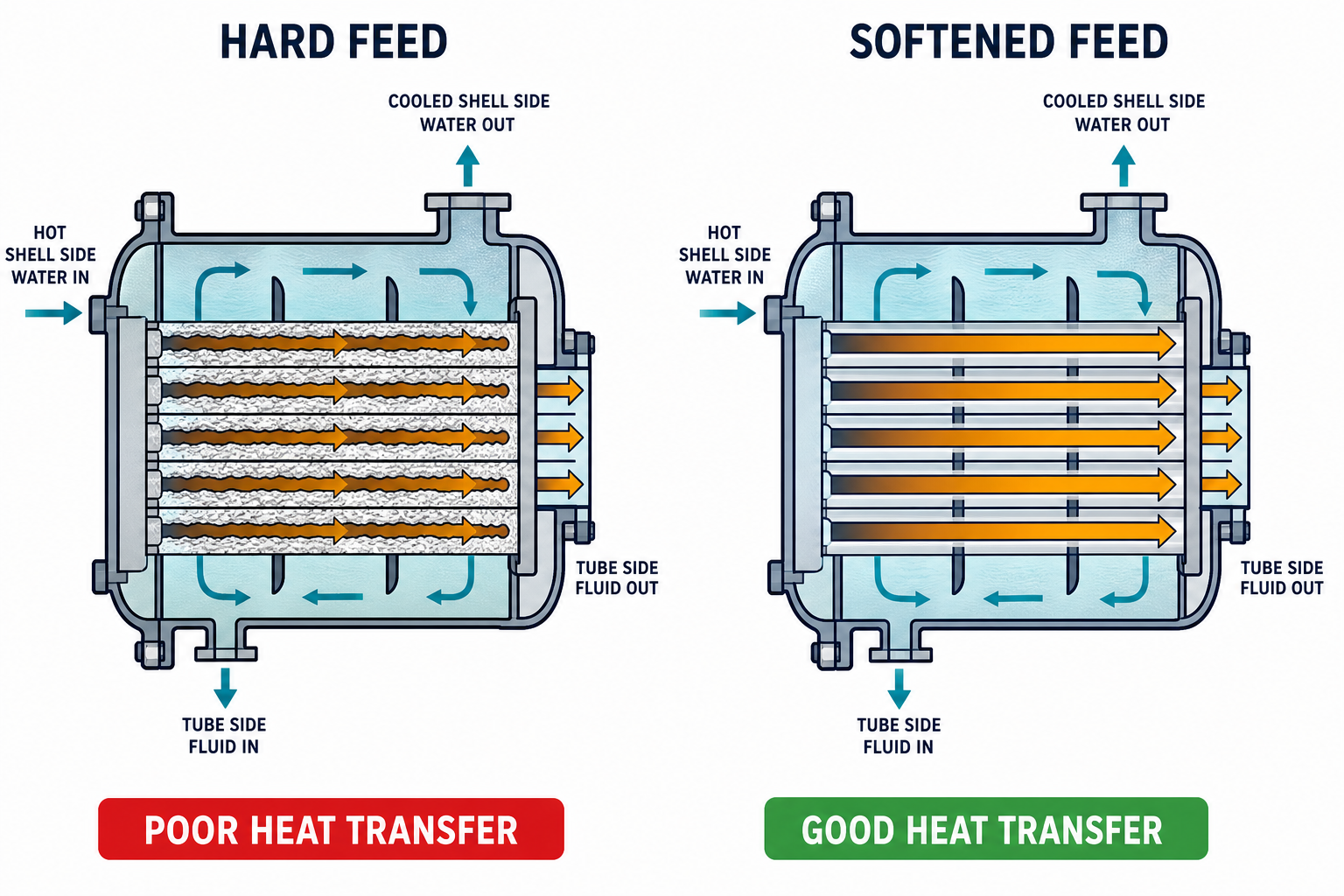
Every kilogram of dissolved mineral that enters an evaporator stays behind as water leaves. As concentration climbs toward saturation, the least soluble species precipitate—preferentially on the hottest surface available, which is exactly the heat-exchange wall. That is scaling: a growing layer of low-conductivity mineral between the heating medium and the process liquor. Corrosion runs on a parallel clock, driven by pH, temperature and chloride content acting on the wetted metallurgy. Foaming attacks vapor handling: detergents and soaps stabilize bubbles that carry liquor into the condensate and trip the separator. None of these three failures is sudden; all of them are gradual, measurable and—handled early—cheap to prevent. Handled late, each one becomes an unplanned shutdown.
Feed Water Limits for MVR Evaporation
MVR systems concentrate heat and hardware in a recycle loop—preheater, heater, vapor-liquid separator, steam compressor and vacuum pump, nearly all of it metal—so inlet limits protect both the thermodynamics and the machinery (commonly applied industry guidelines):
| Indicator | Limit | Why it matters |
|---|---|---|
| Ca2+ + Mg2+ | < 100 mg/L combined | Above the limit, evaporator scaling is rapid; hardness is the #1 scaling driver |
| Silica / silicates | < 30 mg/L | Silica scale polymerizes on surfaces and resists chemical cleaning |
| pH | 5 – 8 | Protects metal components from acid and alkali attack |
| Fluoride F⁻ | < 20 ppm | Fluoride attacks titanium surfaces |
| Cyanide | None allowed | Presents a safety hazard in the vapor system |
| Boiling point elevation (BPE) | Preferably < 15 °C | See next section |
The same logic excludes whole feed families from MVR: strongly acidic or alkaline liquors (outside what the metallurgy tolerates), streams containing volatile, flammable or explosive components (compression of such vapors creates unacceptable safety risk), and high-impurity waters generally—MVR is happiest evaporating relatively clean liquors, and every additional impurity erodes operating stability.
Boiling Point Elevation: The Overlooked Limit
Dissolved salts raise the boiling point of the liquor above that of pure water. A mechanical vapor compressor can only lift the vapor temperature by a fixed amount per stage; when the boiling point elevation is large, the temperature lift the process demands exceeds what one compression stage can deliver. The system then needs multi-stage compression, which raises electricity consumption and erodes the safety margin that keeps the machine out of surge and vibration. Keeping feed BPE below roughly 15 °C keeps the compressor duty—and the power bill—within the economic envelope that makes MVR worth its capital.
Hardness: Origin, Measurement and the Price of Scale
Water hardness comes from calcium and magnesium, present as carbonate hardness (bicarbonates that decompose on heating) and non-carbonate hardness (sulfates and chlorides). Both forms end the same way: as mineral layers on heat-exchanger surfaces. The cost is measured in heat transfer—scale layers can cut heat-transfer efficiency by up to 30%—and in the follow-on expenses: higher steam and electricity consumption to force the same evaporation rate, frequent cleaning, and unplanned downtime. Measurement is standard water chemistry (EDTA titration or instrumental Ca/Mg analysis), but the number that matters for an evaporator is not the raw feed value—it is the projected concentration at the point of maximum concentration inside the machine, which is where saturation is first reached.
Softening Route 1: Ion Exchange
Ion-exchange softening removes Ca2+ and Mg2+ from the feed before evaporation by exchanging them for sodium on a resin bed. It is the most complete answer for heavily scaling waters: hardness leaves the evaporator’s diet entirely, and the resin regenerates with brine on site. The trade-offs are the regeneration system itself (salt storage, rinse water, a small brine waste stream to manage) and resin sensitivity to fouling by organics and suspended solids—which is why ion exchange usually sits downstream of filtration in a pretreatment train. For ZLD projects, the regeneration brine joins the wastewater stream and is evaporated anyway, so the water balance closes cleanly.
Softening Route 2: Chemical Softening and Antiscalants
Where ion exchange is too much, chemical softening and threshold inhibition fill the gap:
- Lime–soda (two-alkali) softening precipitates calcium as carbonate and magnesium as hydroxide by dosing lime and soda ash; variants dose sodium hydroxide to raise pH and drive the same precipitates. The sludge produced is settled, dewatered and landfilled—sludge handling is a real operating line item, sized from stoichiometry plus experience.
- Antiscalant dosing inhibits deposition without actually removing hardness: threshold-active polymers interfere with crystal nucleation and keep minerals in suspension past their normal solubility. It is the economical default for moderate hardness and is often sufficient where full softening would be over-engineering.
- Process-side measures complete the toolbox—pairing MVR with crystallization handles high-TDS water with reduced scaling, and forced-circulation evaporators suppress salt accumulation on tubes by keeping boiling out of the heated tube bundle.
Acidic Wastewater Pretreatment
Acidic feeds bring a regulatory dimension and a corrosion dimension. Under the US RCRA framework, aqueous waste with pH below 2 is classified as corrosive hazardous waste; even above that threshold, acidic water accelerates corrosion of metals and materials, with pH, temperature and inorganic chloride concentration acting as the three decisive variables. The ideal evaporation window is pH 6–7: at process temperature this range simultaneously minimizes corrosivity and foaming tendency. Adjusting to that window is cheap and automatable—and neutralization frequently removes the RCRA hazardous-waste classification entirely, simplifying permitting. Where caustic dosing is used, rayon-grade sodium hydroxide is preferred for its low chloride content (chloride is the corrosion accelerant you are trying to avoid adding). The alternative to pH control is metallurgy: higher-alloy wetted parts instead of the standard 316 stainless steel that most evaporator suppliers furnish—but alloy upgrades price quickly, which is why pH adjustment is almost always the first move.
Alkaline Wastewater Pretreatment
Alkaline feeds arrive from parts washing, vibratory and tumbling operations, compressor condensate, dye-penetrant inspection, floor scrubbing and some plating rinses—usually carrying soaps and detergents. RCRA classifies pH above 12.5 as corrosive hazardous waste. Two problems dominate: a high tendency to foam (the surfactants) and scaling by the insoluble salts of calcium, strontium, barium and magnesium. Three countermeasures, used individually or together, handle nearly all alkaline feeds:
- pH adjustment to neutral or slightly acid, which minimizes or eliminates foaming;
- high-temperature defoamers—mostly silicone-based—which puncture bubbles and lower surface tension;
- reduced heat input, because violent boiling aggravates certain foams (soap solutions classically); the price of turning down the burner is a lower evaporation rate.
Two decades of industry-reported evaporator service indicate that scaling-type alkaline waters are almost all evaporable once pH adjustment, defoamer and heat-input control are applied as a package.
Silica and Fluoride: The Special Cases
Silica earns its own limit because of what happens after it deposits: polymerized silica scale bonds to surfaces and shrugs off the acid and caustic cleans that remove carbonate and metal deposits. Prevention—keeping feed below roughly 30 mg/L, dispersant dosing, or pre-removal by coagulation at high pH—is far cheaper than mechanical removal. Fluoride earns its limit through metallurgy: even modest fluoride levels attack titanium, which is otherwise the premium corrosion-resistant choice for heat-exchange surfaces in chloride service. Fluoride-bearing feeds call for either removal (lime precipitation as calcium fluoride) or a deliberate material substitution so the fluoride never meets the titanium.
What Should Never Enter an MVR System
Some feeds should be redirected before anyone sizes an evaporator: strongly acidic or alkaline liquors beyond what the wetted metals tolerate; streams carrying volatile, flammable or explosive substances, whose vapors would pass through the compressor—an unacceptable safety risk; and feeds so laden with impurities that stable operation is impossible regardless of chemistry. Recognizing these early redirects a project toward multi-effect evaporation with its steam economy, or toward pretreatment investment, instead of toward an MVR failure story.
The Qualification Workflow: Test Before You Buy
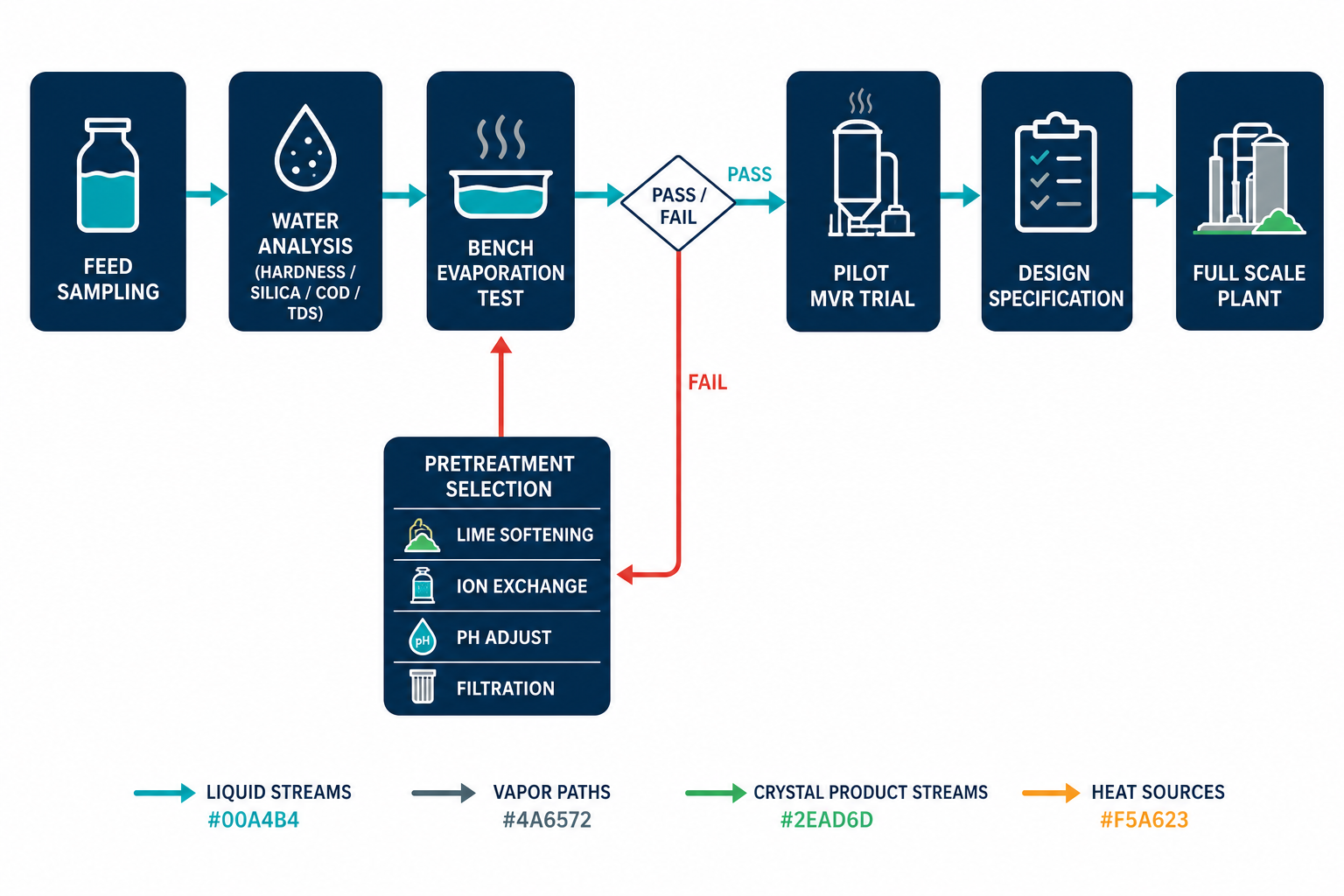
Reputable evaporator practice does not size equipment from an email exchange. The workflow is: full water analysis of a representative sample; laboratory bench testing—concentration runs that observe viscosity rise, crystallization onset, foaming and corrosion behavior; and only then a material and process recommendation, covering metallurgy, pretreatment and operating parameters. Suppliers offer this qualification step (sample analysis leading to materials and operating recommendations) precisely because production-site trial and error is the most expensive way to discover that a feed scales, corrodes or foams. The same discipline applies to softer questions—scale formed during operation is addressed by clean-in-place (CIP) systems that circulate cleaning chemicals without opening the machine, reducing the labor of manual descaling, and ultrasonic antifouling is emerging as a front-running technique worth tracking.
Industry-Ready Starting Points
| Feed family | Typical pretreatment package |
|---|---|
| Food, beverage, pharmaceutical | Softening (ion exchange) + MVR evaporation |
| Mining and general wastewater | Chemical treatment (pH adjustment, precipitation) + forced-circulation evaporation |
| High-hardness cooling blowdown | Lime–soda softening or antiscalant + evaporator/crystallizer |
| Alkaline washwaters | pH adjustment + defoamer + heat-input control |
These pairings are starting points, not verdicts—the qualification workflow exists because your water will have opinions of its own. Feed that resists pretreatment still has an endgame: concentrate it and manage the residue, which is where mother-liquor treatment and ZLD system design take over.
Frequently Asked Questions
What are the inlet water requirements for an MVR evaporator?
Keep combined Ca2+/Mg2+ below 100 mg/L, silica below 30 mg/L, pH between 5 and 8, fluoride below 20 ppm, no cyanide, and boiling point elevation preferably below 15 °C. Strong acids, strong alkalis, and volatile or flammable components should not be sent to MVR at all.
How does water hardness damage an evaporator?
Calcium and magnesium precipitate on heat-transfer surfaces as concentration rises. Scale layers can reduce heat-transfer efficiency by up to 30%, forcing higher steam and electricity use, frequent cleaning and unplanned downtime—while the feed’s own concentration profile decides how fast the layer grows.
Should I soften with ion exchange or chemicals?
Ion exchange removes hardness completely and suits heavily scaling feeds; it needs regeneration salt and brine management. Chemical softening (lime–soda or caustic precipitation) handles bulk hardness but produces sludge. Antiscalant dosing inhibits deposition without removing hardness and is the economical default for moderate cases.
What pH should wastewater be adjusted to before evaporation?
The ideal window is pH 6–7, which at evaporation temperature minimizes both corrosivity and foaming. pH below 2 or above 12.5 additionally classifies the waste as corrosive hazardous waste under RCRA—neutralization often removes that classification and simplifies permitting.
Why does boiling point elevation matter for MVR?
A vapor compressor delivers a fixed temperature rise per stage. High BPE demands multi-stage compression, which raises electricity consumption and narrows the safety margin. Keeping BPE under about 15 °C keeps the compression duty—and operating cost—inside the economical envelope.