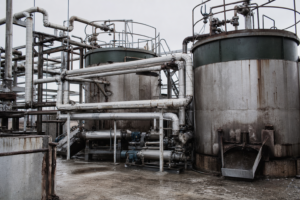
For wastewater carrying ammonia nitrogen from a few hundred milligrams per liter up to 7 g/L, ammonia stripping is the workhorse removal route—and the single biggest lever on its economics is how you supply the heat. Direct steam stripping works everywhere but burns steam continuously; MVR ammonia stripping, its energy-saving retrofit upgrade, uses a mechanical vapor compressor to recycle the stripping steam instead of generating it fresh. On one documented 65 t/h project (external industry reference), the switch cut specific operating cost from 32.91 to 13.97 RMB per ton of water—a 57.5% reduction worth roughly 8.86 million RMB (about 1.23 million USD) per year at 7,200 operating hours at that site’s energy prices. In published projects, feed ammonia of 2,000–7,000 mg/L is stripped to below 15 mg/L in the tower bottoms. This article covers where high-ammonia wastewater comes from, the physics that makes stripping work, the head-to-head energy account, and how to decide which route fits your plant; for complete process routes on specific ammonia-bearing systems, see the related solution pages linked throughout (illustrative applications).
Where High-Ammonia Wastewater Comes From
Ammonia nitrogen concentrates in specific corners of the chemical industry, and the concentration band dictates the treatment route. Biological nitrification copes with low hundreds of mg/L; above that, inhibition and tank volume push plants toward stripping. The documented industrial landscape (external industry references):
| Source | Typical ammonia nitrogen | Notes |
|---|---|---|
| PCB etching / cleaning water | 1.5 – 4.5 g/L | Ammoniacal etchant rinses |
| ADC foaming-agent production | 1.2 – 1.89 g/L | Each ton of product generates 23.7 t of wastewater carrying sulfate, chloride and sodium alongside ammonia |
| Rare-earth separation (wet hydrometallurgy) | 0.6 – 1.6 g/L | Saponification and extraction rinses in rare-earth plants |
| Coal chemical, petrochemical, pesticide, fertilizer | Hundreds of mg/L to g/L | Gasification liquor, synthesis condensates, reaction washwaters |
Sectors where MVR-based ammonia removal is applied (illustrative applications, not an exhaustive list) include new energy materials, petrochemical, coal chemical, pesticides, light industry and fertilizers.
The Physics: Why Stripping Works
Ammonia in water exists in equilibrium between two forms: the ammonium ion NH4+, which is soluble and non-volatile, and free ammonia NH3, which is volatile and strippable. Two variables move the equilibrium toward free ammonia: pH and temperature. Raising pH—typically by caustic dosing above roughly pH 10.8—converts ammonium to free ammonia; raising temperature does the same and simultaneously raises the vapor pressure that drives transfer. Inside a stripping tower, the high-pH, hot wastewater meets a counter-current vapor flow; free ammonia transfers into the vapor phase and leaves the water. The design problem is therefore not chemistry but energy: every degree of heat and every cubic meter of stripping vapor must be paid for—first as steam, or, in the MVR configuration, as electricity.
Direct Steam Stripping vs MVR Ammonia Stripping
The two routes share the tower, the chemistry and the effluent targets; they differ in where the stripping vapor gets its heat.
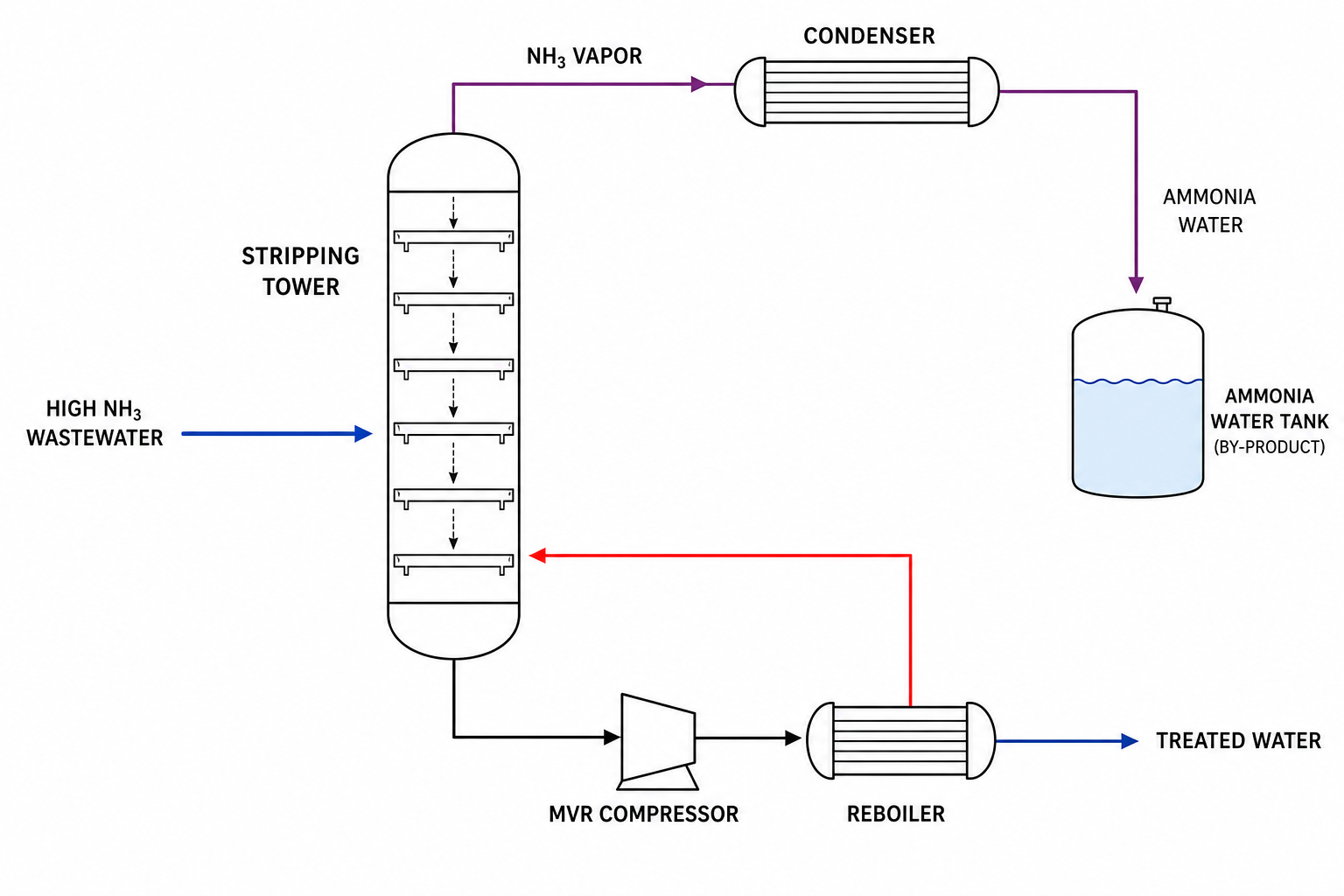
- Direct steam stripping injects live steam into the tower or a reboiler. It is mechanically simple, tolerant of upset, and the default legacy installation wherever steam is cheap and abundant.
- MVR ammonia stripping is the energy-saving retrofit of that same system: a mechanical vapor compressor takes the ammonia-laden vapor from the tower top, compresses it to a higher temperature and pressure, and returns it as the reboiler heating medium. The latent heat of the vapor is recycled instead of being rejected to cooling water, so live steam demand collapses while a modest electricity demand appears.
Because the retrofit keeps the tower and the process chemistry intact, projects are characterized by short construction periods and fast payback—which is exactly why existing direct-steam towers are prime candidates.
The Energy Account: A 65 t/h Benchmark
The comparison below is from one documented 65 t/h project (external industry reference; actual results depend on local energy prices and feed characteristics), priced at 300 RMB/t steam, 0.2 RMB/t circulating cooling water and 0.7 RMB/kWh electricity:
| Consumption per ton of water | Direct steam stripping | MVR ammonia stripping | Change |
|---|---|---|---|
| Steam | 98 kg/t | 20 kg/t | −79.6% |
| Circulating cooling water | 12.3 t/t | 3.1 t/t | −74.8% |
| Electricity | 1.5 kWh/t | 10.5 kWh/t | +7.0 kWh/t |
| Operating cost | 32.91 RMB/t | 13.97 RMB/t | −57.5% |
The Annual Ledger
At 65 t/h and 7,200 operating hours per year, the plant treats roughly 468,000 t of wastewater annually. Direct steam stripping costs about 15.4 million RMB per year at these unit prices; MVR operation costs about 6.54 million—leaving roughly 8.86 million RMB (about 1.23 million USD) on the table every year, year after year, for the life of the retrofit. Few retrofits in the wastewater plant offer that ratio of intervention to return.
Why Electricity Beats Steam: The Structural Reversal
The numbers reverse because of a price asymmetry the compressor exploits. MVR replaces about 78 kg of steam per ton with 10.5 kWh of electricity. Priced out, 10.5 kWh costs 7.35 RMB while 78 kg of steam costs 23.4 RMB—the same thermal duty costs three times more delivered as steam than as compressor electricity, because purchased steam embeds the boiler’s fuel losses, while the compressor only pays for the lift it actually performs on recycled vapor. Cooling water demand falls in parallel, since the condensing load that used to be rejected through the cooling tower is now returned to the process. The retrofit does not improve the chemistry of ammonia removal; it changes the energy currency the chemistry is bought with.
Two-Stage Compression and the Performance Envelope
High-strength feeds stress a single compressor stage: inlet ammonia of 2,000–7,000 mg/L drives a vapor load and temperature demand that single-stage machines cannot cover with margin. The configuration commonly applied in this band is two-stage steam compression, splitting the pressure ratio so each stage operates efficiently and away from surge. With the tower and reboiler sized accordingly, the documented envelope (from published projects) is: feed ammonia nitrogen 2,000–7,000 mg/L in, tower-bottoms ammonia below 15 mg/L out—low enough to feed a downstream biological polishing stage directly or to meet discharge limits, depending on the permit. The same MVR technology family that powers evaporators supplies the compressors, giving the retrofit a mature supply chain.
By-Product Recovery: Ammonia Water and Ammonium Sulfate
The stripped ammonia leaves in the tower-top vapor, and that vapor is an asset rather than a waste. Two recovery routes dominate practice:
- Ammonia water absorption: the top vapor is condensed/absorbed in water to produce aqueous ammonia of commercial concentration, saleable where a local market exists (fertilizer blenders, flue-gas NOx control reagent).
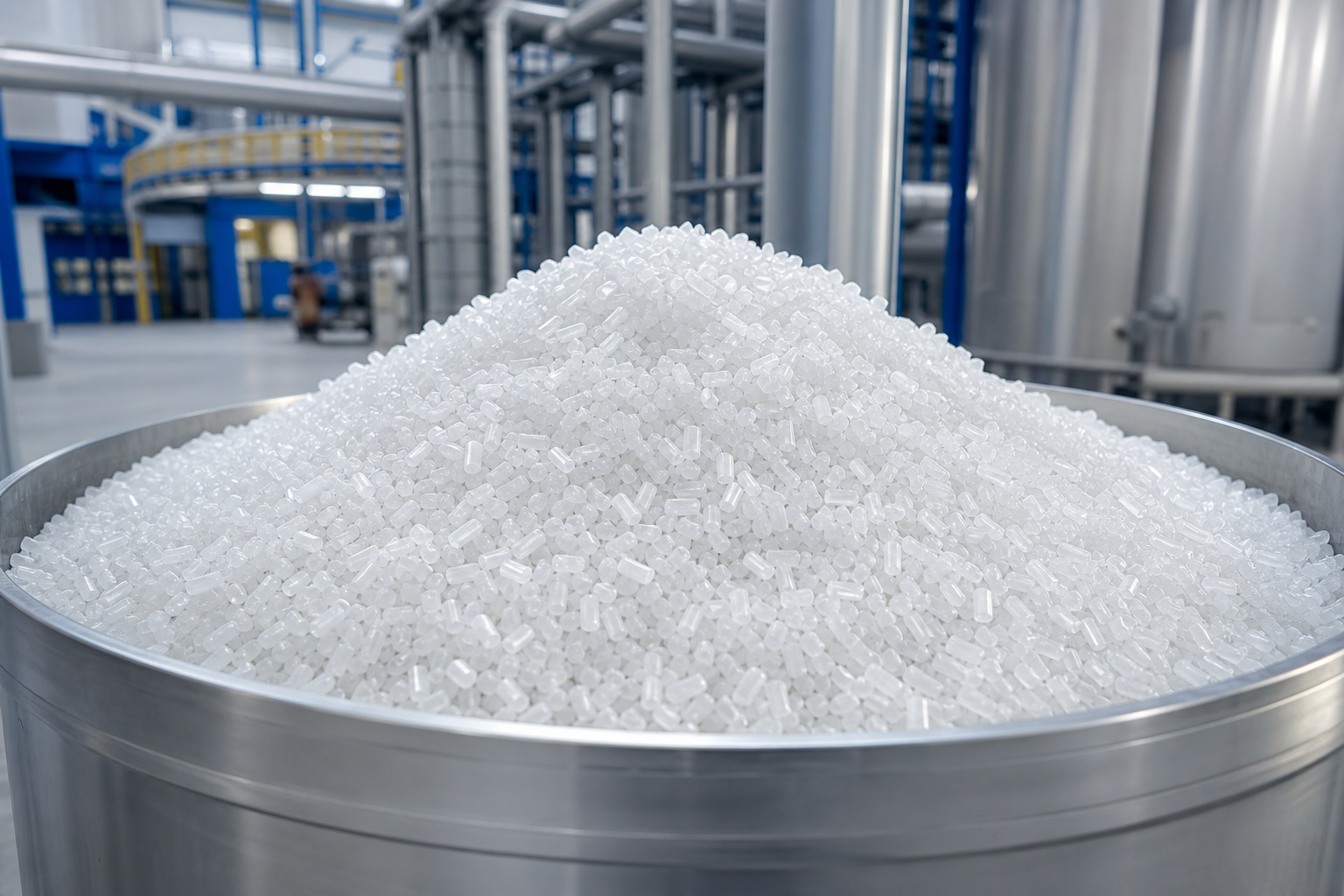
- Ammonium sulfate crystallization: the vapor is absorbed in sulfuric acid and the resulting ammonium sulfate solution is crystallized into a stable, saleable fertilizer salt. This route turns a pollutant into a product stream and pairs naturally with evaporation-crystallization systems (illustrative application: chemical and agrochemical plants).
Choosing between them comes down to local offtake: ammonia water logistics suit short distances and steady consumers; ammonium sulfate suits long-distance shipment and seasonal fertilizer demand. Both belong in the same water-management frame as ZLD system design, where every kilogram of nitrogen has a designated destination.
Process Modules of a Stripping System
| Module | Scope | Selection notes |
|---|---|---|
| Caustic make-down and pH control | NaOH storage, dosing and pH adjustment above roughly 10.8 ahead of the tower | Dosing accuracy protects the free-ammonia share; over-dosing is a direct OPEX penalty |
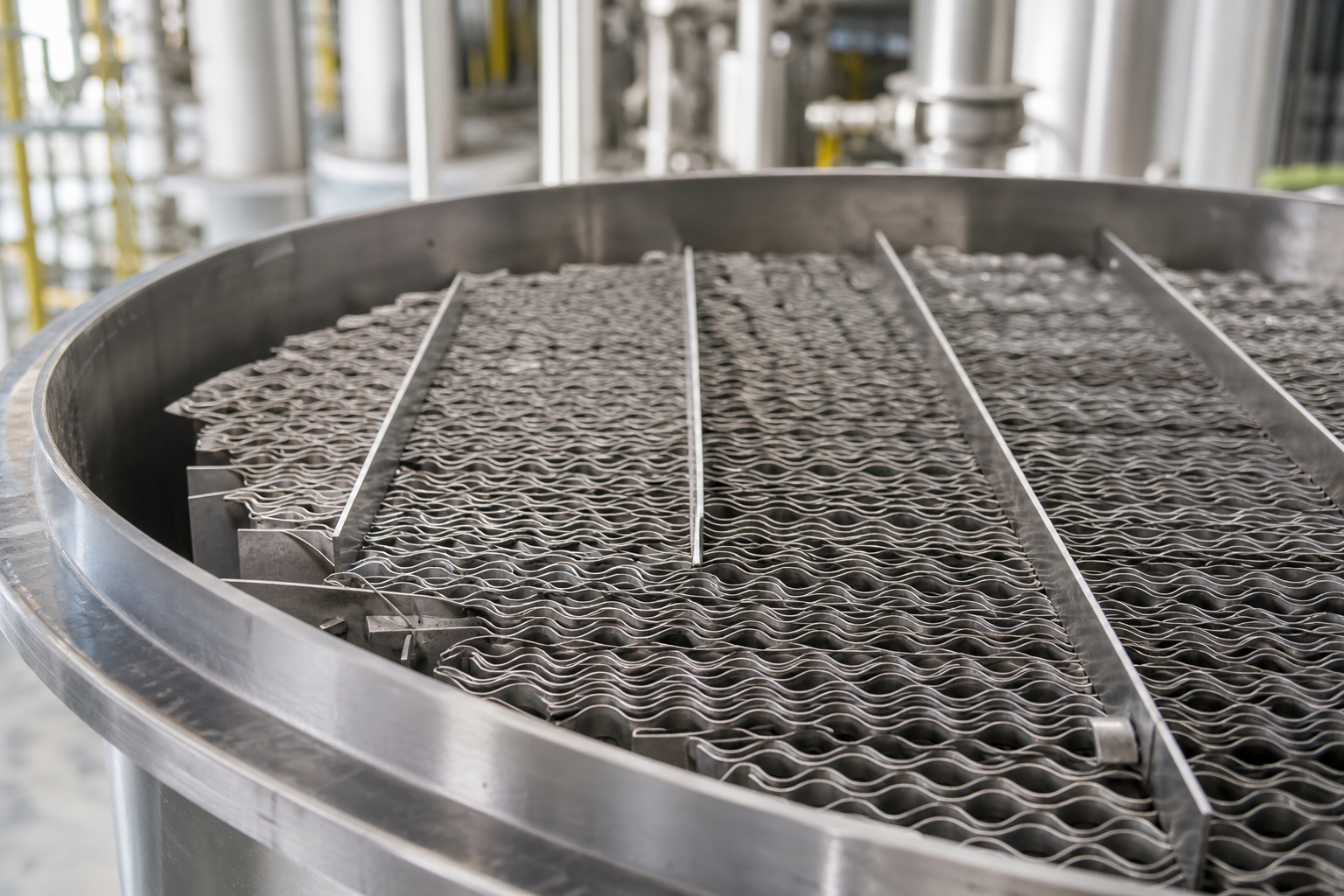
| Stripping tower | Packed tower with structured packing, liquid distributor, demister | Packing choice balances mass-transfer efficiency against fouling margin |
| Reboiler–MVR loop | Mechanical vapor compressor, reboiler, vapor piping; live-steam backup on retrofit designs | Two-stage compression covers the 2,000–7,000 mg/L feed band with surge margin |
| Absorption–crystallization recovery | Ammonia-water absorption, or H2SO4 absorption plus an ammonium sulfate crystallizer | Turns tower-top vapor into a saleable product stream; route set by local offtake |
| Biological polishing interface | Downstream nitrification on tower bottoms | Bottoms below 15 mg/L feed a biological stage directly, depending on the permit |
When to Choose Which Route
The selection logic reduces to two questions:
- What does heat cost at your fence? Plants with cheap surplus or waste steam (cogeneration sites, fermentation complexes with waste heat) can justify direct steam stripping on simplicity alone. Plants buying boiler fuel at market prices will find the three-to-one price asymmetry decisive in favor of MVR.
- What is the scale and the existing asset? New large installations and retrofits of aging direct-steam towers are the sweet spot for MVR ammonia stripping—the tower is retained, the compressor train is added, construction is short and savings begin at commissioning. Small, intermittent flows with modest ammonia loads rarely justify the machinery.
Because ammonia often shares the water with organics and salts, the stripping stage is frequently one station in a train—biological polishing after the bottoms, salt management on any blowdown, and COD control per the logic described in our evaporation COD analysis.
When This Route May Not Fit
Stripping is the workhorse at high ammonia—outside that band, other routes win. Below a few hundred mg/L, biological nitrification removes ammonia at a fraction of the cost per kilogram, and caustic consumption makes stripping OPEX-heavy on dilute water. Small, intermittent flows—a few tonnes per day out of batch campaigns—are cheaper to tanker off-site or to treat by breakpoint chlorination than to dedicate a tower and a compressor train to. Water high in calcium and magnesium must be softened first: at pH above 10.8 these ions carbonate-scale the packing and the reboiler, and a scaled stripping tower loses capacity fast. And where no local offtake exists for ammonia water or ammonium sulfate, the recovery leg collapses into a disposal problem—confirm the product’s market before committing to the crystallization route.
What Must Be Verified
Five checks close out a stripping selection, all on the actual water:
- Feed variability. The full range of ammonia concentrations across batches and campaigns—not just the design average—because tower and compressor are sized to the envelope, not the mean.
- pH and temperature window. Confirmation on the real water that the caustic dose and tower temperature hold the free-ammonia share the design assumes.
- Scaling ions. Calcium and magnesium levels against the softening specification, since hardness at high pH scales packing and heat-transfer surfaces.
- Foaming and entrainment. Surfactants and organics in the feed foam the tower and carry ammonia-laden liquor into the vapor; demister sizing and antifoam strategy belong in the design basis.
- By-product offtake. Named buyers, product specs and prices for ammonia water or ammonium sulfate, before the recovery route is fixed.
Conclusion
High-ammonia wastewater from PCB, ADC foaming-agent, rare-earth, coal-chemical and fertilizer operations (illustrative application sectors) has a commercially demonstrated answer, quantified in the external benchmark above: pH- and temperature-driven stripping in a tower, with the energy supplied by recycled compressed vapor instead of live steam. The 65 t/h benchmark—98 down to 20 kg steam per ton, 57.5% lower operating cost, 8.86 million RMB saved per year—is the arithmetic that turns an environmental obligation into a board-level retrofit proposal. If your plant runs a direct-steam stripper on expensive steam, that arithmetic is already running against you.
Frequently Asked Questions
What is ammonia stripping in wastewater treatment?
Ammonia stripping shifts the NH4+/NH3 equilibrium toward free ammonia by raising pH (typically above about 10.8 with caustic) and temperature, then sweeps the volatile free ammonia out of the water with a counter-current vapor flow in a stripping tower. The ammonia reports to the tower-top vapor, where it can be recovered.
How much does MVR ammonia stripping save compared with direct steam stripping?
On a benchmark 65 t/h project: steam falls from 98 to 20 kg per ton of water, circulating cooling water from 12.3 to 3.1 t/t, electricity rises from 1.5 to 10.5 kWh/t, and total operating cost falls from 32.91 to 13.97 RMB per ton—57.5% lower, worth roughly 8.86 million RMB per year at 7,200 operating hours.
What ammonia concentrations can MVR stripping handle?
The documented envelope (from published projects) is feed ammonia nitrogen of 2,000–7,000 mg/L, treated with two-stage steam compression, delivering tower-bottoms ammonia below 15 mg/L—suitable for downstream biological polishing or direct discharge depending on the permit.
Can the stripped ammonia be recovered as a product?
Yes. The tower-top vapor is absorbed in water to make saleable ammonia water, or absorbed in sulfuric acid and crystallized into ammonium sulfate fertilizer. The choice depends on local offtake and shipping distance.
When is direct steam stripping still the right choice?
When cheap surplus or waste steam exists on site (cogeneration, waste-heat-rich complexes), when flows are small and intermittent, or when maximum mechanical simplicity outweighs energy economics. Otherwise, the steam-versus-electricity price asymmetry favors the MVR retrofit.