Sodium phosphate crystallization is decided less by the crystallizer than by two upstream choices: which hydrate you are making, and at what sodium-to-phosphorus ratio the neutralization is run. Trisodium phosphate dodecahydrate crystallizes readily by cooling — its solubility rises steeply with temperature; monosodium phosphate, with high solubility and a flat curve, demands evaporative crystallization; and the dodecahydrate melts in its own water of crystallization at roughly 73–75°C, capping every operating and drying temperature. Getting these boundaries right separates a plant that makes specification product continuously from one that fights phase transitions, caking, and fines.
The Sodium Phosphate Family and Why Hydrate Choice Drives Everything
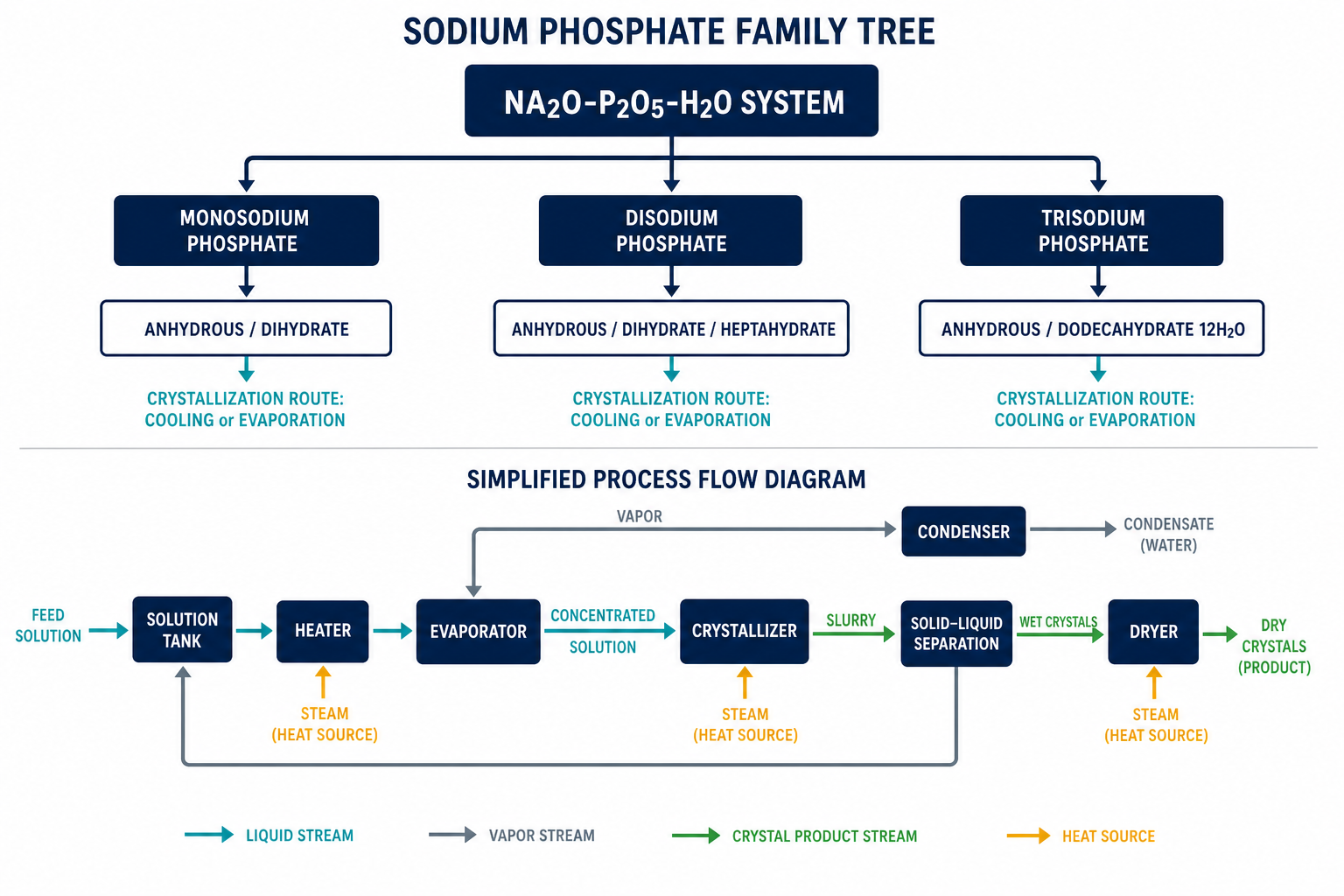
Sodium phosphate is not one product but a family set by the neutralization stage: monosodium (NaH2PO4), disodium hydrogen (Na2HPO4), and trisodium orthophosphate (Na3PO4), each crystallizing as specific hydrates with sharply different behavior. The neutralization ratio — caustic or carbonate charged against purified acid — selects which family member the liquor contains, cascading directly into crystallizer type, operating window, and downstream handling.
| Product | Common Hydrates | Solubility Behavior | Preferred Crystallization Route | Main End Uses |
|---|---|---|---|---|
| Monosodium phosphate (NaH2PO4) | Anhydrous, dihydrate | High solubility, modest temperature coefficient | Evaporative crystallization | Food-grade pH buffers, feed, pharmaceutical intermediates |
| Disodium phosphate (Na2HPO4) | Anhydrous, dihydrate, heptahydrate, dodecahydrate | Moderate temperature coefficient; hydrate transitions across the range | Evaporative or vacuum cooling, hydrate-dependent | Detergents, STPP precursor, food, water treatment |
| Trisodium phosphate (Na3PO4) | Anhydrous, dodecahydrate (dominant commercial form) | Steep temperature coefficient | Cooling crystallization | Boiler water treatment, metal degreasing, heavy-duty cleaning |
The consequence: a single train cannot pivot between family members cheaply — each demands a different supersaturation strategy. Multiproduct plants install parallel trains or campaign-switch with full cleaning.
Feed Sources: From Purified Acid to Recovered Waste Streams
Three feed origins dominate, and each brings its own impurity problem into the crystallizer. The descriptions below are illustrative feed considerations from published literature — a project starts from full analysis of the specific liquor.
Wet-process phosphoric acid (WPA) route. Phosphate rock is acidulated with sulfuric acid, then the crude acid is purified — fluoride removal, sulfate control, organic oxidation, heavy metal and magnesium precipitation — before neutralization with soda ash or caustic. Thermal-process acid (elemental phosphorus burned and hydrated) is purer but more expensive; food and pharmaceutical grades historically sit on thermal acid or deeply purified WPA. Purification must finish before neutralization: fluoride, sulfate, magnesium, and metals that survive into the neutralizer end up at the crystal surface, distorting habit and trapping into product.
Phosphorus-rich industrial wastewater. Glyphosate and other organophosphorus routes generate mother liquors carrying both phosphorus and sodium in substantial concentration. Where the organic load can be destroyed or separated, the residual liquor is a genuine crystallization feed rather than a disposal liability — the resource-recovery logic shared with our waste salt recycling solutions.
Spent alkaline cleaning baths. Metal finishing lines degrease in hot trisodium phosphate solutions accumulating oils and dissolved metals. Concentration and re-crystallization regenerates fresh phosphate while discharging the contaminant heel, closing an in-plant loop.
Crystallizer Selection by Hydrate and Route
For trisodium phosphate dodecahydrate, cooling crystallization is the natural fit: dissolve hot, crystallize by cooling, let the steep solubility curve work. Two implementations are used. Vacuum (flash) cooling drops temperature adiabatically by evaporating a small water fraction — no heat-transfer surface in contact with crystal-bearing liquor, hence no wall scaling. Surface cooling uses an external scraped or high-velocity exchanger where vacuum systems are undesired, demanding more fouling management.
For monosodium phosphate, and for disodium hydrates with unfavorable temperature coefficients, evaporative crystallization concentrates liquor while generating supersaturation — forced-circulation bodies are standard, with MVR increasingly supplying heat economy (the energy framework is covered in our MVR evaporation systems overview). Classified-suspension (OSLO) and draft tube baffle (DTB) designs are specified where size and uniformity carry commercial weight — larger crystals centrifuge drier and wash cleaner.
The 73°C Boundary and Other Hydrate Traps
The dodecahydrate’s defining constraint is thermal: it melts incongruently in its own water of crystallization at approximately 73–75°C. Above that temperature the crystal cannot exist as a solid, so hot liquor must be cooled through the crystallization window under control, and — critically — drying afterward must stay below the transition risk zone. Overheated dryers do not just degrade product; they dissolve it.
Three further traps recur in operating plants:
Efflorescence. The dodecahydrate loses water to dry air over time, fading surface quality and freeing fines. Moisture-barrier packaging with controlled warehouse humidity is part of the process design, not an afterthought.
Caking in storage. Partial surface dissolution and re-crystallization bridges crystals into lumps. Tight size distribution, drying to stable residual moisture, and anti-caking dosage where allowed are the standard defenses.
Hydrate transition during drying. Driving moisture too hard, or too hot, nudges dodecahydrate toward lower hydrates or anhydrous forms. Assay then fails on phosphate-to-water ratio though nothing was contaminated. Drying specs must be written against phase behavior, not just moisture.
Process Control: Metastable Zone Operation
Crystal quality is governed by the same discipline as any cooling crystallization: generate supersaturation inside the metastable zone, never through it. Crossing the limit triggers nucleation showers of fines that steal solute from growing crystals, load the centrifuge, and dust through packaging.
Four control loops carry most of the outcome:
Cooling profile. A linear ramp from boiling point to discharge temperature is rarely optimal; a curve following the solubility line keeps supersaturation near-constant, balancing nucleation and growth.
Slurry density (magma density). Adequate crystal surface area keeps supersaturation consumed as it forms; excessive clear-liquor advance starves the bed, excessive fines recycle chokes classification.
Agitation. Uniform suspension without supersaturation hot spots — around cooling surfaces or at the flash zone — requires circulation rates matched to crystal settling velocity, not scaled from neighboring duties.
Impurity management. Fluoride, sulfate, magnesium, and organics from WPA alter habit even at low levels. The crystallizer amplifies whatever purification lets through, so feed impurity trends deserve the same monitoring as product.
Process Modules and Selection Basis
| Process Module | Candidate Equipment | Selection Basis |
|---|---|---|
| Acid purification (WPA route) | Defluorination, sulfate control, oxidation, metal precipitation | Feed impurity slate versus target grade |
| Neutralization | Stirred reactor with heat removal and carbonate stripping | Na:P ratio fixing the family member |
| Cooling crystallization (TSP dodecahydrate) | Vacuum flash cooler or scraped-surface cooling crystallizer | Steep solubility curve; scaling avoidance |
| Evaporative crystallization (MSP, DSP hydrates) | Forced-circulation body with MVR; OSLO or DTB for size duty | Flat solubility curve; crystal size requirements |
| Centrifuge and low-temperature drying | Centrifuge plus dryer kept below the hydrate transition zone | Hydrate stability; moisture spec |
Note: configurations are indicative; selection depends on actual feed, impurity behavior, hydrate, utilities, and capacity.
Neutralization Section: Where Product Identity Is Set
By the time liquor reaches the crystallizer, its destiny is fixed upstream. Neutralizing purified acid with caustic or soda ash is stepwise — each phosphate proton neutralizes at a characteristic pH band — and the endpoint ratio determines the crystallizing species — mono-, di-, or trisodium phosphate. Engineering issues concentrate in three places: heat removal, since neutralization is strongly exothermic and liquor must arrive at controlled temperature; carbonate management, because soda ash introduces CO2 that must be stripped or it foams the evaporator; and endpoint analytical control, where titration-based Na:P verification at the neutralizer discharge catches drift hours before the crystallizer shows it as yield loss or habit change.

Campaign planning deserves explicit attention in multiproduct plants. Switching the neutralization ratio requires line cleaning, first-product quarantine, and a transition liquor plan; crystallizer, centrifuge, and dryer each see a different hydrate. Plants scheduling long single-grade campaigns and dedicated parallel trains avoid paying the transition tax repeatedly.
Product Grades and Market Requirements
Commercial sodium phosphate spans industrial, technical, food, and pharmaceutical grades; boundaries are set almost entirely by impurity control upstream rather than by crystallization itself. Industrial-grade trisodium phosphate for boiler water treatment and metal degreasing tolerates a broader impurity slate; food-grade monophosphates demand low heavy metals, controlled fluoride, and consistent assay; pharmaceutical intermediates add residual solvent and microbiological requirements. The crystallizer’s contribution to grade is consistency — repeatable size distribution and hydrate form — because users dose by weight and formulate to assay.

Resource Recovery: When Wastewater Becomes Feedstock
Phosphorus discharge limits keep tightening, and sodium phosphate crystallization is one of the few routes that turns a compliance problem into a product. For sodium-rich, phosphorus-rich mother liquors — glyphosate side streams, phosphating bath bleed-offs — evaporation to the crystallization window recovers sodium phosphate directly. For ammonium- or magnesium-bearing streams, struvite precipitation is usually better chemistry; the sodium route wins when sodium dominates and organics can be handled upstream. Selection is a water-chemistry decision made from a full ion balance on the actual stream, before equipment is sized.
Related technology pages: salt separation and crystallization systems, MVR evaporation technology, and zero liquid discharge solutions for the water-balance context. Chemical and agrochemical application examples are collected under our pesticide mother liquor treatment solution.
When This Route May Not Fit
Sodium phosphate crystallization is not the right answer to every phosphorus problem. Where the cation balance is ammonium- or magnesium-led rather than sodium-led, struvite precipitation is usually the better and cheaper chemistry, and forcing the sodium route means reagent cost the project never recovers. Where the organic load in a recovered stream cannot be destroyed or separated at reasonable cost, the crystallizer inherits a habit problem that no operating discipline later fixes. Where the product market is small or distant, recovered salt may not clear logistics and bagging costs against outright disposal. Multiproduct sites running short campaigns between mono-, di-, and trisodium grades pay the transition tax — line cleaning, quarantine, transition liquor — which can erode the margin crystallization earns.
What Must Be Verified
No external case data is embedded in this article, so the validation focus is what must be proven before the route is committed: a full ion balance and impurity profile of the actual feed — fluoride, sulfate, magnesium, organics — because purification requirements and crystal habit consequences both follow from it; confirmation of the target hydrate and its operating window against published phase behavior, with the 73–75°C boundary treated as a hard ceiling for crystallization and drying; solubility and metastable-zone data for the specific liquor where habit or size carries commercial weight; neutralization endpoint control verification by titration at the reactor discharge; and, for recovered feeds, proof that organics are removed to a level that the crystal surface can tolerate in service.
Required inputs for screening: feed liquor analysis (Na:P ratio, impurity profile, organics), target hydrate and grade, capacity — enough to outline the route.
FAQ
Is sodium phosphate crystallized by cooling or evaporation?
It depends on the species. Trisodium phosphate dodecahydrate has a steep solubility-temperature curve and crystallizes efficiently by cooling; monosodium phosphate’s solubility is high and weakly temperature-dependent, so it requires evaporative crystallization; disodium phosphate hydrates fall between, with the route set by which hydrate is targeted.
What is the maximum operating temperature for trisodium phosphate dodecahydrate?
Approximately 73–75°C, where the dodecahydrate melts in its own water of crystallization. Both crystallization and drying must respect this boundary—above it the solid phase cannot exist, and overheated drying dissolves or converts the product rather than drying it.
Can sodium phosphate be recovered from industrial wastewater?
Yes, when the stream is sodium-rich and phosphorus-rich—glyphosate mother liquors and spent phosphate degreasing baths are the classic cases. After organic destruction or separation, the liquor crystallizes like any sodium phosphate feed. For ammonium- or magnesium-dominated streams, struvite precipitation is usually the more suitable chemistry.
Why does caked or effloresced product matter technically?
Because the product fails on phase and handling, not purity. Dodecahydrate loses water to dry air (efflorescence) and partially re-dissolves and re-bridges in humid storage (caking), both of which change the effective phosphate assay and dosing behavior even when chemistry is untouched.
Which impurities most affect sodium phosphate crystallization?
Fluoride, sulfate, magnesium, and residual organics from wet-process acid alter crystal habit and growth kinetics even at modest levels. They belong in the purification train before neutralization; the crystallizer will faithfully concentrate and expose whatever it is fed.