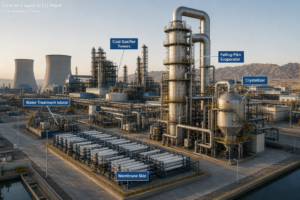
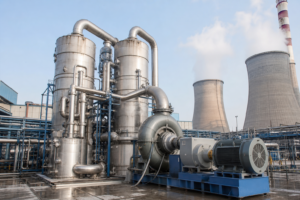
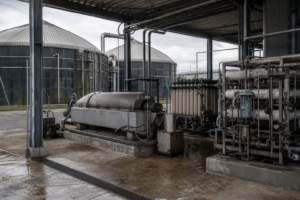
A multi-effect evaporation (MED) system cuts live steam consumption — in industry-reported terms — to roughly 30% of a single-effect evaporator by reusing the vapor boiled off in one effect as the heating medium of the next, operating each subsequent effect at a lower pressure and temperature. For high-salinity wastewater, crystallizing liquors, and resource-recovery duties, this staged energy reuse is what makes thermal concentration economically defensible against membrane and chemical routes. The design decisions that actually determine whether a plant runs for years or fouls in months are the number of effects, the evaporator body type (falling film versus forced circulation), and how the crystallization behavior of the dissolved salts is mapped onto the inter-effect temperature ladder. This page is the system-side view — configuration, body selection, materials and project specification; the cascading-latent-heat thermodynamics, feed arrangements and temperature-difference allocation are treated in depth in our multi-effect principle and design guide.
How Multi-Effect Evaporation Works
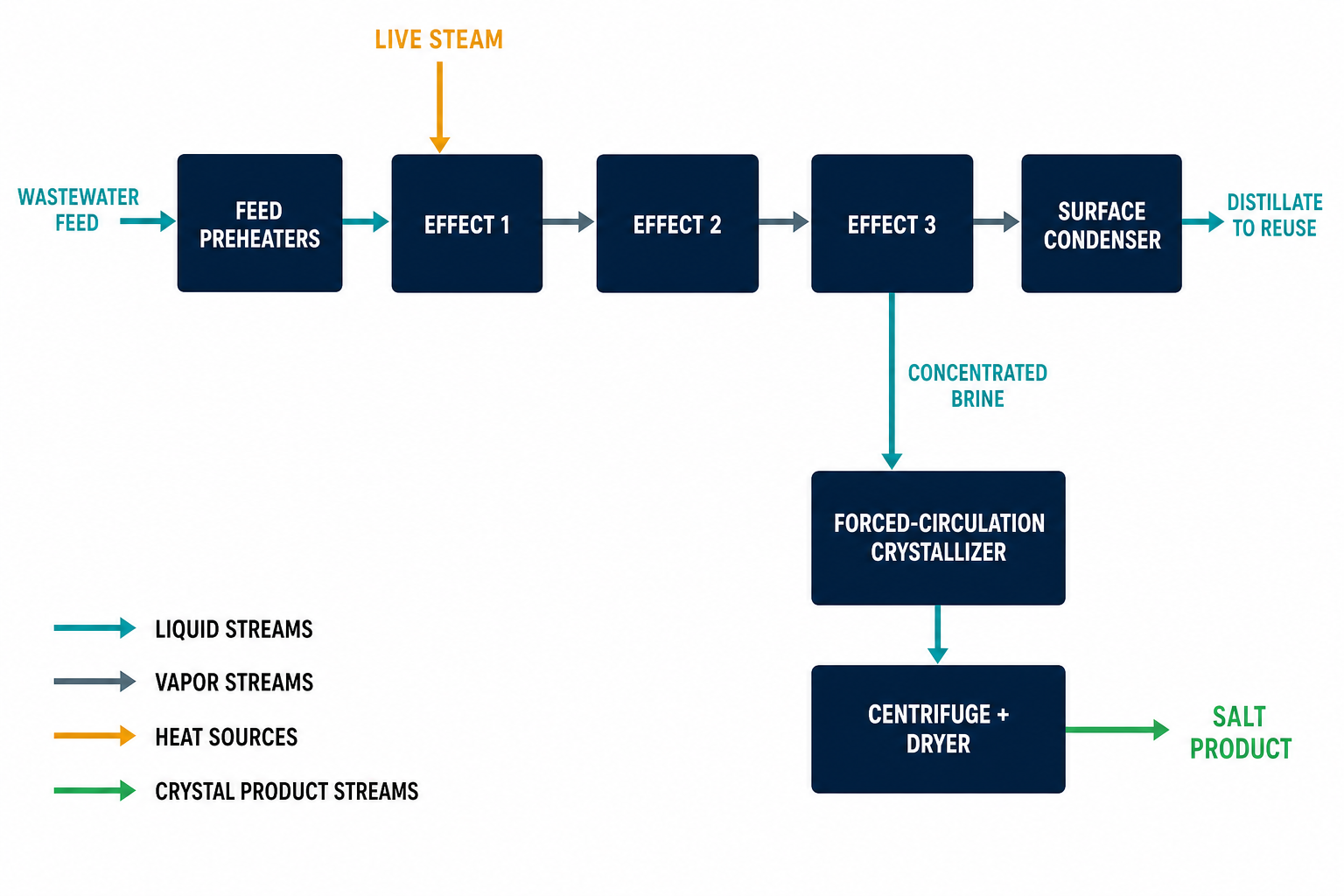
Live steam boils the first effect only; that effect’s vapor becomes the heating steam of the next, which boils at a lower pressure and temperature, and the chain continues through three to five effects to the condenser — so each kilogram of live steam evaporates several kilograms of water across the train. Two constraints bound any configuration: the total available temperature difference must be divided among the effects, and boiling point elevation (BPE) is subtracted from the usable difference in every effect — a liquor with a 16 °C BPE, such as concentrated ammonium chloride, consumes a large share of the thermal budget before a single effect is designed.
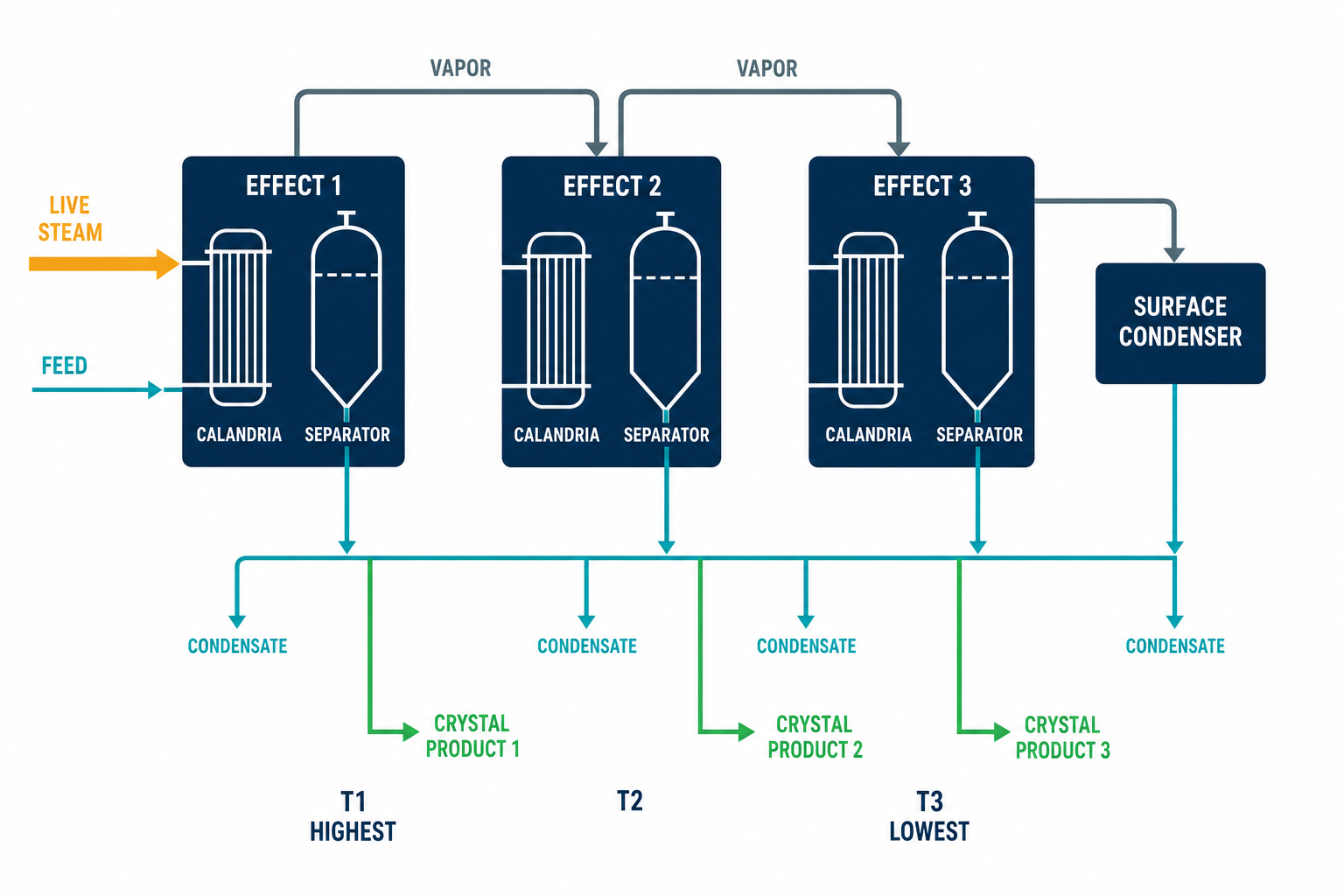
The step-by-step thermodynamics, feed arrangements (forward, backward, parallel) and the temperature-difference allocation logic are laid out once in our multi-effect principle and design guide; the technology-family overview sits on the multiple-effect evaporation technology page.
Steam Economy by Effect Count
The economic case for MED is quantified by specific steam consumption, expressed as kilograms of live steam per kilogram of water evaporated. The figures below are indicative ranges reported in published industry and supplier data — supplier-published indicative ranges, not a project guarantee:
| Configuration | Specific steam use (kg steam / kg water) | Typical evaporation load | Best suited for |
|---|---|---|---|
| Single effect | ~1.0 | < 500 kg/h | Small batches, solvent duties, pilot plants |
| Double effect | ~0.55 | 500–2,000 kg/h | Small plants, low capital budgets |
| Triple effect (no TVR) | 0.33–0.4 | 2,000–10,000 kg/h | Mid-size wastewater and salt plants |
| Four to five effect | ~0.25 | 5,000–20,000 kg/h | Large plants with steady steam supply |
| Triple effect + TVR | ~0.3 | 2,000–10,000 kg/h | Steam-rich sites seeking one extra effect at low capital |
| Five to six effect + TVR | 0.08–0.12 | > 10,000 kg/h | High-volume sites with cheap steam |
| MVR (electric recompression) | Near-zero live steam (15–30 kWh/t electric on low-BPE feed; 30–50 on high-BPE) | > 1,000 kg/h | Sites where electricity is cheaper than steam |
The marginal saving per added effect shrinks while capital cost grows roughly linearly, which is why most wastewater MED plants settle at three or four effects. Thermal vapor recompression (TVR) uses a steam ejector to boost part of the first-effect vapor and is equivalent to adding roughly one extra effect at low capital cost; mechanical vapor recompression (MVR) replaces live steam almost entirely with compressor electricity. A practical hybrid used on crystallizing systems couples a multi-effect train with MVR on the final, coldest effect, where vapor suction also stabilizes the vacuum. The trade-offs are compared in detail on our MVR evaporation page and in the MVR vs multi-effect energy cost calculator.
Choosing the Evaporator Body: Falling Film or Forced Circulation
Multi-effect describes the energy architecture, not the evaporator body. Two body types dominate industrial practice, and the choice follows the behavior of the liquor as it concentrates.
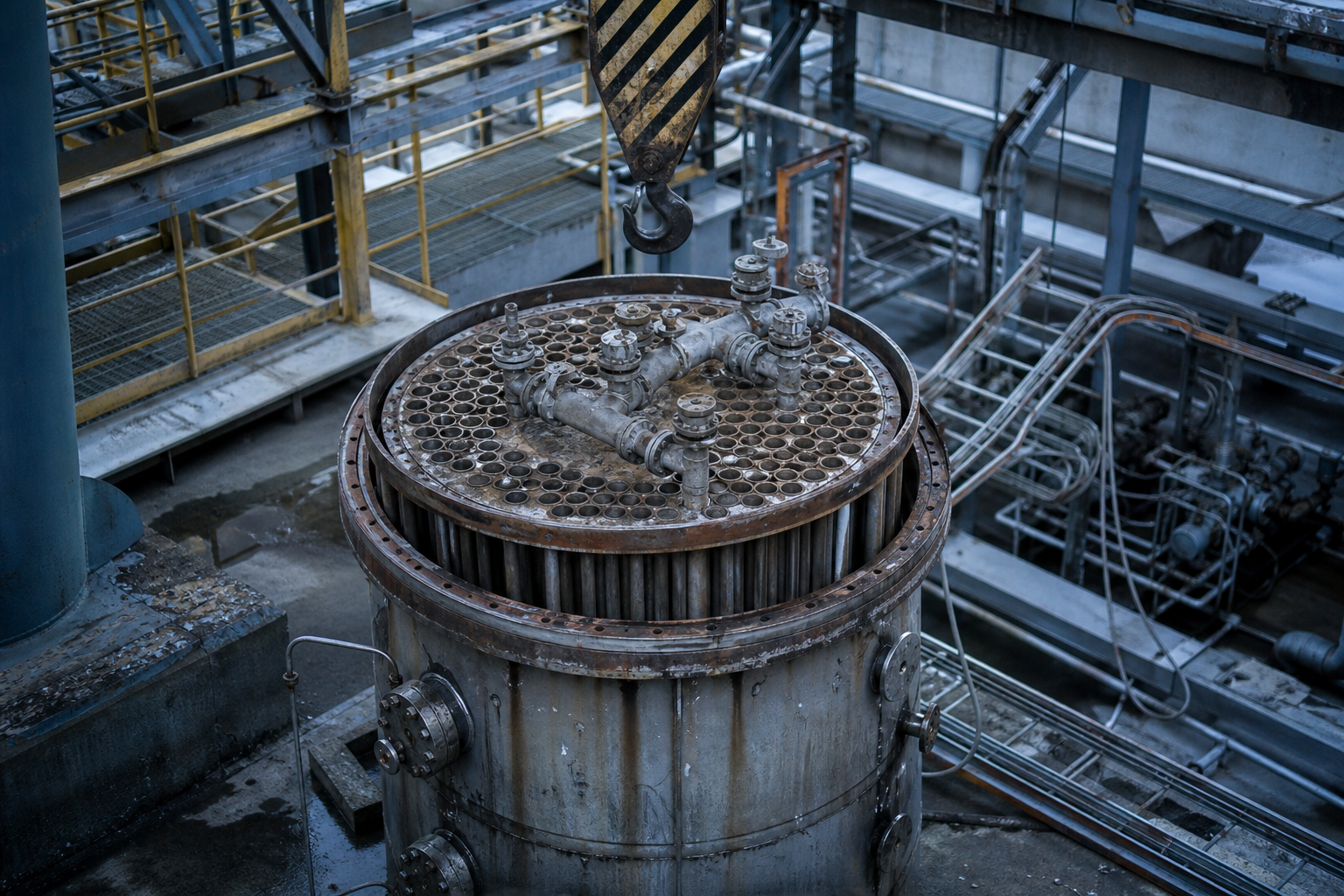
Falling-film evaporators distribute liquor as a thin film down the inside of vertical tubes, boiling at temperature differences of only 3–5 °C with residence times of seconds. They deliver high heat-transfer coefficients on clean, low-viscosity fluids and are the default for pre-concentration stages. Their weakness appears when solids crystallize: a falling film cannot tolerate crystals scraping the tube wall, and any dry patch fouls rapidly.
Forced-circulation evaporators pump the liquor through the heater at tube velocities of at least 1.0 m/s, suppressing film boiling and keeping crystals in suspension so they do not deposit on the heat-transfer surface. The higher velocity and sensible-heat flashing design tolerate scaling-prone, high-viscosity, and crystallizing liquors at the cost of more pumping power and a larger temperature difference. Wastewater MED trains therefore commonly run falling-film effects up to near-saturation, then switch to forced circulation for the crystallizing finisher. Configuration details are on the forced-circulation evaporation page.
Read as process modules, an MED train for wastewater and salt duty looks like this — candidate equipment types, the selection rationale, and the indicative operating envelope each module must cover (envelopes derived from published industry data, not project specifications):
| Process Module | Candidate Equipment Types | Selection Rationale | Indicative Operating Envelope |
|---|---|---|---|
| Effect bodies (1 to n) | Falling-film or forced-circulation calandria | Falling film for clean, low-viscosity duty; forced circulation for crystallizing service | Film ΔT of 3–5 °C per effect; FC tube velocities ≥ 1.0 m/s |
| Inter-effect vapor routing | Staged pressure piping between effects | Each effect boils lower so the prior vapor still condenses | Ladder checked against salt hydrate boundaries |
| Crystallizing finisher | Forced-circulation crystallizer effect | Keeps crystals suspended away from heat surfaces | Cold-end around 40–50 °C on NH₄Cl duty (illustrative) |
| Vapor-liquid separation | Spiral-path demister separators | Droplet removal protects condensate reuse quality | Reported 99.5–99.8% droplet removal |
| Condensation and vacuum | Surface condenser plus vacuum system | Sets the cold-end temperature of the train | First effect typically below 90 °C on wastewater duty |
| Feed preheating | Plate-and-frame heat exchangers | Mechanically cleanable on scaling preheat duty | Heat recovered from condensate and product |
Configuration, materials, and operating ranges depend on the actual feed, temperatures, pressures, corrosion review, fouling behavior, utilities, and project capacity.
Salt Chemistry Dictates the Temperature Ladder
The design step most often underestimated is matching the inter-effect temperature profile to the crystallization behavior of the specific salts in the stream. Sodium sulfate is the classic example: on the standard Na₂SO₄–H₂O phase diagram its solubility peaks at 32.4 °C — the transition between decahydrate (Glauber’s salt, Na₂SO₄·10H₂O) and anhydrous thenardite, with no stable heptahydrate phase. Above 32.4 °C, solubility falls as temperature rises, which is why hot effects discharge free-flowing anhydrous salt as the liquor concentrates by evaporation (published engineering practice on sulfate service). Drift the other way — uncontrolled cooling below 32.4 °C — and the liquor enters the decahydrate region, where Glauber’s salt crystals grow quickly and pack the tubes as hard scale unless chilling is designed in as a deliberate, controlled separation step.
For mixed-salt systems the temperature ladder becomes a separation tool. In a co-evaporation duty separating sodium sulfate and ammonium chloride (published engineering practice), the first effect operates at 85–90 °C where anhydrous sodium sulfate crystallizes on evaporation and is continuously discharged; the second effect drops to 60–70 °C to recover remaining sodium sulfate; the third effect runs at 40–50 °C, near the optimal 40–60 °C window where ammonium chloride solubility falls far enough to maximize yield without spending energy on unnecessary chilling. Mother liquor recycles back to the front of the train to lift overall recovery.
| Salt | Key crystallization behavior | Design consequence for MED |
|---|---|---|
| Sodium sulfate (Na₂SO₄) | Solubility peaks at 32.4 °C (decahydrate ↔ anhydrous transition; no stable heptahydrate phase); above 32.4 °C solubility falls with rising temperature; BPE < 10 °C | Hot effects discharge anhydrous salt on evaporation; below 32.4 °C expect decahydrate (Glauber’s salt) — design chilling deliberately or prevent uncontrolled cooling, or hydrate scale packs the tubes |
| Ammonium chloride (NH₄Cl) | BPE ~16 °C at high concentration; yield rises sharply as temperature falls | BPE eats usable ΔT across all effects; crystallize in the cold final effect at 40–60 °C |
| Sodium chloride (NaCl) | Flat solubility versus temperature; crystallizes mainly by evaporation | Recovery driven by water removal, not cooling; expect constant crystallization through the finisher |
Materials, Demisting, and Anti-Scale Engineering
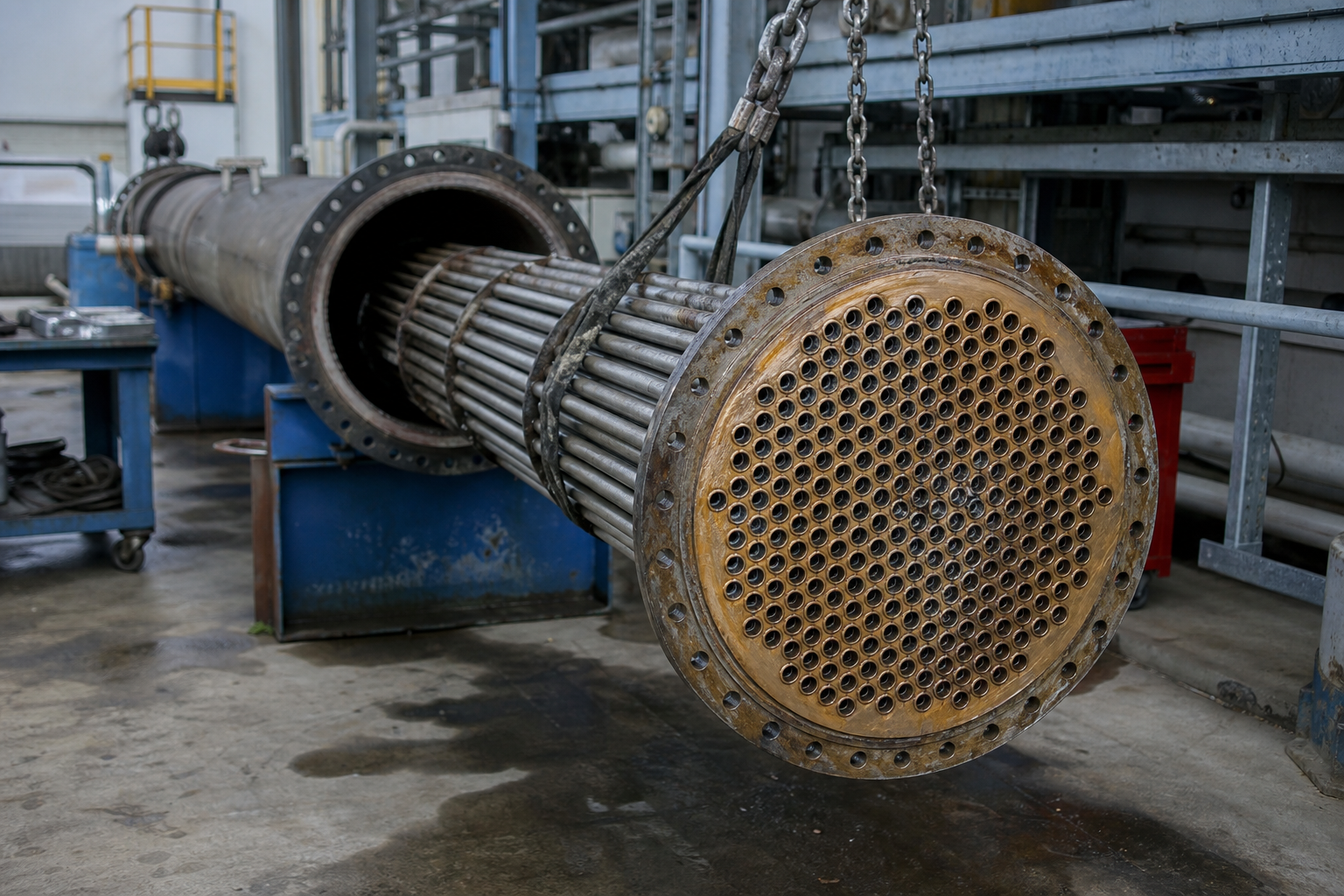
Chloride-bearing liquors select the metallurgy. 2205 duplex stainless steel is the standard recommendation for chloride-rich evaporator bodies and heat exchangers because its resistance to pitting and stress-corrosion cracking far exceeds standard 316L in hot chloride service; titanium is specified for the most aggressive streams. On scaling duties, plate-and-frame heat exchangers are often preferred for the preheater circuit because they can be opened and cleaned mechanically in a fraction of the time a shell-and-tube requires.
Vapor quality is a designed property, not an accident. High-efficiency demisters route secondary vapor in a spiral upward path so droplets are flung to the wall by centrifugal force and drain back by gravity; well-engineered separators are reported, in published equipment data, at 99.5–99.8% droplet removal. This matters directly for condensate reuse: every droplet that carries over transports dissolved COD and salts into the condensate, and condensate destined for boiler feed or process reuse is only as clean as the demister makes it.
Inside the crystallizing effects, a three-phase separation architecture keeps solids away from the heat-transfer surface: vapor leaves from the top of the separator, supersaturated liquor crystallizes in the body, and solids separate under gravity fast enough that crystals never circulate through the heater tubes. Combined with tube velocities held at or above 1.0 m/s and intermittent blowdown, this is what allows forced-circulation effects on sodium sulfate service to run for weeks between washouts rather than days.
Concentration Ratio and ZLD Integration
As a brine concentrator, an MED train can reduce wastewater volume by up to a factor of ten before the crystallizer, which converts a disposal-hauling problem into a small solids stream. When the dissolved salts have resale or reuse value, the same train becomes a salt production unit: one published industry reference — a pesticide-wastewater installation described in vendor and trade literature — combined pretreatment with triple-effect evaporation crystallization to produce an indicative 3,000 tonnes per year of industrial refined salt, with condensate recycled to the plant and zero liquid discharge achieved as a by-product of the recovery economics rather than as a regulatory afterthought. This is an external reference, not an EvapCryst delivery; the quoted rate is a vendor-reported indicative figure, not a project guarantee.
Full ZLD architectures and the downstream solid-handling steps are covered on our high-salinity wastewater ZLD systems page, and the salt-purity side of the flowsheet on the salt separation and resource recovery page.
Operating Temperature Limits
Modern industrial MED plants for wastewater run at low temperatures, typically below 90 °C in the first effect. Low-temperature operation serves three purposes: it widens the choice of corrosion-resistant materials (including non-metallic and composite bodies for the coldest effects), it reduces the scaling rate of inverse-solubility salts such as calcium sulfate, and it allows low-grade or waste heat to drive the first effect where process economics permit. Plants with a reliable waste-heat source should evaluate it before specifying a boiler, because the fuel line item dominates MED operating cost.
Specification Checklist for a Multi-Effect Project
Before requesting proposals, assemble the following data set; the quality of these inputs determines the quality of every configuration you will receive back:
- Feed rate, chloride content, TDS, suspended solids, and annual operating hours
- Salt suite with hydrate transitions and measured BPE at target concentration (not handbook dilute values)
- Target concentration ratio or product crystal specification, including purity and particle size if the salt is to be sold
- Available steam pressure and cost, electricity tariff, cooling water temperature, and any waste-heat sources
- Condensate reuse destination and its quality limit (this fixes the demister and entrainment specification)
- Materials preference and any site experience with 2205, titanium, or composite bodies on similar liquors
When This Route May Not Fit
Multi-effect evaporation loses its case where steam is expensive and electricity is cheap — MVR then wins on operating cost, and the two should be compared per unit of delivered evaporation. Very small duties below roughly 500 kg/h rarely justify more than one or two effects; the added area never pays back. High-BPE liquors (16 °C and more, such as concentrated ammonium chloride) consume so much of the available temperature difference that long trains cannot be staged — fewer effects with higher steam pressure or vapor recompression is the workable shape. And streams with heavy silica or high organics that foul regardless of body type need pretreatment first, not a bigger evaporator.
What Must Be Verified
The inputs that decide the configuration: a salt suite with hydrate transitions and measured boiling point elevation at target concentration — handbook dilute values mis-size the train; feed rate, chloride content, TDS, and suspended solids; the condensate reuse destination and its quality limit, which fixes the demister specification; and the real utility picture — steam pressure and cost, electricity tariff, cooling-water temperature, and any waste-heat source. For crystallizing service, the temperature ladder should be checked against the specific hydrate boundaries of the salts present. Where the salt is to be sold, purity and particle size requirements belong in the specification before proposals are requested.
Frequently Asked Questions
How much steam does a triple-effect evaporator save compared with single-effect operation?
A well-designed triple-effect train without thermal recompression consumes 0.33–0.4 kg of live steam per kilogram of water evaporated, about one third of single-effect consumption; adding a TVR ejector cuts this to roughly 0.3 kg/kg, and specific consumption falls further to 0.08–0.12 kg/kg when five or six effects are combined with thermal vapor recompression. The exact figure depends on the BPE of the liquor, the condenser temperature, and how much of the temperature range each effect is allocated.
When should a multi-effect system be chosen over MVR?
Choose MED when steam is cheap or waste heat is available, when the capacity is very large, or when the liquor carries fouling risk that makes an all-electric single-train compressor a maintenance liability. Choose MVR when electricity is cheaper than steam per unit of delivered evaporation; many plants combine both, using MVR on the cold final effect where compressor suction also holds the train vacuum.
Why does boiling point elevation matter so much in MED design?
BPE is deducted from the usable temperature difference in every effect. A liquor with 16 °C of elevation, such as concentrated ammonium chloride, can consume half the thermal budget of a four-effect train before any heat-transfer area is sized. High-BPE liquors need fewer effects, higher live-steam pressure, or vapor recompression to remain economic.
How is scaling controlled when the wastewater crystallizes during evaporation?
Three measures work together: forced circulation at tube velocities of at least 1.0 m/s so crystals stay suspended instead of depositing, crystallizer geometry that separates vapor, liquor, and solids so crystals never pass through the heater, and a temperature ladder that keeps hydrate-forming salts such as sodium sulfate above their transition temperature until they are discharged as anhydrous crystal.
Can multi-effect evaporation achieve zero liquid discharge on its own?
An MED train concentrates brine by up to about ten times and, when fitted with a crystallizing final effect, discharges solids and clean condensate, which is the essence of ZLD. Feed chemistry still decides the outcome: high sulfate or silica streams need softening or pretreatment, and mixed-salt liquors produce a blended solid unless fractional crystallization is engineered in, as covered in our salt separation and ZLD solution pages.
To get a first-pass configuration, send the feed analysis (rate, TDS, chloride, salt suite with measured BPE) and the target outputs — concentration ratio or salt specification — together with the site steam and power picture.