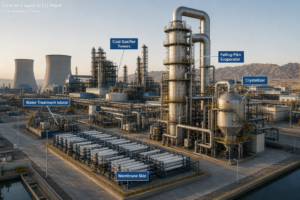
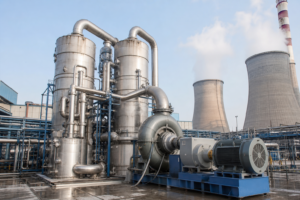
By-product hydrochloric acid can be converted into calcium chloride — a saleable product — instead of being neutralized and discharged at a loss. The proven route neutralizes waste HCl with limestone or lime, purifies the resulting calcium chloride solution, then evaporates, crystallizes or granulates it into dihydrate flake, anhydrous granule, or liquid products. External industry references for this route – published, vendor-reported projects, indicative of the duty class rather than a project guarantee and not a statement of EvapCryst delivery experience – include a 600,000 tpa soda ash and calcium chloride integrated project in Saudi Arabia (reported as the largest anhydrous CaCl2 granule plant of its kind) and 30,000–35,000 tpa anhydrous granule plants in Yunnan and Inner Mongolia that consume by-product HCl from polysilicon production. This page explains where by-product HCl comes from, how the dual resource-recovery line is designed, and what equipment choices matter.
Where By-product HCl Comes From
Hydrochloric acid is generated as a by-product in several major chemical processes, often in quantities that overwhelm on-site consumption:
| Source industry | Origin of the waste acid | Typical concern |
|---|---|---|
| Chlor-alkali / soda ash complexes | HCl synthesis from chlorine values not consumed downstream; Solvay distillation liquor already carries calcium chloride | Chloride effluent load; ammonia traces |
| Polysilicon and silicon chemicals | Chlorosilane hydrolysis and trichlorosilane recovery (HCl absorption water) | Acid strength varies; contains dissolved silica and organics |
| Organic chlorination (pesticides, pharma intermediates, CPO/epoxy routes) | HCl off-gas absorbed into water | Organic impurities, trace solvents |
| Potassium sulfate (Mannheim process) | 2 KCl + H2SO4 → K2SO4 + 2 HCl, with CaCl2 appearing in related sulfate/chloride balances | Co-product salt handling |
In every case the plant faces the same fork: pay to neutralize and dispose of the acid as waste, or upgrade it into a product with a market. Calcium chloride is the natural sink because the raw material on the other side of the reaction — limestone or lime — is cheap and universally available.
The Reaction Route: Two Resource-Recovery Lines
The technology is built around two coupled lines, which is why it is described as a dual resource-recovery (double-line) system:
- Waste HCl line: by-product acid is collected, purified as needed (removal of organics, suspended solids, and silica depending on origin), and neutralized with limestone powder or lime milk. The neutralization CaCO3 + 2HCl → CaCl2 + H2O + CO2 (or Ca(OH)2 + 2HCl → CaCl2 + 2H2O) is exothermic and releases CO2 that can be captured for soda ash or precipitation duties.
- Soda ash distillation line: in integrated Solvay plants, the ammonia recovery distiller already produces a calcium chloride-bearing waste liquor. Instead of ponding it, the liquor joins the same concentration train, converting an environmental liability into the same CaCl2 product slate.
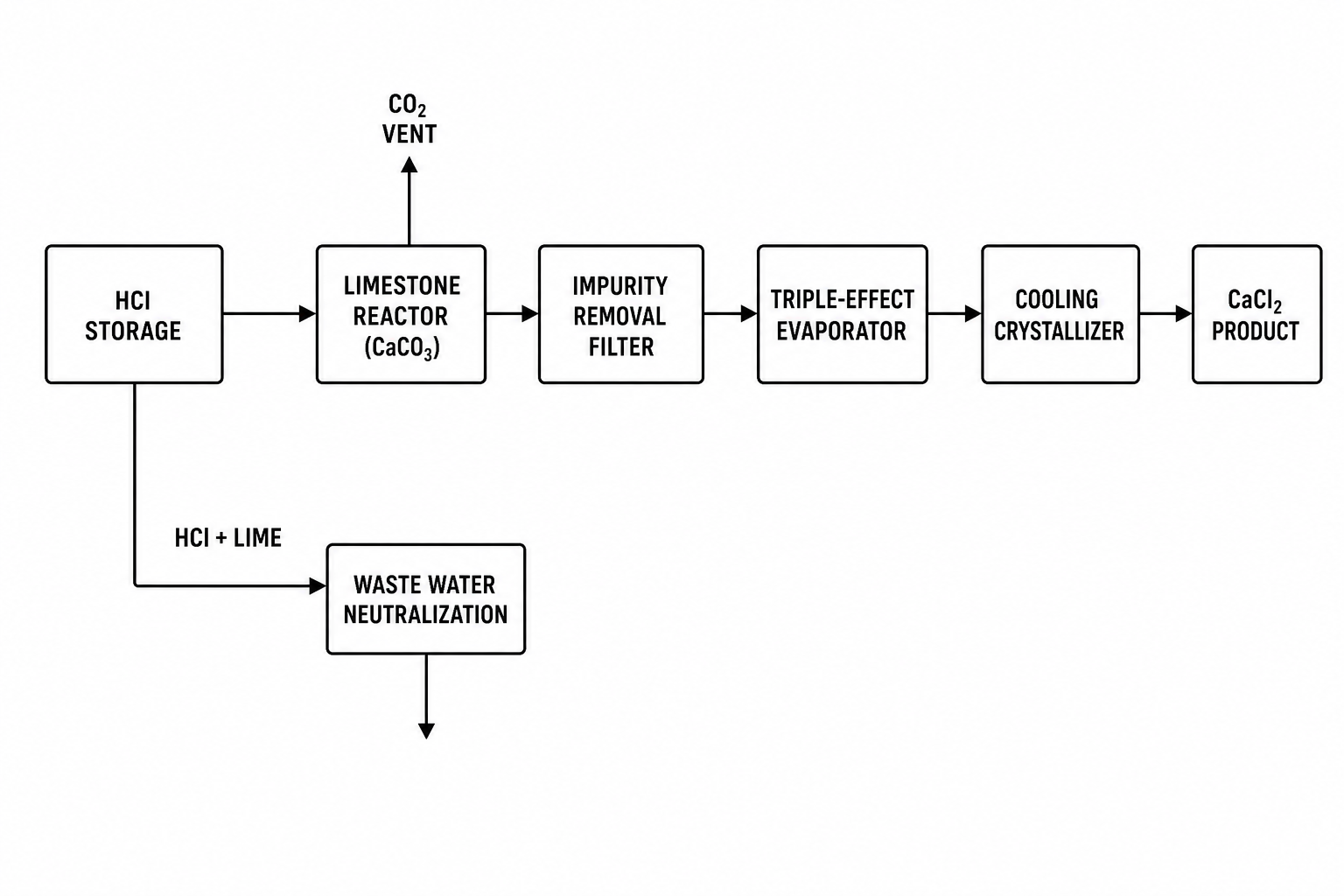
The reference statement from plant designers is direct: by producing CaCl2 you solve the environmental problem from soda ash production while achieving utilization of waste HCl. Both lines converge on one evaporation and finishing section.
Evaporation and Crystallization: The Difficult Duty
Calcium chloride liquor is one of the more demanding evaporation services in the inorganic field, for three reasons:
- High boiling point rise (BPR): concentrated CaCl2 solutions evaporate well above 100 °C at atmospheric pressure, so the effective temperature difference across each effect is small. High-salt liquors of this class can show BPR of 15–20 K at 40–50% concentration (industry-reported; rising to several tens of K above ~50%), which forces either more effects, higher steam pressure, or vapor recompression with adequate temperature lift.
- Corrosivity: hot concentrated chloride brine is aggressive to standard stainless steels. For chloride-rich duties, material selection typically moves from SUS316L to 2205 duplex or titanium when chloride concentrations and temperatures are high — the same material logic described in our MVR evaporator selection guide.
- Viscosity and fouling: viscosity climbs steeply with concentration, and any hardness or sulfate contamination scales heat-transfer surfaces. Forced circulation evaporators, which pump liquor through the heater at high velocity (commonly 2–3.5 m/s design range) to suppress wall fouling, are the standard answer.
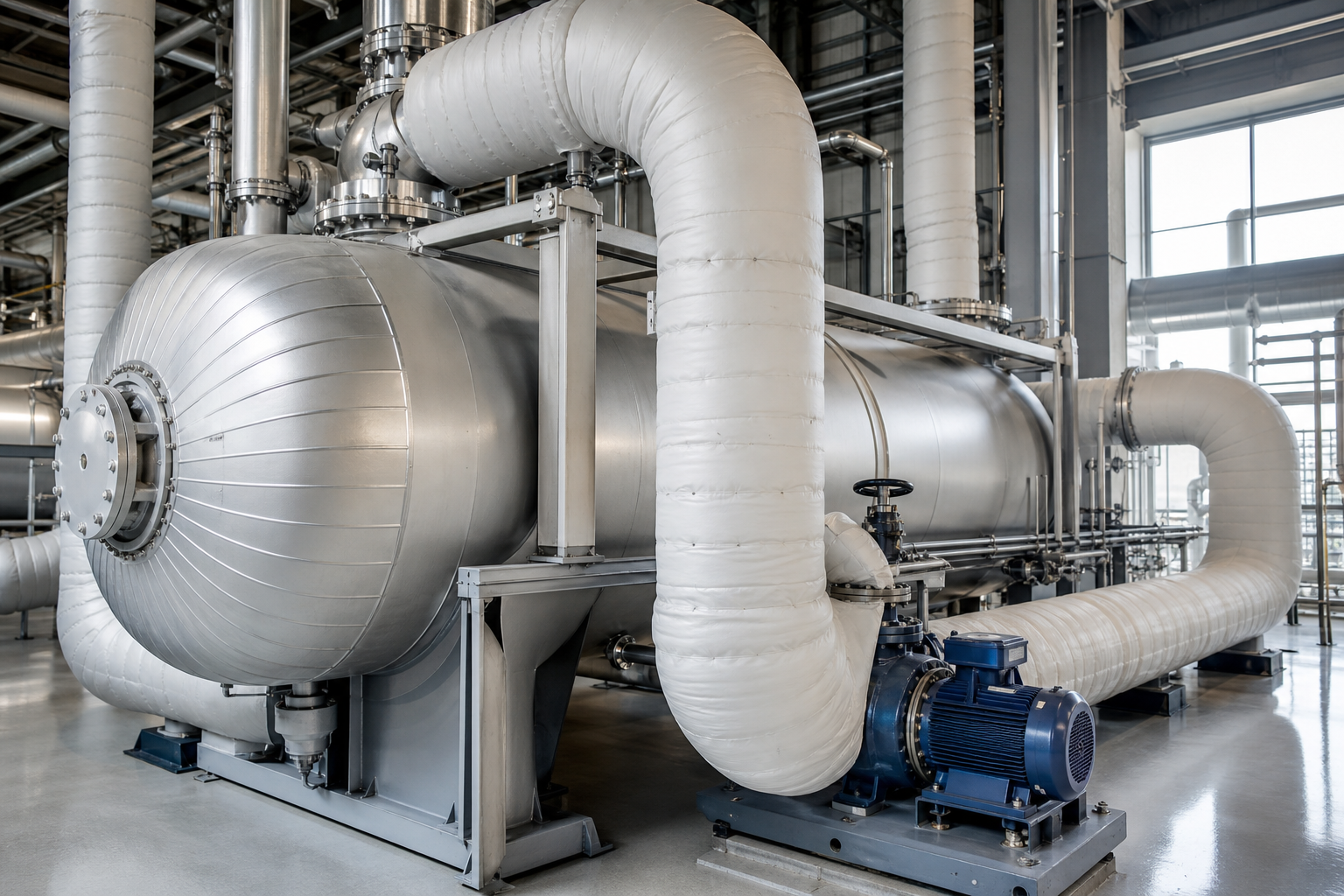
Because the whole purpose of the plant is resource recovery, the energy system is usually chosen for minimum operating cost: multi-effect evaporation where steam is available, or MVR evaporation where electricity is competitive. MVR systems typically consume a supplier-published 20–35 kWh per tonne of evaporated water – an indicative range, not a project guarantee – with almost no live steam after start-up — decisive economics when the product itself is a low-margin commodity salt. The technology background is covered in our MVR systems overview, and CaCl2-specific concentration and granulation process design is detailed on our calcium chloride evaporation and concentration page.
The dual-line plant decomposes into standard process modules:
| Process module | Equipment candidates | Selection basis | Indicative envelope |
|---|---|---|---|
| Acid purification | Settling; filtration; activated carbon or resin | Impurity slate of the actual acid | Per acid analysis |
| Neutralization | Limestone or lime-milk reactors | Cheap alkalinity; CO2 by-product value | Exothermic; CO2 recoverable |
| Clarification | Thickeners; polishing filters | Product-grade solids limit | Per liquor survey |
| Evaporation & crystallization | Forced circulation; multi-effect or MVR | BPR, viscosity, chloride corrosion | Supplier-published 20–35 kWh/t MVR class |
| Finishing | Cooled-drum flakers; spray granulation; fluidized beds | Product slate: flake, granule, liquid | Per product specification |
Configuration, materials, and operating ranges for each module depend on the actual feed, temperature, pressure, corrosion review, fouling behavior, utilities, and project capacity.
Product Forms and Finishing
The concentration train is designed around the target product form:
| Product | Typical route | Main markets |
|---|---|---|
| Liquid CaCl2 (27–38% solution) | Single concentration step, clarification, storage | Dust control, ready-mix concrete, wastewater treatment dosing |
| Dihydrate flake (typically 74–77% CaCl2) | Concentration to dihydrate concentration, flaking on cooled drums | Road de-icing, dust suppression, industrial drying agent feed |
| Anhydrous granule (typically 94%+ CaCl2) | Deep concentration followed by high-temperature spray granulation or fluidized bed dehydration | Desiccant, oilfield completion fluids, high-grade chemical feedstock |
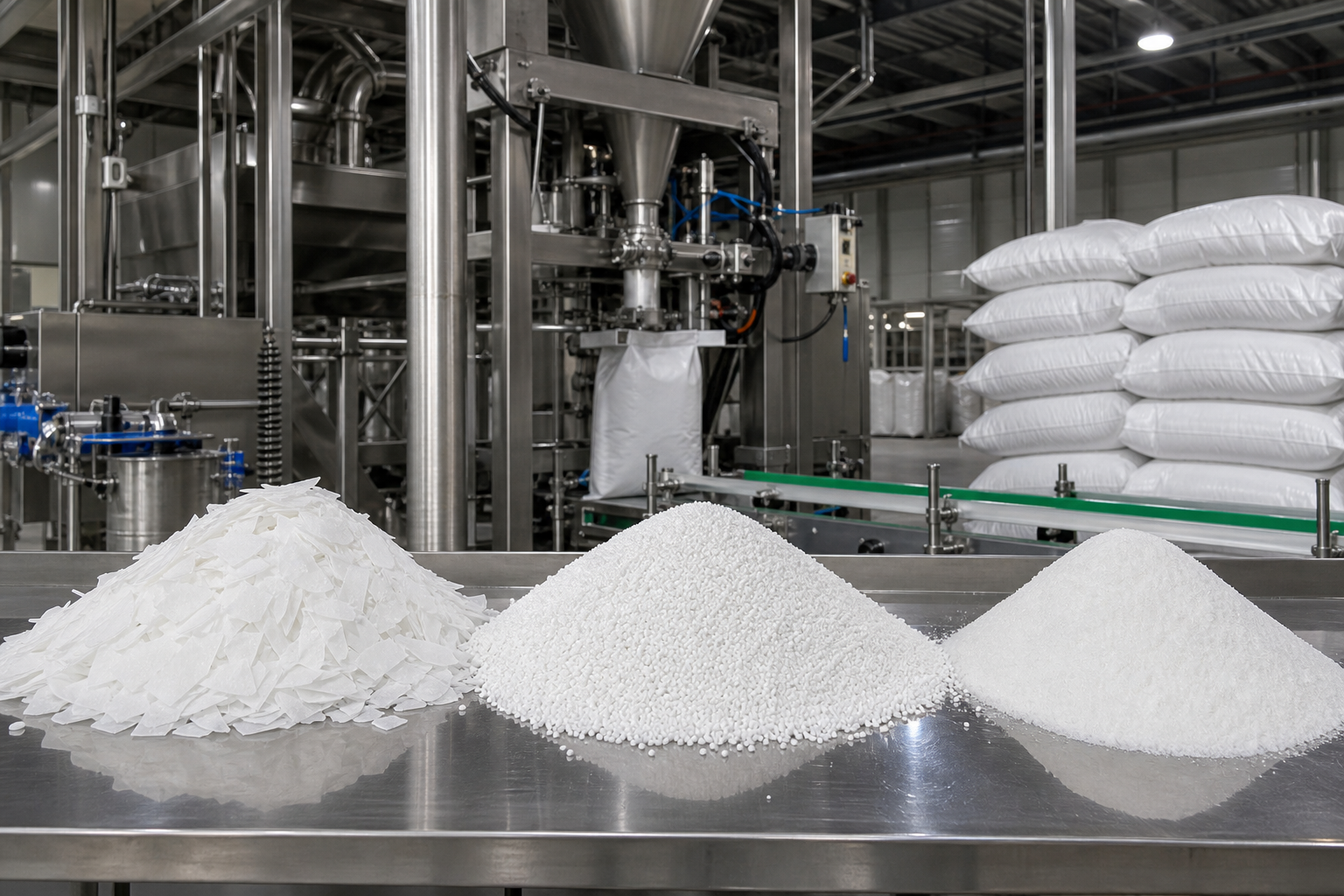
Granulation technology is the visible differentiator between suppliers: spray granulation fluid beds and rotary systems for anhydrous granule dominate modern projects, with dedicated calcium chloride concentration and granulation process lines described in our CaCl2 concentration and granulation solutions page.
Reference Projects
Published external industry references confirm the route at both ends of the size range – supplier-reported and indicative, not a project guarantee:
- 600,000 tpa soda ash and calcium chloride integrated project (Saudi Arabia): designed as the world’s largest anhydrous calcium chloride granule production plant, and the first non-oil-and-gas chemical project built in the Gulf region using Chinese standards.
- 30,000–35,000 tpa anhydrous CaCl2 granule plants (Yunnan and Inner Mongolia): chemical projects that consume by-product hydrochloric acid from the polysilicon industry — a direct waste-acid-to-product conversion.
- Additional delivered projects reported by the same engineering groups include a calcium chloride dihydrate spray granulation project in Russia (ICC), an anhydrous calcium chloride project in Kazakhstan, and a calcium chloride project for a major domestic soda ash producer.
Integration with Soda Ash Operations
The economics improve again when the CaCl2 plant is integrated into the soda ash complex itself. The Solvay process generates calcium chloride in its ammonia recovery loop, and CO2 from the neutralization of waste acid with limestone is exactly the gas the carbonation tower consumes. An integrated design therefore closes three loops at once: waste acid is consumed, distillation waste liquor is upgraded instead of ponded, and reaction CO2 returns to soda ash production rather than venting.
The 600,000 tpa Saudi Arabian project – cited as a published external reference – shows the model at full scale, with soda ash and anhydrous calcium chloride reported as one integrated complex, with the CaCl2 train sized to absorb the chloride burden of the whole site. On a smaller footprint, the same logic applies to single-line plants taking third-party waste acid: the plant is specified by acid availability and chloride balance first, and by product market second, because the acid supply contract is what makes the feedstock nearly free.
Water balance completes the integration. Evaporator condensate from the concentration train is hot and low in dissolved solids, suitable for scrubbing, flaking, and granulation duties inside the same fence; in arid locations — the Saudi and Inner Mongolia references both qualify — condensate recovery is not an optimization but a licensing and operating requirement.
Design Considerations for a By-product HCl to CaCl2 Project
Four decisions determine whether the plant hits its payback:
- Acid purification depth. Polysilicon and organic-chlorination acids carry impurities that contaminate the product; the purification section (settling, filtration, and where necessary activated-carbon or resin steps) should be specified from a full analysis of the actual acid, not nominal concentration alone.
- Product slate flexibility. De-icing flake and oilfield anhydrous granule sell into different seasons and regions. A concentration train designed to swing between dihydrate and anhydrous modes captures both.
- Energy selection. With BPR of 15–20 K possible in the 40–50% band (industry-reported), check that compressor temperature lift (for MVR) or effect count and steam pressure (for multi-effect) actually covers the duty before committing.
- Materials and maintenance. Hot chloride service punishes under-specified metallurgy; the life-cycle cost of duplex or titanium heat exchange surfaces is usually lower than repeated replacement of 316L.
When This Route May Not Fit
This route needs both a waste-acid supply and a salt market to work, and either can veto it. Sites whose acid arisings are small, sporadic, or already committed to another consumer have no feedstock basis for the plant. Locations with no realistic CaCl2 market within hauling range – and no road-deicing season – turn the product into a disposal problem wearing a different label. Where the acid carries heavy organic or silicone contamination, the purification train can cost more than the recovery is worth, and contracted disposal remains the cheaper answer. Cheap natural-gas steam with expensive electricity weakens the MVR case for a commodity-salt plant. And a one-off acid batch from a shutting-down line never justifies permanent equipment.
What Must Be Verified
Before committing to this route, verify four inputs. First, the acid itself: a full analysis of origin, concentration variability, and impurity profile – organics, suspended silica, dissolved metals – because purification depth is sized from the real assay, not the nominal HCl percentage. Second, the chloride and water balance of the host site, which decides whether distillation liquor joins the train and how much condensate the complex can reuse. Third, the target product slate and its market distance: de-icing flake, oilfield granule, or liquid dosing each fix different concentration endpoints and finishing machines. Fourth, the energy picture – steam pressure, electricity price, and operating hours – checked against the boiling point rise at the target concentration before any MVR or multi-effect commitment is made.
Frequently Asked Questions
Why convert by-product HCl to calcium chloride instead of neutralizing it?
Neutralization consumes alkali, generates chloride-laden effluent, and produces nothing of value. Converting the acid with limestone or lime produces a saleable CaCl2 product, and in soda ash complexes the same train can also absorb the calcium chloride-bearing distillation waste liquor — turning an environmental problem into revenue on both lines.
Which industries supply the by-product HCl for these plants?
Reference projects consume by-product acid from polysilicon production, and the technology is equally applied to HCl from chlor-alkali complexes, organic chlorination processes (pesticide and pharmaceutical intermediates), and soda ash distillation liquor. Each source requires its own purification specification.
What evaporator type suits calcium chloride liquor?
Forced circulation evaporators are the standard choice: CaCl2 liquor is highly corrosive, viscous at concentration, and prone to scaling, and high-velocity circulation suppresses fouling on the heat-transfer surfaces. Material selection typically escalates from SUS316L to 2205 duplex or titanium for hot concentrated chloride service.
Is MVR evaporation economical for CaCl2 production?
It can be, because the product is a commodity and energy dominates operating cost. The key check is boiling point rise: concentrated CaCl2 solutions can show 15–20 K BPR in the 40–50% band (industry-reported), so the compressor temperature lift must cover it. Where electricity is competitively priced, MVR at typically 20–35 kWh per tonne of evaporated water outperforms steam-driven multi-effect evaporation.
What product forms can the plant make?
The same concentration train can deliver liquid calcium chloride (27–38% solution), dihydrate flake (typically 74–77% CaCl2) for de-icing and dust control, and anhydrous granule (typically 94%+) via spray granulation or fluidized bed dehydration for desiccant and oilfield markets. The CO2 released by acid neutralization with limestone can also be captured and routed back into soda ash carbonation — one reason the technology fits best as an integrated unit inside a soda ash or chlor-alkali complex rather than a standalone plant.
To screen this route for a specific acid stream, share the acid analysis and availability, the target product slate, and the site energy profile – enough for an initial process-direction assessment.