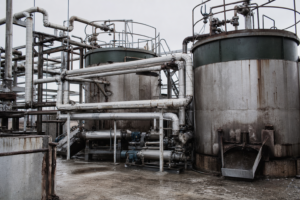
Fouling and scaling are the leading causes of evaporator performance loss: dissolved ions precipitate on heat transfer surfaces and distribution internals, throttling capacity and inflating energy consumption until a cleaning shutdown becomes unavoidable. The discipline that separates reliable plants from problem plants is prevention—understanding the water chemistry before design, controlling hardness at the feed, and managing supersaturation in operation—because once scale has formed, removal is slow, expensive, and in some chemistries close to impractical. This article explains the mechanisms, the warning signs, the prevention toolkit, and the cleaning methods, in the order a plant engineer needs them.
How Scale Forms: Solubility Limits in Motion
Scale is the hard crust that deposits when dissolved salts crystallize on surfaces instead of staying in the bulk liquid. The trigger is simple: when a paired cation and anion exceed their solubility limit, the salt must precipitate—and whether it precipitates as suspended crystals or as an adherent layer on the nearest surface decides whether you have a manageable solids stream or a fouling problem.
Not all ion pairs behave alike:
- Multivalent pairs are the worst offenders. Combinations such as calcium and sulfate have low solubility and reach their limit early during concentration, so they scale first and hardest.
- Mixed-valence pairs deserve suspicion too. The calcium-fluoride pairing is a classic mono-multi exception that causes severe scaling even though fluoride alone attracts little attention.
- Solubility boundaries move with conditions. Temperature, pH, and the presence of other ions all shift the precipitation threshold. Notably, mixed solutions often dissolve ions better than pure binary solutions—the mixed-ion effect acts as a partial buffer—but this behavior is difficult to predict with software models, which is why lab water analysis beats simulation for real feeds.
Where Scale Attacks: Surfaces Beyond the Tubes
Operators tend to equate fouling with tube scaling, but two less obvious locations cause a disproportionate share of field failures:
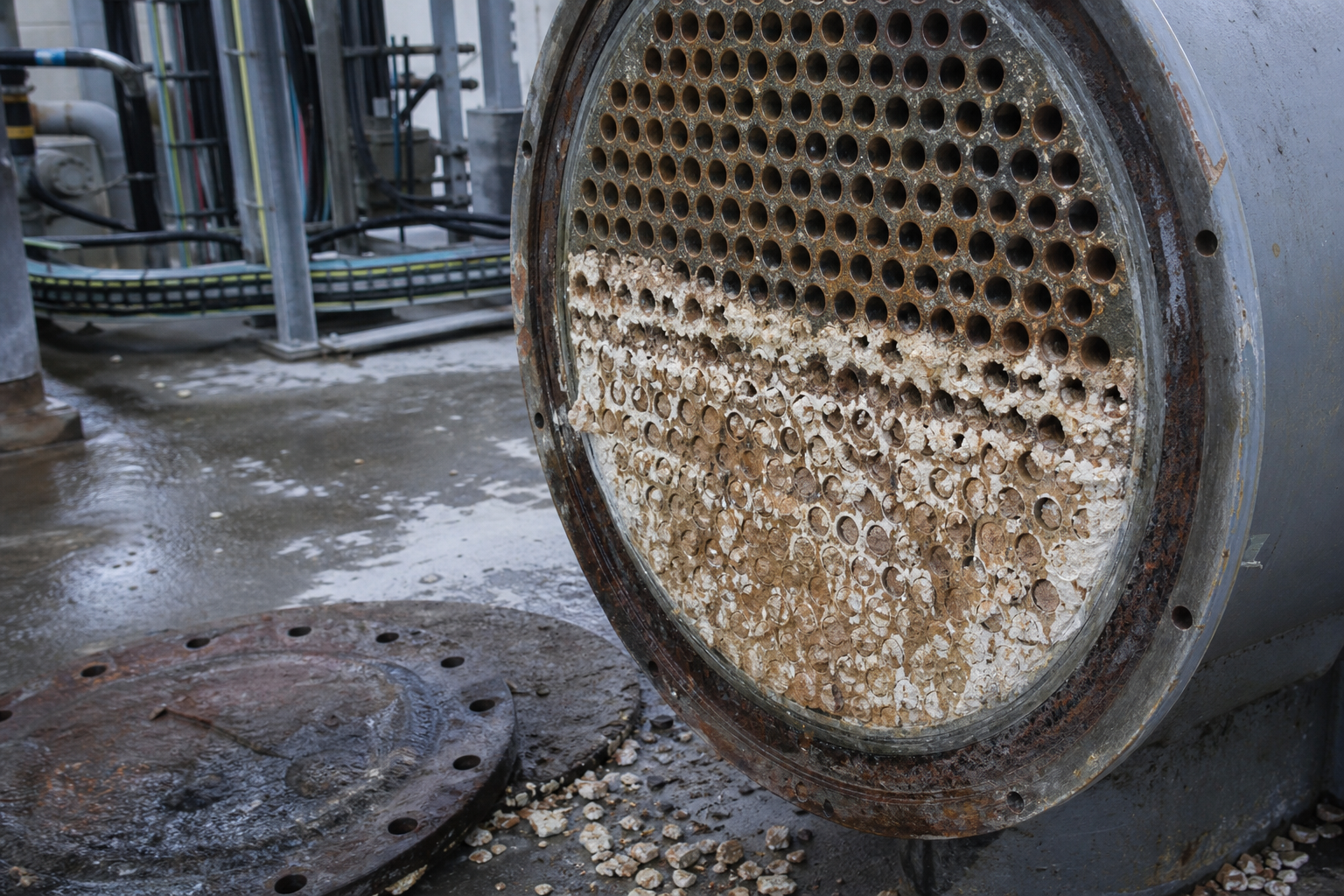
- Distributor passages in falling-film units. Calcium sulfate, calcium carbonate, and silicates precipitate in the narrow gaps of the liquid distributors at the top of falling film evaporators, partially blocking flow and starving downstream tubes of wetting.
- Demister pads. Secondary steam carries a mist of brine droplets; the salt they leave behind crystallizes on the wire mesh and baffles, and severe buildup can force vapor to strike the vessel wall instead of passing cleanly.
Conventional tube-side and shell-side deposition completes the picture: any surface that is hot, concentrated, or intermittently dry is a candidate.
What Fouling Costs: The Damage Chain
Scale layers are insulators. Even a thin deposit adds thermal resistance that must be overcome by more temperature difference, more steam, or more compressor power. The consequences cascade:
- Flow channels narrow and pressure drop across the unit climbs abnormally.
- Heat transfer deteriorates; local hot spots appear where flux concentrates through the remaining clean area.
- Energy consumption rises without a corresponding increase in production.
- Product concentration becomes unstable and off-spec.
- In extreme cases, deposits cause mechanical damage—blocked tubes in neighboring equipment such as RO membranes have ruptured under the differential pressure.
Seven Warning Signs of Blockage in Progress
Fouling announces itself through the process data long before it becomes visible. Monitor continuously for:
- Falling evaporation rate or throughput at constant operating conditions
- Abnormally rising pressure differential across the affected section
- Deteriorating heat transfer—uneven temperature distribution and local hot spots
- Increasing frequency of acid washes and other chemical cleaning interventions
- Visible scale layers on the tube bundle during inspection
- Unstable product concentration or quality
- Rising energy consumption per unit of output with no production increase
Continuous monitoring of flow, temperature, pressure, and power consumption is the practical early-warning system; trends matter more than absolute values.
Prevention I: Control Hardness at the Source
The single most effective rule in evaporator feed management is a hardness limit: keep combined calcium and magnesium below roughly 100 ppm before the liquor enters the evaporator. Calcium and magnesium are the most common triggers of scaling and blockage, and the reliable way to deal with them is upstream removal, not in-unit accommodation.
The standard pretreatment routes include:
- Chemical softening: lime-soda or caustic precipitation removes hardness before evaporation; automated dosing reduces reagent waste compared with manual batch softening.
- Sulfate removal: for sulfate-rich feeds, pre-removal of sulfate drastically extends the interval between calcium sulfate cleaning campaigns.
- Full water chemistry analysis: sampling during both high- and low-concentration periods (typically a few hundred dollars of lab cost) and checking the ion matrix against a scaling-compound reference reveals which pairs will precipitate first.
The design principle is to approach—but never exceed—the solubility limits of the scaling ions in the operating plan.
Prevention II: Antiscalants and Their Limits
Well-selected antiscalant chemicals raise the apparent solubility of scaling ions by a factor of roughly three to four, allowing the process to concentrate further before precipitation begins. Two cautions govern their use:
- Performance varies widely between products and suppliers; selection tests against the actual liquor are essential before standardizing.
- Antiscalants delay precipitation; they do not change the thermodynamics. Beyond their threshold, scaling proceeds anyway, and overdosing carries its own costs and foaming risks.
For high-TDS streams, online ion sensors that track scaling species in real time add a further margin of safety.
Prevention III: Seed Slurry Control
In crystallizing duty, suspended seed crystals give precipitating salts a preferred surface to grow on—so they deposit on the seeds rather than on the heat transfer tubes. The technique works: reported brine-concentrator practice shows calcium sulfate seeding units running a year or more between cleanings and concentrating wastewater to around 300,000 ppm TDS, with seed added only at startup.
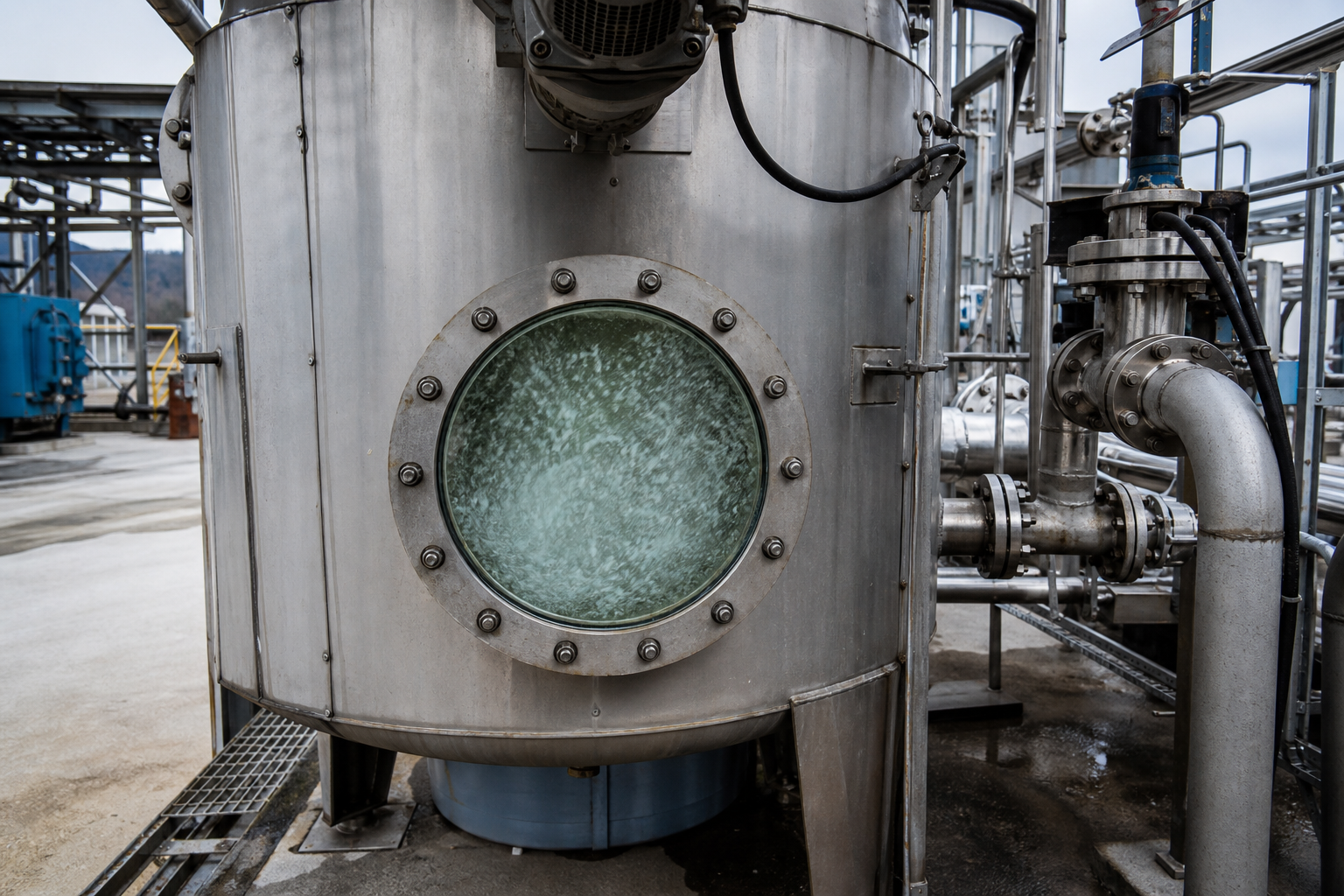
The difficulty is control. The seed concentration in the circulating brine is the critical monitored variable, its workable window is narrow, and analytical results lag the process—if seed depletion goes unnoticed, fouling has typically already begun. Seed management therefore demands disciplined sampling and response procedures rather than casual operation. Applied deliberately, the same principle—controlling supersaturation so crystals grow where you want them—underpins all industrial crystallization practice.
Prevention IV: Mechanical and Design Measures
- Anti-dry-wall design: a pre-cooler that keeps the evaporation tube surface below about 40 °C, plus high-flow, densely packed distributors that guarantee a continuous water film with no dry spots, remove the hot-dry conditions where rapid scaling starts.
- Surface pre-coating: forming a protective film on heat exchange tubes during manufacture impedes the adhesion of scale crystals and extends run length.
- Continuous blowdown: a small continuous purge keeps the calcium concentration factor in the circulating loop below its limit instead of letting it ratchet upward.
- Forced circulation: for scaling and crystallizing fluids, high velocity through the tubes sweeps nascent crystals off the surface—see forced-circulation evaporator design.
Prevention Measures at a Glance
| Measure | What it does | Practical limit |
|---|---|---|
| Hardness limit at feed (~100 ppm Ca+Mg) | Removes the dominant scaling species before entry | Requires softening pretreatment investment |
| Chemical softening / sulfate removal | Extends cleaning cycle drastically for CaSO4 duty | Reagent cost; sludge handling |
| Antiscalant dosing | Raises apparent scaling-ion solubility ~3-4x | Product-dependent; test before standardizing |
| Seed slurry (selective crystallization) | Scales deposit on suspended seeds, not tubes | Narrow control window; analysis lag |
| Anti-dry-wall design (<40 °C, full wetting) | Eliminates hot dry spots that trigger rapid crusting | Must be designed in; retrofit limited |
| Continuous blowdown | Bounds the concentration factor in circulation | Small purge stream to treat |
Cleaning Methods: Three Families
When prevention loses, three families of cleaning techniques restore capacity:
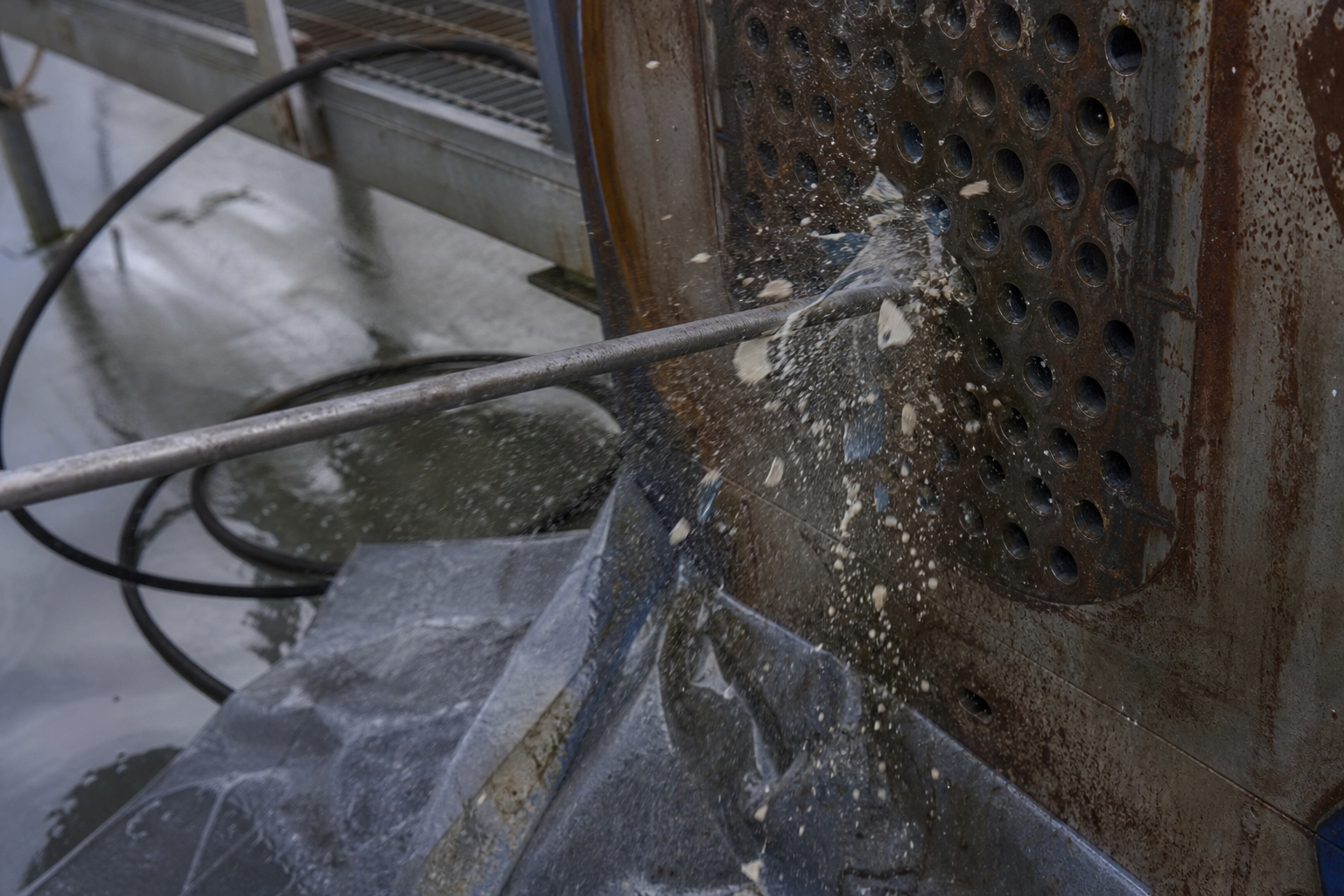
- Mechanical cleaning. Rodding machines push flexible rods through tubes at high pressure—up to about 10,000 psi (~690 bar)—while brushes and drill-heads scrape hard deposits off tube walls.
- Chemical cleaning. A closed-loop circulation of heated acid or alkaline solution through the fouled side, in four steps: isolate the unit; pump and circulate the solution; monitor concentration and replenish as it is consumed; flush with clean water. Effective for carbonate scales and organic fouling; calcium sulfate chemistry consumes long circulation times.
- High-pressure water jetting. Flexible or rigid lances deliver water at up to 2,500 bar (~36,000 psi) directly onto deposits—typically after isolating the unit and opening the channel head to expose the tube bundle, with wash water collected for treatment.
Frequency follows the fouling tendency of the material: plants on benign duty schedule full cleaning campaigns on multi-year intervals, while scaling-prone service tightens the cycle. Preventive maintenance planning per material characteristic—rather than crisis response—is the standard practice.
Five Blockage Types and Their Correct Remedies
Not all blockage is scale, and applying the wrong remedy wastes downtime. Industry-reported field experience sorts tube blockage into five types:
| Blockage type | Root cause | Correct response |
|---|---|---|
| Hardness scale layer | Ca/Mg carbonate or sulfate precipitation in tubes | High-pressure washing or chemical cleaning; CaSO4 needs long chemical exposure—pre-softening or sulfate removal prevents it |
| Foreign-object plug | Scab breaking off vessel walls and lodging in tubes; tube fully blocked, little hard scale on walls, plug mostly salt | Water-jet flushing only; soaking rarely dissolves it |
| Organic coking | Organics polymerize and char on hot walls during long concentration runs; salt particles then pack the coke layer | Periodic alkaline washing before the plug hardens—do not wait for full blockage |
| Pure salt plug | Design shortfall: insufficient vapor-body height or excessive evaporation intensity causing local overheating and crystallization in the upper tube section | Reduce evaporation intensity; increase circulation pump flow to extend the plug-free period; fix the design root cause |
| Sulfate family scaling | Zinc sulfate, manganese sulfate, magnesium sulfate systems | Treat differently from Ca/Mg hardness scale; identify chemistry before choosing chemicals |
Two general rules close the diagnostic picture: carbonate scales yield readily to acid washing, while sulfate scales are poorly soluble and resist chemical attack—prevention economics dominate. And when scaling recurs faster than the plan predicts, a full water analysis on both high- and low-concentration samples is the cheapest way to find out why.
Monitoring and Planned Cleaning Cycles
A defensible fouling management program has four elements:
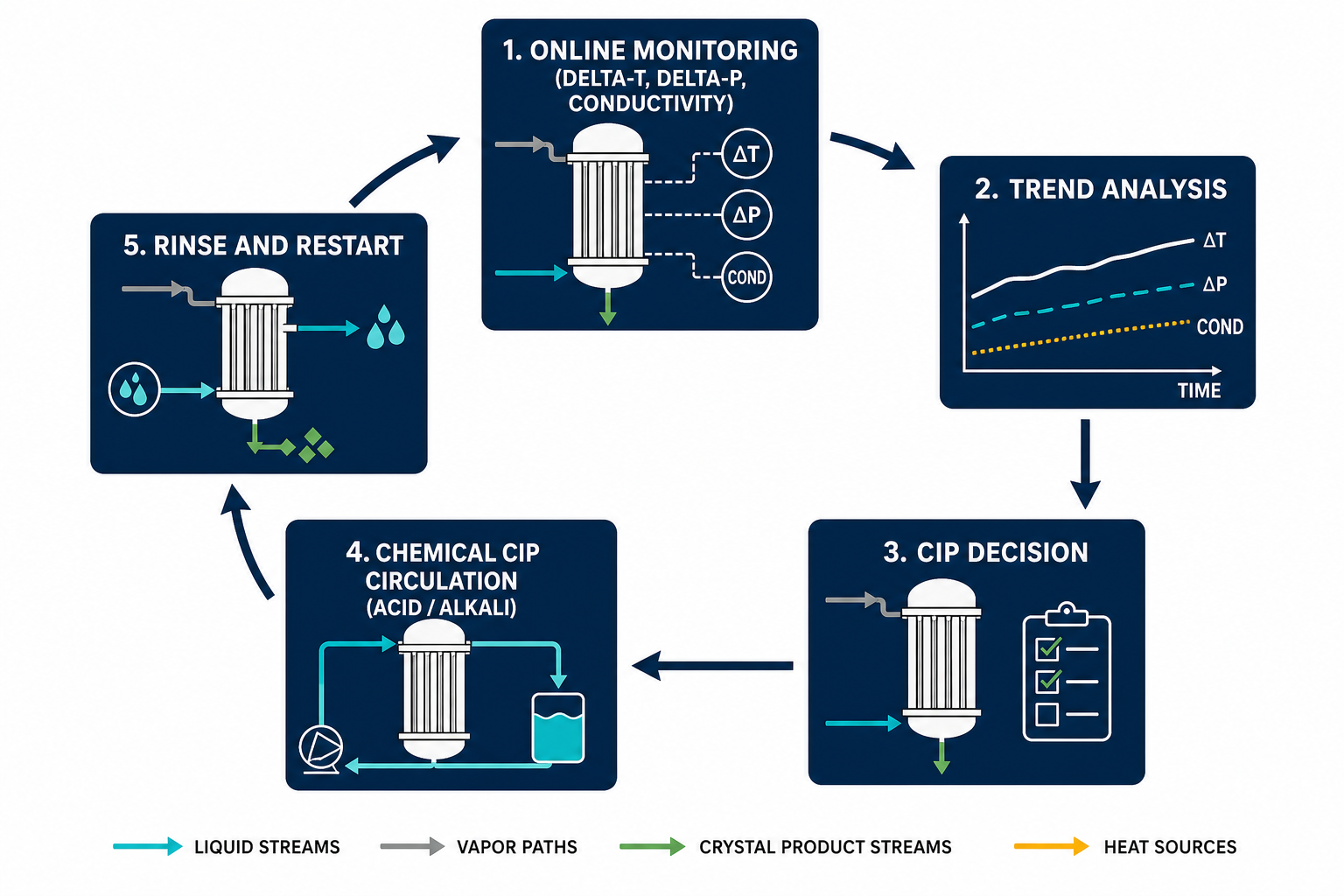
- Continuous process monitoring of flow, temperature, pressure differential, and energy consumption, with trend alarms.
- Water chemistry tracking—periodic full analysis, and for high-TDS service, real-time sensors for scaling ions.
- A scaling-period chart that predicts when each ion pair will reach its solubility limit as concentration proceeds.
- Planned cleaning outages scheduled before performance loss compounds, instead of emergency shutdowns after it does.
Because scale layers consume the same effective temperature difference that boiling point elevation already claims, fouling management and BPE-aware thermal design are two halves of the same capacity-preservation problem. For zero liquid discharge trains where the evaporator feeds a crystallizer, stable anti-fouling operation is also what keeps the downstream ZLD process chain on specification.
Frequently Asked Questions
What causes scaling in evaporators?
Dissolved ion pairs reach their solubility limit as the liquor concentrates and precipitate onto surfaces. Multivalent pairs such as calcium-sulfate scale first because of low solubility; the calcium-fluoride combination is another notorious pair. Temperature, pH, and mixed-ion effects shift the exact precipitation point.
How much calcium and magnesium can an evaporator tolerate?
A widely applied feed guideline is to keep combined Ca2+ plus Mg2+ below about 100 ppm entering the evaporator. Above that range, pretreatment—chemical softening or sulfate removal—is more reliable than trying to manage scaling inside the unit.
How much does antiscalant help?
A correctly selected antiscalant raises the apparent solubility of scaling ions by roughly three to four times, delaying precipitation during concentration. Product performance varies significantly between suppliers, so selection testing against the real liquor is essential.
What are the first signs of evaporator fouling?
Declining evaporation rate, abnormally rising pressure differential, uneven heat transfer with local hot spots, more frequent chemical cleaning, visible scale on the bundle, unstable product concentration, and rising specific energy consumption. Continuous trend monitoring of flow, temperature, pressure, and power catches fouling earliest.
Which cleaning method should be used for evaporator scale?
Carbonate scales respond well to closed-loop acid cleaning; mechanical rodding (up to ~10,000 psi) and high-pressure water jetting (up to ~2,500 bar / 36,000 psi) remove hard and insoluble deposits; organic coking is best prevented with periodic alkaline washes. Calcium sulfate scale is poorly soluble—prevention through pretreatment beats removal.
What is seed slurry fouling control?
Suspended seed crystals—typically calcium sulfate—are maintained in the circulating brine so that precipitating salts grow on the seeds instead of on heat transfer surfaces. Brine concentrators using seeding can concentrate to around 300,000 ppm TDS and run a year or more between cleanings, but the seed concentration window is narrow and must be actively monitored.