The energy answer for evaporation is structural, not incremental: recover the vapor you already made. In a single-effect evaporator, evaporating one kilogram of water consumes roughly one kilogram of live steam, because the heat released by condensing steam and the heat required to boil water are nearly the same. Every efficiency technology in the field — multiple-effect evaporation, thermal vapor recompression (TVR), and mechanical vapor recompression (MVR) — is a way of reusing that vapor before letting it go, and mature plants routinely combine two or all three. The economics are not subtle: retrofits documented below cut energy cost 65–86%, an illustrative 100 t/d chemical plant model shows annual savings of about 6.2 million RMB against a 40% capital premium repaid in 14–18 months, and the largest single lever is design-stage — more than 40% of energy waste in operating systems traces to parameter mismatches fixed, or built in, before start-up.
Where the Energy Goes: The Single-Effect Baseline
Start from the heat balance. Under steady operation, energy in equals energy out; the enthalpy carried by the vapor leaving the liquor is essentially the heat you put in through the heating surface. With condensing steam on one side and boiling liquor on the other, one kilogram of steam delivers roughly one kilogram of evaporation. That 1:1 economy is the baseline every optimization measures itself against, and it is why an un-recovered vapor stream is simply purchased fuel leaving the building. Good design does not fight this balance — it configures the plant so the same joule evaporates water two, four, or twenty times.

The Three Fundamental Saving Technologies
All thermal-vapor economy rests on three techniques, each usable alone, frequently combined:
- Multiple-effect evaporation (MEE) — the vapor from one effect becomes the heating steam of the next, at a lower temperature. Each added effect re-uses the original steam again.
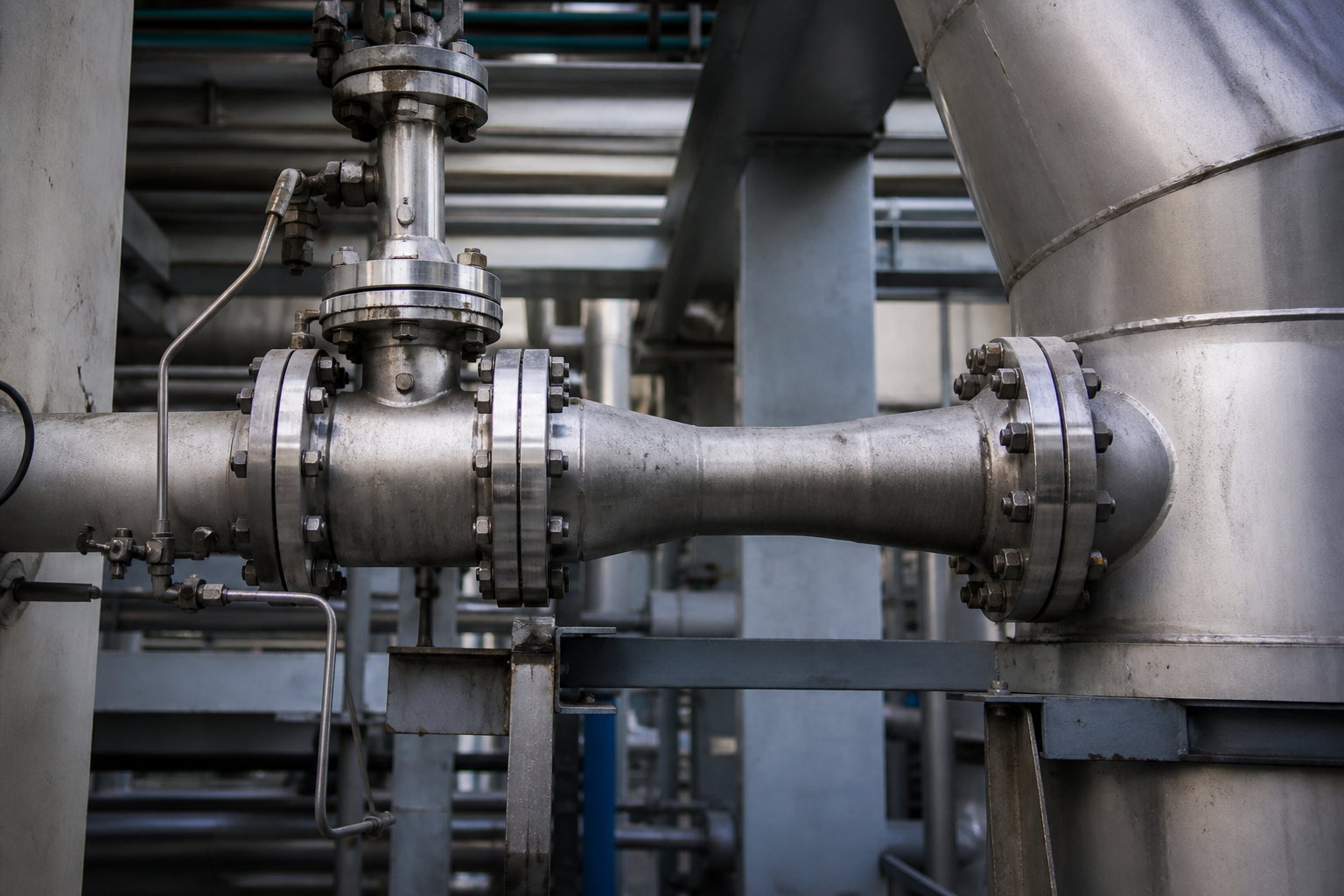
- TVR (thermal vapor recompression) — a steam ejector (no moving parts) mixes high-pressure motive steam with process vapor, lifting part of the vapor to a usable temperature again.
- MVR (mechanical vapor recompression) — a compressor recycles all the process vapor as the heating medium, driven by electricity, with only a fraction of the heat equivalent consumed as electrical work.
Each alone delivers a large reduction; combining two is the standard optimization of both capital and operating cost; mature installations combine all three. The multiple-effect platform page covers the effect-arrangement options in detail.
Multi-Effect: Diminishing Returns by Design
MEE obeys a law of diminishing returns that fixes the economically optimal number of effects. Sending the vapor to a second effect cuts system energy consumption by about 50% — the single largest step available. But each additional effect must operate at a lower temperature than the one before, so the total available temperature difference splits into thinner slices; heat-transfer area per effect grows, total area rises close to linearly with effect count, and the capital climbs while each new effect saves less steam than the last. The optimum is therefore usually three to five effects for wastewater and salt duties, set by the temperature window between the heat source and the cooling medium rather than by ambition.
TVR: A One-Effect Bonus with No Moving Parts
A steam-jet recompressor works on heat-pump principles with zero moving components — hence durable and cheap to maintain. One TVR saves steam and energy roughly equal to adding one more effect, at a fraction of the hardware complexity. It requires motive steam, and the surplus vapor leaving the TVR section — its energy content comparable to the motive steam — flows on to the next effect or to the condenser. Where steam is available and cheap, TVR is the first upgrade to evaluate.
MVR: An Electric Heat Pump at Plant Scale
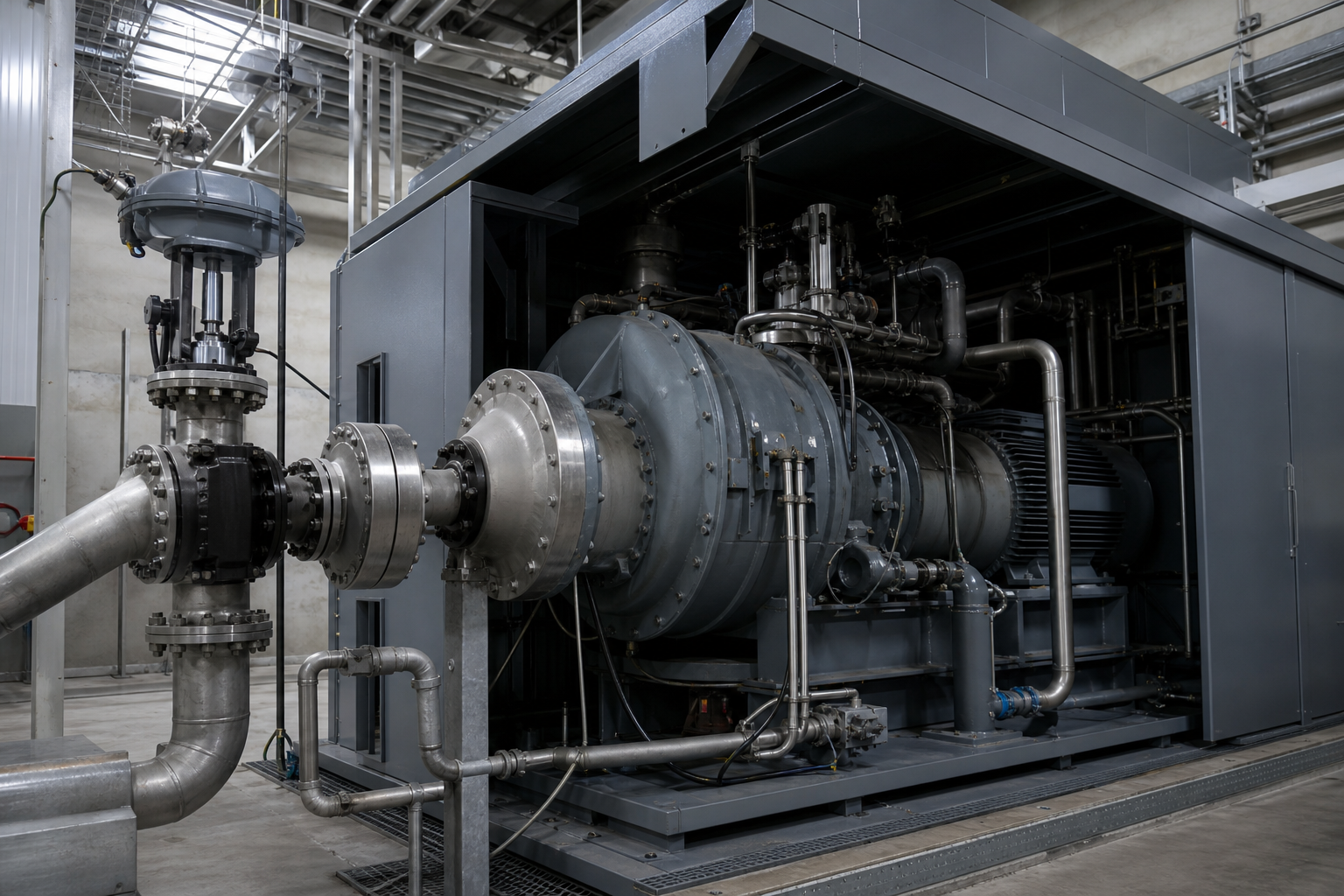
MVR compresses the entire vapor stream (TVR recompresses only part of it), spending electricity to recover the latent heat of the vapor as usable heating duty. Feed preheating against condensate recovers a further increment. Evaporation plants typically use single-stage centrifugal fans with compression ratios of 1:1.2 to 1:2 — modest ratios, because the temperature lift required is small once boiling-point elevation is accounted for. The energy signature changes completely: instead of consuming steam continuously, the plant uses a small steam quantity at start-up and then runs on electricity, converting kilowatt-hours into multiples of themselves as evaporation duty. System behavior, compressor limits, and feed red lines are covered on the MVR technology page.
MVR vs TVR: The Decision Table
| Criterion | MVR | TVR |
|---|---|---|
| Primary energy | Electricity | Live (motive) steam |
| Coefficient of performance | 10.0–20.0 depending on ΔT | 3.0–5.0 |
| Steam consumption vs conventional MEE | Essentially zero in operation | 30–50% lower |
| Typical payback | 12–24 months | 24–36 months |
| Best fit | Stable electricity, continuous large-scale production | Cheap steam, smaller or batch duties |
| Footprint | Compact; no large condenser | Compact; simplest hardware |
Both routes support the energy retrofit and decarbonization programs that wastewater and process plants now run — MVR for the electrification and carbon argument, TVR where the steam system already exists.
The 18-Month Crossover
Capital comparisons mislead in this field. A five-effect steam system has lower CAPEX than an MVR plant of equal duty — but running it for about 18 months typically accumulates enough energy cost to exceed the total cost of the MVR alternative, and the gap widens every hour afterward. Under carbon accounting, purchased steam carries an indirect cost that keeps rising, which shortens the crossover further. The engineering conclusion: evaluate evaporator investments on cumulative cost curves, not on installation quotes.
Retrofit Evidence: Whey
One externally reported dairy-side whey project converted a four-effect falling-film train to MVR. Specific energy moved from 150 kg steam per ton of water evaporated to 18–22 kWh of electricity per ton — an approximately 65% cut in direct energy cost. Paired with multi-stage waste-heat recovery, the MVR configuration recovers more than 90% of the secondary vapor’s heat. The pattern generalizes: food and fermentation duties with modest boiling-point elevation are the easiest MVR conversions, as the food and fermentation applications show.
The Full Account: 100 t/d Chemical Wastewater
An illustrative model for a 100 ton/day chemical wastewater plant (electricity 0.8 RMB/kWh, steam 280 RMB/t, 8,000 operating hours per year):
| Configuration | Steam | Electricity | Annual energy cost |
|---|---|---|---|
| Conventional triple-effect | 3.3 t/h | 50 kW | ≈ 7.6 million RMB |
| MVR | 0 (start-up only) | 220 kW | ≈ 1.4 million RMB |
The difference is about 6.2 million RMB per year. MVR capital runs roughly 40% higher for this duty, repaid in 14–18 months of operation. These are the numbers that reorganize project approvals.
Converting Multi-Effect to MVR: Three Preconditions
Not every existing train converts cleanly. Three conditions must be verified before a retrofit proposal is credible:
- Total heat-transfer ΔT ≤ 40°C, and per-effect ΔT ≤ 15°C — the existing heat exchangers must work with the small temperature lift a compressor provides.
- Last-effect temperature above about 55°C — lower temperatures mean larger vapor volumes, which inflate the compressor specification and the investment.
- Site power and installation space — the electrical capacity for the compressor and the plot space for the skid must exist.
When they hold, retrofitting preserves the existing evaporator bodies while replacing the energy system — low investment, short construction period, and improved system redundancy as a side effect.
Fructose Retrofit: 86% Energy Reduction
An externally reported four-effect fructose train (20 t/h evaporation, 90°C live steam, 55°C last effect) was rebuilt as MVR: a 500 kW two-stage variable-frequency compressor (6 t/h vapor flow, pressure ratio 4.4, temperature rise 35°C), inlet/outlet switching valves, and a vacuum pump. The operating account:
| Item | Before (RMB/h) | After (RMB/h) |
|---|---|---|
| Steam (7.5 t/h → 0.5 t/h) | 1,875 | 125 |
| Electricity (100 → 600 kWh) | 80 | 480 |
| Cooling water (200 → 20 t/h) | 600 | 60 |
| Total | 2,555 | 335 |
At about 6,000 operating hours per year, annual energy cost fell from 15.33 million to 2.01 million RMB — an 86% reduction — while retaining the existing evaporator bodies and maintaining or improving capacity and process quality.
Eight Engineering Levers for MVR Efficiency
Beyond configuration choice, operating plants squeeze MVR efficiency through eight recurring measures:

- Feed pretreatment — filtration/centrifugation/settling to strip suspended solids; pH adjustment and antiscalants to extend cleaning intervals; preheating feed against condensate or concentrate.
- Compressor efficiency — matching centrifugal versus screw selection to the duty, variable-frequency drive for turndown, disciplined maintenance.
- Heat-exchanger performance — uniform liquid distributors, scheduled chemical/mechanical cleaning, and heat-transfer area sized correctly — neither over- nor under-designed.
- Heat integration — waste-heat recovery, coupling MVR with multiple effects (upstream effects reduce compressor load), insulating high-temperature steam and condensate lines.
- Operating parameters — running at the lowest permissible evaporation temperature and compression ratio; stable load, avoiding frequent start-stop cycles.
- Intelligent control — real-time sensing, energy-model monitoring, and periodic energy audits to keep the plant at its design point.
- High-efficiency separators — minimizing entrainment protects both condensate quality and compressor health.
- System redundancy — sparing and bypass design so single interruptions do not cascade into thermal cycling losses.
Diagnosing an Inefficient Triple-Effect Unit
When an existing steam system burns more than it should, four causes cover most cases. Vacuum anomalies — the system should hold roughly 60 kPa; low vacuum raises the boiling point, cutting efficiency and raising steam use, while excessive vacuum increases the latent heat of the vapor and total steam consumption. Steam pressure faults — too high and violent boiling forms vapor films on the tube wall, collapsing the heat-transfer coefficient; too low and the temperature difference cannot support capacity. Unstable operation — drifting levels, concentrations, and discharge temperatures. Equipment aging — vacuum losses, steam-pressure swings, and fouled surfaces degrading transfer. A disciplined diagnostic walk through these four, as part of the routines in the operation and maintenance guide, recovers most lost economy without capital.
Design Beats Maintenance
External industry references put over 40% of energy waste at the design stage — parameter mismatches between heat source, effect count, area, and actual liquor behavior. Two long-horizon facts complete the economics: centrifugal compressor impellers are engineered for roughly 15-year design life with annual maintenance below 1.5% of equipment value (typical supplier-reported figures) when supported by oil analysis and vibration monitoring; and intelligent control that tracks the heat-transfer coefficient K in real time detects fouling early enough to respond with flow adjustment or online chemical compensation instead of shutdown cleaning. For feed streams with variable concentration, two-stage compression or automatic anti-surge bypass protects the compressor and the efficiency curve together. High-vacuum operation at 45–55°C adds the option of protecting heat-sensitive materials — proteins, flavors — while evaporating, which couples the energy argument with product quality rather than trading against it.
FAQ
How much steam does a single-effect evaporator use?
About one kilogram of live steam per kilogram of water evaporated — the condensing steam and boiling liquor transfer nearly identical heat. This 1:1 baseline is what multi-effect design, TVR, and MVR each improve upon.
Which is more efficient, MVR or TVR?
MVR: coefficients of performance run 10.0–20.0 versus 3.0–5.0 for TVR, and typical payback is 12–24 months versus 24–36. TVR remains attractive where cheap motive steam exists and hardware simplicity matters, cutting steam use 30–50% versus conventional multi-effect.
Why does adding effects eventually stop paying?
Each effect subdivides the available temperature difference, so heat-transfer area per effect grows roughly linearly while the steam saved per effect shrinks. Past roughly five effects, capital growth outruns the energy saved, and the optimum is set by the site’s temperature window.
What does it cost to convert multi-effect evaporation to MVR?
Conversion requires total ΔT ≤ 40°C with per-effect ΔT ≤ 15°C, a last-effect temperature above about 55°C, and available power and space. When these hold, the existing evaporator bodies are retained; the fructose retrofit documented here cut energy cost 86% (15.33 to 2.01 million RMB per year) with a 500 kW two-stage compressor package.
Where do most evaporator energy losses originate?
More than 40% of energy waste in operating systems traces to design-stage parameter mismatches — wrong effect count, mis-sized area, liquor behavior unlike the design basis. In operation, the recurring losses are fouling (tracked via the heat-transfer coefficient K), unstable vacuum around the 60 kPa setpoint, and load cycling that defeats steady-state economy.