Project Parameters
| Parameter | Value |
|---|---|
| Process route | Brownfield retrofit: existing six-effect station upgraded to seven effects with forced-circulation duty |
| Industry | Pulp & paper — APMP (alkaline peroxide mechanical) pulp line |
| Feed type & key components | APMP dilute black liquor; wood extractives, peroxide residues, sodium salts, suspended fines |
| Evaporation capacity | 115.4 t/h |
| Project type | Upgrade and retrofit of an operating station |
| Region | East China (Shandong) |
Representative process configuration compiled from published industry project data. Indicative values, not a process guarantee.
Project Description
APMP — alkaline peroxide mechanical pulping — makes high-brightness pulp with high yield, and its black liquor is the mechanical-pulp cousin of the kraft world: dilute, extractive-laden, peroxide-marked, and produced at volumes that grow every time the paper machine speeds up. The published project behind this configuration is the retrofit of an operating six-effect APMP evaporation station at a major integrated paper producer in East China: an upgrade to seven effects with forced-circulation duty, at 115.4 t/h.
Retrofit is a discipline of its own. The existing station — in this case built by an earlier supplier — had capacity and economy benchmarks of its era; the paper producer’s growth outran both. The published answer is not demolition but integration: keep the station’s serviceable body count, add an effect, re-stage the pressure ladder, and put forced circulation where the liquor’s fouling and solids now demand it. The mill keeps evaporating while its station grows — the constraint every retrofit lives under.
Process Technology
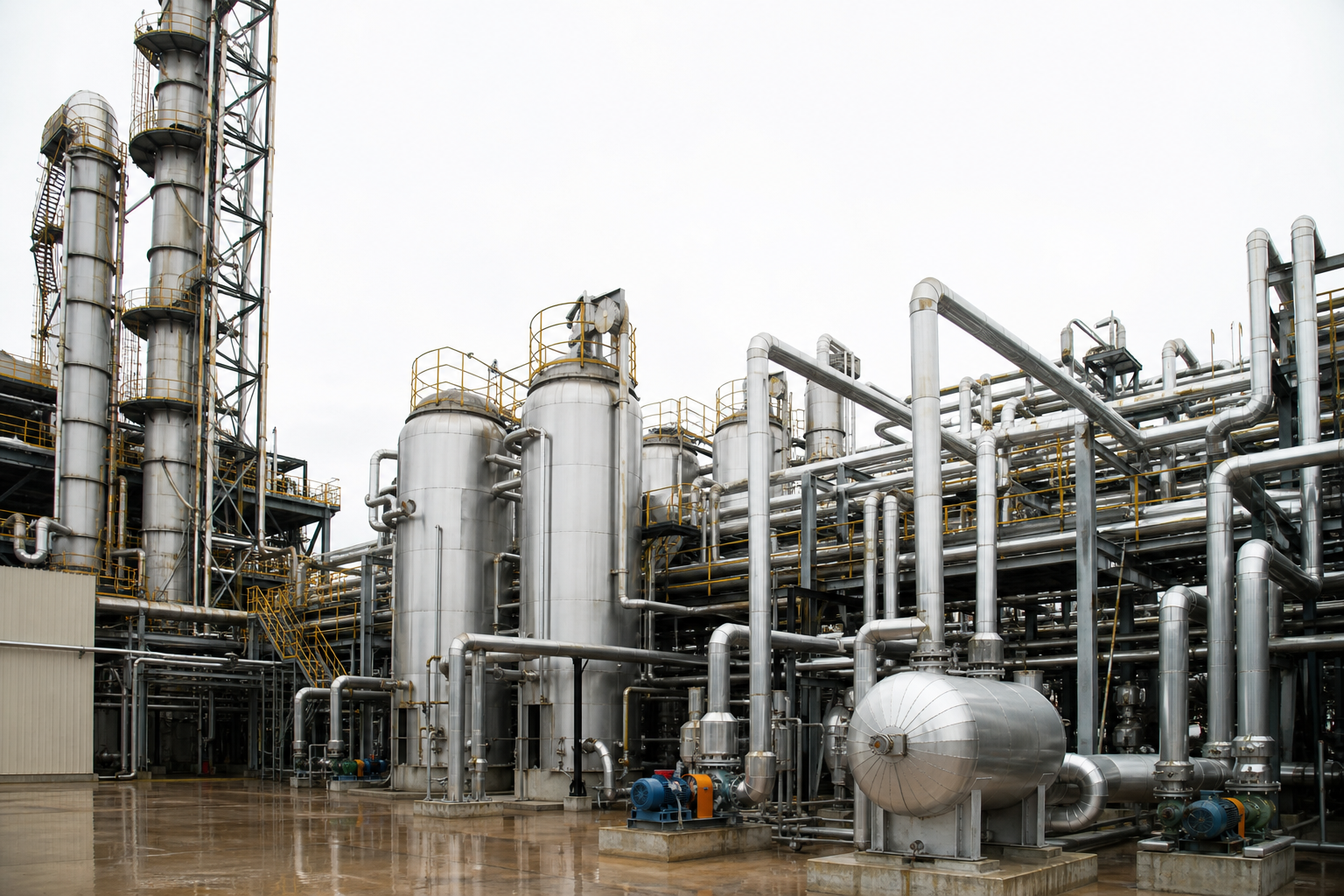
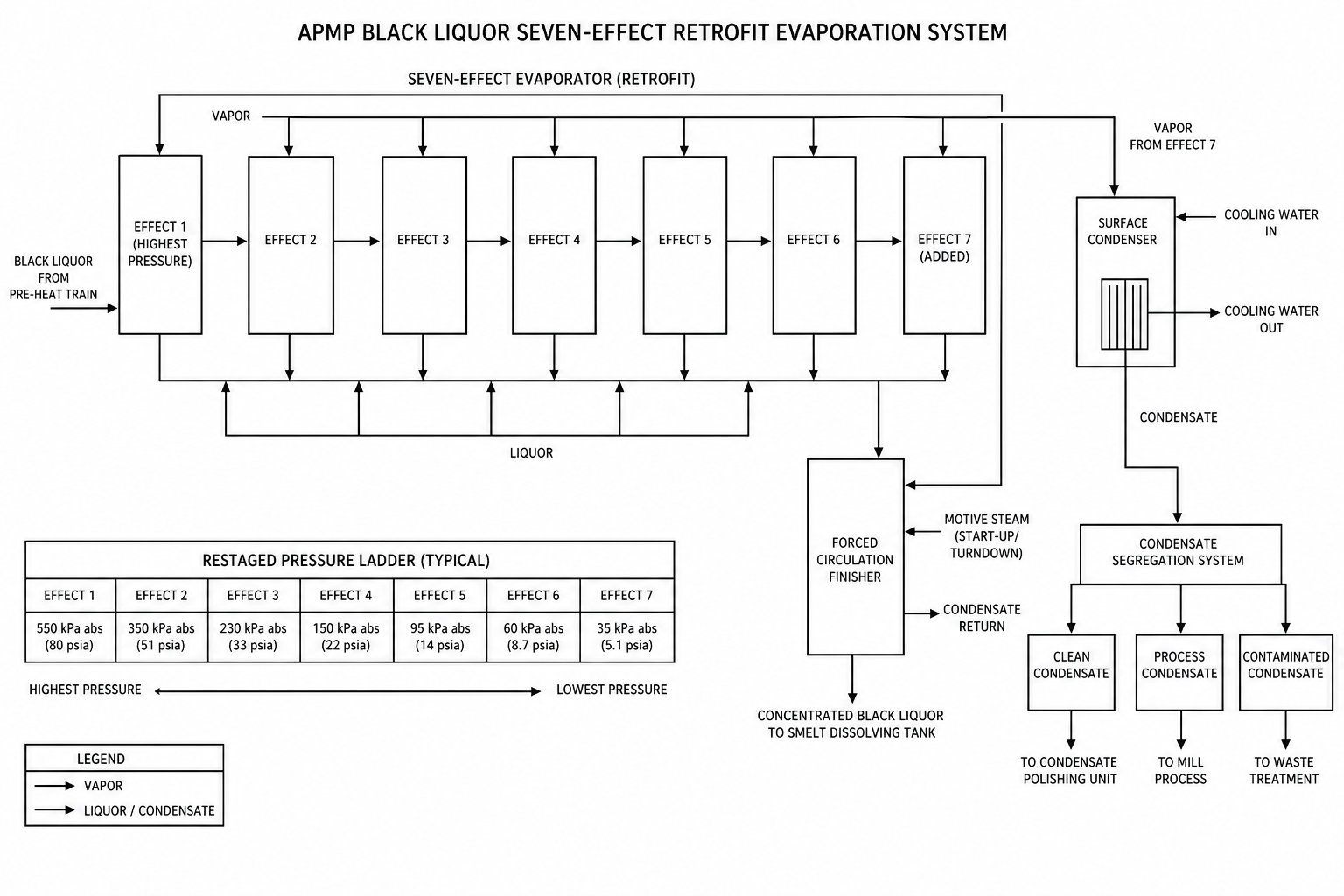
The retrofit’s first lever is the seventh effect. Six to seven effects is a straight steam-economy purchase: the additional effect reuses the tail vapor one more time before the surface condenser, and at 115.4 t/h that reuse is a standing fuel saving for the mill’s boiler house. Re-staging the effects’ pressures redistributes the temperature ladder — each body runs at a slightly gentler temperature difference than before, which is fouling relief as well as economy.
The second lever is forced circulation at the sharp end. APMP liquor’s extractives and fines load its later effects with the deposits that idled the old station between washes; a forced-circulation body moves the liquor through its heater at pumped velocity, keeping the wall shear that falling film alone cannot deliver once viscosity and solids climb. The published configuration pairs the film effects for bulk concentration with the forced-circulation finisher for the high-solids end — the hybrid that APMP’s liquor chemistry argues for.
Integration engineering dominates the retrofit list: the new effect ties into the existing vapor and condensate headers; tie-ins happen in mill shutdown windows; the control system absorbs the seventh body without a platform change; and the washing rotation re-schedules across the enlarged station. Retrofit projects publish less equipment and more engineering — the skill is making new and old behave as one station.
The upgraded station concentrates APMP dilute liquor to the solids its recovery or disposal route requires, with condensate segregation returning clean warm water to the pulp line. For the paper producer, the retrofit converts a bottleneck into headroom: 115.4 t/h of duty with seven-effect economy on a station that started life with six.
Equipment Configuration
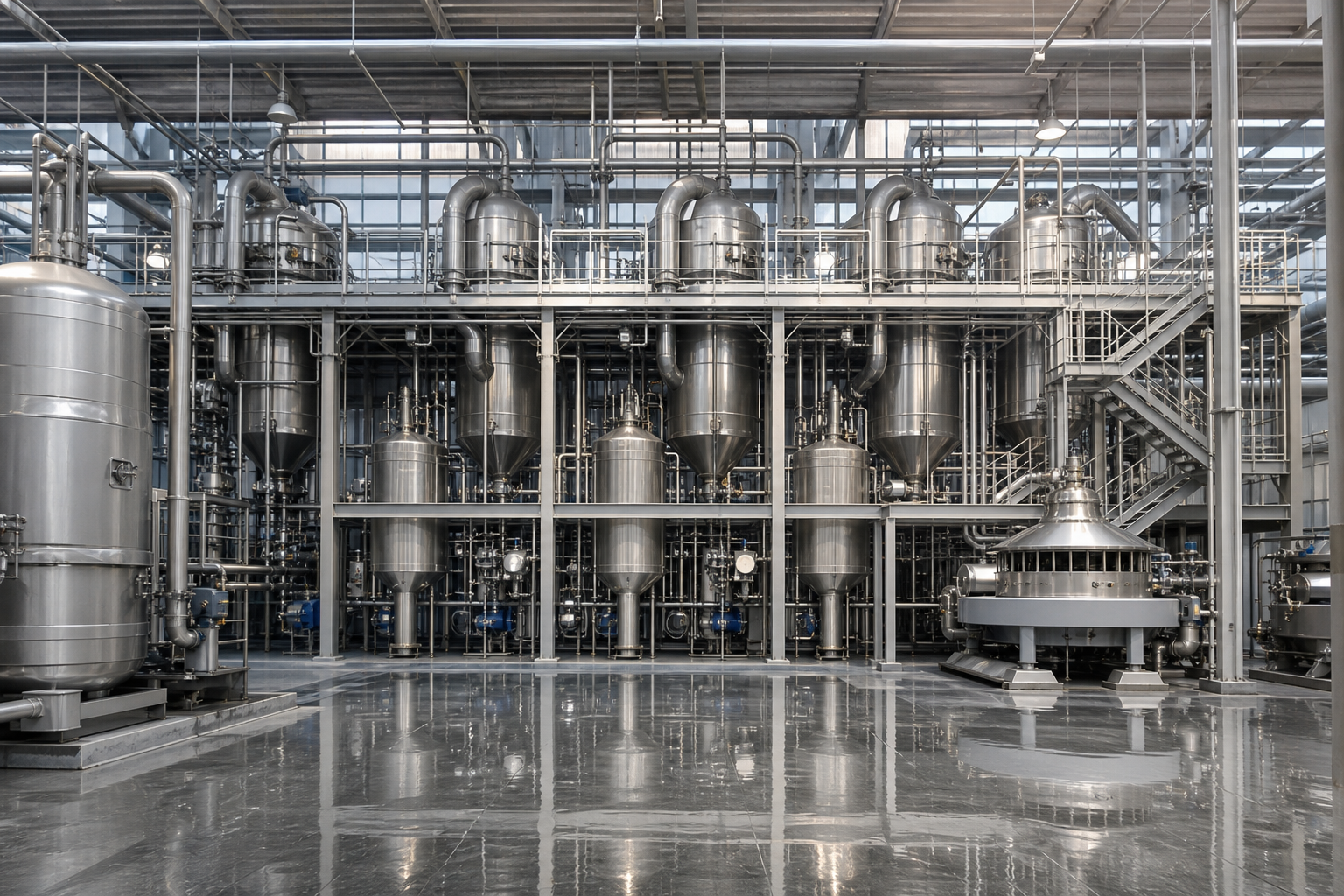
One set of the following equipment is typical for this duty:
- Retrofit tie-in of a seventh effect into the existing six-effect station
- Pressure-ladder re-staging across all effects
- Forced-circulation finisher body for high-solids, fouling duty
- Upgraded surface condenser and vacuum capacity
- Condensate segregation retained / extended across the new effect
- Control-system integration for the enlarged station
- Re-scheduled washing rotation and CIP across seven effects
Performance & Outcome
Compiled from published industry project data, indicative: retrofits of this class lift operating APMP stations from six-effect to seven-effect economy at 115.4 t/h with forced circulation absorbing the high-solids fouling duty, executed against live-mill shutdown constraints. Steam savings and availability gains are quoted per project station specification.
Simplified PFD
The simplified process flow diagram above shows the existing six-effect station with its added seventh effect and the forced-circulation finisher in the re-staged ladder.