The baseline for paper mill effluent treatment is the conventional activated sludge ETP – primary clarifier, aeration tank, secondary clarifier – and the question every mill with upgrade ambitions must answer first is whether that baseline is adequate or exhausted. The published evidence case: Star Paper Mills in Saharanpur, India, an integrated woody-raw-material mill (eucalyptus, poplar, veneer chips, ~300 tpd across four paper machines), whose ETP assessment by the Central Pulp and Paper Research Institute documented BOD falling from 356 to 26 mg/L and COD from 894 to 252 mg/L across the aeration stage, TSS from 123 to 53 mg/L across the secondary clarifier, on freshwater draws of 3,500 m³/d (paper machines and stock preparation) and 2,850 m³/d (pulping) – with the verdict that the plant was adequate, and even had aeration headroom beyond current load (Frontiers in Environmental Science, 2022 – an external academic reference, not an EvapCryst delivery). The design premise: know the baseline’s real ceiling before buying anything downstream of it.
The Baseline Architecture and What Each Stage Owns
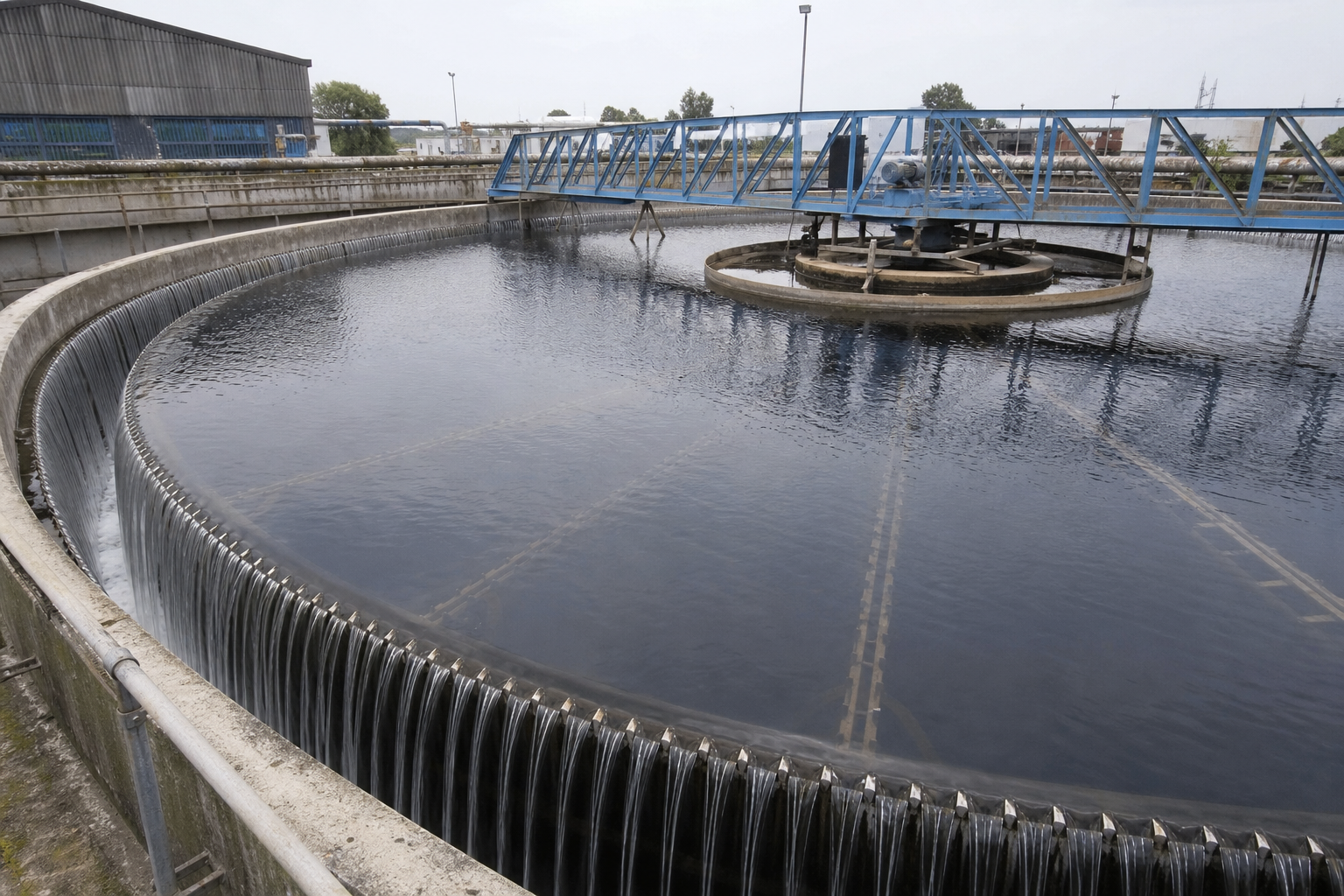
The peer-reviewed review of the field and the case study describe the same ladder. Primary treatment – screening, clarification, dissolved air flotation where needed – removes roughly 80% of suspended solids at surface loading rates up to 1.4 m³/m²·h, taking out fiber and settleable matter. Secondary treatment is the organic workhorse: the activated sludge process (aeration tank plus secondary clarifier) is the most common configuration in the industry, and on the case mill’s numbers it delivered the 356→26 mg/L BOD and 894→252 mg/L COD reductions already cited. Tertiary treatment – coagulation, membrane processes, advanced oxidation – is the polishing tier for residual COD, color and toxicity where discharge or reuse standards demand it. The case mill’s assessment adds the operational layer: MLSS held at 2,500-3,000 mg/L, dissolved oxygen at 1-2 mg/L, nutrient dosing at BOD:N:P of 100:5:1, and continuous effluent monitoring (OCEMS) at the outfall.
What the baseline does not own: dissolved solids. The case data shows more than 50% TDS removal from primary clarifier outlet to secondary clarifier outlet – meaningful but partial – and the review is explicit that water reuse raises organic and inorganic concentrations that impact paper formation, raise bacterial load, and cause corrosion and odor. Salt is not a biological problem; it accumulates past biology and must be handled by the concentration stages (membranes, thermal) covered in the ZLD route.
The Case Mill’s Numbers, As Published
| Parameter | Case value | Stage / note |
|---|---|---|
| Mill capacity | ~300 tpd, four machines, integrated | Eucalyptus/poplar/veneer furnish; CEOPHH bleach sequence with oxygen delignification |
| Freshwater draw | 3,500 m³/d paper & stock + 2,850 m³/d pulping | Five of ten borewells in rotation, reservoir-buffered |
| Water-to-effluent ratio | 85-90% of freshwater used becomes wastewater | Review-stated figure for the class |
| BOD across aeration | 356 → 26 mg/L | Adequate; capacity beyond current load |
| COD across aeration | 894 → 252 mg/L | Same assessment |
| TSS across secondary clarifier | 123 → 53 mg/L | September 2021 sampling |
| Aeration capacity | 11×50 HP + 1×30 HP surface aerators + 50 HP blower | Assessed adequate for higher BOD loads than present |
| Sludge handling | Primary to filter press at ~30% consistency (sold to board mills); secondary via Volute press | Sludge has a market outlet |
Figures from the peer-reviewed CPPRI assessment of Star Paper Mills (Frontiers in Environmental Science 10:960639, 2022 – an external academic reference; indicative, not a project guarantee, and not an EvapCryst delivery).
What “Adequate” Means – and When the Baseline Breaks
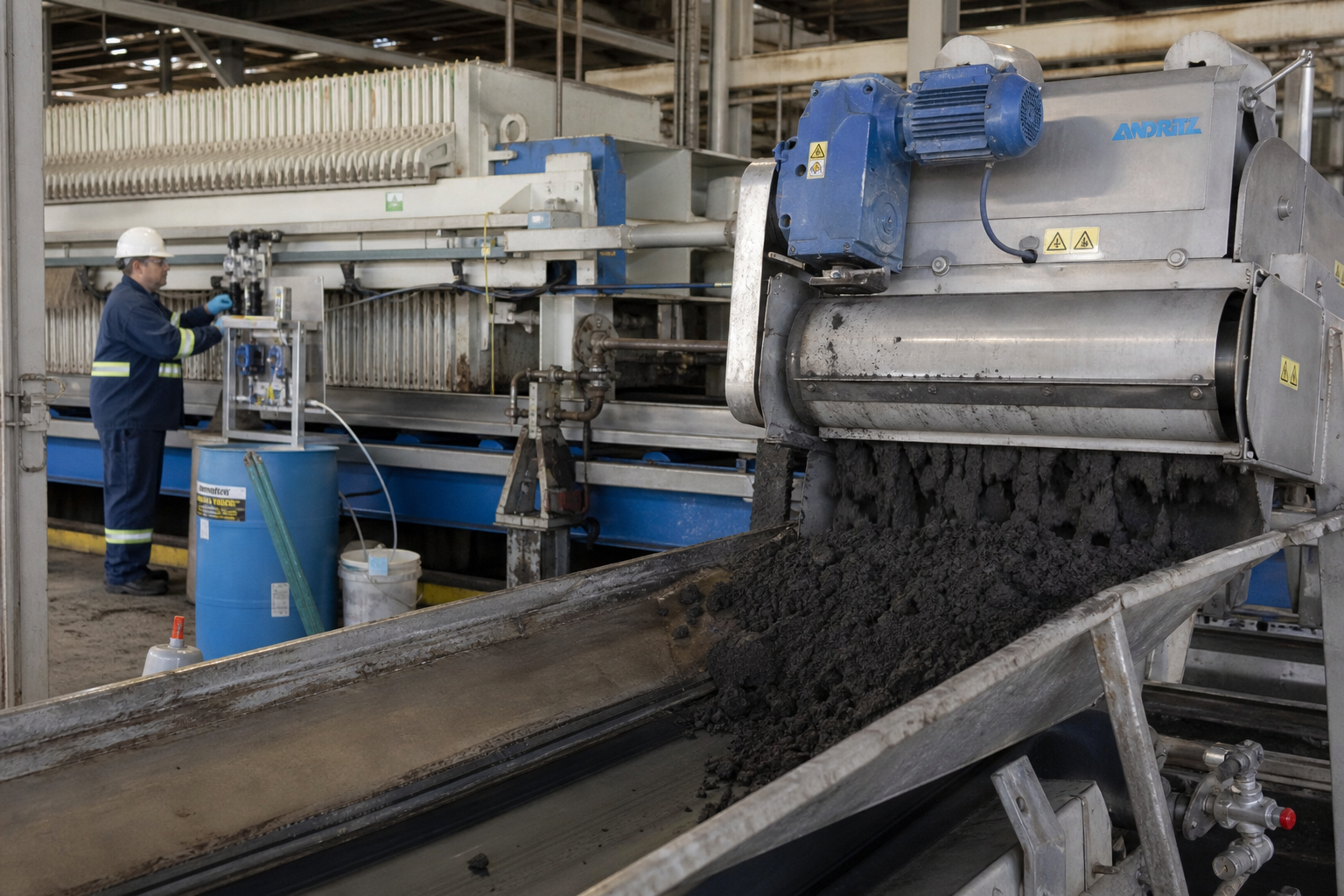
The case assessment’s adequacy verdict rested on four checks: retention times in the clarifiers and aeration tank sufficient for solids removal and organic oxidation; oxygenation capacity of the installed aerators (found adequate even for higher BOD loads than present, given optimum operation); settling performance in the secondary clarifier (the TSS halving above); and operational discipline – the recommended measures list (nutrient ratio, MLSS level, DO level, timely sludge withdrawal, routine daily testing of pH/TSS/COD/BOD) is the maintenance schedule of adequacy. The mill had also invested upstream: oxygen delignification and new pulp washers had reduced water consumption per ton before any end-of-pipe question was asked – source reduction outranking treatment, the same sequencing the denim-route article documents in textiles.
The baseline breaks in three characteristic ways. First, load growth: the case mill’s aeration had headroom, but mills that expanded production without ETP expansion land on the wrong side of their oxygenation capacity – bulking sludge, poor settling, compliance drift. The review notes pulp-and-paper activated sludge is particularly prone to thickening and settling problems, with hydraulic variation, organic load variation and filamentous bulking all degrading performance. Second, tighter standards: where discharge limits tighten below what biology delivers (the case mill’s 252 mg/L COD would not meet stringent receiving-water standards everywhere), tertiary polishing or reuse-grade treatment enters. Third, reuse and ZLD mandates: when the effluent must return to the process, dissolved solids, color and refractory organics become the design problem – the membrane and thermal architecture of the paper ZLD route, which needs a stable biological stage feeding it.
The Upgrade Path From an Adequate Baseline
The review maps the technology ladder beyond activated sludge: anaerobic stages (UASB-class reactors) for high-strength streams with biogas value; attached-growth systems for nitrification and load-tolerance; membrane bioreactors converting the clarifier to a membrane barrier (the textile-cluster article covers the same logic); tertiary coagulation, UF, NF/RO and advanced oxidation for reuse-grade water; and ion exchange, electrodialysis and reverse osmosis for dissolved solids – the entry to concentration and ZLD closure. The sequencing discipline the case study models: verify the baseline is adequate and optimally operated first (the O&M measures list), reduce at source second (oxygen delignification, washing efficiency), and only then extend the ladder – because every stage downstream of an unstable biology inherits the instability.
Expected Performance and Limits
The published reference performance: BOD 356→26 mg/L, COD 894→252 mg/L, TSS 123→53 mg/L at an integrated ~300 tpd mill with conventional activated sludge, assessed adequate with oxygenation headroom; the review-level baseline: ~80% SS removal at primary, activated sludge as the industry-standard secondary stage, tertiary as the conditional tier (Frontiers in Environmental Science 2022 – an external academic reference; indicative, not project guarantees). The practical limits: biological stages treat organics, not salts – the >50% TDS removal observed at the case mill is a ceiling effect of the chemistry, not a treatment guarantee; seasonal and grade-driven load swings stress the settling stage the review identifies as the class’s weak point; and any downstream reuse ambition changes the target water quality – at which point the baseline’s output becomes feedstock to a different train rather than final effluent.
Industry References and Validation
One peer-reviewed anchor with full method transparency: the Star Paper Mills CPPRI assessment – mill characterization, ETP layout, unit-by-unit adequacy criteria (retention times, surface overflow rates, volumetric loading, oxygenation capacity), September 2021 performance sampling, and the O&M recommendations (Frontiers in Environmental Science 10:960639, 2022; an external academic reference, not an EvapCryst delivery). The wider review context (stage characterization, treatment ladder, biokinetics) rounds out the field picture. For your own project, validation effort should concentrate on: a unit-by-unit adequacy assessment of your existing ETP against current and planned loads; 24-hour profiled sampling (not grab samples) across each stage; sludge settleability and bulking-risk trending; and a water balance separating what can be source-reduced before any treatment capital is sized.
Frequently Asked Questions
How do I know if my existing ETP is adequate?
The case study’s checklist: verify retention times per unit, surface overflow rates on clarifiers, volumetric loading on the aeration tank, and oxygenation capacity against actual BOD load – then profile 24-hour performance across every stage. Adequacy is a measured verdict, not a feeling.
Can activated sludge handle all the COD?
The biodegradable fraction, yes – 80-85% removal is the class norm and the case mill landed BOD at 26 mg/L. The refractory fraction (lignin derivatives, color bodies) passes through; that is what tertiary stages or reuse trains address.
Why did the case mill’s TDS drop 50% through the plant?
Partly entrained solids carrying dissolved material out with the sludge, partly precipitation and adsorption effects in the clarifiers. It is a real but chemistry-limited effect – biology does not metabolize salt, so TDS removal through an ETP has a ceiling well short of what reuse requires.
What are the classic failure modes of paper ETPs?
The review’s list: hydraulic shock, organic load shock, and filamentous bulking – all landing on the secondary clarifier, the class’s weak point. The mitigations are equalization, loading discipline and the operational measures the case study enumerates.
When should we move past the baseline entirely?
Three triggers: load growth beyond verified oxygenation capacity; discharge limits below biological capability; or a reuse/ZLD mandate that makes dissolved solids and refractory organics the design problem. Before the first two, fix operation; only the third justifies the membrane-and-thermal ladder.
When This Route May Not Fit
This article is the baseline rather than an upgrade route, so the question inverts: the baseline stops fitting when any of the three triggers above fire. If the mill’s effluent is small and discharge standards loose, the conventional ETP remains the correct endpoint – and the discipline is keeping it at the adequacy the case study documents rather than gold-plating it.
What Must Be Verified Before Committing
Five items: a unit-by-unit adequacy assessment (retention, loading, oxygenation) against current and five-year loads; 24-hour profiled sampling across every stage; settleability and bulking-risk trending on the biology; a water balance quantifying source-reduction potential (the case mill’s oxygen delignification and washer investments cut consumption before treatment was ever the question); and the discharge or reuse standard that actually governs – which decides whether the story ends at the secondary clarifier or continues into the concentration stages. These are the standard screening package we would run before any quote.