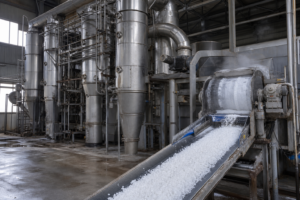
Calcium Chloride Evaporation and Concentration Solution
Hybrid CaCl2 concentration: MVR below ~35%, multi-effect forced circulation to 55-60%, single-effect falling film finisher to 68%+ for flake and granule production. Proven on

Hybrid CaCl2 concentration: MVR below ~35%, multi-effect forced circulation to 55-60%, single-effect falling film finisher to 68%+ for flake and granule production. Proven on
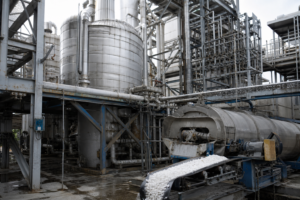
Calcium chloride concentration and anhydrous granulation from soda ash distiller waste – high boiling-point-rise evaporation, spray granulation, 600,000 TPA reference practice.

Continuous cooling crystallization purifies hydroquinone: isomer separation from catechol, oxidation color control, four critical process control points, and photographic-grade polishing routes.
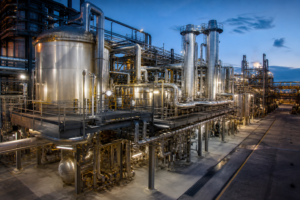
KCl purification by MVR forced-circulation evaporation and DTB crystallization: 34% hot dissolution, BaCl2/EDTA purification, 1.5-2.0% supersaturation control, 0.2-1.5 mm Class I premium potash product.
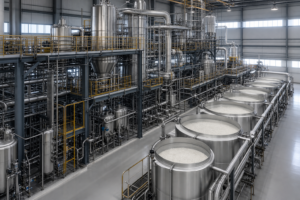
Two-stage fractional crystallization separates NaCl from KCl in mixed chloride brines: evaporation recovers 96-98% pure sodium chloride, flash cooling recovers potassium chloride, and an

Continuous MVR evaporation and crystallization upgrades PMIDA (N-phosphonomethyl iminodiacetic acid) production for the IDA glyphosate route: over 80% energy savings, stable crystal quality and