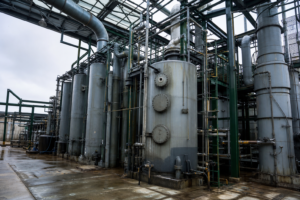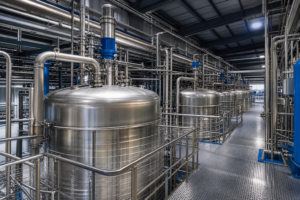
Fumaric acid evaporation and crystallization solutions recover a saleable chemical from the mother liquors and saline wastewaters that fumaric acid plants, maleic anhydride downstream units and resin producers otherwise pay to treat: the liquor is concentrated by multi-effect or MVR evaporation to the saturation boundary, crystals are grown in an external-circulation crystallizer, and the separated solids — dried and screened — go back into food, feed and resin markets while the condensate returns to the process. In the representative configuration, a three-effect evaporation crystallizer concentrates the saline liquor to saturation and crystallizes the acid out in an external circulation (OSLO-type) crystallizer, achieving salt-water separation while the non-volatile organic load reports to the crystal and purge streams rather than the condensate. This page explains where fumaric acid liquors come from, why the compound’s unusual solubility behavior makes it one of the friendliest organics to crystallize, and how the evaporation-crystallization train is engineered around that behavior. Ranges quoted here form an illustrative envelope from published data and industry practice, not a project datasheet.
Where Fumaric Acid Liquors Come From
Fumaric acid (trans-butenedioic acid) reaches industrial scale through three routes, and each generates a liquor that evaporation-crystallization can valorize.
Maleic anhydride isomerization. The dominant petrochemical route hydrolyzes maleic anhydride to maleic acid and isomerizes it to fumaric acid; the acid crystallizes out of the isomerization liquor, and the mother liquor — carrying unconverted maleic acid, catalyst residues and dissolved fumaric values — is the classic feed for recovery evaporation.
Fermentation route. Bio-based production by fungi such as Rhizopus generates dilute broth at a few percent acid, acidified and clarified before crystallization; the spent broth and wash waters form a second, more dilute liquor stream.
Downstream and wastewater streams. Resin plants polymerizing unsaturated polyester, paper sizing operations and food-grade handling washdown all release dilute fumaric-bearing saline wastewater — the streams that three-effect evaporation crystallizers are routinely quoted to clean up, concentrating the non-volatile organic load into the crystal and purge streams so the condensate can be reused or discharged compliantly.
Why Fumaric Acid Crystallizes So Readily
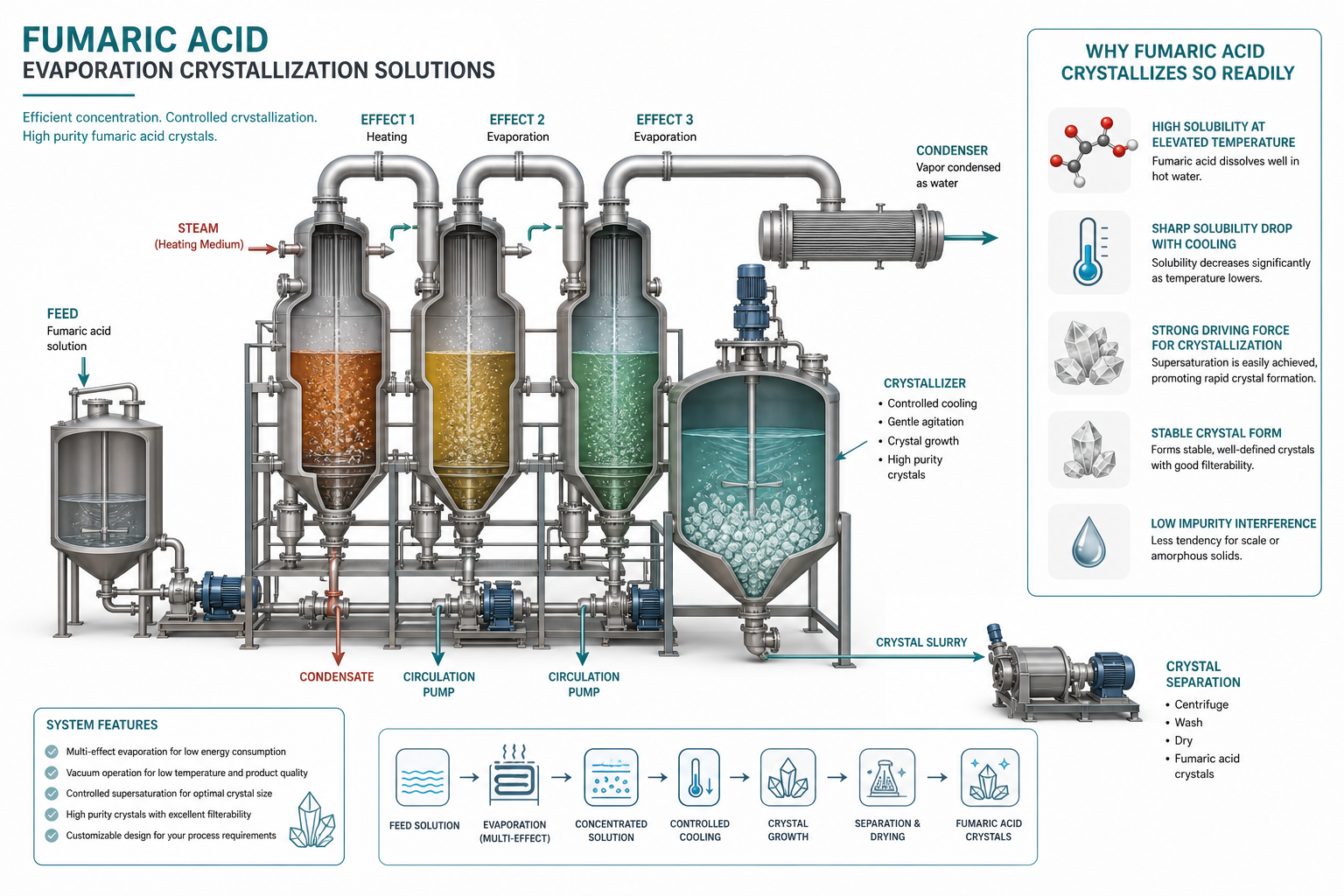
The trans configuration makes fumaric acid remarkably insoluble in cold water — published solubility curves show well under one gram per 100 grams of water near room temperature — while solubility climbs steeply toward boiling, rising by roughly an order of magnitude. Two consequences follow. First, hot liquors self-crystallize on cooling with high yield, which is why acidification/cooling crystallization is the primary recovery step in the plant itself. Second, the residual dissolved acid left in mother liquors can be pushed out by evaporation: removing water drives the liquor to saturation at its operating temperature, and the external-circulation crystallizer grows the crystals that gravity then separates. The low cold solubility is also what keeps product losses in the centrifuge mother low and lets purge streams recycle without dissolving the product back.
Process Design: Evaporation Followed by External-Circulation Crystallization
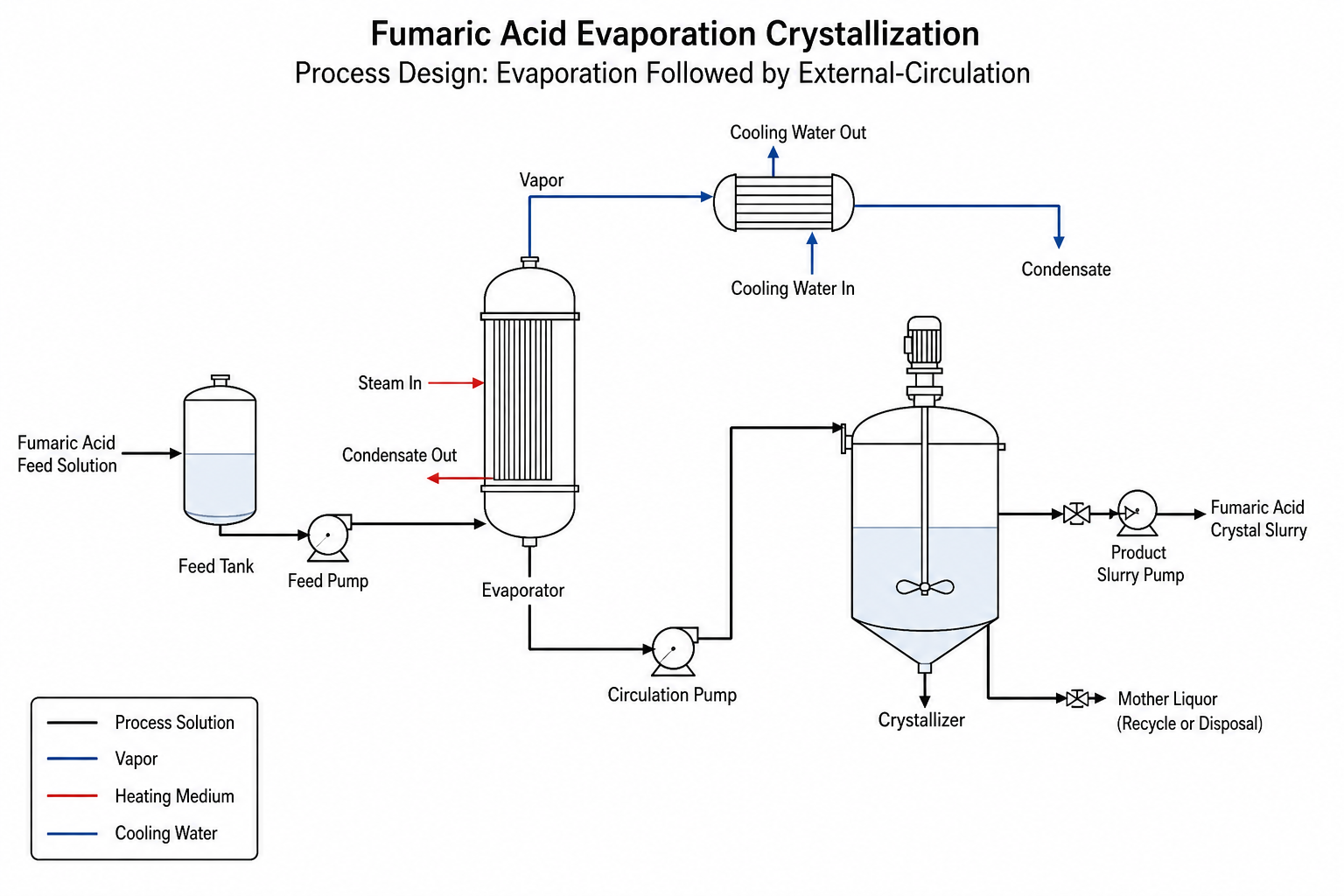
Concentration to Saturation
The feed liquor — mother liquor, bio-based broth concentrate or saline wastewater — is evaporated in a multi-effect or MVR forced-circulation train sized for the liquor’s fouling tendency and acidity. Organic acids plus chlorides from upstream processing put the duty firmly in 316L-or-better material class; where the wastewater carries chloride salts, the train is designed on forced-circulation principles so that any co-crystallizing salt stays suspended instead of plating the tubes.
External Circulation Crystallizer
At saturation, liquor passes to the external-circulation (OSLO-type) crystallizer: slurry circulates through an external loop past a heat exchanger while supersaturation generated by evaporation (or cooling) is consumed on suspended crystals in a fluidized classification zone. The design grows large, well-formed fumaric acid crystals that centrifuge and wash cleanly — directly relevant to food and feed grade brightness — instead of the fine, occluded solids a boiling body without classification would produce.
Separation, Drying and Product Handling
Centrifugation or vacuum filtration dewaters the crystal slurry; flash or fluidized drying then brings product moisture to specification before screening into industrial, feed or food grades. Fumaric acid’s low hygroscopicity makes final moisture control straightforward compared with citric or malic acids. Dried crystals are recycled directly into the plant’s product slate — the value that separates this solution from pure wastewater treatment. Drying and solids handling design follows the same principles described on our drying and packing technology page.
Condensate and COD
Water balance closes through the condensate system, and its quality decides how much of the evaporated water the plant is allowed to reuse.
Evaporator condensate carries the volatile organic load; in representative three-effect wastewater service the condensate carries only the volatile fraction of the organic load, since the non-volatile organics stay with the crystal and purge streams; it is either reused in the process or polished before discharge. This behavior is what makes evaporation-crystallization a standard unit in high-COD organic wastewater trains — a broader application family we cover on our high-COD organic wastewater evaporation page.
At procurement level the train resolves into four core modules:
| Module | Candidate Equipment Types | Selection Rationale | Indicative Operating Envelope |
|---|---|---|---|
| Evaporation concentration | Multi-effect or MVR forced-circulation train | Removes water to the saturation boundary; handles acidic chloride duty | 316L-or-better wetted class; live steam or electricity |
| External-circulation crystallization | OSLO-type classified growth body | Grows large clean crystals for food and feed brightness | Supersaturation consumed on suspended crystals |
| Separation and drying | Centrifuge or vacuum filter; flash or fluidized-bed dryer | Low hygroscopicity simplifies final moisture control | Product screened to industrial, feed, food grades |
| Condensate and purge handling | Condensate segregation; small recovery effect | Volatile COD routed to reuse or polishing; purge stops yield leak | Density-instrumented purge on measurement |
Configuration, materials, and ranges depend on actual feed, corrosion review, fouling behavior, utilities, and project capacity.
Three-Effect Steam versus MVR: Choosing the Energy System
| Criterion | Three-Effect Steam System | MVR System |
|---|---|---|
| Energy input | Live steam, roughly 1/3 of single-effect demand | Electricity, typically 15-30 kWh per ton evaporated water for low-BPE clean liquors, higher for high-BPE or fouling service |
| Site utilities required | Steam boiler and cooling water | Power and cooling water; minimal steam only |
| Best fit | Sites with existing steam balance, lower power availability | Continuous duty, high electricity availability, new builds |
| Capital pattern | Three bodies, no compressor | One body plus compressor and drive |
| Control behavior | Effect-by-effect temperature ladder fixed at design | Single-stage compression, flexible at turndown |
The two systems are not in opposition — many fumaric acid recovery plants run the concentration train as three-effect steam service where a boiler already exists and reserve MVR for expansion capacity or water-stressed sites. The process chemistry of the crystallizer is indifferent to which vapor system feeds it; the choice is an energy economics exercise on local steam and power prices, run on the same basis as any MVR evaporation project.
Mother Liquor Recycle and Purge
Centrifuge mother liquor recycles to the evaporator feed, and like every recycle it accumulates whatever the crystal rejects: salts, maleic acid isomerization residues, color bodies and any catalyst carryover. The plant runs a deliberate purge, and the engineering question is the same one faced in every fractional crystallization system — the purge ratio trades recovered acid value against impurity concentration in the crystallizer, which in turn sets crystal color and filtration rate. Practical designs instrument the mother liquor density and impurity proxies, schedule the purge on measurement rather than habit, and route the purge itself through a small recovery effect or to the wastewater evaporation train so the purge decision stops being a silent yield leak.
Recovery Economics: When the Wastewater Pays for Itself
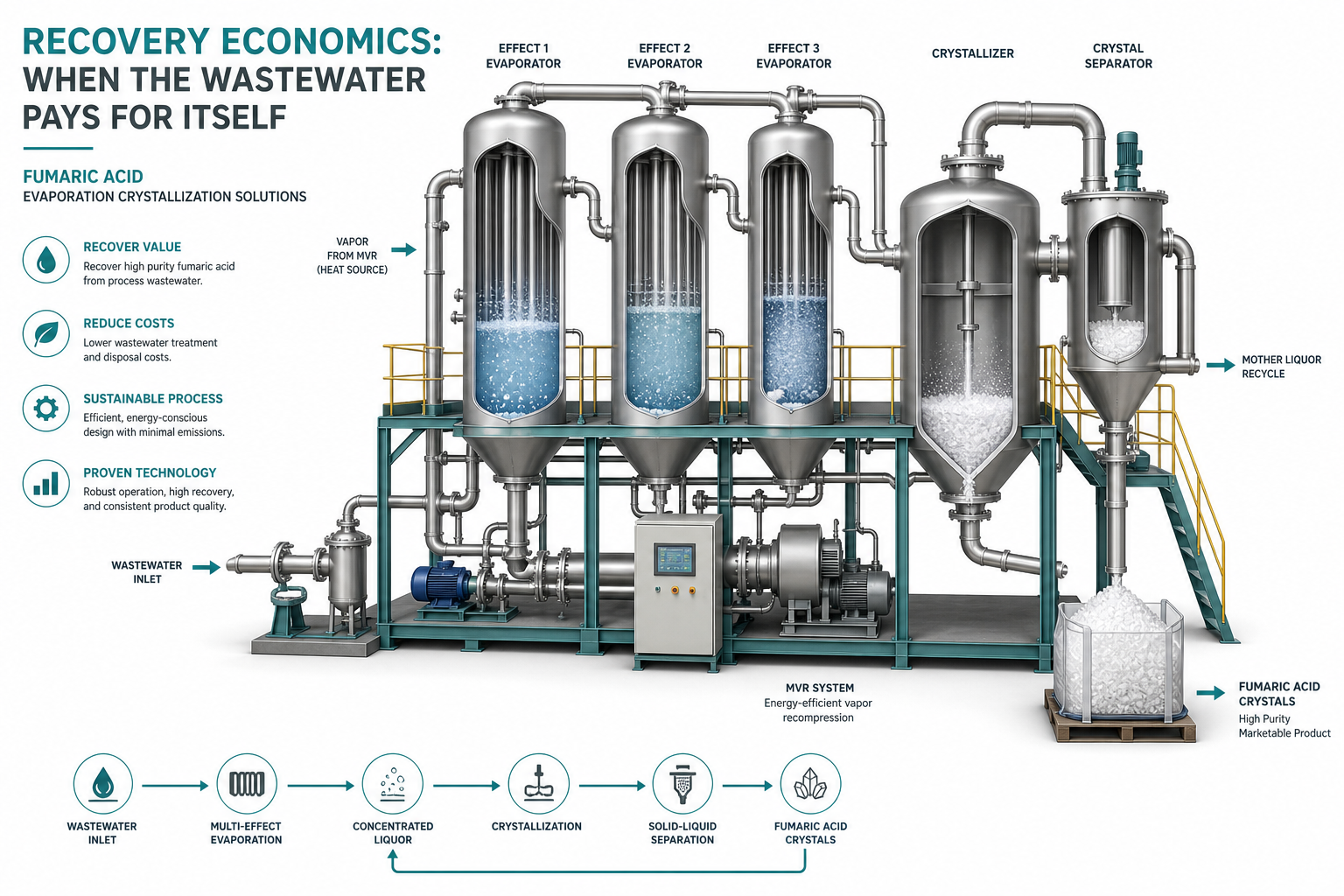
What separates a fumaric acid recovery project from an end-of-pipe treatment project is the revenue line. The evaporation-crystallization train removes water at thermal-treatment cost and returns dried acid at industrial or feed grade pricing, so the feasibility study is a balance of recovered product value, avoided wastewater treatment and discharge fees, and energy cost per ton of water removed. Projects tip clearly positive when three conditions hold together: the feed carries enough dissolved acid to yield product rather than just salt, the site runs continuously enough to amortize the crystallizer, and energy is available at MVR-friendly prices. Where the acid concentration fades — washing waters and general plant effluent — the same equipment still earns its keep as a COD-reduction and water-recovery unit feeding a ZLD arrangement, with the organic acid crystals as a by-product credit rather than the business case itself.
Materials, Fouling and Availability
Acidic organic duty prices the wetted surfaces: 316L is the entry point, with duplex or higher alloys where chloride accumulates in recycled mother liquor. Fouling in fumaric service is dominated by two mechanisms — crystallization on heat transfer surfaces when supersaturation is allowed to reach the wall, and polymerizable impurities from maleic anhydride service baking on at hot spots — and both are controlled by forced-circulation velocities, tight delta-T limits and CIP cycles triggered on heat transfer coefficient drift rather than the calendar. A plant that respects these limits runs weeks between cleans; one that chases capacity past them trades a week of output for a weekend of descaling.
Related Organic Acid Recovery
Fumaric acid recovery sits inside a family of organic acid finishing problems — citric, tartaric, malic and amino acids share the evaporation-then-crystallization skeleton with individual solubility and polymorph quirks. Our fermentation finishing solutions for lysine, MSG and citric acid describe the same architecture applied to fermentation broths, and the cooling crystallization variant used for acids with steeper temperature solubility is covered among our crystallization solutions.
Validation focus. Statements here reflect published solubility data and industry practice, not EvapCryst deliveries — indicative, not a project guarantee. Before committing this route, analyze the actual liquor (acids, chlorides, catalyst residues), confirm product-grade reach against that impurity profile, and test purge behavior on recycled mother liquor. The checklist consolidates these gates.
When This Route May Not Fit
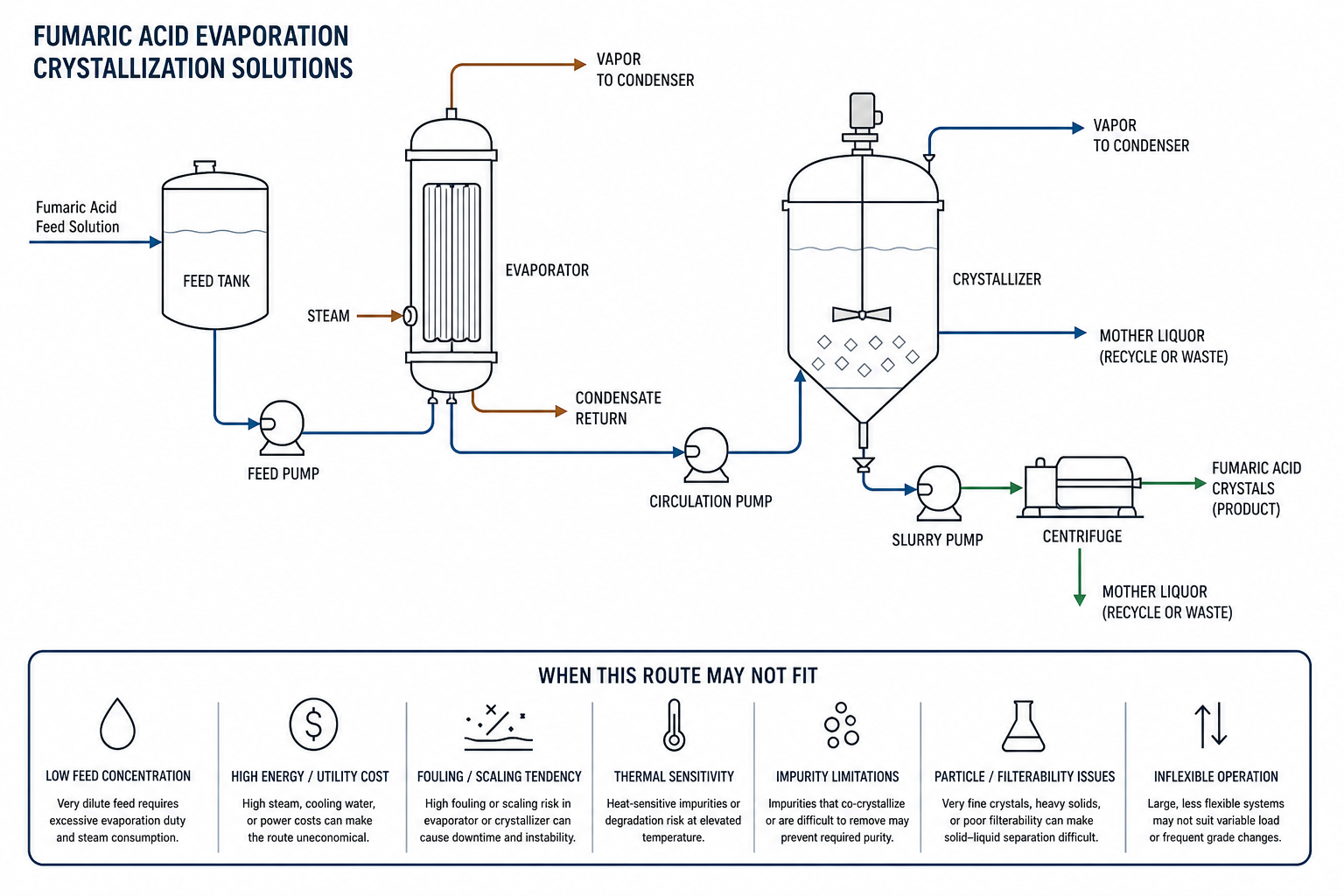
Recovery economics fail when the feed is too thin: washing waters and general plant effluent at trace acid levels yield mostly salt and clean water, not product, and forcing a product crystallizer onto them buys duty it cannot pay back. The route also misfits batch or seasonal operations, because an evaporation-crystallization train with a classification zone amortizes only across continuous campaigns, and short runs leave it as expensive tankage. Sites whose power and steam prices both run high should check the energy line before committing either vapor system, since the crystallizer is indifferent but the operating cost is not. And where the mother liquor impurity profile — catalyst residues, color bodies, maleic carryover — has no tested purge strategy, the plant will trade crystal brightness for yield within months.
What Must Be Verified
Before a fumaric recovery project is committed, the following must be verified against site data rather than the illustrative envelope above. A full liquor analysis — fumaric and maleic acid content, chloride, sulfate, catalyst metals, and color precursors — because impurity carryover sets both the achievable product grade and the purge ratio. Measured solubility behavior of the actual liquor against temperature, since the cooling-yield calculation follows from it. Evaporation trials confirming fouling rate and condensate COD on the real feed. A confirmed outlet for the recovered acid — industrial, feed, or food grade — matched to the impurity profile the feed can deliver. And an energy review fixing three-effect versus MVR on local steam and power prices before the vapor system is specified.
FAQ
Why does fumaric acid crystallize better than maleic acid?
The trans structure of fumaric acid packs into a crystal lattice far more readily than the cis configuration of maleic acid, which is why isomerization to fumaric acid is itself the purification step in maleic anhydride plants and why the residual acid in liquors comes out cleanly on evaporation or cooling.
Can fumaric acid wastewater really yield saleable product?
Yes — the low residual solubility means the acid removed by evaporation-crystallization reports almost entirely to the crystal phase, and after drying and screening the recovered solids meet industrial and feed-grade uses depending on the feed impurity profile.
Is three-effect or MVR evaporation better for this duty?
Both work; steam three-effect suits sites with an existing boiler and modest power, while MVR suits continuous duty where electricity is available, cutting specific energy to the 15-30 kWh-per-ton class for this low-BPE organic acid duty. The crystallizer design does not change between them.
What is the main fouling risk in fumaric acid evaporators?
Crystallization on the heat transfer surface when supersaturation reaches the wall, plus polymerizable by-products from maleic anhydride service baking onto hot spots — both are managed with forced circulation, limited temperature difference and condition-based CIP.
What happens to the mother liquor after crystallization?
It recycles to the evaporator feed to recover remaining acid value, with a controlled purge that removes accumulated impurities — catalyst residues, salts and unconverted maleic acid — to the wastewater plant.
Next step: send your liquor analysis, feed rate, and target product grade, and receive a first-pass screening of the process direction and boundary conditions — inputs exchanged for engineering direction.