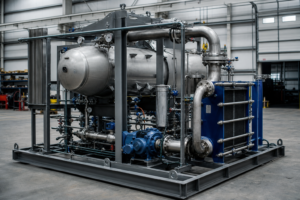
The vacuum system is what turns an evaporator into a low-temperature machine: by holding the evaporation chamber at sub-atmospheric pressure it lowers the liquor’s boiling point, typically enables evaporation at 50–70°C for heat-sensitive products, unlocks low-grade steam and heat-pump heat sources, and continuously sweeps out the non-condensable gases (CO₂, N₂, O₂) that would otherwise blanket heat-transfer surfaces. In most industrial plants the workhorse is the liquid-ring vacuum pump — near-isothermal compression that tolerates condensable vapor, droplets and dust — installed after a condenser so the pump only handles residual vapor and inerts, which shrinks it dramatically. This guide covers the functions, the equipment families, the sizing logic, the layout that saves the most money, control and maintenance practice, and how vacuum integrates with multi-effect and MVR trains.
What the Vacuum System Actually Does
Three duties, all simultaneous:
- Holds evaporation pressure stable — the setpoint that fixes boiling temperature, evaporation intensity and, ultimately, product consistency.
- Draws off and condenses secondary vapor — in cooperation with the condenser, moving the evaporated solvent out of the system.
- Continuously removes non-condensable gases. CO₂, nitrogen and oxygen degas from the liquor as it evaporates; left alone they accumulate on heat-transfer and condensing surfaces as insulating gas films that can, per published heat-transfer references, depress heat-transfer coefficients by 20–30% — the mechanism is detailed in heat transfer in evaporation systems.
Why Vacuum Evaporation Pays
Lowering pressure lowers boiling temperature, and that single lever buys three things: thermally sensitive products (food, pharma, fine organics) concentrate without degradation; low-pressure steam, waste heat and heat-pump sources become usable because the temperature lift required is small; and energy consumption falls with the temperature level. The flip side is that vacuum stability becomes a process variable — pressure swing means boiling-point swing, which shows up as fluctuating evaporation intensity and inconsistent product.
The Liquid-Ring Vacuum Pump: How It Works
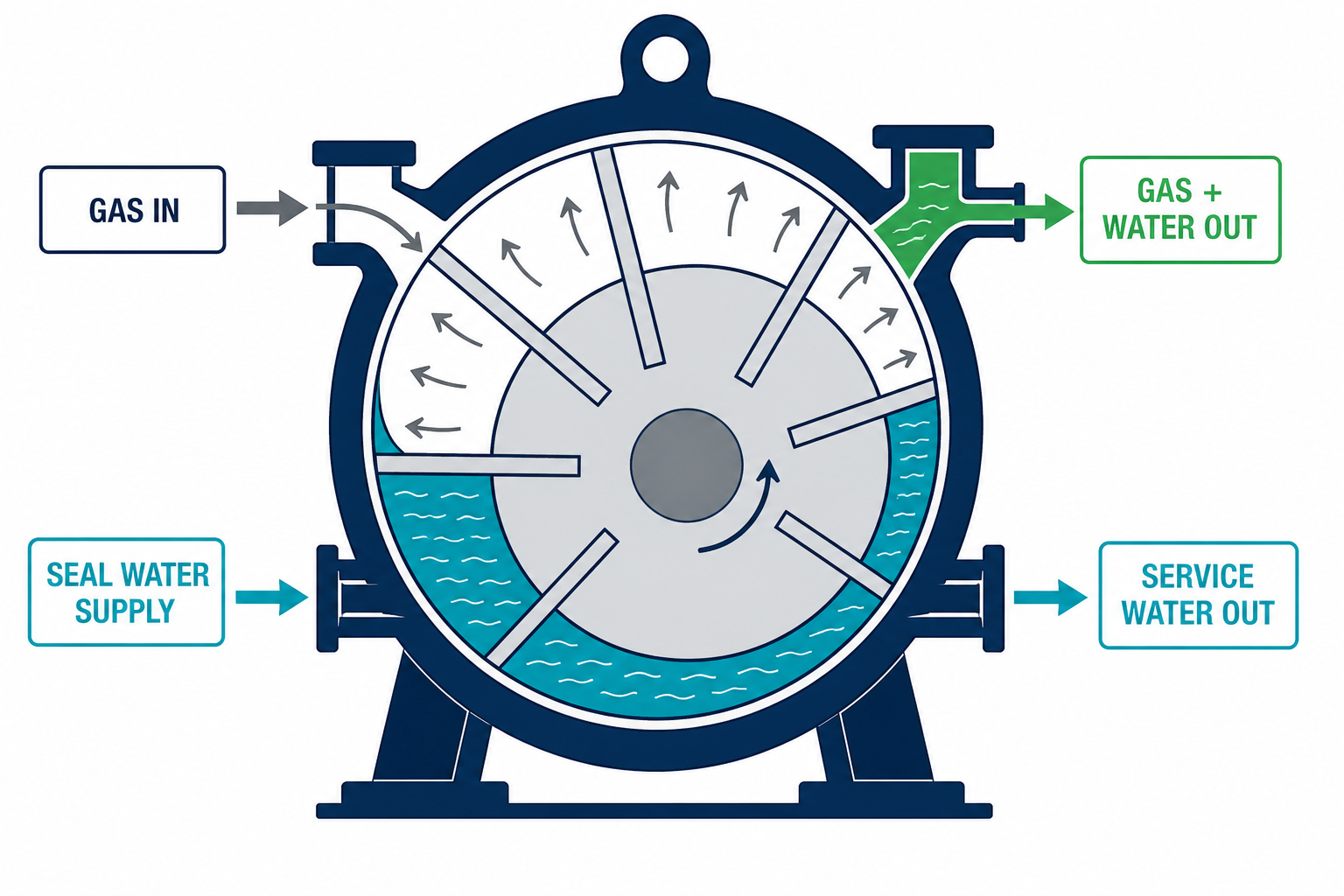
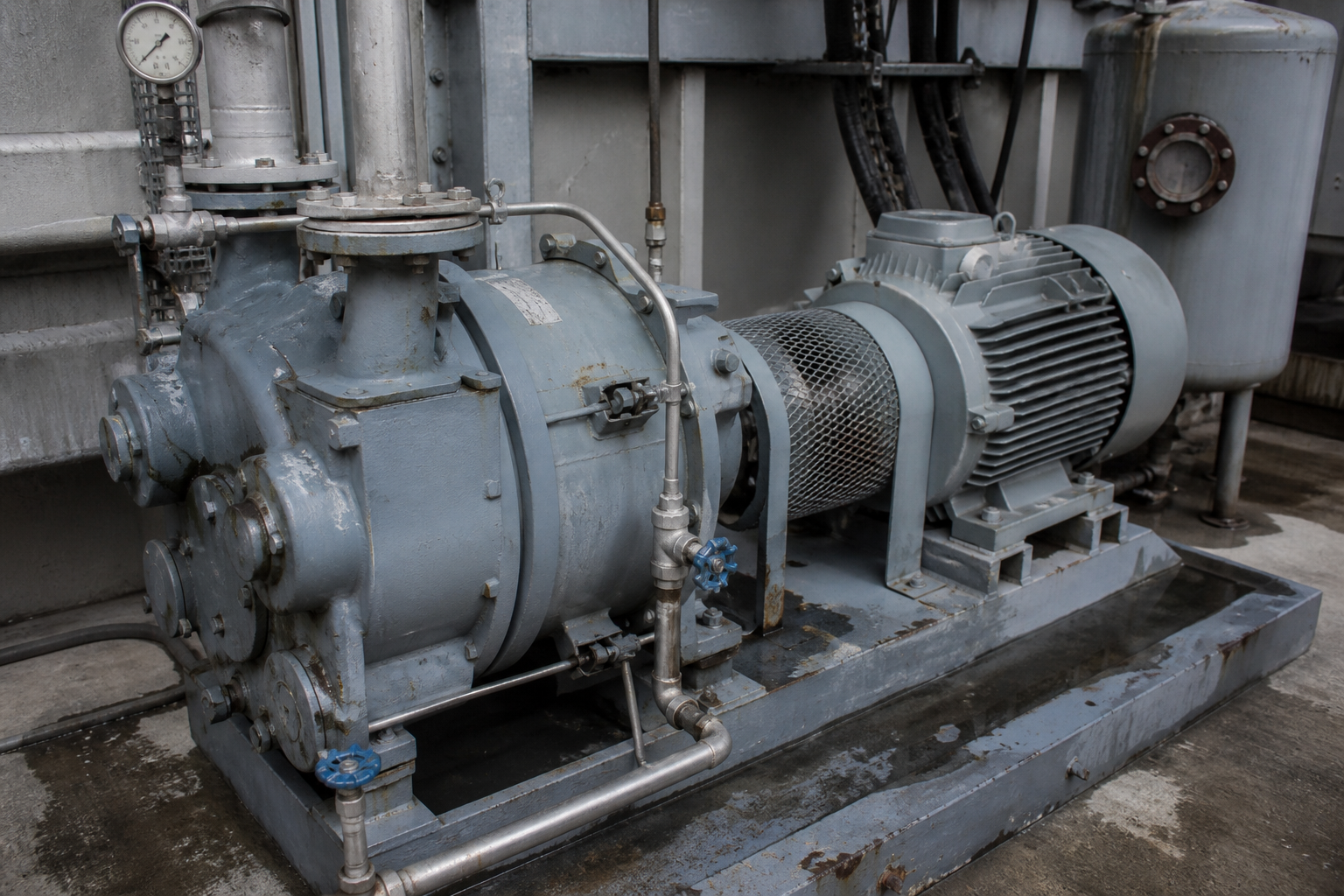
In a liquid-ring vacuum pump (LRVP), an impeller is mounted eccentrically inside a cylindrical casing. As it rotates, it drags a sealing liquid (usually water) into an eccentric ring against the casing wall. The space between impeller blades and liquid ring forms crescent-shaped chambers that expand as they pass the inlet (drawing gas in) and compress as they approach the outlet (discharging it). The liquid ring does three jobs at once: it seals the blade tips, it compresses the gas, and it cools the compression — which is why compression is close to isothermal.
Why Liquid-Ring Pumps Suit Evaporator Duty
- Condensable vapor is not a problem but a feature. The pump can ingest saturated vapor, droplets and even dust-laden gas without damage; the sealing liquid directly condenses part of the steam, reducing the gas volume the pump must move.
- Near-isothermal compression avoids the temperature spikes that damage dry pumps handling combustible or reactive vapors.
- Simple, corrosion-tolerant construction. The only significant rotating part is the impeller, and the sealing liquid itself can be chosen (or treated) to match corrosive service.
These properties map exactly onto evaporator secondary vapor — hot, saturated, condensable, sometimes fouling — which is why the LRVP is the default selection.
Selecting and Sizing a Liquid-Ring Pump
Three parameters decide the selection:
- Ultimate vacuum requirement — matched to the boiling temperature the process needs.
- Pumping speed versus gas load — sized against the system’s air leakage plus the estimated non-condensable generation from the liquor, with margin for transient slugs.
- Sealing-liquid temperature. The achievable vacuum is set by the vapor pressure of the sealing liquid: colder liquid, deeper vacuum. A working-liquid cooler (heat exchanger) is part of the vacuum system, not an accessory — undersized cooling silently costs vacuum level.
Other Vacuum Equipment, Compared
| Equipment | Working Principle | Strengths | Weaknesses |
|---|---|---|---|
| Liquid-ring pump | Eccentric liquid ring compresses gas isothermally | Tolerates condensable vapor, droplets, dust; simple; corrosion-adaptable | Limited ultimate vacuum; sealing-water consumption and treatment |
| Water jet pump | High-velocity water jet entrains gas | Extremely simple, no moving parts, cheap | Low efficiency; high water consumption |
| Steam ejector | Motive steam entrains gas through a nozzle | No moving parts, handles huge loads, robust | Continuous steam consumption; noisy |
| Dry screw / claw pump | Positive displacement without sealing liquid | Clean, oil-free, deep vacuum, low utility use | Vulnerable to condensable and fouling vapor — needs upstream condensing |
| Roots + liquid-ring combo | Roots booster backed by LRVP | Deep vacuum at high capacity | Higher CAPEX and control complexity |
The Layout That Saves the Most Money: Condense First, Pump Second
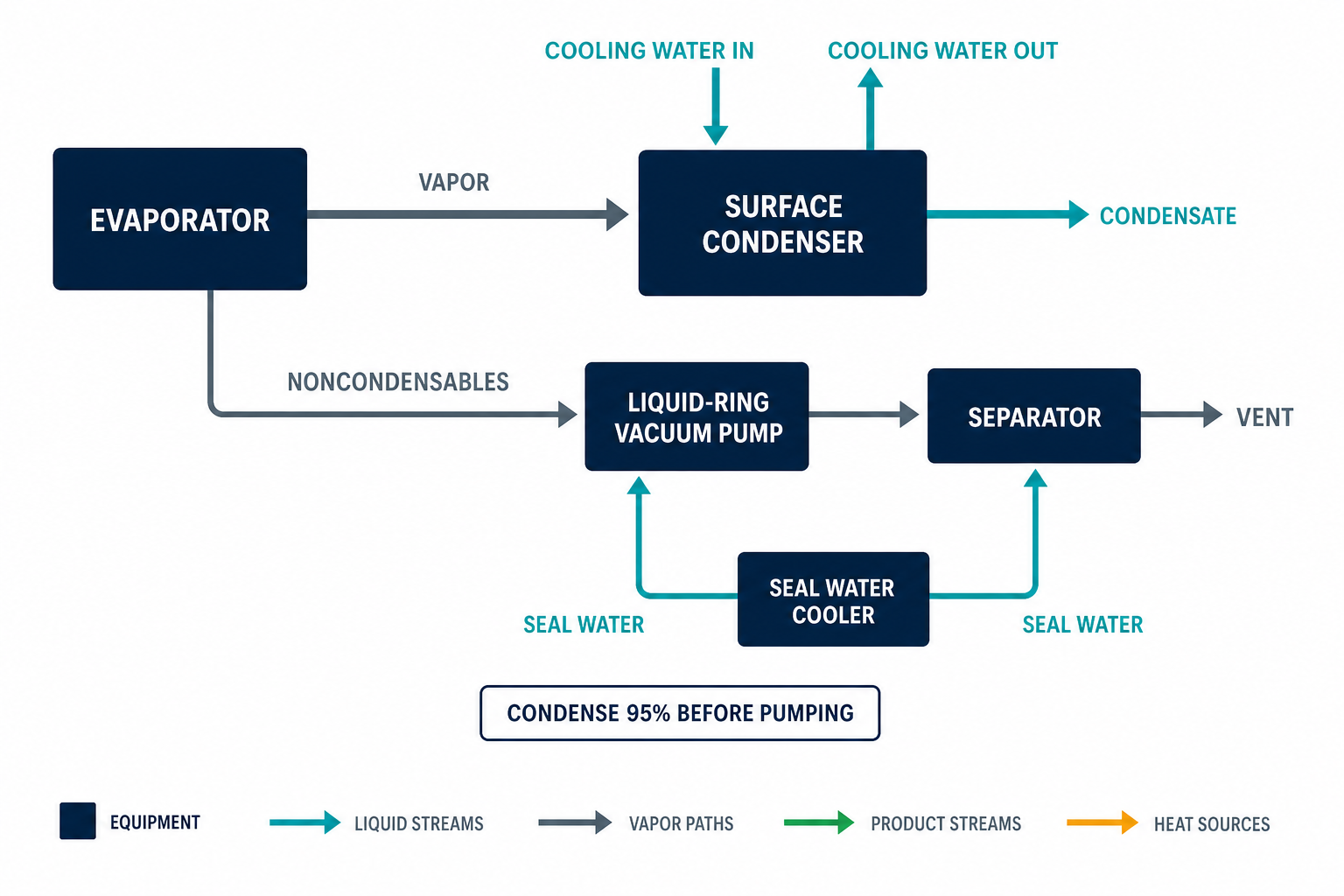
The most consequential single design decision is usually the sequence. The standard arrangement runs: evaporation chamber → condenser (condensing the bulk of the secondary vapor) → vacuum pump (removing only non-condensables and residual vapor). Because a liquid-ring pump sized to handle the entire vapor stream would be enormous, condensing first reduces the pump’s gas load by an order of magnitude, cutting both pump capacity and energy draw. Plants that skip the condenser or undersize it pay for it in the vacuum pump — permanently.
Handling High-Boiling Organic Vapors
Chemical, pharmaceutical and agrochemical evaporation often generates high-boiling organic vapors (VOCs) that a conventional condenser cannot fully capture. A dedicated high-boiling organic condensing device, placed after the main condenser and before the vacuum pump, serves three functions:
- It raises total condensation recovery and cuts organic emissions — an environmental-compliance duty.
- It protects the vacuum pump: high-boiling organics contaminating the sealing liquid degrade performance and damage the pump.
- It recovers solvent for reuse, reducing material cost.
Design centers on matching condensing temperature to the organics’ dew-point and boiling characteristics (refrigerated or deep-cooled media where needed), with heat-exchange surfaces configured against organic fouling and wall build-up.
Holding Vacuum Stable: Control Strategy
Pressure wander is a product-quality and heat-transfer problem, so stable control is engineered, not hoped for:
- Variable-frequency drive on the pump modulates capacity to the actual gas load.
- An inert-gas make-up valve (bleeding controlled gas into the suction) trims vacuum when the load drops suddenly.
- Online pressure monitoring on the evaporation chamber closes the loop; setpoint deviations alarm before boiling temperature drifts product spec.
Maintenance: Leaks, Seals and Cavitation
- Leak-rate discipline. Air in-leakage is the gas load the pump must fight forever; periodic leak testing (and a leakage-rate acceptance criterion at commissioning) keeps the sizing honest.
- Seal and working-liquid management. Sealing-liquid flow and temperature are monitored continuously — temperature rise is an early warning of both cooling failure and vacuum loss.
- Cavitation protection. Deep-vacuum operation can flash the sealing liquid itself, cavitating the pump. Countermeasures are increasing the working-liquid flow or series-mounting an atmospheric air ejector ahead of the pump, which lifts its suction pressure out of the cavitation regime.
Vacuum in Multi-Effect and MVR Trains
In a multiple-effect evaporation train, the vacuum system anchors the final effect: its setpoint fixes the overall temperature profile across all effects, so the last-effect pressure is effectively the plant’s capacity throttle. In MVR systems, the vacuum design must account for compressor suction conditions and the small temperature differences the whole loop runs on; non-condensable removal is even more critical because gas accumulating in the compressor circuit degrades compression efficiency across the entire plant. ZLD and high-salinity wastewater trains add a further twist — continuous CO₂ and amine release from the liquor — which is why their vacuum equipment is deliberately oversized on inert capacity; see zero liquid discharge solutions for the system context.
Conclusion
Specify a vacuum system the way you specify the evaporator it serves: from the gas load (leakage plus non-condensables), the required boiling temperature, and the vapor’s character. Condense first and pump second; pick a liquid-ring pump when the vapor is dirty and condensable, a dry pump only behind reliable condensing; cool the sealing liquid properly; control pressure actively; and treat air in-leakage as the permanent tax it is. Done well, the vacuum system disappears into the plant’s background — which is exactly the point.
FAQ
Why do evaporators operate under vacuum?
Vacuum lowers the liquor’s boiling point, enabling low-temperature evaporation for heat-sensitive products, allowing low-pressure steam or heat-pump heat sources, and reducing energy use. It also provides the pressure driving force that continuously removes secondary vapor and non-condensable gases from the system.
Why is a liquid-ring vacuum pump the usual choice for evaporators?
Its compression is near-isothermal and its sealing liquid tolerates condensable steam, droplets and dust — exactly the character of evaporator secondary vapor — while partially condensing the vapor and reducing the gas load. Dry screw or claw pumps are cleaner but need reliable upstream condensing to survive.
How does sealing-water temperature affect vacuum level?
Directly: the achievable vacuum is limited by the sealing liquid’s vapor pressure, so colder water yields deeper vacuum. A working-liquid cooler is therefore part of the vacuum system, and monitoring liquid temperature gives early warning of vacuum degradation.
Should the condenser come before or after the vacuum pump?
Before. Condensing the bulk of secondary vapor upstream means the vacuum pump only handles non-condensables and residual vapor, shrinking its required capacity and energy consumption dramatically — the standard layout is evaporation chamber → condenser → vacuum pump.
How do you stop a liquid-ring pump from cavitating at deep vacuum?
Increase the working-liquid flow, or install an atmospheric air ejector in series ahead of the pump to raise its suction pressure above the cavitation regime. Cavitation typically appears when the sealing liquid itself flashes under deep-vacuum suction conditions.