Zero liquid discharge (ZLD) is a wastewater engineering approach that recovers all—or nearly all—of the water from an industrial waste stream and reduces the pollutants to solid form for disposal or reuse. A complete ZLD system chains pretreatment, evaporation, and crystallization: each stage makes the water cleaner and the residue smaller, until the plant discharges no liquid at all beyond its fence line. The engineering challenge compounds with every stage, because as the brine concentrates, salinity, scaling compounds, and organics rise together—and the technologies at the end of the train must survive conditions that would cripple the ones at the beginning.
What Counts as Zero Liquid Discharge
The boundary definition matters more than it first appears. The conventional reading draws the line at the plant property boundary: no liquid waste leaves the site. Some operators extend the definition to include trucked-off-site liquid management—deep-well injection, off-site treatment, or incineration—since these also eliminate continuous discharge to surface water or sewer, though at noticeably higher cost.
Two related categories complete the vocabulary:
- Near-ZLD / minimal liquid discharge (MLD): the plant reduces its liquid effluent to a small residual flow without eliminating it. For some facilities, concentrating to a low volume ratio is more economical than forcing the last few percent to zero.
- Source segregation: splitting and re-routing water streams so that some liquid waste never forms at all—the cheapest “removal” is the one avoided.
Project economics should compare all three postures honestly; ZLD is a target, not a religion, and the right answer depends on discharge limits, water value, and residue chemistry.
Why Plants Choose ZLD: Five Commercial Drivers
- Waste volume and disposal cost. Every cubic meter of liquid that becomes solid or recovered water is a cubic meter that never buys a disposal ticket.
- On-site water reuse. Recovered distillate replaces fresh intake, cutting both water purchase cost and supply risk—and sidestepping the expense of polishing to strict discharge standards.
- Trucked waste elimination. Off-site hauling carries greenhouse gas emissions and road accident exposure alongside its direct cost.
- Permitting position. A ZLD plant enters environmental reviews and future permit negotiations from a fundamentally stronger stance.
- Resource recovery. The solids are not always waste: ammonium sulfate recovered as fertilizer, sodium chloride sold for de-icing, gypsum from mine water or FGD streams sold to wallboard plants, and lithium from oilfield brines at concentrations approaching South American salar levels.
The Regulatory Geography
Strict discharge regulation in this field traces to the US Clean Water Act of 1972, but the past decade’s mandatory ZLD rules have come from India and China, driven by heavily polluted river basins. In Europe and North America, the push is economic rather than statutory: inland facilities face high disposal costs for brine, making elimination the cheaper long-run option. A plant’s regulatory context usually decides whether ZLD is a compliance project or an ROI project—which changes how it should be engineered.
The Standard ZLD Process Chain
Whatever the industry, the architecture converges on three stages:

- Pretreatment removes solids, oils, and constituents that would damage downstream equipment—softening for hardness, organics reduction, suspended solids removal.
- Evaporation and concentration separate the water from the dissolved load, producing clean condensate and a concentrated brine.
- Crystallization and solidification convert the concentrated brine to a solid—either a mixed salt for disposal or, with salt separation, individual products for sale.
Membrane concentration (reverse osmosis, high-pressure RO) frequently sits between stages one and two as an economical pre-concentrator, shrinking the thermal duty. The chain works because each technology only needs to survive the concentration window it is given.
Three Core Technologies for Full Solids Recovery
Three thermal technologies anchor the all-solid endgame of ZLD trains.

1. MVR Brine Concentration
The mechanical vapor recompression evaporator is the workhorse of the concentration stage. Its defining feature is energy self-sufficiency: the heat needed for evaporation is supplied by the condensing vapor and cooling distillate within the loop, with no latent heat lost to the atmosphere; the plant consumes only electricity for pumps, the vapor compressor, and controls.
Hardware durability follows the duty: evaporator bodies and heat exchange tubes in established ZLD service are commonly built in high-grade titanium alloy for a quoted design life beyond 30 years. Single machines span roughly 27 to 3,800 m³/day of capacity (supplier-published range; not a project guarantee) and parallel into larger trains.
Inside a brine concentrator, the sequence runs: pH adjustment to 5.5–6.0 for degassing; feed heating to boiling in exchangers; deaeration removing oxygen and CO2; blending with recirculating brine in the sump; pumping to distributors at the tube tops where liquor falls as a film down the inner walls; heat from shell-side steam evaporating part of it; the vapor passing a demister to the compressor; compressed vapor condensing on the shell side while its latent heat drives the falling film on the other side of the wall; distillate preheating incoming feed; and a controlled brine blowdown holding the loop concentration.
2. Seed Slurry Scaling Control
Brine concentrators survive high supersaturation through seeding: calcium sulfate crystals are suspended in the circulating brine (supplemented artificially if the wastewater lacks calcium and sulfide), and “selective crystallization” directs calcium and CaSO4 precipitation onto the suspended seeds instead of the heat transfer tubes. Seeded concentrators routinely push wastewater to around 300,000 ppm TDS and run a year or more between cleanings, with seed added only at startup. The control burden is real—seed concentration windows are narrow and analysis lags the process, as covered in the fouling and scaling guide.
3. Mixed-Salt Crystallization
After the concentrator has recovered typically 95–98% of the water, the remaining liquor must become solid. Where the volume justifies it, crystallizers beat dryers on economics. Mixed-salt brines are hostile service: they foam, they corrode, their component salts differ in boiling point elevation, and they foul heat surfaces unevenly. The forced-circulation steam-compressed crystallizer answers with full-tube pressurized flow that suppresses boiling in the heater, tangential swirl evaporation in the vapor body, crystal production in the zone, large recirculation with a small bleed to centrifuge, and vapor compression recovering latent heat as distillate—the working sequence detailed on the forced-circulation crystallizer and forced-circulation evaporation pages.
Core ZLD Technologies Compared
| Technology | Role in the train | Key capability | Watch items |
|---|---|---|---|
| MVR brine concentrator | Bulk water recovery from pretreated brine | ~95-98% water recovery; power-driven, minimal steam; titanium construction, quoted 30-year corrosion life | Boiling point rise limits compressor lift; feed softening still needed |
| Seed slurry (selective crystallization) | Scaling control inside the concentrator | Operation to ~300,000 ppm TDS; year-plus runs between cleanings | Narrow seed concentration window; lagging analysis |
| Mixed-salt crystallizer | Solidification of the final concentrate | Handles foaming, corrosive, mixed-salt brines; electric compression option improves efficiency | Uneven fouling across salts; product is mixed salt unless separation is added |
Why MVR Is the Economic Heart of ZLD
A conventional evaporation system discards the latent heat of the vapor it generates—to the atmosphere or to cooling water. MVR captures that latent heat, recompresses the vapor, and returns it as the heating medium, cutting external energy demand to a small startup and trim role. For continuously operating plants, the fuel and electricity savings are the difference between a ZLD project that pays and one that does not; MVR uses roughly 60% less energy than conventional multi-effect evaporation in comparable duty, and the comparison can be run site-specifically in the MVR vs multi-effect energy calculator. The distillate it produces is high-purity water suitable for washdown and cooling tower makeup. Technology fundamentals are covered in the evaporation fundamentals article and on the MVR technology page.

MVR versus ZLD: A Unit Operation Is Not a Plant
The two terms are frequently conflated. They answer different questions:
| Dimension | MVR evaporator | ZLD system |
|---|---|---|
| What it is | A unit operation / equipment item | A plant-level objective and the full technology chain that achieves it |
| Scope | Efficient evaporation and water recovery | Elimination of all liquid waste: pretreatment + membrane + evaporation + crystallization + solids handling |
| Best fit | Maximizing water reuse without needing zero discharge; smaller footprint, simpler operation | Strict regulatory environments or sustainability targets beyond compliance |
| Investment / complexity | Lower | Higher—more unit operations, more integration |
A plant can deploy MVR without ZLD, and no plant achieves ZLD with MVR alone.
Recovery Rates and the Industries That Benefit Most
Complete ZLD systems recover on the order of 95–99% of the water for reuse. The industries with the strongest economics are those combining difficult wastewater with high water value or discharge constraints: chemical manufacturing, electroplating, PCB and electronics fabrication, and battery production lead the list, with textiles, pharmaceuticals, food processing, mining, and metal finishing close behind. Industry-specific architectures are described on the industry pages, including coal chemical ZLD and textile and dyeing wastewater applications.
What a Complete ZLD Project Actually Contains
Procurement should account for the whole system, not just the headline units:
- MVR evaporation core—the concentrator train and its compressor(s).
- Utilities—cooling water systems, instrument air, electrical distribution.
- Condensate recovery—tanks, polishing, and routing back to production.
- Downstream solids handling—crystallizer discharge, centrifuge or filter, drying, storage, and disposal or sales logistics.
- Pretreatment—frequently the weak link: the evaporation vendor’s scope often starts after the pretreatment block, which the owner must procure separately or explicitly integrate.
Selection: Four Questions That Shape the Design
- Wastewater composition—the full water analysis, including scaling ions and organics, sets the pretreatment and materials of construction.
- Required capacity—peak and average flow determine train count and turndown strategy.
- Local energy economics—the price and availability of electricity versus steam decide the balance between MVR, TVR, and multi-effect staging.
- Expansion plans—modular trains and spare bays cost little at design time and a great deal to retrofit.
Reference Case: High-Strength Chloride Brine to Product Salt
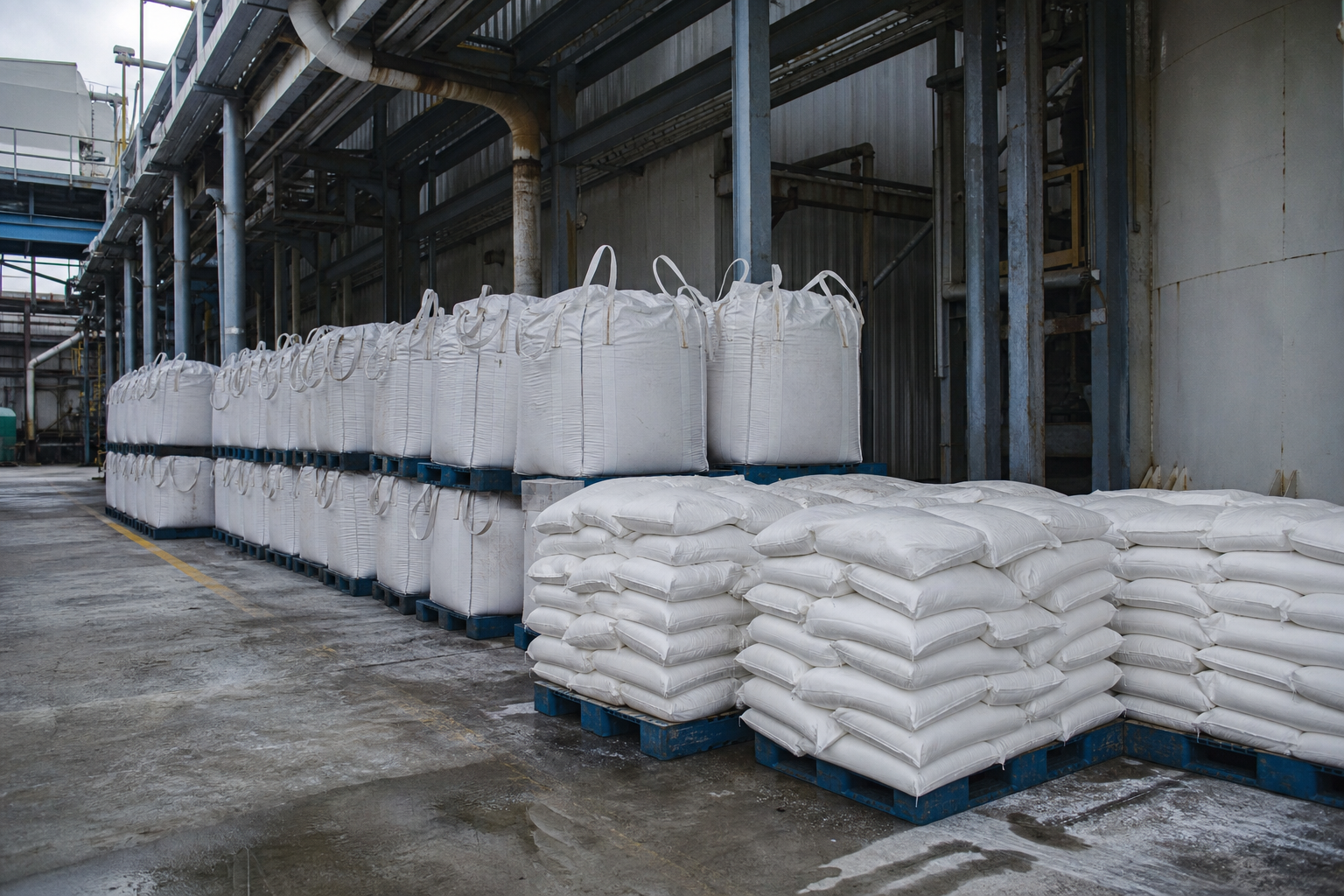
An externally reported project frame: wastewater at roughly 26% NaCl treated through MVR concentration, MVR evaporation crystallization, and drying, producing industrial-grade sodium chloride with moisture at or below 5% while recovering high-purity distillate. Supersaturation, temperature, and circulation rate are controlled precisely, with seed crystals guiding the product toward large, regular, high-purity grains; the salt slurry passes through a thickener and centrifuge to a vibrating fluidized-bed dryer. Most mother liquor recycles to the crystallizer, with a small periodic purge—further concentrated and dried to a minor mixed salt—keeping trace impurities in check. The end state is no liquid discharge, a sellable salt, and reusable water: the full ZLD value proposition. Solution architecture details are available on the high-salinity ZLD solutions page (illustrative application).
Frequently Asked Questions
What is zero liquid discharge?
ZLD is a wastewater treatment approach that recovers essentially all the water from a waste stream and reduces the pollutants to solid form for disposal or reuse, so that no liquid waste leaves the plant. The standard chain is pretreatment, evaporation-concentration, and crystallization.
How much water does a ZLD system recover?
Complete systems typically recover 95–99% of the water as reusable high-purity distillate; brine concentrators alone recover about 95–98% before the crystallizer finishes the job.
What is the difference between MVR and ZLD?
MVR is a single unit operation—a mechanical vapor recompression evaporator that recovers water efficiently. ZLD is a plant-level objective achieved by a chain of technologies including pretreatment, membrane concentration, MVR evaporation, and crystallization. MVR is usually the economic core of a ZLD plant, but it is not synonymous with ZLD.
Why does MVR make ZLD economical?
Because it recovers the latent heat of the secondary vapor instead of discarding it, MVR cuts external energy demand by roughly 60% compared with conventional multi-effect evaporation, and runs on electricity with only small startup steam. For continuous plants this energy saving is what turns ZLD from a pure compliance cost into a defensible investment.
How does seed slurry technology prevent scaling in brine concentrators?
Calcium sulfate seed crystals are suspended in the circulating brine so that scaling species crystallize onto the seeds rather than the heat transfer tubes. Seeded concentrators operate to around 300,000 ppm TDS and can run more than a year between cleanings, with seed needed mainly at startup.
Which industries benefit most from ZLD?
Chemical manufacturing, electroplating, PCB/electronics, and battery production see the strongest economics, followed by textiles, pharmaceuticals, food processing, mining, and metal finishing—anywhere difficult wastewater meets high disposal cost or strict discharge limits.