Denim Mill Water Loops: Bioreactor Treatment, Indigo Recovery and RO Reuse
Denim mills close their water loops with a biological-plus-membrane architecture whose published benchmarks come from two sites of one group: a Shunde, China mill
Selection logic, retrofit economics and mother-liquor yield — articles from three lines: technology deep-dives on evaporator and crystallizer selection, application solutions for specific wastewaters and process duties, and anonymized project case studies. New articles are published continuously.
Technology ArticlesApplication SolutionsProject Case Studies

Denim mills close their water loops with a biological-plus-membrane architecture whose published benchmarks come from two sites of one group: a Shunde, China mill

For coal chemical brines where sodium chloride and calcium chloride coexist, scaling control in the falling-film evaporator is not a cleaning-schedule question – it

Representative configuration of a 4 t/h scraped film evaporator concentrating high-viscosity, heat-sensitive collagen liquor in East China, where wall wiping keeps heat transfer alive

Representative configuration of a seven-train evaporation program (396 t/h x5, 124 t/h, 32 t/h) with MVR plate and tubular falling film evaporators treating antibiotic

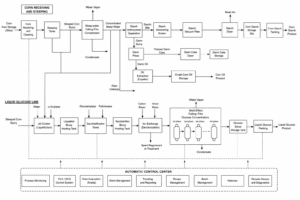
Representative configuration of a 600,000 tpy corn deep-processing plant in Northeast China producing starch and liquid glucose on two production lines: designed 2012, trial-run

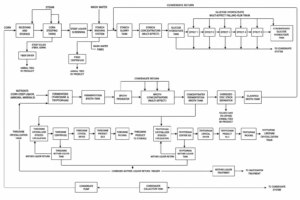
Representative configuration of the evaporation and crystallization scope inside a 1,500,000 tpy corn deep-processing plant in Northeast China producing threonine, tryptophan and co-products: designed

Representative configuration of a complete 600 TPD corn starch and 480 TPD fructose plant evaporation scope in the Middle East: steep-water, glucose and fructose

Representative configuration of a 170 t/h (2 x 85 t/h) four-effect evaporation train with falling-film and forced-circulation service concentrating glutamate mother liquor at a

Throughput decides evaporator technology before any vendor talk: below 300 L/h single-effect wins, 300-500 L/h is the MEE transition zone, above 5,000 L/h think

Salt is made by solar evaporation, rock mining, or solution mining, then refined mechanically (97-99% NaCl) or by vacuum recrystallization to PDV grade (>99.5%).
Send your feed characterization (TDS, COD, main salts, viscosity), throughput and product targets — we respond with a preliminary process route within two business days.