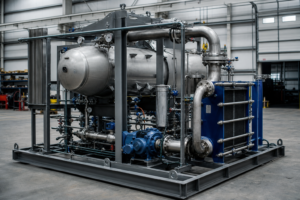
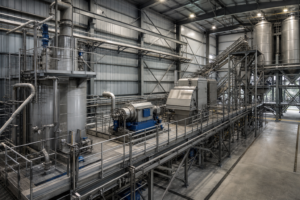
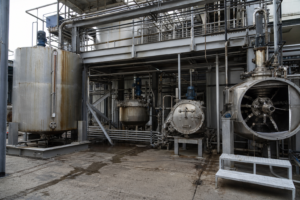
Material selection for evaporators and crystallizers is decided by one question before any other: does the wastewater contain chlorides? Chloride-bearing streams (NaCl, NH4Cl, MgCl2, CaCl2) attack standard austenitic stainless steels through pitting and stress-corrosion cracking and push the specification toward titanium or duplex grades; non-chloride streams (sulfates, carbonates, nitrates) are comparatively benign and allow economical 316L construction. Around that first fork sit four more variables — chloride concentration, operating temperature, pH, and scaling tendency — plus a set of zoned-construction tactics that put expensive alloys only where liquor actually touches metal. This guide lays out the hierarchy, the corrosion phenomena behind it, the quantified cost-and-payback logic, and the verification tests that confirm a material choice before and after fabrication.
The First Question: Chloride or Non-Chloride
Evaporator feeds divide cleanly into two families, and they take different material routes:
- Chloride systems — sodium chloride, ammonium chloride, magnesium chloride, calcium chloride, and mixed brines from high-salinity wastewater. Chloride ions break the passive film on stainless steel locally, initiating pitting; under tensile stress and elevated temperature they drive chloride stress-corrosion cracking (SCC), the failure mode that turns a heat-exchanger tube wall into cracks without warning thinning.
- Non-chloride systems — sodium sulfate, ammonium sulfate, sodium carbonate, nitrates. These salts are far less aggressive: 316L is the workhorse, with 304 or carbon steel as the economy option in mild zones.
Calling this split correctly at the water-analysis stage is worth more than any downstream mitigation, because everything else — alloy budget, wall thickness allowances, inspection intervals — inherits it.
The Material Hierarchy for Chloride Service
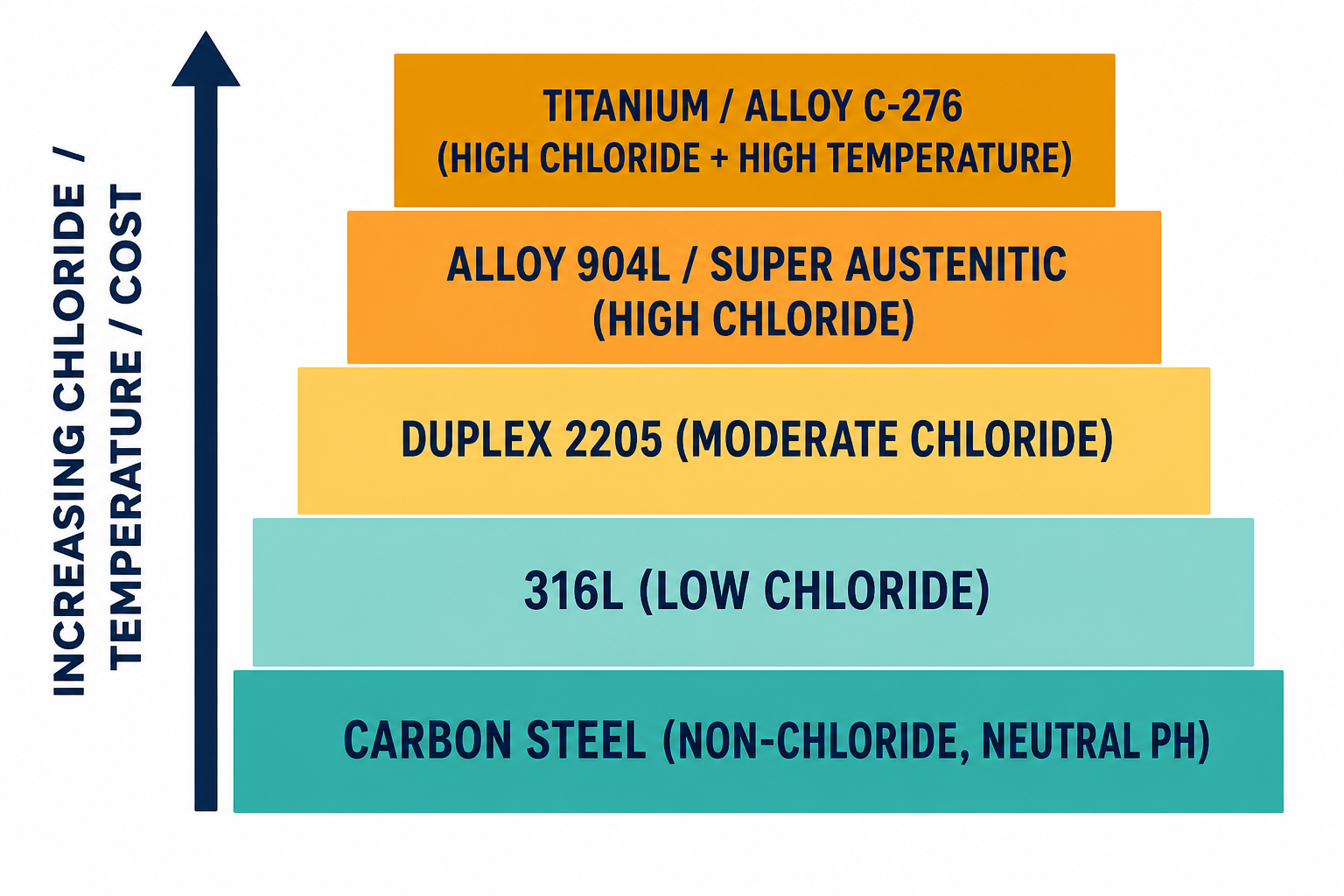
For chloride-bearing liquors, the resistance ranking from highest to lowest is consistent across the industry:
| Tier | Materials | Position |
|---|---|---|
| 1 | Titanium TA2 / TA9 / TA10 | Benchmark for chloride resistance; default for high-chloride and high-temperature service |
| 2 | Duplex stainless (2205, 2507) | Strong pitting and SCC resistance; roughly double the mechanical strength of 316L, allowing thinner walls |
| 3 | Carbon steel | Usable only in defined, limited duty — concentration and temperature windows matter |
| 4 | SS304 / 316L | Chlorides cause pitting and stress-corrosion cracking; last resort for chloride service |
For added margin in mixed chemistry: externally reported laboratory testing across 50+ chemical media found single 316L components frequently developing pitting within six months, while titanium and duplex grades with higher critical pitting temperatures (CPT) held up; for strongly acidic or alkaline duties, graphite heat exchangers or Hastelloy-clad tube bundles enter the specification.
Zoned Construction: Alloys Where Liquor Touches
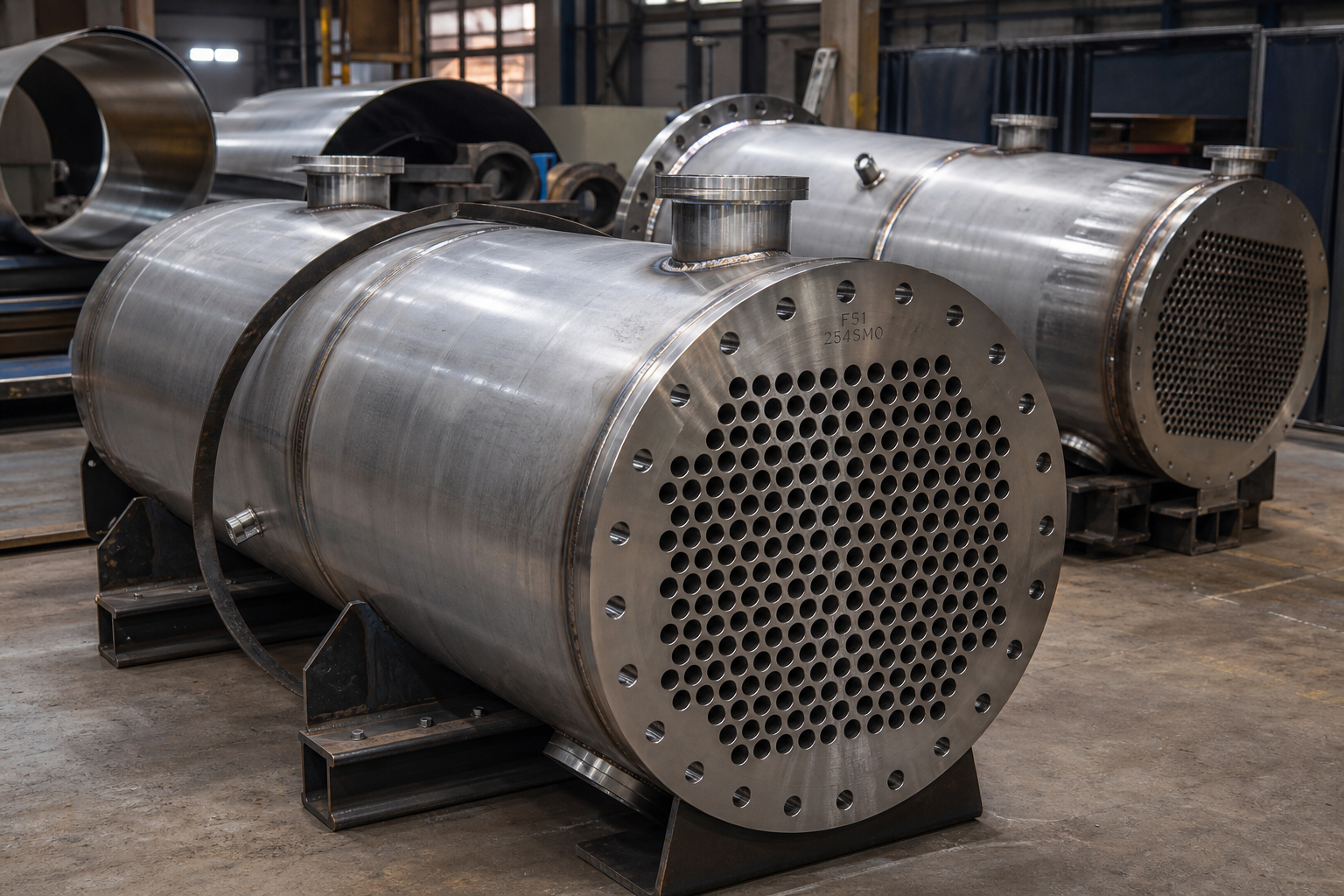
The single most effective cost lever is zoning. Wetted parts — heat-exchanger tubes, separators, piping, pumps — see the liquor and need the corrosion-resistant grade. Non-wetted parts — frames, external structures, platforms — never contact process fluid and can be carbon steel. An externally reported case describes a specialty amino-acid producer applying exactly this split: titanium on all contact surfaces, 316L outside the wetted zone, achieving full corrosion compliance at about 30% lower material cost than an all-titanium design (supplier-published figure; not a project guarantee). The zoning discipline extends to welds and joints, where galvanic pairs between dissimilar alloys must be managed rather than stumbled into.
Temperature and pH Accelerate Everything
Two operating parameters multiply corrosion rates independent of alloy choice:
- Temperature — a commonly cited industry rule is that every 10°C rise raises corrosion rates by roughly one to three times. An alloy-marginal selection that survives a 60°C pilot can fail quickly at 85°C full-scale operation.
- pH — lower pH generally means faster metal loss, with specific exceptions by chemistry. This is why feed pH adjustment is standard pretreatment ahead of MVR evaporation, not merely a process nicety.
The chloride-temperature interaction has a specific threshold worth memorizing: 316L in chloride environments above about 60°C carries a significant stress-corrosion-cracking risk. Repeated tube perforation and re-tubing is the classic signal that the material was mis-specified in the first place — upgrading to duplex, titanium, or a super-austenitic grade, or reducing chloride concentration at the source, is the engineering fix rather than another round of replacements. That diagnosis logic is part of the broader evaporator troubleshooting guide.
Five Corrosion Phenomena to Expect in MVR Service
MVR evaporators corrode in identifiable patterns, and each has its own geography:
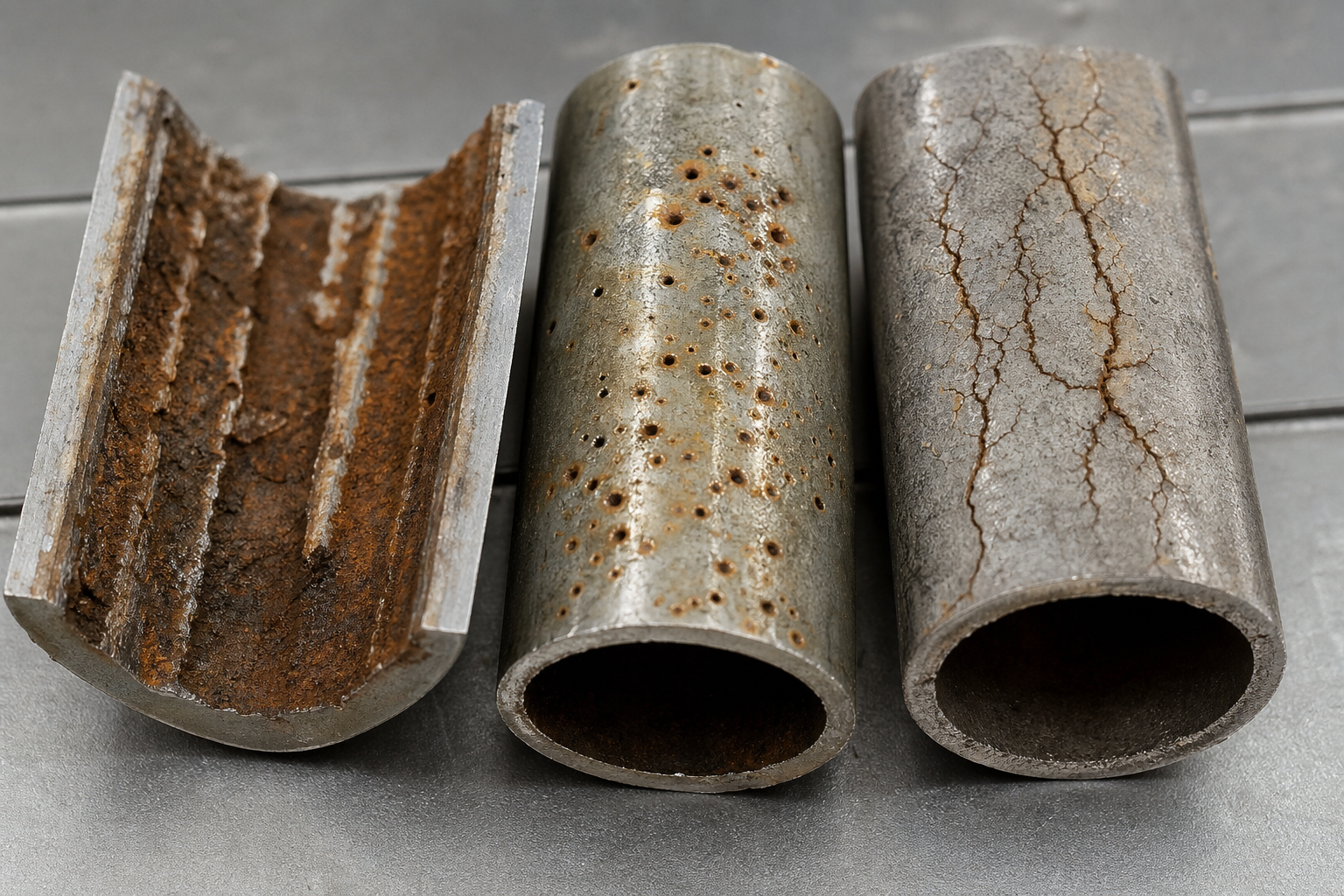
- Chemical and electrochemical corrosion — the baseline attack of the liquor on the metal, unavoidable in principle, managed by alloy selection.
- Temperature-related corrosion — accelerated degradation in the hottest zones: heating surfaces, compressor discharge piping.
- Cavitation (cavity corrosion) — in pump systems under high flow velocity and pressure fluctuation, vapor cavities collapse against metal surfaces and carve spongy damage. It appears as impeller cavitation, gap cavitation, and vortex cavitation depending on where the pressure field collapses.
- Hot corrosive liquid and steam leaks — concentrated attack at the inevitable weak points: welds, flanges, gland packing, and expansion joints. These joints concentrate stress, crevices, and fabrication imperfections at once.
- Under-deposit attack — scaling shields the surface from inhibitor and bulk chemistry, creating local cells beneath the deposit layer; tying this to scale control is covered with the other fouling countermeasures in the operation and maintenance guide.
Cost and Payback, Quantified
Material upgrades are capital decisions with measurable returns (typical supplier-published and industry-reported figures; not a project guarantee):
| Comparison | Cost delta | Return |
|---|---|---|
| 316L vs 304 | About 40% higher price | Roughly double the service life, about 50% lower maintenance cost, typical payback in 3–4 years |
| Titanium vs 316L | About three times the price | Under extreme duty (pH below 2.0 or chlorides above 5%), service life beyond 10 years |
| Duplex 2205/2507 vs 316L | Step up in price | Near-double mechanical strength (thinner sections), superior pitting resistance in high-salt organic liquors |
The correct frame is total life cost against the duty window: an alloy that looks expensive per kilogram and survives the actual chemistry for a decade is cheaper than one re-tubed twice.
Food and Pharma Grade: The Hidden Standards Beyond Alloy
For food-grade crystallization duties (and pharma-adjacent products), three material tiers apply, and then surface quality takes over as the deciding specification:
- SUS316L baseline — with the explicit caveat that high-chloride environments carry SCC risk even here.
- Duplex 2205/2507 — for high-salt organic liquors, bringing strength and pitting resistance together.
- TA2 titanium — where zero metallic contamination or strong organic acids rule.
Then the “invisible” requirements: internal surface roughness below Ra 0.4 μm with mirror polishing (rougher walls trap particles and seed fouling — the documented main cause of scaling in distillery and dairy projects), and full argon-shielded or automatic orbital welding to eliminate oxide black spots that are both contamination sources and corrosion initiators.
Compliance anchors the specification: FDA 21 CFR 177.2600, EU 10/2011, and GB 4806.9 for food-contact materials. Migration testing runs with 3% acetic acid or 10% ethanol food simulants at 40°C, and metal migration is measured by ICP-MS to a precision of 0.001 mg/kg — a level at which alloy choice, surface finish, and welding quality all leave fingerprints.
Verification: Before, During, and After Fabrication
A material specification only counts if it is verified. A three-stage gate used by fabricators serving regulated industries:
- Incoming — spectroscopic analysis of every raw material lot to confirm alloy composition matches the specification.
- In-process — blue-spot testing (passive-film integrity) plus surface-roughness inspection on polished wetted surfaces.
- Pre-shipment — 48-hour immersion testing to verify low metallic-ion release into the product-contact environment.
On installed plant, add field corrosion coupons (mounted specimens of candidate alloys exposed to the real liquor) and periodic laboratory immersion tests on 20-liter process samples for streams whose chemistry drifts — they catch a mis-match before it becomes equipment failure.
Cleaning Chemistry Must Match the Alloy
Material selection does not end at commissioning — the cleaning regime becomes part of the corrosion environment. Acid CIP cycles (hydrochloric-based descalers in particular) can attack stainless steel and titanium differently than the process liquor does; chloride-containing cleaning agents applied to austenitic equipment at elevated temperature recreate exactly the pitting and SCC conditions the alloy choice tried to avoid. The discipline is symmetrical: specify cleaning agents, contact times, and temperatures against the same alloy data used for the process duty, and include the planned CIP chemistry in corrosion coupons when the stream warrants it. Alkaline cleaning, chelant programs, and neutral rinse steps exist precisely because they decouple scale removal from metal attack; choosing them is a materials decision, not merely a janitorial one.
Decision Variables and Active Protection
The final material datasheet is generated from five variables: salt composition, chloride concentration, pH, operating temperature, and fouling/scaling tendency. Around the passive (alloy) choice, two active measures extend life further: flow-velocity control — keeping circulation rates high enough to prevent under-deposit attack yet within design limits to limit erosion-corrosion and cavitation — and inhibitor chemistry, where compatible with the product and the downstream salt quality. Combining correct alloys, zoned construction, disciplined verification, and these active measures is what turns corrosion from a schedule of surprise outages into a managed cost line.
FAQ
Which evaporator material is best for high-chloride wastewater?
Titanium (TA2/TA9/TA10) is the top tier for chloride service, followed by duplex stainless steels 2205/2507. Standard 304/316L are the last resort: chlorides pit these grades and drive stress-corrosion cracking, especially above about 60°C.
Is 316L worth the premium over 304?
Typically yes for duty beyond mild service: 316L costs about 40% more than 304 but delivers roughly double the service life and about half the maintenance cost, with payback in 3–4 years in corrosive duties.
When is titanium economically justified?
Titanium runs about three times the price of 316L, but in extreme conditions — pH below 2.0 or chloride content above 5% — it delivers service life beyond 10 years, which usually beats repeated replacement of lesser alloys.
How do you cut material cost without cutting corrosion resistance?
Zone the construction: corrosion-resistant alloys (titanium, duplex) for wetted parts — tubes, separator, piping, pumps — and carbon steel for non-wetted frames and structures. One externally reported amino-acid project cut material cost about 30% this way while meeting full corrosion requirements.
What surface finish do food-grade evaporators need?
Internal product-contact surfaces below Ra 0.4 μm with mirror polishing, joined by full argon-shielded or automatic orbital welds. Compliance testing per FDA 21 CFR 177.2600 / EU 10/2011 / GB 4806.9 uses 3% acetic acid or 10% ethanol simulants at 40°C, with metal migration measured by ICP-MS down to 0.001 mg/kg.