10 t/h Sodium Sulfate Salt Production in Uzbekistan: MVR Evaporation Case
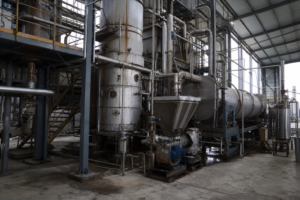
Representative configuration of a 10 t/h MVR evaporation crystallization plant producing sodium sulfate salt in Uzbekistan (Central Asia) from local sulfate brine or solution
Selection logic, retrofit economics and mother-liquor yield — articles from three lines: technology deep-dives on evaporator and crystallizer selection, application solutions for specific wastewaters and process duties, and anonymized project case studies. New articles are published continuously.
Technology ArticlesApplication SolutionsProject Case Studies

Representative configuration of a 10 t/h MVR evaporation crystallization plant producing sodium sulfate salt in Uzbekistan (Central Asia) from local sulfate brine or solution

Ammonium sulfate recovery by MVR evaporation crystallization and neutralization: by-product sources, 1.6-2 mm large-particle crystallization, route selection, drying, and ZLD economics.

Natural circulation, forced circulation, falling film vs rising film, multi-effect and MVR evaporators compared: heat-transfer coefficients, energy 0.1-1.5 kWh/kg, CAPEX, maintenance, plus a 16

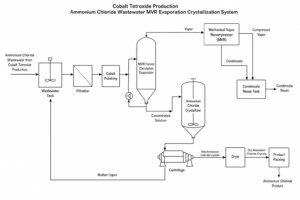
Representative configuration of a 33 t/h train in Central China treating ammonium chloride wastewater from cobalt tetroxide precursor production with MVR evaporation and forced-circulation

Sodium acetate crystallizes by cooling, not evaporation: supersaturation controlled through temperature, concentration, cooling rate and agitation, with continuous operation delivering pharma and food-grade consistency.

How much COD does evaporation actually remove? High-boiling organics stay in the concentrate while low-boiling organics distill over with the water vapor. A five-point

Representative configuration of a 19.3 t/h train in North China (Inner Mongolia) treating rare earth extraction ammonium chloride wastewater with MVR, three-effect falling-film and

Evaporation and crystallization plants that turn copper sulfate liquors, etch solutions and smelter waste streams into pentahydrate crystal product, reusable water and recovered copper

Representative configuration of a 16 t/h MVR forced-circulation train with plate heat exchangers recovering sodium sulfate from LFP battery cathode wastewater in Southern China,

MVR forced-circulation evaporation plus cooling crystallization recovers ammonium chloride from soda-ash coupling and rare-earth wastewater; steam rotary drying cuts cost by $15.57/t with 14.4
Send your feed characterization (TDS, COD, main salts, viscosity), throughput and product targets — we respond with a preliminary process route within two business days.