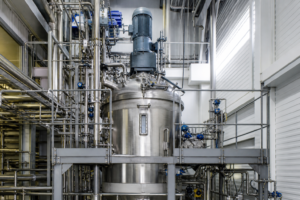
Forced Circulation Evaporator: Working Principle and Applications
Forced circulation evaporator explained: pump-driven 2-3.5 m/s loop, no boiling in tubes, anti-scaling mechanism, design parameters, MVR+FC ZLD configuration, applications and limits.
Selection logic, retrofit economics and mother-liquor yield — articles from three lines: technology deep-dives on evaporator and crystallizer selection, application solutions for specific wastewaters and process duties, and anonymized project case studies. New articles are published continuously.
Technology ArticlesApplication SolutionsProject Case Studies

Forced circulation evaporator explained: pump-driven 2-3.5 m/s loop, no boiling in tubes, anti-scaling mechanism, design parameters, MVR+FC ZLD configuration, applications and limits.

Representative configuration of a 21.78 t/h multi-effect falling-film train concentrating clarified pectin juice at a pectin producer in Chongqing, Southwest China, under the low-temperature

Integrated BPA wastewater treatment with low-temperature MVR evaporation and crystallization: phenol recovery first, salt recovery second, reusable condensate and compliant solids for epoxy resin

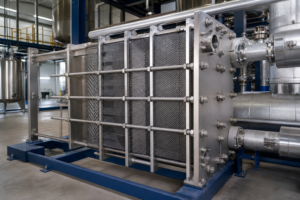
Plate evaporator selection across seven parameters: capacity sizing with margin, falling-film vs forced-circulation plates, 316L/duplex/titanium corrosion grades, 30-65C vacuum window for actives, 1.8-2.5 m/s

Representative configuration of a complete tomato paste evaporation line in Northwest China (Xinjiang): four 1,500 t/d lines plus one 750 t/d line in triple-effect

Lecithin concentration and drying solutions from degumming to thin-film vacuum drying – capacities 3-150 t/d, four product grades, food-grade specs and the viscosity challenges

How industrial evaporation works: single-effect vs multiple-effect vs MVR energy performance, vacuum boiling, evaporator types by material behavior, and the concentration endpoint that hands

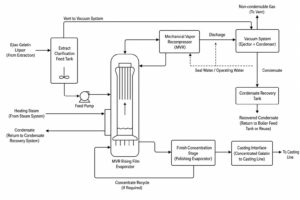
Representative configuration of a 4 t/h MVR rising film evaporator concentrating ejiao (donkey-hide gelatin) liquor in China, handling high-viscosity collagen solutions at low temperature

Crystallizing vitamin C (ascorbic acid) from concentrated fermentation-purification liquor is a crystal-size and stability problem: the product oxidizes in the presence of heat, air

Why 30% of industrial crystallization projects fail at scale-up, the Lab-Pilot-Industrial validation ladder with the 1:10-1:20 pilot sizing rule, DTB/OSLO/FC selection through the scale-up
Send your feed characterization (TDS, COD, main salts, viscosity), throughput and product targets — we respond with a preliminary process route within two business days.